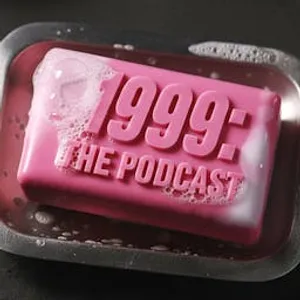
Free Daily Podcast Summary
1999: The Podcast: Daily Summaries Delivered
by John Brooks and Julia Sirmons
Was 1999 the best year in movie history? We think it might be! John Brooks, Julia Sirmons, and special guests work their way through all the year has to offer, one movie at a time, and we’ll ask special guests to share their memories of this amazing year and the movies that made it unforgettable. Unfortunately, nobody can be told what 1999: The Podcast is… you have to hear it for yourself!
Latest Episodes
The most recent episodes — sign up to get AI-powered summaries of each one.
- 1 weeks ago1h 28m
(Rerelease) OCTOBER SKY - with Amanda Jane Stern
No new episode this week, but please enjoy this rerelease from a year ago, about a movie with a lot of connections to our last episode, The Iron Giant: October Sky was the 63rd-highest grossing movie of the year, just behind The 13th Warrior. Opening on February 19th with just shy of $6 million, it went on to gross $34.7 million worldwide on a $25 million budget. October Sky was adapted from the memoir Rocket Boys (an anagram of "October Sky") by NASA engineer Homer Hickman and directed by Joe Johnston, beautifully shot by journeyman cinematographer Fred Murphy with a score by Mark Isham it starred newcomer Jake Gyllenhaal, Chris Cooper, Lauren Dern, William Lee Scott, Chad Lindberg, Natalie Canderday, Chris Ellis, and in a really wonderful performance, American Pie’s Sherminator himself, Chris Owen. A critical hit and modest commercial success, October Sky was largely forgotten by the time award season rolled around, and it is now a fondly if faintly remembered gem (as well as the breakout film for its young star!) This week, Julia and John welcome actor/writer Amanda Jane Stern from the podcast Don't Be Crazy to talk about her new film, Joe Johnston's aggressively earnest style, and boys and their rockets. Amanda is on Bluesky @amandajanestern.com
- 3 weeks ago1h 12m
THE IRON GIANT - with Sam Summers
Our episodes on robots and animation have finally led us here: The Iron Giant, one of 1999's most notorious duds, and also one of its most beloved films. The Iron Giant was the feature directorial debut of Brad Bird, who would go on to direct landmark Pixar films The Incredibles and Ratatouille and now serves in Pixar’s senior creative team. Unfortunately released in the highly competitive first week of August, coming in at #9 behind the likes of, among others, The Thomas Crown Affair, Runaway Bride, The Blair Witch Project and, also debuting that weekend, the box office behemoth The Sixth Sense, going on to make just $23 million on a budget of $70 million. How and why did such a lovely movie featuring a giant robot (and inspired by the suicide of Sylvia Plath) fail? We discuss that and a lot more with someone who would know: Dr. Sam Summers, co-host of the Disniversity podcast, and a lecturer on Animation History and Theory at Middlesex University in England.
- Aug 25, 20261h 43m
See Also: A.I. - ARTICIAL INTELLIGENCE (2001) and DISCLOSURE DAY (2026)
Following up on our discussion of Bicentennial Man, we discuss two movies, starting with the 28th highest-grossing movie of 2001, Steven Spielberg's A.I. - Artificial Intelligence. A.I. has a lot of connections to 1999, since it was originally meant to be directed by Stanley Kubrick, who died in 1999, and starred two of 1999's Best Supporting Actor Oscar nominees, Haley Joel Osment and Jude Law. It's also proven stunningly prescient and holds up in a way that makes it arguably better now than it was 25 years ago. Spielberg's latest, Disclosure Day, while appearing to share a lot of DNA with A.I., is...less good. And John rants about it a lot.
- Aug 5, 20261h 5m
BICENTENNIAL MAN
Bicentennial Man was the 40th highest grossing movie of 1999, opening December 17th in 4th place and taking in $87 million dollars worldwide on an almost literally unbelievable $100 million dollar budget. It's also the one movie of the year to star the late Sam Neill. Directed by Chris Columbus with script by Elia Kazan’s son Nicholas Kazan, based on the short story “The Bicentennial Man” AND the novel “The Positronic Man” by Isaac Asimov, with perhaps the most phoned-in score James Horner ever wrote, Bicentennial Man stars Robin Williams, Sam Neil, Embeth Davidtz, Wendy Crewson, Oliver Platt, Kiersten Warren, Hallie Eisenberg, John Michael Higgins, Bradley Whitford, Stephen Root, and noted January 6th Capitol Insurrectionist, Jay Johnston. This week, John and Julia talk "family films", uncanny valleys, Williams, and, of course, Sam Neill.
- Jul 21, 20261h 19m
TOY STORY 2 (Revisited)
This summer's Toy Story 5 is unique among Toy Story movies in that it's a direct continuation of the story of Toy Story 2, so we decided it was a great time to take a second look at Toy Story 2! Originally conceived as a direct-to-video sequel, Toy Story 2 opened November 19, 1999, bringing in $487 million worldwide and going on to become the 3rd-highest grossing movie of the year. The film brought back Tom Hanks, Tim Allen, Wallace Shawn, John Ratzenberger, Don Rickles, Jim Varney, Annie Potts, Laurie Metcalf, R. Lee Ermey, Estelle Harris, from the first film, adding Joan Cusack, Kelsey Grammer, Wayne Knight, and Ariel the Little Mermaid herself, Jodi Benson as Barbie, and this time Randy Newman brought in Sarah McLachlan to help craft the most famously devastating three minutes in the whole series.
- Jul 7, 20261h 35m
(Rerelease from 6/25) - AUSTIN POWERS: THE SPY WHO SHAGGED ME - with Siri Dahl
Austin Powers: The Spy Who Shagged Me was the 4th-highest grossing movie of 1999, behind Toy Story 2, The Sixth Sense, and The Phantom Menace, opening on June 11 and taking in $55 million that weekend, going on to make $206 million at the domestic box office on a $33 million budget. Directed by Jay Roach and written by Mike Myers and Michael McCullers, The Spy Who Shagged Me saw Heather Graham stepping in to the Powers Girl role, replacing Elizabeth Hurley. The hugely anticipated and hyped sequel to the 1997 original, the movie came in with sky high expectations. The results were, well...mixed. But there's no question that Austin Powers was a huge cultural milestone, so we wanted to see how it held up. Helping us get the summer off to the most shagadelic start possible is actor, writer, podcaster, and activist Siri Dahl!
- Jun 23, 20261h 22m
See Also: HARDBALL (2001) - with Jacki Krestel
VARSITY BLUES director Brian Robbins follow-up was another inspirational, somewhat edgy sports movie HARDBALL - this time about baseball and set in Chicago. 1999 icon Keanu Reeves plays down-on-his-luck sports gambler Conor O'Neill who finds himself the head coach of an inner-city Chicago youth baseball team. Somehow, he makes the team better. Somehow, the team makes him better. Diane Lane is also involved for unclear reasons. Is HARDBALL a good baseball movie? No. But is it a good movie? Also no. But the kids are great, including a very young Michael B. Jordan. Anyway, since it's about baseball and set in Chicago, Jacki Krestel is once again with us to talk about how, if you're going to make a baseball movie, you gotta actually demonstrate that you love baseball!
- Jun 9, 20261h 29m
VARSITY BLUES - with Jacki Krestel
We sadly lost 1990s icon James Van Der Beek in February, so we decided it was time to look at his most prominent non-Dawson's Creek role - the teen comedy-drama sports movie Varsity Blues. Released very early in the year on January 15th, Varsity Blues was the 45th highest grossing movie of the year. Opening as a surprise number, it made back most of its 16 million dollar budget in its debut weekend and would go on to gross an impressive 54 million dollars worldwide, but it really became a summertime hit in its home video release in June. Also starring Jon Voight, Paul Walker, Ron Lester, Scott Caan, Amy Smart, Ali Larter, and a little baby Jesse Plemons, and featuring an incredibly 1999 soundtrack including Foo Fighters, Green Day, Collective Soul, Third Eye Blind and Fastball, Varsity Blues has something of a cult status, in part due to one very memorable line delivery. But how does it hold up as a teen movie or a sports film? This week, our friend Jacki Krestel joins us to talk sports, teens, 90s tropes, and James Van Der Beek. Jack writes about baseball on her blog, Jack Likes Baseball.
Get 1999: The Podcast summaries in your inbox
Free AI-powered daily recaps. Key takeaways, quotes, and mentions — in a 5-minute read.
Get Free Summaries →Free forever for up to 3 podcasts. No credit card required.
You Might Also Like
Listeners also like.
Dear Movies, I Love You
Film enthusiasts discuss blockbusters and obscure cinema with enthusiasm, exploring movie culture through personal and critical perspectives.
The Big Picture
Film critics discuss essential movies, rankings, drafts, and awards season with deep analysis and curated lists.
The Documentary Podcast: Archive 2009
A collection of documentaries from the BBC World Service originally broadcast in 2009.
The Confused Breakfast
Revisiting and analyzing beloved childhood movies to see how they hold up decades later.
Table Read
Hollywood actors perform acclaimed screenplays with cinematic sound design and immersive audio.
The Video Archives Podcast with Quentin Tarantino & Roger Avary
Filmmakers revisit and critique classic and obscure films from their former video store’s VHS collection, discussing favorites and film history.
The Filmcast
Film critics and guests discuss recent movies, TV shows, and entertainment news with analysis and debate.
Unspooled
Two film enthusiasts analyze classic and contemporary movies, breaking down scenes, characters, and cultural impact.
In Retrospect with Susie Banikarim and Jessica Bennett
Revisits 1980s and 1990s pop culture moments to examine how they shaped societal views of women and the world.
How Did This Get Made?
Comedians dissect hilariously bad films, from cult classics to major flops, with sharp humor and celebrity guests.
We Hate Movies
Comedians critique and mock poorly received movies from the 1980s to today, focusing on bad action films, rom-coms, and CGI-heavy blockbusters.
You Must Remember This
Explores hidden and forgotten stories from Hollywood’s first century, uncovering the truth behind myths, scandals, and iconic figures.
About 1999: The Podcast
Was 1999 the best year in movie history? We think it might be! John Brooks, Julia Sirmons, and special guests work their way through all the year has to offer, one movie at a time, and we’ll ask special guests to share their memories of this amazing year and the movies that made it unforgettable. Unfortunately, nobody can be told what 1999: The Podcast is… you have to hear it for yourself!
Customized Recaps
AI-powered recaps with compact key takeaways, quotes, and insights.
Straight to Your Inbox
Get key takeaways from 1999: The Podcast in a 5-minute read.
Save Hours Every Week
Stay current on your favorite podcasts without falling behind.
Frequently Asked Questions
What is Podzilla's 1999: The Podcast daily summary?
It's a free AI-powered email that summarizes new episodes of 1999: The Podcast as soon as they're published. You get the key takeaways, notable quotes, and links & mentions — all in a quick read.
How does the 1999: The Podcast podcast summary work?
When a new episode drops, our AI transcribes and analyzes it, then generates a personalized summary tailored to your interests and profession. It's delivered to your inbox every morning.
Is this an official 1999: The Podcast product?
No. Podzilla is an independent service that summarizes publicly available podcast content. We're not affiliated with or endorsed by John Brooks and Julia Sirmons.
Can I get summaries of other podcasts too?
Absolutely! The free plan covers up to 3 podcasts. Upgrade to Pro for 15, or Premium for 50. Browse our full catalog at /podcasts.
How often does 1999: The Podcast release new episodes?
1999: The Podcast publishes biweekly. Our AI generates a summary within hours of each new episode.
What topics does 1999: The Podcast cover?
1999: The Podcast covers topics including Film, TV & Film. Our AI identifies the specific themes in each episode and highlights what matters most to you.
Start getting 1999: The Podcast summaries tomorrow morning.
Free forever for up to 3 podcasts. No credit card required.
Free forever for up to 3 podcasts. No credit card required.