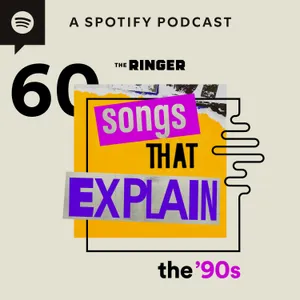
Free Daily Podcast Summary
60 Songs That Explain the '90s: Daily Summaries Delivered
by The Ringer
First came '60 Songs That Explain the '90s.' (We did that.) Then came '60 Songs That Explain the '90s: The 2000s.' (We're doing that now—and yes, that's the actual name.) But whether you want to jump back to the Clinton years or join us as we reboot our old iPods, you can find all of the collected works of Rob Harvilla below.
Latest Episodes
The most recent episodes — sign up to get AI-powered summaries of each one.
- Yesterday1h 42m
Green Day — “American Idiot”
At the turn of the 21st century, Green Day seemed cooked. They experienced diminishing returns on the next few albums that followed their breakthrough success with ‘Dookie,’ bottoming out with ‘Warning’ in 2000—until they realized they weren’t part of the redneck agenda. This week, Rob looks back on how Billie Joe Armstrong and co. captured the mood of wartime in the Bush era to fuel their extraordinary comeback. He recounts how Green Day appeared lost once they grew out of the songs of teenage angst and ennui that put them on the map, and how the early-2000s political climate (and a Lynyrd Skynyrd song) eventually gave them the creative spark they needed. Later, Rob is joined by journalist Alex Pappademas, who talks about interviewing Green Day back in 2004 and how the politics of ‘American Idiot’ have aged since its release. Host: Rob Harvilla Guest: Alex Pappademas Producers: Julianna Ress, Chris Sutton, Justin Sayles, and Olivia Crerie CONNECT Instagram: https://www.instagram.com/60songsthatexplainthe90s TikTok: https://www.tiktok.com/@60songsthatexplainthe90s Intro: When Rob went to Libya with the Heavenly States This week’s song: “American Idiot” by Green Day ‘Insomniac’ and Green Day’s attempts to follow-up ‘Dookie’ Diminishing success on ‘Warning’ Responding to the political climate with “American Idiot” Righteous discontent on other ‘American Idiot’ singles Interview with Alex Pappademas Outro Learn more about your ad choices. Visit podcastchoices.com/adchoices
- 1 weeks ago1h 36m
Christina Aguilera — “Beautiful”
Don’t you bring us down today, because it’s time to talk about Christina Aguilera. This week, Rob looks back on the superstar songwriters behind some of the biggest pop hits of ‘90s and 2000s before landing on how 4 Non Blondes’ Linda Perry penned “Beautiful,” one of Xtina’s signature songs. Aguilera’s powerhouse voice is what put her on the map, and landed her on a Disney soundtrack, but it’s her striking restraint that makes the song land that much harder. Later, Rob’s joined by ‘Mighty Real’ author Barry Walters to discuss Aguilera’s emergence from a crowded class of pop stars and how “Beautiful” became a major LGBTQ+ anthem. Host: Rob Harvilla Guest: Barry Walters Producers: Julianna Ress, Chris Sutton, Justin Sayles, and Olivia Crerie CONNECT Instagram: https://www.instagram.com/60songsthatexplainthe90s TikTok: https://www.tiktok.com/@60songsthatexplainthe90s Intro: Can you tell which famous songwriters wrote these pop hits? This week’s song: “Beautiful” by Christina Aguilera Christina’s Disney days and early vocal talent “Genie in a Bottle” and why Christina’s debut album didn’t let her cook Reintroducing herself with ‘Stripped’ The “Beautiful” music video and Linda Perry’s influence Interview with Barry Walters Outro Learn more about your ad choices. Visit podcastchoices.com/adchoices
- 2 weeks ago1h 45m
E-40 — “Tell Me When To Go”
Get hyphy and go dumb—we’re headed to the Bay Area to talk E-40. This week, Rob pays tribute to the wonderful dictionary of hip-hop slang, much of which was coined by E-40 himself. He looks back on how the hyphy movement, spearheaded by West Coast rappers Mac Dre and Keak da Sneak, made a massive impact locally even if it didn’t achieve the nationwide recognition of similar genres, like crunk. Later, Rob is joined by The Ringer’s Logan Murdock to discuss what E-40 means to the Bay Area and the legacy of hyphy. Host: Rob Harvilla Guest: Logan Murdock Producers: Julianna Ress, Chris Sutton, Justin Sayles, and Olivia Crerie CONNECT Instagram: https://www.instagram.com/60songsthatexplainthe90s TikTok: https://www.tiktok.com/@60songsthatexplainthe90s Intro: The most “acknickulous” made-up words This week’s song: “Tell Me When to Go” by E-40 The Federation, The Click, and E-40’s early tracks E-40’s massive discography Keak da Sneak, Mac Dre, and the hyphy movement E-40 blows up with “Tell Me When to Go” Interview with Logan Murdock Outro Learn more about your ad choices. Visit podcastchoices.com/adchoices
- 3 weeks ago1h 20m
Fountains of Wayne — “Stacy’s Mom”
A song played at every wedding, at every dance, and in every store, “Stacy’s Mom” has cast a great shadow over the rest of the discography of Fountains of Wayne. Today, Rob is here to shine some light on their prolific careers, commemorating the life of legends including the lead bassist and lyricist for the band, Adam Schlesinger. Fountains of Wayne are clearly a 2000s-sounding band, but their lyrics are reminiscent of bands from Rob’s youth like The Cars, giving them a timeless sound. Later, he is joined by music journalist Annie Zaleski, who shares her favorite songs from their catalog, how “Stacy’s Mom” became a novelty song, and the many different projects of Adam Schlesinger after Fountains of Wayne like ‘Crazy Ex-Girlfriend’ and the band Ivy. Host: Rob Harvilla Guest: Annie Zaleski Producers: Julianna Ress, Chris Sutton, Justin Sayles, and Olivia Crerie CONNECT Instagram: https://www.instagram.com/60songsthatexplainthe90s TikTok: https://www.tiktok.com/@60songsthatexplainthe90s Intro: Starting from the End: Rob’s favorite song from Fountains of Wayne This week’s song: “Stacy’s Mom” by Fountains of Wayne New Jersey’s prevalence in rock, and the influences of Fountains of Wayne The best of Adam Schlesinger’s lyricism Fountains of Wayne’s humor Interview with Annie Zaleski Outro Learn more about your ad choices. Visit podcastchoices.com/adchoices
- 4 weeks ago1h 38m
At The Drive-In — “One Armed Scissor”
For a brief moment in 2000, At the Drive-In were the best live band in the world—then they broke up. This week, Rob tracks how the El Paso post-hardcore outfit burned so bright so quickly with their complex, politically-charged tunes that made for some of the wildest shows in rock. The band then suddenly flamed out after it became clear that their intensity wasn’t sustainable when they struggled to contain an unruly, “sheep”-like crowd at Big Day Out. Later, Rob is joined by journalist Suzy Exposito to discuss the herculean task of covering “One-Armed Scissor” and the politics of the pit. Host: Rob Harvilla Guest: Suzy Exposito Producers: Julianna Ress, Chris Sutton, Justin Sayles, and Olivia Crerie CONNECT Instagram: https://www.instagram.com/60songsthatexplainthe90s TikTok: https://www.tiktok.com/@60songsthatexplainthe90s Intro: “Ice cream-eating motherf–kers,” Big Day Out 2001, and how to wrangle a mosh pit This week’s song: “One-Armed Scissor” by At the Drive-In ATDI’s formation amid tragedy The band’s ferocious, dense lyricism “One-Armed Scissor,” as performed on various late-night shows Interview with Suzy Exposito Outro Learn more about your ad choices. Visit podcastchoices.com/adchoices
- Oct 14, 20261h 36m
Bon Iver — “Skinny Love”
Pack up your winter gear—we’re headed to the Wisconsin woods. This week, Rob retreats into Justin Vernon’s cabin to remember the buzzy indie album ‘For Emma, Forever Ago,’ which launched the career of the eventual Grammy-winning band Bon Iver. He looks back on how critics and audiences were enamored with the narrative that Vernon wrote the album while heartbroken and alone in the woods, and the way his voice conveyed those feelings. Later, Rob’s joined by The New York Times’ Jon Caramanica to discuss if “Skinny Love” possibly led to “stomp-clap” music and what collaborators like Kanye West and Taylor Swift heard in Bon Iver. Intro: Neko Case’s voice as a force of nature This week’s song: “Skinny Love” by Bon Iver Justin Vernon’s (many) early bands Bon Iver’s abstract lyrics “Skinny Love” and the narrative of ‘For Emma, Forever Ago’ Interview with Jon Caramanica Outro Host: Rob Harvilla Guest: Jon Caramanica Producers: Julianna Ress, Chris Sutton, Justin Sayles, and Olivia Crerie CONNECT Instagram: https://www.instagram.com/60songsthatexplainthe90s TikTok: https://www.tiktok.com/@60songsthatexplainthe90s Learn more about your ad choices. Visit podcastchoices.com/adchoices
- Oct 7, 20261h 36m
Black Eyed Peas — “I Gotta Feeling”
Are bad lyrics good lyrics? That’s the question Rob posits as he tackles the Black Eyed Peas, who may have mastered the art of good-bad songwriting. He looks back on how the Peas jumped from hip-hop to pop after they added Fergie to their crew, until they ultimately hit dance music in 2009—but they maintained their goofy sensibility the whole way. Later, Rob’s joined by columnist Leslie Gray Streeter to discuss the merits of “My Humps” and why “I Gotta Feeling” has come to represent the Obamacore era. Intro: Lyrics so bad that ... maybe they're good? This week’s song: “I Gotta Feeling” by Black Eyed Peas BEP’s early hip-hop days Shifting to pop and recruiting Fergie The wonderfully dumb ‘The E.N.D.’ and “I Gotta Feeling” Interview with Leslie Gray Streeter Outro Host: Rob Harvilla Guest: Leslie Gray Streeter Producers: Julianna Ress, Chris Sutton, Justin Sayles, and Olivia Crerie CONNECT Instagram: https://www.instagram.com/60songsthatexplainthe90s TikTok: https://www.tiktok.com/@60songsthatexplainthe90s Learn more about your ad choices. Visit podcastchoices.com/adchoices
- Sep 30, 20261h 36m
Lee Ann Womack — “I Hope You Dance”
She sings both kinds of music—country and Western—and you better be grateful for it. Lee Ann Womack followed in the footsteps of icons like Dolly Parton, Loretta Lynn, and Tammy Wynette, but she took even greater inspiration from male country stars like George Jones. After making a name for herself with her captivating tunes, Womack reckoned with love and faith on the beautiful—and melancholy?—"I Hope You Dance," which became a crossover hit and Womack's signature song. Rob is joined by music journalist Marissa R. Moss, who discusses what Womack faced as a woman in country music during the late '90s and 2000s and the selflessness it takes to write a love song to someone who is leaving your life. Intro: The Blues Brothers go to Bob's Country Bunker Remembering Dolly Parton This week's song: "I Hope You Dance" by Lee Ann Womack Womack's early tracks and the state of country in the late '90s Is "I Hope You Dance" a sad or happy song? Interview with Marissa R. Moss Outro Host: Rob Harvilla Guest: Marissa R. Moss Producers: Julianna Ress, Chris Sutton, Justin Sayles, and Olivia Crerie Power up your play with Nintendo Switch 2. Instagram: https://www.instagram.com/60songsthatexplainthe90s/?utm_source=ig_web_button_share_sheet TikTok: https://www.tiktok.com/@60songsthatexplainthe90s?is_from_webapp=1&sender_device=pc Learn more about your ad choices. Visit podcastchoices.com/adchoices
Get 60 Songs That Explain the '90s summaries in your inbox
Free AI-powered daily recaps. Key takeaways, quotes, and mentions — in a 5-minute read.
Get Free Summaries →Free forever for up to 3 podcasts. No credit card required.
You Might Also Like
Listeners also like.
Talk ’90s to me
Podmasters
One Song
Two friends humorously dissect one iconic pop song at a time, revealing hidden layers and connections in the music.

The Story Behind The Song
Explores the creative origins of iconic songs through conversations with the artists who made them.
Rolling Stone's 500 Greatest Songs
A deep dive into the stories and cultural impact behind the songs on Rolling Stone's list of the 500 greatest tracks of all time.

Professor of Rock
Music historian Adam Reader examines the origins and stories of classic rock songs through interviews and detailed episode explorations.
1001 Album Complaints
The Chop Unlimited
2004: The Year Indie Rock Broke
A deep dive into 2004’s pivotal indie rock explosion, featuring key artists and industry figures who shaped the genre’s breakthrough.
The Cobain 50
Explores Kurt Cobain’s musical influences by examining albums from his personal top 50 list.

Every Single Album
Two music fans analyze every album by major pop artists, exploring themes, collaborations, and creative influences in depth.

Bandsplain
A podcast where experts break down cult bands and iconic artists to explore why they resonate with fans.
You Had 2 Be There
Revisits 90s and 2000s pop culture, fashion, and internet nostalgia with humor and guest stories.
Dissect
A music podcast that analyzes one iconic album per season, breaking down each song to explore its artistic and cultural significance.
About 60 Songs That Explain the '90s
First came '60 Songs That Explain the '90s.' (We did that.) Then came '60 Songs That Explain the '90s: The 2000s.' (We're doing that now—and yes, that's the actual name.) But whether you want to jump back to the Clinton years or join us as we reboot our old iPods, you can find all of the collected works of Rob Harvilla below.
Customized Recaps
AI-powered recaps with compact key takeaways, quotes, and insights.
Straight to Your Inbox
Get key takeaways from 60 Songs That Explain the '90s in a 5-minute read.
Save Hours Every Week
Stay current on your favorite podcasts without falling behind.
Frequently Asked Questions
What is Podzilla's 60 Songs That Explain the '90s daily summary?
It's a free AI-powered email that summarizes new episodes of 60 Songs That Explain the '90s as soon as they're published. You get the key takeaways, notable quotes, and links & mentions — all in a quick read.
How does the 60 Songs That Explain the '90s podcast summary work?
When a new episode drops, our AI transcribes and analyzes it, then generates a personalized summary tailored to your interests and profession. It's delivered to your inbox every morning.
Is this an official 60 Songs That Explain the '90s product?
No. Podzilla is an independent service that summarizes publicly available podcast content. We're not affiliated with or endorsed by The Ringer.
Can I get summaries of other podcasts too?
Absolutely! The free plan covers up to 3 podcasts, any in the catalog. Basic raises that to 15, Pro to 40 and Max to 100. Browse our full catalog at /podcasts.
How often does 60 Songs That Explain the '90s release new episodes?
60 Songs That Explain the '90s publishes weekly. Our AI generates a summary within hours of each new episode.
What topics does 60 Songs That Explain the '90s cover?
60 Songs That Explain the '90s covers topics including Music. Our AI identifies the specific themes in each episode and highlights what matters most to you.
Start getting 60 Songs That Explain the '90s summaries tomorrow morning.
Free forever for up to 3 podcasts. No credit card required.
Free forever for up to 3 podcasts. No credit card required.