Free Daily Podcast Summary
Acquisition Talk: Daily Summaries Delivered
by Eric Lofgren
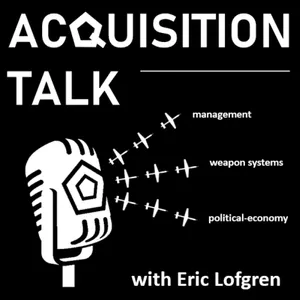
A podcast on the management, technology, and political-economy of weapon systems acquisition.
Latest Episodes
The most recent episodes — sign up to get AI-powered summaries of each one.
- Yesterday55 min
AUTOWARCOM Debate with Bryan Clark and Mark Cancian
In this episode of Acquisition Talk, host Eric Lofgren debates the proposal to create Autonomous Warfare Command (AUTOWARCOM), a new four-star functional combatant command intended to accelerate the fielding of unmanned and autonomous systems. The target stand-up date is October 1, 2027, with interim work led by Project Agen Corps. Bryan Clark (Hudson Institute) argues in favor of a CYBERCOM-like model: a functional combatant command that serves as a central demand-signal and clearinghouse for the geographic combatant commands without becoming an independent service or owning its own personnel and acquisition pipelines. He contends the core problem is one of demand, not supply—the services already have funding and mature commercial technologies, but lack a clear joint customer and operational problem set to prioritize against. A focused AUTOWARCOM could help define kill chains, force packages, and concepts of employment so the services can field systems more quickly, ideally working itself out of a job over time. Mark Cancian (CSIS) is skeptical. He prefers an MDA-style organization focused on development and initial procurement that then transitions systems to the services, arguing that giving AUTOWARCOM operational responsibilities risks creating SOCOM-like stovepipes that fail to integrate with conventional forces. He warns that the Secretary’s more expansive vision (own personnel, procurement authorities, and operational control) would balkanize the force and pull the Department backward. Both agree the command should not have full Title 10 personnel and training authorities, but they differ sharply on acquisition authority, the risk of a “valley of death,” and whether centralized demand or centralized supply is the better forcing function. The conversation also covers major force programs, O&M experimentation budgets, the role of existing UXS acquisition offices, lessons from Ukraine, and the tension between near-term commercial systems and longer-term service concepts.
- 2 days ago1h 10m
NatSec News: Nov 16, 2026
Eric Lofgren and Matt McGregor cover a wide range of defense acquisition, industrial base, and technology news. Highlights include the Department of War’s (DOW) new commercial-first procurement policy, the rise of venture-backed “roll-up” platforms for legacy defense suppliers, major funding for Ukrainian unmanned systems (UFORCE’s $700M Series A), and DoD efforts to expand alternative launch capacity via loans to Rocket Lab and Stoke Space. Other key topics: Anduril’s preference for flexible human manufacturing over heavy automation for low-volume/high-complexity systems; the “chicken-and-egg” challenge of demand signals versus production capacity for non-traditionals; Drone Dominance Program Gauntlet 2.5 (dominated by Ukrainian firms); B-21 weapons-release progress; Hermeus–Northrop Grumman partnership; CDAO’s rebrand to Super Intelligence Office; containerized micro-factories for Lucas drones; Lockheed’s $8B missile-production investment (and the disparity in government risk-sharing between traditional and non-traditional firms); Path Robotics’ AI welding scale-up; contested logistics architectures; M-SHORAD palletized short-range air defense requirements; Columbia-class and undersea systems progress versus China’s XLUUV push; C-17 palletized munitions; Golden Dome funding politics; and lessons from Ukraine’s unmanned forces model.
- 6 days ago1h 0m
NatSec News: Nov 9, 2026
In this week’s episode of Acquisition Talk, hosts discuss a packed slate of defense tech and acquisition headlines with Matt McGregor of the Defense Tech and Acquisition Substack. Topics include the delivery of more than 25,000 autonomous and counter-unmanned systems to CENTCOM, a new world speed record for a small jet-powered drone, Shield AI’s ExBat VTOL concept and its $5.3 billion acquisition of Echodyne, General Atomics’ hybrid-electric stealth drone, SOCOM’s low-cost Zeus shoulder-fired missile, and Lockheed’s Lamprey undersea vehicle that recharges from host ships. The conversation also covers subterranean and fiber-optic drone experiments, the role of super-intelligence in military decision-making, challenges unifying the fragmented S&T enterprise, expeditionary robotic factories for Lucas drones, private equity versus venture capital in the AI era, the potential I-81 defense industrial corridor, an Office of Strategic Capital loan to a drone company, and the implications of Democratic control of Congress for the defense budget, continuing resolutions, and reconciliation. Additional items include Navy fleet structure recommendations, Saildrone and M-USV protest outcomes, PAC-3 integration on warships, multi-year fighter procurement, bird-mimicking drones, lessons from Operation Epic Fury, Space Force’s new special operations component, and interoperability issues among satellite constellations.
- 1 weeks ago37 min
Defense Innovation Unit with Maj Gen Joseph "Solo" Kunkel
In this episode, Major General Joseph “Solo” Kunkel, military deputy to the Defense Innovation Unit, discusses how operational problems in the Pacific are driving a new approach to force design and acquisition. He explains the Mission Area 1/2/3 framework (and the emerging “Edge force”), why Collaborative Combat Aircraft are better understood as extensions of the traditional force rather than pure Edge capabilities, and how smaller, posturable systems change basing and partner relationships. Solo outlines the thinking behind an Autonomous Warfare command focused on rapid adaptation cycles measured in days and weeks rather than years, its nesting relationship with the Direct Reporting Program Manager for Unmanned Systems and DIU, and why decisive mass requires deep integration with the services rather than a pure SOCOM-style model. He also covers DIU’s deliberate shift to carry promising capabilities past the prototype stage into LRIP—until a service can absorb them in its own budget—and the expansion of the successful “gauntlet” competitive testing model from drone dominance to surface vessels, subsurface systems, and longer-range UAVs. The conversation closes with practical observations on operational-problem-driven requirements, transition paths, Other Transaction authorities, and the industrial-base implications of producing at the rate of expenditure.
- 2 weeks ago56 min
NatSec News: Nov 3, 2026
NatSec News: Nov 3, 2026 by Eric Lofgren
- 3 weeks ago55 min
NatSec News: Oct 26, 2026
defense tech and acquisition, discussion of the news and events in defense acquisition for october 26, 2026 including AUTOWARCOM, JIATF-401, F-35, contracting agreements, cislunar space, quantum, small modular reactors, air force, navy, army, unmanned systems, fortress america, reconciliation, defense budget
- Feb 19, 202349 min
Programmed to Fail - 10. Culture
In this final episode of Programmed to Fail, we explore the true importance of reforming the Planning, Programming, Budgeting, and Execution process in the Department of Defense. Some may say that it is only a poor craftsman who blames his tools, that it is deficiencies in the workforce rather than problems of the acquisition and budgeting systems that are holding weapons innovation back. But certainly, it is not the lack of quality and drive in the people that has held North Korea back relative to their neighbors in South Korea, or that has stymied the growth of nations in the former Soviet Union. It was the ideologies of the political economy thrust upon the people that so devastated their culture. The PPBE is a similarly radical break from American values and traditions that has left good people burdened by a bad process. No longer can the defense acquisition workforce take joy in their hefty responsibility. No longer can the workforce see themselves in their work. They are tossed about in a system too large for them to affect, and the workforce is expected to be like a caretaker driving a train down pre-set tracks, rather than an explorer, a creator, and a builder with intrinsic value. Fulfilling individual desires to contribute to national security will more rapidly accelerate our common security than any top-down optimization and 30-year lifecycle plan. The problem is how large groups of people can be coordinated to achieve an end that is beyond the comprehension of any small group or plan. That is what we will explore in this final chapter of Programmed to Fail. This podcast was produced by Eric Lofgren. You can follow me on Twitter @AcqTalk and find more information at https://AcquisitionTalk.com
- Feb 19, 20231h 9m
Programmed to Fail - 9. Cost
In this episode of Programmed to Fail, we explore how accounting costs do not reveal the value being generated in the production process and cannot be used, on their own, as a guide for specific choices. Cost is not an objective reality, particularly to those who know the vagaries of cost accounting. Instead, our view of cost depends on subjective use value and is related to the term opportunity cost, or the next-best choice foregone. This chapter reveals that for defense acquisition to truly understand weapons value and leverage the power of commercial markets, it needs to shift away from its obsession with financial metrics. This podcast was produced by Eric Lofgren. You can follow me on Twitter @AcqTalk and find more information at https://AcquisitionTalk.com
Get Acquisition Talk summaries in your inbox
Free AI-powered daily recaps. Key takeaways, quotes, and mentions — in a 5-minute read.
Get Free Summaries →Free forever for up to 3 podcasts. No credit card required.
You Might Also Like
Listeners also like.

The Contracting Experience
Discusses government contracting through expert interviews, current topics, and real-world lessons.
Irregular Warfare Podcast
Examines irregular warfare through expert discussions on small wars, special operations, counterterrorism, and conflict tactics.

The Merge
Veterans and experts discuss military technology, aerospace, and national security strategy with firsthand insight and candor.
NatSec Matters
Former national security officials interview top leaders on critical security challenges and U.S. policy responses.

Cleared Hot - Powered By BRCC
A former military pilot shares stories of adventure, fitness, and leadership to explore resilience and personal growth.

Aviation Week's Check 6 Podcast
Aerospace and defense industry analysis from Aviation Week & Space Technology editors.

Cheap Talk
Two international relations professors discuss global politics and foreign affairs in weekly conversations.

Scope Conditions Podcast
A podcast showcasing cutting-edge research in comparative politics.

The Lawfare Podcast
Discussions with experts on national security, law, and policy covering foreign policy, intelligence, cybersecurity, and governance.

Cyber Focus: Cybersecurity, National Security, and Critical Infrastructure
Expert discussions on cybersecurity, national security, and threats to critical infrastructure like energy and water systems.
The Quill & Sword
Military legal experts discuss court cases, national security, leadership, and JAG Corps history in a U.S. Army podcast series.
Phoenix Cast
Discusses cybersecurity, technology, and innovation issues in the military.
About Acquisition Talk
A podcast on the management, technology, and political-economy of weapon systems acquisition.
Customized Recaps
AI-powered recaps with compact key takeaways, quotes, and insights.
Straight to Your Inbox
Get key takeaways from Acquisition Talk in a 5-minute read.
Save Hours Every Week
Stay current on your favorite podcasts without falling behind.
Frequently Asked Questions
What is Podzilla's Acquisition Talk daily summary?
It's a free AI-powered email that summarizes new episodes of Acquisition Talk as soon as they're published. You get the key takeaways, notable quotes, and links & mentions — all in a quick read.
How does the Acquisition Talk podcast summary work?
When a new episode drops, our AI transcribes and analyzes it, then generates a personalized summary tailored to your interests and profession. It's delivered to your inbox every morning.
Is this an official Acquisition Talk product?
No. Podzilla is an independent service that summarizes publicly available podcast content. We're not affiliated with or endorsed by Eric Lofgren.
Can I get summaries of other podcasts too?
Absolutely! The free plan covers up to 3 podcasts, any in the catalog. Basic raises that to 15, Pro to 40 and Max to 100. Browse our full catalog at /podcasts.
How often does Acquisition Talk release new episodes?
Acquisition Talk publishes every few days. Our AI generates a summary within hours of each new episode.
What topics does Acquisition Talk cover?
Acquisition Talk covers topics including Government. Our AI identifies the specific themes in each episode and highlights what matters most to you.
Start getting Acquisition Talk summaries tomorrow morning.
Free forever for up to 3 podcasts. No credit card required.
Free forever for up to 3 podcasts. No credit card required.