Free Daily Podcast Summary
Atmosphere with Emily Gracey: Daily Summaries Delivered
by Emily Gracey
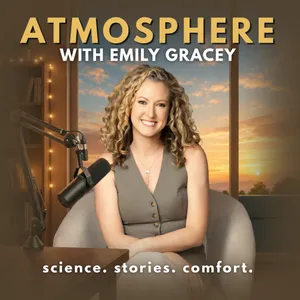
Meteorologist Emily Gracey sits down each week with leading scientists, researchers, and experts in weather, climate, earth science, and beyond. Every episode goes deeper than the science itself, uncovering the human stories behind the work and making complex ideas feel relevant, relatable, and real. From hurricanes and severe storms to earthquakes and emerging research, Atmosphere turns complicated ideas into conversations everyone can connect with.
Latest Episodes
The most recent episodes — sign up to get AI-powered summaries of each one.
- Yesterday5 min
BONUS: Sunny Day Flooding - Why Streets Flood Without Rain
How can streets flood when it hasn’t rained? Sunny day flooding, also called high-tide flooding or tidal flooding, can bring saltwater into coastal communities under clear blue skies.Recent king-tide flooding in Florida and California has brought attention to a surprising coastal hazard: streets can flood without rain. In this quick bonus episode, meteorologist Emily Gracey explains how tides, wind, ocean temperatures and sea level rise can combine to push water into coastal communities.Emily shares stories from her hometown of Charleston, South Carolina, to explain the science behind flooded streets... and why a sunny forecast doesn’t tell the whole story.Also listen to or watch “Rising Tides: Two Meteorologists, Two Coastal Communities,” a collaborative episode of Atmosphere and Tidal Flooding Talk with Joe Martucci.
- 2 days ago49 min
Rising Tides: Two Meteorologists, Two Coastal Communities
Sunny skies, flooded streets. What does it mean when coastal flooding becomes part of everyday life?Meteorologist Joe Martucci joins Emily Gracey for a collaborative episode of Atmosphere and Tidal Flooding Talk about tidal flooding, sea level rise, and life along a changing coastline. From Charleston, South Carolina, to the Jersey Shore, we compare how communities experience high-tide flooding, what newcomers may not realize about flood risk, and how towns are adapting.Joe and I also share a friendship—and the experience of rebuilding our careers after layoffs. We talk about digital meteorology, independent weather reporting, podcasting, and finding new ways to connect people with science. There’s plenty of weather talk, with a few detours along the way.This conversation is being shared on both shows.Listen and subscribe to Tidal Flooding Talk.Emily's Substack: https://atmospherepodcast.substack.com/Weekly Weather BriefAtmosphere is sponsored by Weather100. Explore 100 years of weather history at https://www.weather100.com/ and use code EMILY20 for 20% off.
- 6 days ago10 min
BONUS: Inside COP31 - What Happens at a UN Climate Summit?
What actually happens at a global climate conference?Bernadette Woods Placky, executive director of Talking Climate Collaborative, joins me from COP31 in Antalya, Turkey, for a bonus conversation on Atmosphere. We talk about who shows up, how Americans are participating, and why communication matters when the science and policy get complicated. Plus, where she sees progress, and the people working to move things forward.This is our full interview, recorded November 12, 2026, with Bernadette joining from the conference.Learn more about Talking Climate Collaborative: https://talkingclimate.comCOP31:https://cop31.tr/
- 1 weeks ago44 min
Wildfires: Rising Risks & New Solutions
What happens when a wildfire creates its own weather? Can artificial intelligence detect a fire before it spreads? And could autonomous drones someday help firefighters protect entire communities?Meteorologist and wildfire chaser Jaclyn Whittal has spent years covering extreme weather, from hurricanes and tornadoes to devastating wildfires. But after moving to British Columbia, the wildfire threat became personal. She's experienced evacuation alerts, watched the sky turn red with smoke, and swept burning embers off her own back porch.In this episode of Atmosphere, Jaclyn joins meteorologist Emily Gracey to explore the science behind wildfires, their connection to our changing climate, and some remarkable new technologies being developed to fight them.We talk about fire-generated thunderstorms, fire tornadoes, "zombie fires" that survive the winter, AI-powered detection systems, firefighting drones, and new ways to protect homes and communities.And perhaps most importantly, why preparing for the next wildfire season needs to start long before the first flames appear.Sponsored by Weather100. Explore 100 years of weather history at https://www.weather100.com and use code EMILY20 for 20% off.Atmosphere on Instagram: https://www.instagram.com/atmospherepodcast/Jaclyn on Instagram: https://www.instagram.com/jwhittalclimate/Subscribe for more conversations about weather, climate, science, and the people behind the research.
- 2 weeks ago45 min
Why Weather Disasters Hit Some Communities Harder
Why do some communities suffer far greater consequences from the same weather disaster? And what can we do to change that?When Hurricane Katrina struck in 2005, meteorologist Dr. Jamese Sims urged her parents to evacuate. Her father refused, insisting he needed to "protect the house." It took years for Jamese to fully understand what he meant, and that experience helped inspire her new book, Protect the House: Weather Doesn't Discriminate, But Impact Does.In this episode of Atmosphere, Jamese joins Emily to explore why weather disasters disproportionately affect underserved communities. From financial barriers and generational wealth to cultural beliefs and the lasting impacts of disasters, she explains why preparing for extreme weather isn't as simple as telling people to evacuate or have an emergency kit.They also discuss where traditional weather communication falls short and share practical ways families, meteorologists, and community leaders can work together to make everyone safer.Because a good forecast can only save lives if people have the information, resources, and support to act on it.Atmosphere is proudly supported by founding sponsor Weather100. Learn more at https://weather100.com/Protect the House is available on Amazon: https://a.co/d/0acVHZsWSubscribe to Atmosphere for more conversations about the science, stories, and people behind our changing world.
- 3 weeks ago7 min
BONUS: The History of Daylight Saving Time in America
Who decided we should change our clocks twice a year? And why are we still doing it?From the days when every town kept its own time to America's failed experiment with permanent daylight saving time in 1974, meteorologist Emily Gracey takes a quick trip through the surprisingly messy history of timekeeping.Plus, why Arizona refuses to play along, how China manages with just one time zone, and what all of this has to do with saving energy.For more on the science of daylight saving time and how it affects our sleep and health, listen to the full Atmosphere episode featuring Stanford sleep researcher Dr. Jamie Zeitzer.Sources & Further ReadingCongressional Research Service — Daylight Saving Time: https://www.everycrsreport.com/reports/RS22284.htmlU.S. Department of Transportation — The Daylight Saving Time Study: A Report to Congress (1975): https://rosap.ntl.bts.gov/view/dot/92250Smithsonian National Museum of American History — On Time: Synchronizing Time: https://americanhistory.si.edu/ontime/synchronizing/zones.htmlArizona State University — Why Arizona Has Opted Out of Daylight Saving Time: https://news.asu.edu/20180305-discoveries-why-arizona-has-opted-out-daylight-saving-time?page=3Timeanddate — Daylight Saving Time in Arizona: https://www.timeanddate.com/time/us/arizona-no-dst.htmlTimeanddate — China Only Has One Time Zone: https://www.timeanddate.com/time/china/one-time-zone.html
- 3 weeks ago34 min
Daylight Saving Time: The Great Debate
Twice a year, Americans change their clocks. Twice a year, we argue about whether we should stop. But what does the science actually say?Stanford sleep researcher Dr. Jamie Zeitzer joins Atmosphere to unpack the surprisingly complicated science behind daylight saving time. Is permanent standard time really healthier? And are we overlooking a much bigger problem while arguing about the clocks?From the Sunshine Protection Act to our alarming lack of natural daylight, Jamie explores how sunlight affects our circadian rhythms, sleep, and overall health. He also shares surprisingly simple ways to get a better night's sleep, explains why some of us are night owls while others are early birds, and challenges some conventional thinking about changing the clocks.Maybe the problem isn't what time we're setting our clocks. It's what we're doing with the daylight we've got.Atmosphere is supported by founding sponsor Weather100.Learn more at https://weather100.com/ and use code EMILY20 for 20% off your purchase.
- Oct 20, 202637 min
Clouds! The Science, the Wonder & Why NASA Needs You.
What if simply looking up at the clouds could help NASA?Satellites can observe Earth in extraordinary detail, but there's something they can't do: stand on the ground and look up with the human eye. And that human perspective turns out to be incredibly valuable to scientists.In this episode of Atmosphere, meteorologist Emily Gracey talks with Dr. Andy Sayer, an atmospheric scientist working with NASA's PACE satellite, and Jessica Taylor from NASA's GLOBE Clouds program about the surprising limitations of satellite technology and how everyday people can help fill in the gaps.Through NASA's free GLOBE Observer app, anyone with a smartphone can collect cloud observations that contribute to real scientific research. No scientific background required!But there's another benefit to all this cloud watching. Taking a few minutes to look up can reconnect us with nature, help us appreciate the world around us, and maybe even bring a little peace to our busy lives.Become a cloud observer:NASA GLOBE Observer app: https://observer.globe.gov/about/get-the-appPACE Clouds Challenge: https://www.globe.gov/do-globe/measurement-campaigns/field-measurement-campaigns/pace-clouds-challengeAtmosphere is supported by founding sponsor Weather100. Learn more at https://weather100.com and use code EMILY20 for 20% off your purchase.
Get Atmosphere with Emily Gracey summaries in your inbox
Free AI-powered daily recaps. Key takeaways, quotes, and mentions — in a 5-minute read.
Get Free Summaries →Free forever for up to 3 podcasts. No credit card required.
You Might Also Like
Listeners also like.

Everything Weather Podcast
A conversational and educational podcast exploring various aspects of weather and how it impacts the world.

A Matter of Degrees
Two climate experts explore the systems driving climate change and spotlight solutions through stories of leadership and activism.
The EF-Show
AJ Raber Meteorology
ScienceSphere
A weekly exploration of scientific discoveries across physics, biology, astronomy, and technology, explained clearly for all listeners.
Challenging Climate
Jesse Reynolds and Pete Irvine

Rare Earth
Explores environmental issues and wildlife conservation through conversations with scientists and activists.
Weather with Cliff Mass
A weekly weather forecast and analysis of current and future weather patterns in the Pacific Northwest by atmospheric scientist Cliff Mass.

Emonthebrain
A neuroscientist-turned-coach explores how brain science, emotions, and subconscious beliefs shape reality and personal transformation.
Biosphere 2 Podcast
Aaron Bugaj
Scientista
Scientista

Inquiring Minds
Explores the intersection of science and society through critical thinking and in-depth analysis.
Natural Causes
Explores the intersection of outdoor access, conservation, and environmental justice in an era of climate crisis and political threat.
About Atmosphere with Emily Gracey
Meteorologist Emily Gracey sits down each week with leading scientists, researchers, and experts in weather, climate, earth science, and beyond. Every episode goes deeper than the science itself, uncovering the human stories behind the work and making complex ideas feel relevant, relatable, and real. From hurricanes and severe storms to earthquakes and emerging research, Atmosphere turns complicated ideas into conversations everyone can connect with.
Customized Recaps
AI-powered recaps with compact key takeaways, quotes, and insights.
Straight to Your Inbox
Get key takeaways from Atmosphere with Emily Gracey in a 5-minute read.
Save Hours Every Week
Stay current on your favorite podcasts without falling behind.
Frequently Asked Questions
What is Podzilla's Atmosphere with Emily Gracey daily summary?
It's a free AI-powered email that summarizes new episodes of Atmosphere with Emily Gracey as soon as they're published. You get the key takeaways, notable quotes, and links & mentions — all in a quick read.
How does the Atmosphere with Emily Gracey podcast summary work?
When a new episode drops, our AI transcribes and analyzes it, then generates a personalized summary tailored to your interests and profession. It's delivered to your inbox every morning.
Is this an official Atmosphere with Emily Gracey product?
No. Podzilla is an independent service that summarizes publicly available podcast content. We're not affiliated with or endorsed by Emily Gracey.
Can I get summaries of other podcasts too?
Absolutely! The free plan covers up to 3 podcasts, any in the catalog. Basic raises that to 15, Pro to 40 and Max to 100. Browse our full catalog at /podcasts.
How often does Atmosphere with Emily Gracey release new episodes?
Atmosphere with Emily Gracey publishes weekly. Our AI generates a summary within hours of each new episode.
What topics does Atmosphere with Emily Gracey cover?
Atmosphere with Emily Gracey covers topics including Science, Earth Sciences. Our AI identifies the specific themes in each episode and highlights what matters most to you.
Start getting Atmosphere with Emily Gracey summaries tomorrow morning.
Free forever for up to 3 podcasts. No credit card required.
Free forever for up to 3 podcasts. No credit card required.