Free Daily Podcast Summary
BirdNote Daily: Daily Summaries Delivered
by BirdNote
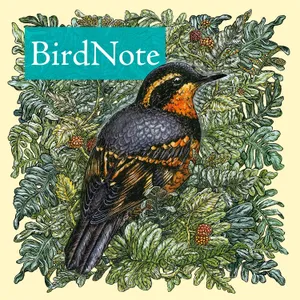
Escape the daily grind and immerse yourself in the natural world. Rich in imagery, sound, and information, BirdNote inspires you to notice the world around you.
Latest Episodes
The most recent episodes — sign up to get AI-powered summaries of each one.
- Today1 min
Flyin' in the Rain
Most birds are mostly waterproof. Their feathers, aided by oil from preen glands, keep them pretty watertight. So why do birds avoid flying during rainstorms? It may have more to do with the air than with the water. Rainstorms tend to occur when atmospheric pressure is low. Air in a low-pressure system is less dense. But it’s dense air that gives birds the aerodynamic lift they need to take wing. Falling rain and high humidity make air even less dense. Many birds perch and wait out a storm. Afterward, birds once again take to the skies.More info and transcript at BirdNote.org.Want more BirdNote? Subscribe to our weekly newsletter. Sign up for BirdNote+ to get ad-free listening and other perks. BirdNote is a nonprofit. Your tax-deductible gift makes these shows possible. Hosted by Simplecast, an AdsWizz company. See pcm.adswizz.com for information about our collection and use of personal data for advertising.
- Yesterday1 min
Where Swallows Go in Winter
Through all of spring and summer, swallows dart and sail overhead, their airborne grace a wonder to behold. But by October, the skies seem empty. Most swallows have flown south, in search of insects. The eight species of swallows that nest in the U.S. — including the Cliff Swallow — migrate south to Central or even South America. Watch for them again next spring!More info and transcript at BirdNote.org.Want more BirdNote? Subscribe to our weekly newsletter. Sign up for BirdNote+ to get ad-free listening and other perks. BirdNote is a nonprofit. Your tax-deductible gift makes these shows possible. Hosted by Simplecast, an AdsWizz company. See pcm.adswizz.com for information about our collection and use of personal data for advertising.
- 2 days ago1 min
Questions That Get Kids Curious About Nature
Brianna Amingwa is a birder, environmental educator, and mom of two bird-loving boys. In this episode, Brianna shares one of her favorite, tried-and-true techniques for sparking curiosity with kids outside. This easy activity has a funny name: INIWIRMO. It’s an acronym for I Notice. I Wonder. It Reminds Me Of. INIWIRMO works by inviting kids and adults to turn each phrase into a statement about something they observe in nature.More info and transcript at BirdNote.org.Want more BirdNote? Subscribe to our weekly newsletter. Sign up for BirdNote+ to get ad-free listening and other perks. BirdNote is a nonprofit. Your tax-deductible gift makes these shows possible. Hosted by Simplecast, an AdsWizz company. See pcm.adswizz.com for information about our collection and use of personal data for advertising.
- 3 days ago1 min
The Eurasian Tree Sparrow
In Lafayette Park in St. Louis, Missouri, a dozen or so Eurasian Tree Sparrows from Germany were released. But unlike other introduced species such as the similar-looking House Sparrow, they did not spread very far and remained in a limited area in the Midwest. It’s not fully clear why, but it’s possible that they just behave differently. And the aggressive House Sparrow may have helped prevent the tree sparrows from spreading further by competing for the same nesting sites. BirdNote is supported by the Bamford Foundation and by generous listeners around the world. More info and transcript at BirdNote.org. Want more BirdNote? Subscribe to our weekly newsletter. Sign up for BirdNote+ to get ad-free listening and other perks. BirdNote is a nonprofit. Your tax-deductible gift makes these shows possible. Hosted by Simplecast, an AdsWizz company. See pcm.adswizz.com for information about our collection and use of personal data for advertising.
- 4 days ago1 min
Birding 101: Where to Find Birds
There’s no wrong place to search for birds — looking out the window and listening for calls and songs is a great place to start. But you might be curious where else to look. In this episode, get a few quick tips on good places to find birds. Listen to this episode in Spanish. More info and transcript at BirdNote.org. Want more BirdNote? Subscribe to our weekly newsletter. Sign up for BirdNote+ to get ad-free listening and other perks. BirdNote is a nonprofit. Your tax-deductible gift makes these shows possible. Hosted by Simplecast, an AdsWizz company. See pcm.adswizz.com for information about our collection and use of personal data for advertising.
- 5 days ago1 min
Which Bird Has the Most Feathers?
In general, the bigger the bird, the higher the number of feathers. Someone counted the feathers on a Tundra Swan and came up with 25,216. At least 80% were on the swan’s neck. Penguins, on the other hand, have lots of small feathers all over their bodies. The largest species is the Emperor Penguin, and one project counted around 80,000 feathers on a single bird. That’s nearly sixty per square inch – keeping the penguin insulated and waterproof in harsh climates. But the most feathered creature ever? It may have been a dinosaur! More info and transcript at BirdNote.org. Want more BirdNote? Subscribe to our weekly newsletter. Sign up for BirdNote+ to get ad-free listening and other perks. BirdNote is a nonprofit. Your tax-deductible gift makes these shows possible. Hosted by Simplecast, an AdsWizz company. See pcm.adswizz.com for information about our collection and use of personal data for advertising.
- 6 days ago1 min
Great Horned Owl Family in Autumn
Compared to many birds, Great Horned Owls remain with their parents a long time. They hatched in early March, from eggs laid in late January. By April, both parents were hunting through the night to feed their young. But for the last two weeks, the adults have not fed the young. The owlets have learned the skills they need to hunt for themselves. And any night now, the young owls will strike out on their own. More info and transcript at BirdNote.org. Want more BirdNote? Subscribe to our weekly newsletter. Sign up for BirdNote+ to get ad-free listening and other perks. BirdNote is a nonprofit. Your tax-deductible gift makes these shows possible. Hosted by Simplecast, an AdsWizz company. See pcm.adswizz.com for information about our collection and use of personal data for advertising.
- 1 weeks ago1 min
Prions Filter-Feed Like Whales
Birds called prions have an especially creative approach to getting their food. They pass seawater through their mouths and filter it to catch tiny animals such as krill and other small crustaceans. It’s similar to how baleen whales feed, leading to the prion’s nickname: the whale-bird. The sides of their bills have comb-like structures. Small food items get trapped in the combs as water flows past. In Greek, the word “prion” means saw, which refers to the bird’s highly specialized mouth. More info and transcript at BirdNote.org. Want more BirdNote? Subscribe to our weekly newsletter. Sign up for BirdNote+ to get ad-free listening and other perks. BirdNote is a nonprofit. Your tax-deductible gift makes these shows possible. Hosted by Simplecast, an AdsWizz company. See pcm.adswizz.com for information about our collection and use of personal data for advertising.
Get BirdNote Daily summaries in your inbox
Free AI-powered daily recaps. Key takeaways, quotes, and mentions — in a 5-minute read.
Get Free Summaries →Free forever for up to 3 podcasts. No credit card required.
You Might Also Like
Listeners also like.
The Science of Birds
A lighthearted exploration of bird biology for birders and naturalists, hosted by a professional birding guide with a PhD in Zoology.

Get Birding
A birder and actor guides listeners through the basics of birdwatching and nature connection.
Okay, But... Birds
A biologist explores the surprising science and stories behind birds, revealing their impact on the world with humor and expert insights.
The American Birding Podcast
Discusses birds, birding, conservation, and birding-related travel with experts and enthusiasts across North America and beyond.
Terrestrials
A nature podcast exploring surprising animal and plant behaviors through immersive storytelling and original songs.
The Plodcast
A weekly exploration of the British countryside featuring guest interviews and immersive soundscapes of the natural world.

Wonder
A brief weekly journey into the natural world through immersive soundscapes and mindful reflection.
Short Wave
A daily science podcast exploring discoveries, everyday mysteries, and the stories behind scientific headlines.
Outside/In
Explores connections between people and the natural world through stories on science, policy, and culture.
¡Hola Nature! A Spanish Learning Adventure for Kids
A nature-themed Spanish learning podcast for kids featuring stories, poems, and facts to foster language skills and environmental curiosity.

The Wild with Chris Morgan
Explores wildlife and wild places through stories of animals adapting to survive and the people protecting them.

Animal
A writer travels the world exploring human connections with animals through intimate encounters and philosophical reflection.
About BirdNote Daily
Escape the daily grind and immerse yourself in the natural world. Rich in imagery, sound, and information, BirdNote inspires you to notice the world around you.
Customized Recaps
AI-powered recaps with compact key takeaways, quotes, and insights.
Straight to Your Inbox
Get key takeaways from BirdNote Daily in a 5-minute read.
Save Hours Every Week
Stay current on your favorite podcasts without falling behind.
Frequently Asked Questions
What is Podzilla's BirdNote Daily daily summary?
It's a free AI-powered email that summarizes new episodes of BirdNote Daily as soon as they're published. You get the key takeaways, notable quotes, and links & mentions — all in a quick read.
How does the BirdNote Daily podcast summary work?
When a new episode drops, our AI transcribes and analyzes it, then generates a personalized summary tailored to your interests and profession. It's delivered to your inbox every morning.
Is this an official BirdNote Daily product?
No. Podzilla is an independent service that summarizes publicly available podcast content. We're not affiliated with or endorsed by BirdNote.
Can I get summaries of other podcasts too?
Absolutely! The free plan covers up to 3 podcasts. Upgrade to Pro for 15, or Premium for 50. Browse our full catalog at /podcasts.
How often does BirdNote Daily release new episodes?
BirdNote Daily publishes daily. Our AI generates a summary within hours of each new episode.
What topics does BirdNote Daily cover?
BirdNote Daily covers topics including Science, Education, How To, Nature, Natural Sciences. Our AI identifies the specific themes in each episode and highlights what matters most to you.
Start getting BirdNote Daily summaries tomorrow morning.
Free forever for up to 3 podcasts. No credit card required.
Free forever for up to 3 podcasts. No credit card required.