Free Daily Podcast Summary
Break Fake Rules: Change Big Giving For Good: Daily Summaries Delivered
by Stupski Foundation
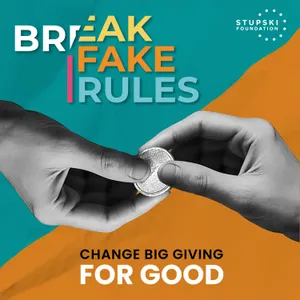
Some rules are meant to be broken—especially the fake ones! Break Fake Rules is a podcast that brings today’s news and big philanthropic issues into focus, challenging the self-imposed rules that shape the flow of money, power, and resources in America. Join Glen Galaich, CEO of the Stupski Foundation, and a rotating cast of co-hosts as they unpack the news of the day and engage in conversations with principled rulebreakers in philanthropy, nonprofits, government, media, and more. Each episode examines the fake rules holding the systems in place that don’t serve us—and which rules we must break to secure a better future for all. If you have ever questioned why we live by certain rules and wondered what becomes possible when we do things differently, this show is for you.
Latest Episodes
The most recent episodes — sign up to get AI-powered summaries of each one.
- Today47 min
Who Should Control the Money? feat. Glen Galaich and Jamie Allison
Break Fake Rules listeners, enjoy this special feed swap from our partners at the Center for Effective Philanthropy (CEP), who invited our co-hosts, Glen Galaich and Jamie Allison, to guest star on their Giving Done Right podcast. Follow Giving Done Right here or wherever you get podcasts. New episodes of Break Fake Rules return next week.In this episode, co-hosts Phil Buchanan and Elisha Smith Arrillaga, CEP's vice president of Research, discuss some of philanthropy's oldest tensions: who should decide how charitable dollars get spent and how to balance short-term needs with the long view? Their guests, Glen Galaich, CEO of the Stupski Foundation, and Jamie Allison, executive director of the Walter & Elise Haas Fund, are usually the ones asking the questions, as frequent co-hosts on Glen’s podcast, Break Fake Rules.Glen makes the case from his new book, “CONTROL: Why Big Giving Falls Short”, that too much charitable wealth sits parked in private equity and hedge fund accounts rather than moving out to the communities that need it, and that donors should treat public stewardship, not private control, as their guiding value. Jamie pushes back on the idea that this is a binary choice between spending down and staying perpetual, describing how the Walter & Elise Haas Fund has worked to increase payout and shift toward larger, unrestricted grants without abandoning a long time horizon. Together, they debate what foundations with large endowments owe to this moment of crisis for nonprofits, why "responsiveness" matters more than any single spending formula, and what foundations might learn from everyday donors.Order your copy of Glen’s book, CONTROL: Why Big Giving Falls Short.
- 1 weeks ago44 min
Who Benefits When We Stop Trusting Each Other? feat. Dr. Ibram X. Kendi
Why are people willing to give up power in exchange for the promise of protection? Recorded live with Northern California Grantmakers at SFJAZZ, host Jamie Allison invited Dr. Ibram X. Kendi, renowned historian and scholar, and Glen Galaich, CEO of the Stupski Foundation, to discuss their new books, Dr. Kendi’s Chain of Ideas: The Origins of Our Authoritarian Age, and Glen’s CONTROL: Why Big Giving Falls Short.Together, Dr. Kendi and Glen explore what it takes to move away from distrust and zero-sum thinking toward trust, solidarity, and shared responsibility. Their conversation asks a timely question of both democracy and philanthropy: what becomes possible when we stop treating one another as threats and start recognizing how connected we actually are?💡Dr. Ibram X. Kendi: “The weakest link in the chain of ideas are those who believe they're not connected to the rest of us.”Order Dr. Ibram X. Kendi’s book, Chain of Ideas: The Origins of Our Authoritarian Age, and his new children’s book, The Power of Our. Learn about his work at the Howard University Institute for Advanced Study. Learn about the Walter and Elise Haas Fund, Northern California Grantmakers, and the Stupski Foundation.Order your copy of Glen’s book, CONTROL: Why Big Giving Falls Short. Host: Jamie Allison Guests: Dr. Ibram X. Kendi & Glen GalaichExecutive Producer: Claire CallahanProduction Team: SFJazz and PodflyVideo Editing: SeeBoundlessGraphic Design: Middle MGMT
- 3 weeks ago32 min
Put Your Money Where Your Mission Is feat. Daniel Gould
When does protecting an endowment get in the way of the mission? In this episode, co-hosts Glen Galaich and Dr. Carmen Rojas, President and CEO of the Marguerite Casey Foundation, unpack the foundation’s bold decision to double its grantmaking over the next decade. They get into what fiduciary duty should really mean and why a mission has to show up in the dollars a foundation invests, not only the dollars it gives away.They’re joined by Daniel Gould, Vice President of Investments and Operations at Marguerite Casey Foundation, who helped move the foundation from roughly 12% to 100% mission-aligned assets. Daniel reveals what went into the foundation’s decision to give $500 million over the next decade, a timely move to increase its grantmaking in alignment with its mission. Together, they challenge funders to question inherited norms around endowments, investment committees, and what responsible stewardship is supposed to look like.💡Daniel Gould: “Don’t accept norms in this sector as facts or laws. You have to interrogate a lot of the underlying norms in our sector.”Learn more about Marguerite Casey Foundation and its bold decision to double its grantmaking in service of its mission.Read the RAND study on the nearly $80 trillion redistributed from the bottom 90% to the top 1% since 1975.Order your copy of Glen’s book, CONTROL: Why Big Giving Falls Short. Learn about the Stupski Foundation.Co-Hosts: Dr. Carmen Rojas & Glen GalaichGuests: Daniel Gould Executive Producer: Claire CallahanProduction Team: Podfly & Gary Community VenturesVideo Editing: Edith BelmontGraphic Design: Middle MGMT
- Sep 2, 202629 min
Is Philanthropy Funding Democracy With the Wrong Tools? feat. Leah Greenberg
What will it take for philanthropy to unlock the extraordinary potential of 501(c)(4)s? In this episode, co-hosts Glen Galaich and Ralph Lewin, Executive Director of the Peter E. Haas Jr. Family Fund, challenge the fake rules telling philanthropy to stay neutral, avoid risk, stick to funding 501(c)(3)s, and keep political work at arm’s length. They’re joined by Leah Greenberg, Co-Founder and Co-Executive Director of Indivisible, a nationwide movement of everyday people organizing across all 50 states. Leah pulls back the curtain on what happens after the protest: local organizing, voter registration, advocacy, mutual aid, relationship-building, and the hard work of turning moments of public anger into sustained political participation. She also challenges funders to stop treating 501(c)(3) status as a moral status and to take seriously what well-resourced 501(c)(4) work can unlock. Together, Leah, Ralph, and Glen pose a sharper question to philanthropy: if the goal is real democratic change, are funders willing to back the people actually organizing to win?💡Leah Greenberg: “Anybody who's frustrated with, “why am I not unlocking the impact that I should have with the amount of resources that I am putting in,” should really think about whether they're actually putting their resources in in a way that allows us to tap into that impact.” 💡Ralph Lewin: “Organized people shift what's possible, and then institutions and politicians follow.”Learn more and get involved with Indivisible. Check out its Hands Off Our Vote movement, supporting efforts to ensure eligible voters can cast their ballots and have those ballots counted.Order your copy of Glen’s book, CONTROL: Why Big Giving Falls Short. Learn about the Stupski Foundation.Co-Hosts: Ralph Lewin & Glen GalaichGuest: Leah Greenberg Executive Producer: Claire CallahanProduction Team: Podfly Video Editing: Edith BelmontGraphic Design: Middle MGMT
- Aug 19, 202629 min
Philanthropy Needs a Youth-Led Update feat. Gilbert Murillo & Godswill Uyon
Philanthropy needs a reboot. Youth are nearly non-existent in the rooms where decisions are made about where charitable dollars flow. So what changes when we bring in young people to help direct these dollars? In this episode, co-hosts, Stupski Foundation CEO Glen Galaich and Malila Becton-Consuegra, Stupski’s Bay Area Postsecondary Success Program Officer, welcome two young leaders in philanthropy, Gilbert Murillo and Godswill Uyong, for a conversation about youth voice, power, and who gets to decide where dollars go. Part case study, part vision for the future, they use Stupski’s six-year internship program as an example of how philanthropy can give young people real grantmaking responsibility, space to question established practices, and access to a field whose decisions directly affect their communities.Gilbert and Godswill share their perspectives on philanthropy and what they learned from interviewing nonprofit leaders about Stupski’s spend down. They challenge the idea that foundations should preserve wealth in perpetuity, question why the 5% payout minimum so often becomes a ceiling, and call on philanthropy to move beyond transactional giving. Glen and Malila also consider how foundations can teach young people about the sector without training away the fresh perspectives that make their participation so valuable.At the heart of the conversation is a call to recognize youth leadership as essential to better decision-making and bring relationship, accountability, and love back into philanthropy. 💡Gilbert Murillo: “The rules aren't fake. They are designed the way they're designed, and it's been like that for 400 plus years already.”💡Godswill Uyong: “When youth help drive grant making, factually, there's more collective knowledge and experience being used to make decisions.” Learn more about California Youth Power Fund, its youth leadership work co-led with Youth Organize! California (YO! Cali), and its partnership with Northern California Grantmakers.Order your copy of Glen’s book, CONTROL: Why Big Giving Falls Short. Learn about the Stupski Foundation.Co-Hosts: Glen Galaich & Malia Becton ConsuegraGuests: Gilbert Murillo and Godswill UyongExecutive Producer: Claire CallahanProduction Team: Podfly & Gary Community VenturesVideo Editing: Edith BelmontGraphic Design: Middle MGMT
- Aug 5, 202630 min
The Fight Is Generational. The Funding Should Be Too. feat. Emily Lee
What could we change if we broke out of boom-and-bust election-cycle funding to support long-term generational transformation? In this episode, Glen and co-host Ari Datta, Stupski Foundation’s Food Justice Program Manager, sit down with Emily Lee, executive director and co-founder of Seed the Vote Action, for a conversation about voter organizing, political power, and the fake rules that keep philanthropy funding too little, too late. Emily has dedicated her career to grassroots organizing, multiracial coalition building, and growing people-powered political movements. Through Seed the Vote Action, she mobilizes volunteers in battleground states while building lasting political power in working-class communities and communities of color.Emily challenges funders to move beyond short-term grant cycles and invest in the relationships, organizing, and risk-taking required to meet this moment. At the heart of the conversation is a clear call to philanthropy: stop funding like this is a two-year fight, and start funding like democracy depends on what we build for generations.💡Ari Datta: “Get really clear on what fake rules you're operating with, and those will be rules set by your board, by internal culture, by your mindset or your belief system, and get really clear on what the real rules are.” 💡Emily Lee: “Don't fund for the grant cycle, fund for the generational fight.” Learn more about Seed the Vote and support its work to build people-powered movements through voter organizing, deep canvassing, and long-term community power.Order your copy of Glen’s book, CONTROL: Why Big Giving Falls Short. Learn about the Stupski Foundation.Co-Hosts: Ari Datta & Glen GalaichGuest: Emily Lee Executive Producer: Claire CallahanProduction Team: PodflyGraphic Design: Middle MGMT
- Jul 22, 202624 min
Is The Future of Philanthropy Impermanence? feat. Santhosh Ramdoss
What changes when we embrace impermanence instead of trying to live forever? In this episode, Glen Galaich sits down with Santhosh Ramdoss, president and CEO of Gary Community Ventures, for a conversation about impermanence and legacy. Guided by Gary’s commitment to move all its assets into the community by 2035, Santhosh debunks the fake rule that philanthropic impact depends on institutional permanence. He invites the sector to imagine a legacy rooted in stronger systems, durable public funding, and the beauty, love, and care we leave behind. In a Break Fake Rules exclusive, Santhosh rolls out a new game, The Philanthropy Challenge, that funders can play to respond to urgent crises and see where philanthropic funds can have the greatest impact. At the heart of the conversation is a more expansive question for wealth holders and foundation leaders: what if ending an institution is not a loss, but a strategic opening? And what becomes possible when philanthropy brings more joy, wonder, and imagination into the work of building a world that can outlast any one foundation?💡Santhoush Ramdoss: “I think one of the practices that philanthropy does need a lot more of is joy and wonder. I think we've lost our capacity to see what's possible, and sometimes the moment of being in that wondrous possibility of what systems could be is lost.” Learn more about Gary Community Ventures and play The Philanthropy Challenge for yourself! Order your copy of Glen’s book, CONTROL: Why Big Giving Falls Short. Learn about the Stupski Foundation.Host: Glen GalaichGuest: Santhosh Ramdoss Executive Producer: Claire CallahanProduction Team: Podfly & Gary Community VenturesVideo Editing: Edith BelmontGraphic Design: Middle MGMT
- Jul 8, 202631 min
Philanthropy Needs Its Critics feat. Gara LaMarche
What happens when philanthropy’s sharpest critique comes from inside the sector itself? In this episode, Stupski Foundation CEO Glen Galaich and co-host Eric Brown sit down with Gara LaMarche - longtime philanthropic leader, democracy advocate, and one of the OG fake rule breakers. Gara worked with George Soros at Open Society Institute, and Chuck Feeney at The Atlantic Philanthropies, and famously served as the “prosecutor” where he put philanthropy on trial in a 2011 mock trial before thousands of foundation leaders.Gara takes on the fake rule that people inside philanthropy are not supposed to criticize it, arguing that philanthropy should release its obsession with ego and that foundations should treat their resources as a public trust. Along the way, he digs into investing in power building, questions philanthropy’s instinct to be overly cautious, and calls on foundation leaders to use their influence to support communities, even when it’s uncomfortable or inconvenient.💡 Gara LaMarche: If you can't speak out about authoritarianism or attacks on the very communities that you're purporting to protect, if not now, when?Learn more about Gara LaMarche and his work advancing philanthropy, democracy, human rights, and social justice. Watch Gara put philanthropy on trial.Order your copy of Glen’s book, CONTROL: Why Big Giving Falls Short.Learn about the Stupski Foundation.Co-Hosts: Eric Brown & Glen GalaichGuest: Gara LaMarche Executive Producer: Claire CallahanProduction Team: PodflyVideo Editor: Edith BelmontGraphic Design: Middle MGMT
Get Break Fake Rules: Change Big Giving For Good summaries in your inbox
Free AI-powered daily recaps. Key takeaways, quotes, and mentions — in a 5-minute read.
Get Free Summaries →Free forever for up to 3 podcasts. No credit card required.
You Might Also Like
Listeners also like.
What the Fundraising
Nonprofit leaders explore fundraising, leadership, and mindset with experts from inside and outside the sector.

The PM Podcast
Personal conversations with changemakers driving social impact, exploring their journeys of struggle, resilience, and purpose.

Hoax!
Explores famous historical hoaxes and why people believe them, from fairy sightings to modern media scams.
Everything Is Fake
Explores how fakery in modern life is often rewarded and why people remain indifferent to it.
Our Fake History
Explores the blurred line between historical events and the myths surrounding them.

Around with Randall
A concise weekly discussion on improving nonprofit effectiveness through practical philanthropy strategies.
FundraisingAI
Examines the ethical and practical use of AI in fundraising, including trends, data privacy, and social impact.

Scamfluencers
Examines real stories of online influencers who manipulate trust to run scams in social media, finance, wellness, and fashion.
Nonprofit Everything
A bi-weekly Q&A podcast covering topics related to nonprofits.
Inspired Nonprofit Leadership
Practical advice and inspiration for nonprofit leaders to grow their skills and impact.

Get Obsessed : With Living Your Best Life
Two hosts explore transformative stories and taboo topics with people challenging norms and living unfiltered lives.
QUESTION EVERYTHING
Journalist Danielle Robay conducts in-depth interviews with prominent figures, exploring their personal journeys and beliefs through thoughtful questioning.
About Break Fake Rules: Change Big Giving For Good
Some rules are meant to be broken—especially the fake ones! Break Fake Rules is a podcast that brings today’s news and big philanthropic issues into focus, challenging the self-imposed rules that shape the flow of money, power, and resources in America. Join Glen Galaich, CEO of the Stupski Foundation, and a rotating cast of co-hosts as they unpack the news of the day and engage in conversations with principled rulebreakers in philanthropy, nonprofits, government, media, and more. Each episode examines the fake rules holding the systems in place that don’t serve us—and which rules we must break to secure a better future for all. If you have ever questioned why we live by certain rules and wondered what becomes possible when we do things differently, this show is for you.
Customized Recaps
AI-powered recaps with compact key takeaways, quotes, and insights.
Straight to Your Inbox
Get key takeaways from Break Fake Rules: Change Big Giving For Good in a 5-minute read.
Save Hours Every Week
Stay current on your favorite podcasts without falling behind.
Frequently Asked Questions
What is Podzilla's Break Fake Rules: Change Big Giving For Good daily summary?
It's a free AI-powered email that summarizes new episodes of Break Fake Rules: Change Big Giving For Good as soon as they're published. You get the key takeaways, notable quotes, and links & mentions — all in a quick read.
How does the Break Fake Rules: Change Big Giving For Good podcast summary work?
When a new episode drops, our AI transcribes and analyzes it, then generates a personalized summary tailored to your interests and profession. It's delivered to your inbox every morning.
Is this an official Break Fake Rules: Change Big Giving For Good product?
No. Podzilla is an independent service that summarizes publicly available podcast content. We're not affiliated with or endorsed by Stupski Foundation.
Can I get summaries of other podcasts too?
Absolutely! The free plan covers up to 3 podcasts. Upgrade to Pro for 15, or Premium for 50. Browse our full catalog at /podcasts.
How often does Break Fake Rules: Change Big Giving For Good release new episodes?
Break Fake Rules: Change Big Giving For Good publishes weekly. Our AI generates a summary within hours of each new episode.
What topics does Break Fake Rules: Change Big Giving For Good cover?
Break Fake Rules: Change Big Giving For Good covers topics including News, Business, Politics, Commentary, Non-Profit. Our AI identifies the specific themes in each episode and highlights what matters most to you.
Start getting Break Fake Rules: Change Big Giving For Good summaries tomorrow morning.
Free forever for up to 3 podcasts. No credit card required.
Free forever for up to 3 podcasts. No credit card required.