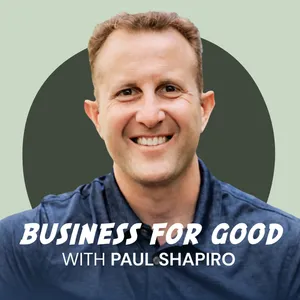
Free Daily Podcast Summary
Business for Good Podcast: Daily Summaries Delivered
by Paul Shapiro
Join host Paul Shapiro as he talks with some of the leading start-up entrepreneurs and titans of industry alike using their businesses to help solve the world's most pressing problems. Whether it's climate change, unsustainable agricultural practices, cyber threats, coral reef die-offs, nuclear waste storage, plastic pollution, or more, many of the world's greatest challenges are also exciting business opportunities. On this show, we feature business leaders who are marrying profit and purpose by inventing solutions to both build a better world and offer investors a bang for their bucks.
Latest Episodes
The most recent episodes — sign up to get AI-powered summaries of each one.
- 4 days ago34 min
Rebuilding the Ocean Floor with Clay Castles with Dr. Ulrike Pfreundt
Coral reefs cover less than one percent of the ocean floor but support roughly a quarter of all marine life. They are dying fast, and in many places, the physical structure of the reef itself has already crumbled away. Without that foundation, coral larvae have nowhere to land, and marine ecosystems cannot recover on their own. In this episode of Business For Good, Paul Shapiro talks with Dr. Ulrike Pfreundt, co-founder and CEO of rrreefs, about a new approach to ocean restoration. Instead of only growing coral in labs and transplanting it, rrreefs is 3D printing modular clay structures designed to replicate the hydrodynamics and habitat complexity of natural reef systems. These structures are anchored to the seafloor in degraded areas, and within months, coral larvae settle, invertebrate populations establish, and fish biomass increases by two to ten times compared to nearby unrestored areas. The conversation covers why previous artificial reef efforts using tires and concrete blocks failed, how clay performs in acidifying oceans compared to natural calcium carbonate reef rock, and why the company chose not to patent its core design. Dr. Ulrike explains how rrreefs generates revenue through corporate biodiversity partnerships, hotel contracts, and an emerging model she describes as a precursor to coral credits. She also discusses a community-based crowdfunding round launching in June 2026 that allows everyday investors to own a stake in the company, and why the long-term market may ultimately be driven by governments activating natural assets on their sovereign balance sheets to protect coastlines. Things You Will Learn: Why degraded coral reefs often cannot recover on their own, even when water quality improves, because the physical habitat structure is already gone. How 3D printed clay structures restore hydrodynamic conditions that allow coral larvae to settle and invertebrate communities to establish within months. Why clay outperforms natural reef rock in acidifying oceans, since calcium carbonate dissolves while clay does not. How rrreefs generates revenue through corporate biodiversity contracts, hotel partnerships, and an emerging coral credit model. Why rrreefs chose open-source principles for its reef design and is pursuing a social franchise model instead of traditional patent protection. Tools & Frameworks Covered: Hydrodynamic Habitat Design: An approach to artificial reef construction that prioritizes water flow patterns, cavity diversity, and larval settlement conditions rather than simply providing shade and structure for fish. Coral Credits <span class= "author-d-1gg9uz65z1iz85zgdz68zmqkz84zo2qowz80zsz81z9ytz75zz8
- 3 weeks ago53 min
Hannah Ritchie Has Some Uncomfortable Truths About Helping the Planet
What if the things you believe are best for the environment are actually making it worse? In this episode of Business For Good, Paul Shapiro sits down with Hannah Ritchie, data scientist at Our World in Data and author of Not the End of the World and Clearing the Air, to challenge some of the most widely held assumptions in sustainability. Hannah explains why locally produced food rarely has a meaningfully lower carbon footprint than imported alternatives, why organic farming often demands more land to produce the same amount of food, and why nuclear energy is one of the safest and most land-efficient power sources available. She walks through the data behind each of these claims and explains how well-intentioned environmental orthodoxies can actually slow progress toward the outcomes they aim to achieve. Things You Will Learn: Why buying local food does not significantly reduce your carbon footprint compared to choosing lower-impact foods from anywhere in the world. How the carbon footprint of keeping a dog compares to the average American's total annual emissions. Why nuclear energy has caused far fewer deaths per unit of electricity than fossil fuels over its entire history. Why cement production and air conditioning represent some of the most neglected opportunities for climate innovation. Tools & Frameworks Covered: Food Miles vs. Production Emissions: A data-driven framework showing that transportation accounts for roughly five percent of total food system emissions, while on-farm production and land use change dominate the footprint of most foods. Land Sparing vs. Land Sharing: Two competing approaches to balancing agricultural production with biodiversity conservation, where intensive farming on less land is weighed against lower-intensity farming spread across more land. Per-Unit Safety Comparison for Energy: A method of evaluating energy sources by calculating deaths per unit of electricity generated, which consistently shows nuclear and renewables are far safer than fossil fuels. #BusinessForGood <a class="dynamiclink" href= "https://w
- May 1, 202651 min
Why Jim Mellon Is Still All In on Alternative Protein After Five Years
Episode Summary: Five years ago, billionaire investor Jim Mellon came on Business For Good and laid out his thesis that cultivated meat and precision fermentation would transform the food system. Since then, venture capital has fled the space, plant-based stocks have cratered, and many startups have gone under. So why is Jim putting even more money in? In this episode, Paul Shapiro reconnects with Jim Mellon, Author of Moo's Law and Chairman of Agronomics, to find out what has changed and what hasn't. Jim reveals that his portfolio company, Clean Food Group, is producing precision fermentation-based palm oil, olive oil, and cocoa butter at a factory near Liverpool that is already sold out to buyers, including Mondelēz. He shares how media costs for cultivated meat have dropped from nearly $1,000 per liter to under three cents, and why he expects the company to go public later this year in what could be the first IPO of a precision fermentation company. The conversation also covers why the Middle East may become the next major hub for alternative protein infrastructure, how robotics could improve agricultural yields and reduce food waste, and what Jim plans to change in the updated edition of Moo's Law. He also explains why, despite personal wealth, no single investor can fund the scale of infrastructure this industry requires. Things You Will Learn: How precision fermentation-based oils are already reaching price parity with conventional palm oil, olive oil, and cocoa butter. Why cultivated meat media costs have dropped from roughly $1,000 per liter to under three cents in just a few years. Why the Middle East could become the next major hub for alternative protein manufacturing. What Jim Mellon plans to change in the updated edition of Moo's Law. How robotics and AI could reduce crop waste and improve agricultural yields globally. Tools & Frameworks Covered: Moo's Law: The idea that the cost of producing cultivated animal products will decline on a curve similar to Moore's Law in computing, driven by advances in media formulation, facility design, and scale. Precision Fermentation for Commodity Oils: Using microbial fermentation to produce bio-identical palm oil, cocoa butter, and olive oil at competitive prices with greater supply consistency and without deforestation. Infrastructure-First Scaling: Building dedicated production facilities and securing offtake agreements before going to market, reducing capital carry costs, and proving commercial viability to attract institutional investment. #BusinessForGood #FutureOfFood #AlternativeProtein #SustainableBusiness
- Apr 15, 202656 min
Investing in Biodiversity with Venture Capitalist Tom Quigley
Episode Summary: What if the next great venture opportunity isn't in AI or fintech but in protecting nature itself? In this episode of Business For Good, Paul Shapiro sits down with Tom Quigley, Co-founder of Superorganism, one of the first venture funds built entirely around biodiversity protection. With a freshly closed $26 million fund, Tom explains why over half of global GDP depends on healthy ecosystems, and why the degradation of those systems creates massive risk exposure for industries and supply chains worldwide. The conversation covers how biodiversity investing differs from climate tech, why cattle is among the most destructive forces for tropical ecosystems, and where venture-backed startups can intervene across areas like AI-powered wildlife monitoring, bird-safe glass, forest microbiome restoration, and silvopasture transitions. Things You Will Learn: Why over 55% of global GDP is moderately or heavily dependent on intact natural ecosystems. How biodiversity investing differs from climate tech and why it opens up categories like invasive species, bird-safe infrastructure, and soil restoration. Why cattle ranching is one of the most significant drivers of tropical biodiversity loss, hitting multiple vectors from deforestation to methane to runoff. How AI-powered camera systems are helping wind farm operators monitor and reduce bird strikes while defending against political opposition. Why bird-safe glass could prevent up to one to two billion bird deaths per year in the US alone, and what makes it an investable category. Tools & Frameworks Covered: Biodiversity Venture Thesis: A three-pillar investment framework targeting companies that disrupt industries driving biodiversity loss, operate at the overlap of climate and nature, or build enabling deep technologies for conservation. Dynamic Curtailment for Wind Farms: AI-powered camera systems that identify bird species near turbines and trigger slowdowns or shutdowns in real time to reduce strikes while maintaining energy output. Forest Microbiome Restoration: <span class= "author-d-1gg9uz65z1iz85zgdz68zmqkz84zo2qowz80zsz81z9ytz75zz83zc2kz79zwz71zz75znvz67zixvcz65zrz67zz73zz73zz85zdz87zz
- Apr 1, 202635 min
Using Wildlife Intelligence to Prevent Animal Collisions with Sára Nožková
Episode Summary: What if AI could help prevent bird strikes, train collisions, and livestock attacks by communicating with wild animals in ways they already understand? In this episode of Business For Good, Paul Shapiro speaks with Sára Nožková, CEO and Co-founder of Flox Intelligence, about building AI systems designed to detect wildlife and guide animals away from danger. Sára explains how her company combines machine learning, wildlife science, and real-world infrastructure applications to reduce human-wildlife conflict across airports, train tracks, roads, farms, and other critical areas. Rather than relying on blunt deterrents, Flox develops species-specific audio responses and adaptive systems that learn from animal behavior over time. Things You Will Learn: How Flox Intelligence uses AI vision, sensors, and species-specific audio to keep animals away from dangerous infrastructure. Why airports, rail systems, farms, and public agencies have economic incentives to reduce human-wildlife conflict. How wildlife communication research is shaping a new category of AI-powered biodiversity solutions. Why solving physical, measurable problems may be one of the strongest long-term applications of AI. How mission-driven founders can combine software, hardware, and science to build practical climate and conservation businesses. Tools & Frameworks Covered: Wildlife Intelligence: A practical AI category focused on detecting, interpreting, and influencing animal behavior to reduce conflict with human infrastructure. Adaptive Species-Specific Playlists: Tailored sound interventions matched to
- Mar 15, 202641 min
Turning Green Leaves Into High-Performing Protein with Ross Milne
Episode Summary: What if the most abundant protein on Earth has been hiding in plain sight inside green leaves? In this episode of Business For Good, Paul Shapiro sits down with Ross Milne, CEO of Leaft Foods, to explore how a new approach to food production could unlock massive amounts of high-quality protein directly from plants. Instead of feeding crops to animals or waiting for plants to produce seeds, Ross explains how his team isolates Rubisco, a highly digestible protein found in every green leaf, through mechanical fractionation processes that separate proteins, fiber, and carbohydrates. The conversation explores why Alfalfa is uniquely suited for this system, how Rubisco compares nutritionally to whey and egg proteins, and why leaf-based protein could become a fourth pillar of global protein production alongside meat, dairy, and seed proteins. Things You Will Learn: Why Rubisco is the most abundant protein on Earth, and why humans rarely consume it directly. How isolating protein from green leaves could dramatically increase food system efficiency. Why Alfalfa is a powerful crop for scalable protein production.</span
- Mar 1, 202650 min
Vasectomies, Family Planning, and Environmental Pressure with Dr. Douglas Stein (The Vasectomist)
Episode Summary: What if one of the highest-leverage climate and poverty interventions isn't a new technology, a policy mandate, or a venture-backed breakthrough, but simply making permanent contraception easier for men to choose? In this episode of Businesses For Good, host Paul Shapiro sits down with Dr. Douglas Stein, a Florida physician known as "The Vasectomist," who has performed 45,000+ vasectomies and taken his work internationally, including providing free procedures and (in some cases) small cash offsets for travel and missed wages. Their conversation moves beyond the clinic into systems: fertility rates, infrastructure strain, unintended pregnancies, cultural and religious resistance, and the practical barriers that keep men from sharing the family-planning burden. You'll also hear an honest debate about incentives, the limits of government policy, and the bigger question underneath it all: if we believe human ingenuity can solve hard problems, what would it look like to proactively reduce pressure on the planet through voluntary family planning? Things You Will Learn: Why vasectomy adoption is less about medicine and more about behavior, trust, and access. How Dr. Stein thinks about incentives, and why he frames them as cost offsets. What policy and infrastructure gaps keep family planning from scaling in lower-income regions, even when demand is high. Tools & Frameworks Covered: No-Scalpel Vasectomy Model:
- Feb 15, 202650 min
Feed the People Authors on Abundance, Food Policy, and Meat Demand
Episode Summary What if the global food system isn't "broken" in the way sustainability debates usually claim, and treating it that way leads to worse decisions? Paul Shapiro sits down with Jan Dutkiewicz and Gabriel Rosenberg, authors of Feed the People, to unpack how industrial scale and trade created unprecedented food abundance, why "eat local" and small-farm nostalgia collapses at 8 billion people, and what practical policy levers can improve outcomes without fantasy. They explore a clear framework, more food, less feed, no fuel, why animal agriculture remains an inefficient use of land and protein, and how public policy can reshape meat demand by changing incentives instead of accepting forecasts as fate. You'll leave with sharper systems thinking, grounded tradeoffs, and a clearer view of what scalable food system decarbonization can actually look like. Things You Will Learn How to evaluate food system claims using systems logic instead of slogans. Why meat demand rises, and how policy can bend the curve without moralizing. What "more food, less feed, no fuel" implies for land use, emissions, and investment priorities. Tools & Frameworks Covered More food, less feed, no fuel. Prioritizes crops for human food over animal feed and biofuels. Incentives over narratives. Shows how policy choices shape production, prices, and demand.
About Business for Good Podcast
Join host Paul Shapiro as he talks with some of the leading start-up entrepreneurs and titans of industry alike using their businesses to help solve the world's most pressing problems. Whether it's climate change, unsustainable agricultural practices, cyber threats, coral reef die-offs, nuclear waste storage, plastic pollution, or more, many of the world's greatest challenges are also exciting business opportunities. On this show, we feature business leaders who are marrying profit and purpose by inventing solutions to both build a better world and offer investors a bang for their bucks.
Customized Recaps
AI-powered recaps with compact key takeaways, quotes, and insights.
Straight to Your Inbox
Get key takeaways from Business for Good Podcast in a 5-minute read.
Save Hours Every Week
Stay current on your favorite podcasts without falling behind.
Frequently Asked Questions
What is Podzilla's Business for Good Podcast daily summary?
It's a free AI-powered email that summarizes new episodes of Business for Good Podcast as soon as they're published. You get the key takeaways, notable quotes, and links & mentions — all in a quick read.
How does the Business for Good Podcast podcast summary work?
When a new episode drops, our AI transcribes and analyzes it, then generates a personalized summary tailored to your interests and profession. It's delivered to your inbox every morning.
Is this an official Business for Good Podcast product?
No. Podzilla is an independent service that summarizes publicly available podcast content. We're not affiliated with or endorsed by Paul Shapiro.
Can I get summaries of other podcasts too?
Absolutely! The free plan covers up to 3 podcasts. Upgrade to Pro for 15, or Premium for 50. Browse our full catalog at /podcasts.
How often does Business for Good Podcast release new episodes?
Business for Good Podcast publishes biweekly. Our AI generates a summary within hours of each new episode.
What topics does Business for Good Podcast cover?
Business for Good Podcast covers topics including Education, Business. Our AI identifies the specific themes in each episode and highlights what matters most to you.
Start getting Business for Good Podcast summaries tomorrow morning.
Free forever for up to 3 podcasts. No credit card required.
Free forever for up to 3 podcasts. No credit card required.