Free Daily Podcast Summary
C-Suite Perspectives: Daily Summaries Delivered
by The Conference Board
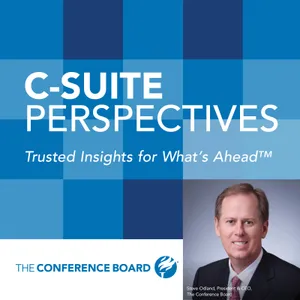
Welcome to C-Suite Perspectives, a podcast series by The Conference Board. Hosted by our President & CEO, Steve Odland, this weekly conversation will take an objective, data-driven look at a range of business topics aimed at executives. Listeners will come away with what The Conference Board does best: insights for what's ahead™.
Latest Episodes
The most recent episodes — sign up to get AI-powered summaries of each one.
- Today27 min
How NetApp CEO George Kurian Turns Disruption into Opportunity
An established company can be profitable and still lose its place in the future. Avoiding that fate requires treating disruption as an opportunity, preserving what remains valuable, and renewing the organization for the next era. In this episode of C-Suite Perspectives, David Young, President of The CEO Center at The Conference Board, speaks with George Kurian, CEO of NetApp and a recipient of the 2026 Distinguished Leadership Award, about leading an established technology company through the rise of cloud computing into AI. Together, they discuss how customer empathy informs strategy, why CEOs must be willing to say no, and how authenticity can help employees understand difficult decisions. They also explore NetApp's response to cloud computing and AI, the importance of cyber resilience and responsible risk-taking, and why business leaders should view themselves as stewards responsible for building institutions that will endure beyond their own tenure. This episode is part of the Leadership in Challenging Times series from The CEO Center at The Conference Board. The series features discussions with the business leaders who are recipients of the Distinguished Leadership Awards.
- 3 days ago25 min
Why the Best CEOs Act as Catalysts, Not Commanders
No CEO can personally master every technological, geopolitical, and economic challenge confronting a modern organization. The leadership advantage now comes from building a system that draws on the knowledge of the entire team—and enables the business to keep transforming without depending on one person for every answer. In this episode of C-Suite Perspectives, Steve Odland, President and CEO of The Conference Board, speaks with Constantine Alexandrakis, CEO of Russell Reynolds Associates and author of The Catalyst CEO, about why the traditional command-and-control model is no longer enough. Together, they explore why effective CEOs lead from the center of the organization rather than the top; how empowerment differs from abdication; and why humility, adaptability, resilience, and self-awareness are becoming essential leadership capabilities. They also discuss the board's role in transformation, how AI is changing jobs and workflows, and why CEOs must build cultures and leadership systems capable of continuous change. More from The Conference Board: · What Does It Really Take to Succeed in the C-Suite? · A Framework for Agentic AI and Work Redesign · Transforming Organizations for AI: Critical Factors for AI Success · Shedding Light on Culture: A Framework for Board Insights
- 6 days ago27 min
Salary Budgets Are Flat—But Jobs and Skills Are Changing Fast
US salary increase budgets are projected to remain at 3.5% in 2027, unchanged from 2026. But stability in the headline number does not mean the workforce—or the way companies allocate compensation—is standing still. In this episode of C-Suite Perspectives, Steve Odland, President and CEO of The Conference Board, speaks with Diana Scott, US Human Capital Center Leader at The Conference Board, about findings from the 41st annual US Salary Increase Budgets 2026–2027 study and what they mean for business and human capital leaders. Together, they discuss why the average merit budget of 3.1% should reward performance rather than compensate for inflation; how companies can target limited pay dollars toward promotions, critical skills, retention, and equity; and why AI capabilities should be rewarded only when they create measurable business value. They also explore how automation is changing the mix of work even when overall headcount remains stable, the expanding role of CHROs in workforce transformation, and why transparency and a broader total rewards story are essential to maintaining employee trust. More from The Conference Board: · US Salary Increase Budgets 2026–2027 · The Evolving Role of the CHRO in the Boardroom · A Framework for Agentic AI and Work Redesign · Skilling for AI: Critical Factors for Navigating AI Disruption
- 1 weeks ago20 min
How Better Boards Navigate Disruption and Transformation
Strategic errors rarely begin as obviously bad decisions but emerge when a strategy outlives the assumptions on which it was built—and leaders fail to recognize that disruptions or transformations have changed the game. In this episode of C-Suite Perspectives, Sara Murray, Managing Director, International at The Conference Board, speaks with Vincent Giolito, Professor of Strategy and Organization at emlyon business school and Senior Fellow at The Conference Board, about how boards can identify strategic errors before they threaten the future of the company. They discuss why boards must continually test strategic assumptions, recognize weak signals, and understand transformation as an ongoing process rather than a single event. They also explore the competencies boards need beyond financial expertise, why directors require "progressive lenses" that let them examine both operational details and the wider business landscape, and how ruthless empathy can help boards support CEOs while still challenging them when necessary. More from The Conference Board: Board <span cl
- 1 weeks ago22 min
State of the Economy for September 2026: Consumer Confidence Takes a Tumble
US Consumer Confidence fell to 81.9 in September, marking a third consecutive monthly decline. In this episode of C-Suite Perspectives, The Conference Board's Eric Lundh and Allen Li examine what is driving greater consumer caution — from financial well-being and inflation concerns to signs of softer discretionary spending. They also discuss The Conference Board's latest global economic forecast: how energy disruptions and trade uncertainty are weighing on growth; how AI investment and semiconductor demand are supporting parts of the global economy; and what to expect in the US, Asia, the Gulf region, and Europe through 2027.
- 1 weeks ago30 min
Leading for the Next Generation: Graybar CEO Kathy Mazzarella
- 2 weeks ago32 min
Why Empathy Is a CEO's Strategic Advantage: Terumo CEO Antoinette Gawin
Leading a global organization does not mean making every decision yourself. It means creating enough strategic clarity for people to act, understanding the context behind difficult choices, and knowing when to step in—or step back. In this episode of C-Suite Perspectives, David Young, President of The CEO Center at The Conference Board, is joined by Antoinette Gawin, President and CEO of Terumo Blood and Cell Technologies and a recipient of a 2026 Distinguished Leadership Award, to explore the experiences that shaped her leadership and how she empowers people to act across a complex global organization. Together, they discuss why leaders have an obligation to speak when invited to the table, how strategic alignment can give teams greater operational autonomy, and why empathy is an underrated leadership attribute. They also examine the potential of blood and cell therapies, the role of AI and data in accelerating medical discovery, the need to expand access to innovation, the fragility of the global blood supply, and how regulation can protect patients without unnecessarily slowing progress. This episode is part of the Leadership in Challenging Times series from The CEO Center at The Conference Board. The series features discussions with the business leaders who are recipients of the Distinguished Leadership Awards.
- 2 weeks ago28 min
Why AI Alone Won't Fix Health Care Staffing: Covista CEO Steve Beard
The US has no shortage of people who want careers in health care—or employers eager to hire them. Yet tens of thousands of qualified nursing and medical-school applicants are turned away each year, revealing a constrained pipeline with too few classroom seats, faculty members, and clinical placements to train the workforce the country needs. In this episode of C-Suite Perspectives, David Young, President of The CEO Center at The Conference Board, is joined by Steve Beard, Chairman and CEO of Covista, to examine why the health care workforce shortage begins long before employers try to fill open positions—and what it will take to build a larger, stronger, and more sustainable talent pipeline. Together, they discuss how educational institutions can expand access without sacrificing quality; how employer-educator partnerships can connect tuition assistance, clinical training, and employment; and why reducing administrative burdens is essential to retaining clinicians. They also explore how AI can personalize health care education and give clinicians more time with patients, the policy changes needed to increase training capacity and remove barriers to practice, and the leadership required to drive continuous change at scale.
Get C-Suite Perspectives summaries in your inbox
Free AI-powered daily recaps. Key takeaways, quotes, and mentions — in a 5-minute read.
Get Free Summaries →Free forever for up to 3 podcasts. No credit card required.
You Might Also Like
Listeners also like.
Leading By Example: Executives Making An Impact
Executives share pivotal moments and personal experiences that shaped their leadership and decision-making in real-world business environments.
HBR IdeaCast
Features leading thinkers in business and management discussing key ideas and trends.

The Diary Of A CEO with Steven Bartlett
Raw, unfiltered conversations with influential figures and experts exploring personal growth, mindset, and the realities of success.
Leaders with Francine Lacqua
Francine Lacqua interviews CEOs and industry leaders about leadership, success, and navigating change in global business.
The AI in Business Podcast
Interviews with AI executives reveal practical applications and strategic insights for business leaders adopting AI.
Human Capital Leadership
Explores leadership, HR, talent management, and organizational development through global expert interviews and research.

Intelligence Squared: Business
Discusses the future of capitalism and major economic trends with business leaders, authors, and economists.

Becker’s Healthcare Podcast
Daily 15-minute episodes covering U.S. healthcare news, analysis, and insights from industry leaders.
Unbossing
Conversations with business and tech leaders about redefining leadership by unlearning outdated rules in times of change.

The Cast Nexa Show
Explores how AI, creativity, and digital storytelling are reshaping business, communication, and content in the modern era.

Digital HR Leaders with David Green
Senior HR leaders discuss how to drive data-driven and digital transformation in human resources to prepare for the future of work.
"The Cognitive Revolution"
Explores the transformative impact of artificial intelligence through interviews with innovators shaping its future.
About C-Suite Perspectives
Welcome to C-Suite Perspectives, a podcast series by The Conference Board. Hosted by our President & CEO, Steve Odland, this weekly conversation will take an objective, data-driven look at a range of business topics aimed at executives. Listeners will come away with what The Conference Board does best: insights for what's ahead™.
Customized Recaps
AI-powered recaps with compact key takeaways, quotes, and insights.
Straight to Your Inbox
Get key takeaways from C-Suite Perspectives in a 5-minute read.
Save Hours Every Week
Stay current on your favorite podcasts without falling behind.
Frequently Asked Questions
What is Podzilla's C-Suite Perspectives daily summary?
It's a free AI-powered email that summarizes new episodes of C-Suite Perspectives as soon as they're published. You get the key takeaways, notable quotes, and links & mentions — all in a quick read.
How does the C-Suite Perspectives podcast summary work?
When a new episode drops, our AI transcribes and analyzes it, then generates a personalized summary tailored to your interests and profession. It's delivered to your inbox every morning.
Is this an official C-Suite Perspectives product?
No. Podzilla is an independent service that summarizes publicly available podcast content. We're not affiliated with or endorsed by The Conference Board.
Can I get summaries of other podcasts too?
Absolutely! The free plan covers up to 3 podcasts. Upgrade to Pro for 15, or Premium for 50. Browse our full catalog at /podcasts.
How often does C-Suite Perspectives release new episodes?
C-Suite Perspectives publishes every few days. Our AI generates a summary within hours of each new episode.
What topics does C-Suite Perspectives cover?
C-Suite Perspectives covers topics including News, Business, Non-Profit. Our AI identifies the specific themes in each episode and highlights what matters most to you.
Start getting C-Suite Perspectives summaries tomorrow morning.
Free forever for up to 3 podcasts. No credit card required.
Free forever for up to 3 podcasts. No credit card required.