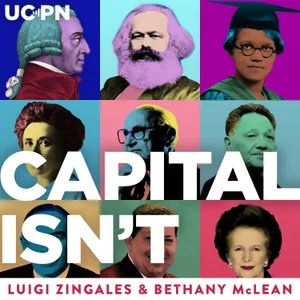
Free Daily Podcast Summary
Capitalisn't: Daily Summaries Delivered
by University of Chicago Podcast Network
We investigate how capitalism is—or more often isn’t—working in our world today. Hosted by economist Luigi Zingales and business journalist Bethany McLean, our podcast explains why capitalism can go wrong and what we can do to fix it.
Latest Episodes
The most recent episodes — sign up to get AI-powered summaries of each one.
- 1 weeks ago47 min
The Workplace Is a Dictatorship? - ft. Elizabeth Anderson
At the center of our market economy sits an institution that runs more like a dictatorship. The firm you work for writes the rules and enforces them. There is no vote, no appeal, and no constitution. The only real remedy is to leave.University of Michigan philosopher Elizabeth Anderson, author of "Private Government" and "Hijacked: How Neoliberalism Turned the Work Ethic Against Workers," argues we spent centuries building limits on rulers who held this much power over people's daily lives, and built almost nothing for the place where most of that life is actually spent. "Hijacked: How Neoliberalism Turned the Work Ethic Against Workers and How Workers Can Take It Back": https://www.cambridge.org/core/books/hijacked/E7E4A7D850C1E7289BA7AAF910455136"Private Government: How Employers Rule Our Lives": https://press.princeton.edu/books/hardcover/9780691176512/private-government?srsltid=AU7gw4XkqB24hl23B55i5Stpj4twB-lI8JX8SWqtj09h0AO22q1dBlGl Connect with us:📺 Subscribe to our YouTube Channel📱 Follow Capitalisn’t on Instagram & TikTok✉️ Email your questions and comments to capitalisntpod@gmail.com Hosted by Simplecast, an AdsWizz company. See pcm.adswizz.com for information about our collection and use of personal data for advertising.
- 2 weeks ago52 min
Why Congress Protects Car Dealers More Than Elon Musk - ft. Eric Zwick
For every member of the Forbes 400, there are more than 4,000 private business owners worth at least $10 million. You probably have never heard of any of them.They own the beer distributorship in your town, the dental group with four offices, the HVAC trucks that passed your house this morning. A decade inside anonymized IRS data turned up three million of them, and the version of that story running in many outlets this month is the hopeful one: fortunes still being built in unglamorous industries, far from the coasts, by people with no degree and no connections. The American Dream, alive and hiding in plain sight.That is one part of what the data says. The other part is that the largest fortunes are concentrated where the law limits who can compete at all, and the owners have the political weight to keep it there. Whether the first part redeems the second is the entire argument here. The economist who found the numbers doesn’t know for sure whether it’s a good or worrying story.Eric Zwick is the Joel F. Gemunder Professor of Economics and Finance at the University of Chicago Booth School of Business and co-author, with Owen Zidar of Princeton University, of “The Everywhere Millionaire: Who Is Really Rich in America and How They Got There”: https://us.macmillan.com/books/9781250378507/theeverywheremillionaire/ Connect with us:📺 Subscribe to our YouTube Channel📱 Follow Capitalisn’t on Instagram & TikTok✉️ Email your questions and comments to capitalisntpod@gmail.com Hosted by Simplecast, an AdsWizz company. See pcm.adswizz.com for information about our collection and use of personal data for advertising.
- 3 weeks ago57 min
Can Capitalism Serve the Common Good? - ft. Mariana Mazzucato
The drugs in your medicine cabinet were probably discovered on your dime, in a university lab, with NIH money. You don't hold the patent. You don't set the price. Same story with the touchscreen, the GPS and the voice assistant in your pocket.The public often helps fund breakthroughs, while private companies claim all the profits. Economist Mariana Mazzucato thinks it’s time to renegotiate. In “The Common Good Economy: A New Compass”, she makes the case for reshaping markets around the common good. Luigi Zingales and Bethany McLean press the uncomfortable question: can a government captured by business really be trusted to change the rules?You can find “The Common Good Economy: A New Compass” here: https://marianamazzucato.com/books/the-common-good-economy/the-common-good-economy-us/ Mariana Mazzucato is a Professor at University College London, Founding Director of the UCL Institute for Innovation and Public Purpose and author of “The Common Good Economy: A New Compass”.Connect with us:📺 Subscribe to our YouTube Channel📱 Follow Capitalisn’t on Instagram & TikTok✉️ Email your questions and comments to capitalisntpod@gmail.com Hosted by Simplecast, an AdsWizz company. See pcm.adswizz.com for information about our collection and use of personal data for advertising.
- Aug 27, 20261h 0m
The One Thing That Could Decide If AI Takes Your Job - Ft. Luis Garicano
AI is coming for your job; AI isn't coming for your job. Economist Luis Garicano thinks both camps are asking the wrong question. In Messy Jobs: The Work That AI Cannot Reach, Garicano and co-authors Jin Li and Yanhui Wu argue that all knowledge work varies along a dimension of “messiness”, and that the jobs which survive won't be the ones that are hardest, but the messiest. Bethany McLean and Luigi Zingales press Garicano on where that framework holds and where it breaks. Connect with us: 📺 Subscribe to our YouTube Channel 📱 Follow Capitalisn’t on Instagram & TikTok ✉️ Email your questions and comments to capitalisntpod@gmail.com Hosted by Simplecast, an AdsWizz company. See pcm.adswizz.com for information about our collection and use of personal data for advertising.
- Aug 13, 202653 min
Can Liberalism Survive This Kind of Capitalism? - ft. Daron Acemoglu
For most of the last century liberal democracies offered a simple deal: the economy grows and, if you work hard, you get a fair shot at the rewards. According to 2024 Nobel Prize-winning economist Daron Acemoglu, that deal is broken. Acemoglu joins Bethany McLean and Luigi Zingales to discuss his new book, What Happened to Liberal Democracy?, and why the system that delivered unprecedented freedom and prosperity abandoned the working class in favor of the college-educated elite. Acemoglu makes the case that things will only get worse as AI is being designed to replace human labor, driving wage stagnation and economic anxiety. But he thinks we can still turn things around, and he brought his solutions to our podcast. Connect with us: 📺 Subscribe to our YouTube Channel 📱 Follow Capitalisn’t on Instagram & TikTok ✉️ Email your questions and comments to capitalisntpod@gmail.com Hosted by Simplecast, an AdsWizz company. See pcm.adswizz.com for information about our collection and use of personal data for advertising.
- Aug 6, 202648 min
How Washington Privatized The Capital Market - ft. Renée Jones
Amazon went public three years after it was founded. SpaceX stayed private for 24 years. What changed and why does it matter? The standard story is that companies avoid an IPO because public markets carry too many government rules and too many lawyers looking to sue. Renee Jones, law professor, former SEC official, and author of the new book Untamed Unicorns: Why Startup Finance Is Broken and How to Fix It, makes the opposite case. Jones argues what changed was the deregulation of private markets, driven by decades of industry lobbying. Due to decisions in Washington, companies became able to raise billions privately and there was no reason to go public . You could get the capital and keep total control, without ever having to disclose anything to regulators. If you've never bought a share of a startup, you might assume none of this touches you. But most of the money flowing into these private markets comes from pension funds and retirement accounts, meaning ordinary savers are already invested in companies whose books they'll never see. Connect with us: 📺 Subscribe to our YouTube Channel 📱 Follow Capitalisn’t on Instagram & TikTok ✉️ Email your questions and comments to capitalisntpod@gmail.com Hosted by Simplecast, an AdsWizz company. See pcm.adswizz.com for information about our collection and use of personal data for advertising.
- Jul 30, 202646 min
A Conservative's Attack On Neoliberalism - Ft. Chris Griswold
The Republican Party is often associated with free-market fundamentalism, deregulation, and tax cuts. But a new faction on the right is challenging that consensus. In this episode, Bethany and Luigi sit down with Chris Griswold, the Policy Director at American Compass. Drawing on Catholic social teaching, Griswold argues that we need to stop viewing our economy as a force of nature or an end unto itself, but a tool meant to serve human flourishing and dignity. The conversation explores if the traditional neoliberal regime has failed working-class Americans, and whether policy should step in to channel capital toward productive uses. To fix our current system, Griswold argues we need to go back to a first-principles question: What is capitalism, or any economy for that matter, actually for? Connect with us: 📺 Subscribe to our YouTube Channel 📱 Follow Capitalisn’t on Instagram & TikTok ✉️ Email your questions and comments to capitalisntpod@gmail.com Hosted by Simplecast, an AdsWizz company. See pcm.adswizz.com for information about our collection and use of personal data for advertising.
- Jul 16, 202650 min
Was The Constitution An Anti-Democratic Coup? - ft. Michael Klarman
Were the foundations of American governance engineered to protect the wealthy? Harvard Law professor Michael Klarman argues that the US Constitution was actually a counter-revolutionary coup to constrain democracy rather than protect it. This episode explores how debt, taxes, and money influenced the drafting of America's founding document. And whether a wealthy elite bypassed democratic institutions to secure their own financial interests and reduce populist power. Connect with us: 📺 Subscribe to our YouTube Channel 📱 Follow Capitalisn’t on Instagram & TikTok ✉️ Email your questions and comments to capitalisntpod@gmail.com Hosted by Simplecast, an AdsWizz company. See pcm.adswizz.com for information about our collection and use of personal data for advertising.
Get Capitalisn't summaries in your inbox
Free AI-powered daily recaps. Key takeaways, quotes, and mentions — in a 5-minute read.
Get Free Summaries →Free forever for up to 3 podcasts. No credit card required.
You Might Also Like
Listeners also like.
Capital Record
David Bahnsen discusses free markets and capitalism with business leaders and economists.

Wall Street Week
Wall Street Week explores global capitalism stories, hosted by David Westin in New York.
Everybody's Business
A weekly look at business news from Wall Street to unusual ventures, with insights from Bloomberg Businessweek journalists.

The Prof G Pod with Scott Galloway
A no-holds-barred take on business, tech, culture, and life from a professor, author, and entrepreneur.
Optimist Economy
Economists analyze U.S. economic challenges like housing, healthcare, and retirement, pairing data and history with practical solutions.

Intelligence Squared: Business
Discusses the future of capitalism and major economic trends with business leaders, authors, and economists.

InvestTalk
Daily stock market and investment advice covering portfolios, retirement, inflation, and economic trends through listener-driven analysis.
Not Another Politics Podcast
Political scientists analyze major political issues using data, theory, and research to explain the forces shaping American politics.

The Ezra Klein Show
Conversations on pressing political, social, and cultural issues with experts and thinkers.

Prof G Markets
Daily market news and analysis on earnings, geopolitics, Big Tech, and AI with clear, no-jargon insights.

Afford Anything | Get Smarter With Money
A weekly discussion on financial freedom covering psychology, income, investing, real estate, and entrepreneurship with experts.

Intelligence Squared
Live debates and in-depth discussions on pressing global issues featuring leading experts and thinkers.
About Capitalisn't
We investigate how capitalism is—or more often isn’t—working in our world today. Hosted by economist Luigi Zingales and business journalist Bethany McLean, our podcast explains why capitalism can go wrong and what we can do to fix it.
Customized Recaps
AI-powered recaps with compact key takeaways, quotes, and insights.
Straight to Your Inbox
Get key takeaways from Capitalisn't in a 5-minute read.
Save Hours Every Week
Stay current on your favorite podcasts without falling behind.
Frequently Asked Questions
What is Podzilla's Capitalisn't daily summary?
It's a free AI-powered email that summarizes new episodes of Capitalisn't as soon as they're published. You get the key takeaways, notable quotes, and links & mentions — all in a quick read.
How does the Capitalisn't podcast summary work?
When a new episode drops, our AI transcribes and analyzes it, then generates a personalized summary tailored to your interests and profession. It's delivered to your inbox every morning.
Is this an official Capitalisn't product?
No. Podzilla is an independent service that summarizes publicly available podcast content. We're not affiliated with or endorsed by University of Chicago Podcast Network.
Can I get summaries of other podcasts too?
Absolutely! The free plan covers up to 3 podcasts. Upgrade to Pro for 15, or Premium for 50. Browse our full catalog at /podcasts.
How often does Capitalisn't release new episodes?
Capitalisn't publishes biweekly. Our AI generates a summary within hours of each new episode.
What topics does Capitalisn't cover?
Capitalisn't covers topics including News, Business, Government. Our AI identifies the specific themes in each episode and highlights what matters most to you.
Start getting Capitalisn't summaries tomorrow morning.
Free forever for up to 3 podcasts. No credit card required.
Free forever for up to 3 podcasts. No credit card required.