Free Daily Podcast Summary
Climate Rising: Daily Summaries Delivered
by Harvard Business School Business & Environment Initiative
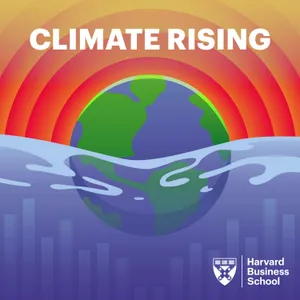
Climate Rising is about the impact of climate change on business. It brings business and policy leaders and Harvard Business School faculty together to share insights about what businesses are doing, can do, and should do to confront climate change. It explores the many challenges and opportunities that climate change raises for managers, such as decisions about where they choose to locate, the technologies they develop and use, their strategies with respect to products, marketing, customer engagement, and policy—in other words, the full spectrum of business concerns.
Latest Episodes
The most recent episodes — sign up to get AI-powered summaries of each one.
- 5 days ago1h 9m
Powering AI and the Energy Transition: Why Permitting Reform Matters
Permitting reform has become one of the most consequential—and controversial—topics in U.S. climate and energy policy. As electricity demand rises due to AI, data centers, electrification, and economic growth, many argue that the country’s permitting, transmission, and interconnection processes are too slow to support the clean energy transition. In this special crossover episode jointly produced by the Climate Rising and CleanLaw podcasts, Mike Toffel and Harvard Law School Professor Jody Freeman speak with Nat Keohane, President of the Center for Climate and Energy Solutions (C2ES). They discuss why permitting reform has emerged as a rare area of bipartisan interest, the challenges of modernizing America’s electric grid, and the tradeoffs between accelerating infrastructure development and maintaining environmental safeguards. The conversation examines how permitting, transmission planning, utility incentives, AI-driven electricity demand, and federal-state governance intersect—and why solving these challenges may be essential to both climate progress and American competitiveness.
- 2 weeks ago40 min
Amazon’s Climate Pledge Friendly Program: Can Sustainability Labels Change How Consumers Shop?
How can companies make sustainability information useful to consumers at the moment they make a purchase? Justine Mahler and Cameron Westfall of Amazon join Climate Rising to discuss Climate Pledge Friendly, Amazon’s sustainable shopping program. They explain how Amazon uses third-party certifications to identify products with sustainability attributes, how the company evaluates which certifications qualify, and how it translates complex standards into information consumers can quickly understand. The conversation also explores what Amazon has learned about consumer behavior since launching the program in 2020. Cameron shares research showing a sales lift for products after joining Climate Pledge Friendly, while Justine explains why the environmental impacts that matter most differ across product categories. They also discuss how customer feedback, experimentation, and evolving sustainability science continue to shape the program.
- Sep 2, 202623 min
How Companies Tell Climate Stories: Lessons from New Belgium, Allbirds, and Microsoft
Climate action requires more than technology, policy, and capital. It also requires communication. In this special curated episode of Climate Rising, we revisit three past conversations to explore how companies communicate about climate change to different audiences. The episode features excerpts from Mike Toffel’s conversations with leaders of New Belgium Brewing, Allbirds, and Microsoft that illustrate distinct approaches to climate storytelling. New Belgium used products and campaigns to engage consumers directly. Allbirds embedded sustainability into product design and customer experience. Microsoft focused internally, translating climate ambition into governance structures and decision-making processes. Taken together, these leaders highlight how climate communication can influence customers, employees, policymakers, and business leaders—and why storytelling remains an essential part of accelerating climate action.
- Aug 19, 202629 min
Carbon Trust: How Carbon Labeling Shapes Climate Communication and Consumer Choice
Carbon labeling has become one of the most visible ways climate actions enter everyday consumer decisions. In this episode of Climate Rising, Julia Nicoara, Marketing and Communications Director at the Carbon Trust, explains how carbon labeling systems, certification standards, and corporate partnerships are helping organizations measure, reduce, and communicate their climate impact. The conversation explores how carbon labels evolved from early experimental initiatives into widely adopted transparency tools, how companies balance credibility and communication in sustainability claims, and how regulation is shaping the future of green marketing
- Aug 5, 202646 min
Potential Energy Coalition: Why Climate Messaging Fails - and How to Fix It
Addressing climate change isn’t just a technology or policy challenge - it’s a communication challenge. John Marshall, founder of Potential Energy Coalition, joins Climate Rising to discuss how marketing techniques can accelerate climate action. Drawing on decades of experience advising major corporations, John explains how his team uses behavioral science, focus groups, large-scale experimentation, and data-driven messaging to shift public perception on climate and energy. The conversation explores why traditional climate messaging often fails, how concepts like “net zero” and “climate crisis” can backfire, and why trust, identity, and local relevance matter more than abstract global narratives. John also discusses the role of AI in reshaping marketing and the risks and opportunities it presents for climate communication
- Jul 22, 202645 min
Good Power: How Climate Communication Can Accelerate the Energy Transition
Transforming the energy system isn’t just a technical challenge - it’s a communication challenge. Leah Qusba, CEO of Good Power, joins Climate Rising to discuss how public perception, political engagement, and storytelling are shaping the pace of the clean energy transition. Good Power operates at the intersection of behavioral science, data, and campaigning, working to accelerate renewable energy adoption and counter misinformation. The conversation explores how permitting bottlenecks, disinformation campaigns, and community resistance are slowing renewable energy deployment—and how targeted communication strategies can overcome these barriers. Leah also discusses the role of peer-to-peer storytelling, the importance of trusted messengers, and how digital media ecosystems influence climate outcomes. The episode also examines Good Power’s expansion into regenerative agriculture, the role of demand creation in scaling sustainable food systems, and how emerging technologies like AI are reshaping climate communication.
- Jul 8, 202646 min
McKinsey on Climate Adaptation: The Global Resilience Gap
Climate adaptation is emerging as one of the most critical—and least understood—challenges in the climate transition. Mekala Krishnan, Partner at the McKinsey Global Institute, joins Climate Rising to discuss McKinsey’s new research assessing adaptation needs, costs, and gaps around the world. The conversation explores why the world is already underinvesting in resilience, and how climate risks are distributed unevenly across geographies and income levels. Mekala explains the concept of the “resiliency gap,” highlighting that billions of people remain under-protected despite the existence of cost-effective solutions. The episode also examines how climate risks will evolve in the coming decades, why adaptation spending needs could rise to over $1 trillion annually, and what barriers—beyond finance—are preventing action. The discussion concludes with insights into how businesses, governments, and financial institutions are beginning to respond, and what it will take to scale adaptation globally.
- Jun 24, 202639 min
Rain: Using Autonomous Aircraft to Stop Wildfires Before They Start
Wildfires are becoming larger, more destructive, and more expensive every year. But what if the most effective intervention happens not after a fire grows, but within the first few minutes after ignition? Max Brodie, co-founder and CEO of Rain, joins Climate Rising to discuss how autonomous aircraft could transform wildfire response. Rain is developing AI-powered wildfire suppression systems that upgrade helicopters with autonomous capabilities, enabling faster response times and more effective intervention during the critical first minutes of a fire. The conversation explores the economics of wildfire prevention, the role of autonomy in aerial firefighting, the challenges of balancing suppression with ecological fire management, and the growing relationship between wildfire risk and climate change. Max also discusses the broader implications of autonomy, public-private partnerships, and how emerging technologies can accelerate climate adaptation and mitigation.
Get Climate Rising summaries in your inbox
Free AI-powered daily recaps. Key takeaways, quotes, and mentions — in a 5-minute read.
Get Free Summaries →Free forever for up to 3 podcasts. No credit card required.
You Might Also Like
Listeners also like.

Intelligence Squared: Business
Discusses the future of capitalism and major economic trends with business leaders, authors, and economists.
A Matter of Degrees
Two climate experts explore the systems driving climate change and spotlight solutions through stories of leadership and activism.
HBR On Strategy
A weekly curation of case studies and expert discussions on business strategy and innovation from Harvard Business Review.

Energy Gang
A podcast that breaks down clean energy technology, policy, and market trends shaping the global energy transition.

HBR IdeaCast
Features leading thinkers in business and management discussing key ideas and trends.
Power: Limits and Prospects for Human Survival
Explores how humanity's pursuit and misuse of power drives ecological and social crises, and why rethinking power is key to survival.
A Podcast About Leadership
Examines modern leadership through interviews with experts in business, psychology, and human performance.
Change Cycle
Examines how businesses can implement circular economy practices to reduce waste and drive sustainable change.

Harvard Business Review
Explores management ideas and leadership strategies to improve organizational effectiveness and workplace productivity.
Everybody's Business
A weekly look at business news from Wall Street to unusual ventures, with insights from Bloomberg Businessweek journalists.

James Reed: all about business
Candid conversations with business leaders and philanthropists sharing actionable insights on leadership and strategy.
Smart Talks with IBM
Conversations with leaders leveraging AI, quantum computing, and emerging technologies to transform global businesses.
About Climate Rising
Climate Rising is about the impact of climate change on business. It brings business and policy leaders and Harvard Business School faculty together to share insights about what businesses are doing, can do, and should do to confront climate change. It explores the many challenges and opportunities that climate change raises for managers, such as decisions about where they choose to locate, the technologies they develop and use, their strategies with respect to products, marketing, customer engagement, and policy—in other words, the full spectrum of business concerns.
Customized Recaps
AI-powered recaps with compact key takeaways, quotes, and insights.
Straight to Your Inbox
Get key takeaways from Climate Rising in a 5-minute read.
Save Hours Every Week
Stay current on your favorite podcasts without falling behind.
Frequently Asked Questions
What is Podzilla's Climate Rising daily summary?
It's a free AI-powered email that summarizes new episodes of Climate Rising as soon as they're published. You get the key takeaways, notable quotes, and links & mentions — all in a quick read.
How does the Climate Rising podcast summary work?
When a new episode drops, our AI transcribes and analyzes it, then generates a personalized summary tailored to your interests and profession. It's delivered to your inbox every morning.
Is this an official Climate Rising product?
No. Podzilla is an independent service that summarizes publicly available podcast content. We're not affiliated with or endorsed by Harvard Business School Business & Environment Initiative.
Can I get summaries of other podcasts too?
Absolutely! The free plan covers up to 3 podcasts. Upgrade to Pro for 15, or Premium for 50. Browse our full catalog at /podcasts.
How often does Climate Rising release new episodes?
Climate Rising publishes biweekly. Our AI generates a summary within hours of each new episode.
What topics does Climate Rising cover?
Climate Rising covers topics including Science, Business, Management, Natural Sciences. Our AI identifies the specific themes in each episode and highlights what matters most to you.
Start getting Climate Rising summaries tomorrow morning.
Free forever for up to 3 podcasts. No credit card required.
Free forever for up to 3 podcasts. No credit card required.