Free Daily Podcast Summary
Composers Datebook: Daily Summaries Delivered
by American Public Media
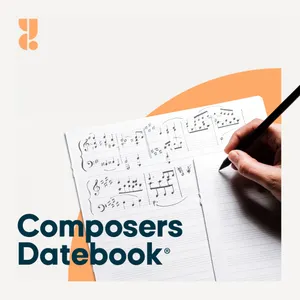
Composers Datebook™ is a daily two-minute program designed to inform, engage, and entertain listeners with timely information about composers of the past and present. Each program notes significant or intriguing musical events involving composers of the past and present, with appropriate and accessible music related to each.
Latest Episodes
The most recent episodes — sign up to get AI-powered summaries of each one.
- Today2 min
Music for the movies
SynopsisOn today’s date in 1927, the landmark film The Jazz Singer received its premiere showing at the Warner Theater in New York. The Jazz Singer starred Al Jolson and is usually credited with being the first “talkie” — the first motion picture to successfully incorporate prerecorded music and spoken dialogue. Both the music and dialogue were recorded using the Vitaphone process, essentially a set of disc recordings synchronized for playback with the film’s projector.The previous year, the New York Philharmonic had participated in the first Vitaphone projects, recording Wagner’s Tannhauser Overture as the first music video and performing the soundtrack for the otherwise silent drama Don Juan, starring John Barrymore.Within a decade, Hollywood orchestras would be recording the classic film scores of European émigré composers like Erich Wolfgang Korngold and Max Steiner, and within two decades American composers like Aaron Copland and Bernard Herrmann would be writing their memorable film scores, as well.But back in 1927, all of that was well in the future, and, as one of Jolson’s lines in The Jazz Singer so prophetically put it, “You ain’t heard nothin’ yet.”Music Played in Today's ProgramFelix Arndt (1889-1918): An Operatic Nightmare (Desecration Rag No. 2); Paragon Ragtime Orchestra; Rick Benjamin, conductor; Newport Classics 60039 Erich Wolfgang Korngold (1897-1957): The Prince and the Pauper film score; National Philharmonic; Charles Gerhardt, conductor; RCA/BMG 0185
- Yesterday2 min
Grove and Sullivan 'discover' Schubert
SynopsisOn today’s date in 1867, two eminent British Victorians arrived in Vienna in search of Franz Schubert. Now, Schubert had been dead for 39 years, as the two Brits were quite aware. George Grove, 47, was England’s finest musicologist, and Arthur Sullivan, 25, one of the country’s most promising young composers.Grove believed there might be forgotten manuscripts in the possession of the late composer’s relatives, so the pair met with Schubert’s nephew, Herr Doktor Schneider, who said he did have some pieces by Uncle Franz that no one had played for more than 40 years. If the two gentlemen had no objection to getting dusty, they were welcome to rummage the family’s storage closets.The two visitors braved the dust and found orchestral parts for Schubert’s Rosamunde incidental music, tied up in a big bundle after the work’s premiere back in 1823 and untouched since then.Grove and Sullivan spent the rest of the day carefully making a copy of their discovery. At 2 a.m., after finishing the task, their spirits must have been pretty high, since to celebrate the proper Victorian gentlemen began an impromptu game of leapfrog. Music Played in Today's ProgramFranz Schubert (1797-1828): Rosamunde Incidental Music; Chamber Music Orchestra of Europe; Claudio Abbado, conductor; DG 431 655
- 2 days ago2 min
Copland's 'Appalachian Spring' Suite
SynopsisOn today’s date in 1945, Artur Rodzinski conducted the New York Philharmonic in the premiere performance of an orchestral suite arranged from Aaron Copland’s ballet score Appalachian Spring.For the ballet’s 1944 premiere at the Library of Congress, Copland called for a chamber orchestra of 13 players, but for most music lovers, it’s as a work for a larger symphony orchestra that Appalachian Spring is most often remembered.He said he had conducted all of his own works but knew his Appalachian Spring best of all. He also had some specific advice for other conductors of his score. “I have often admonished orchestras, professional and otherwise, not to get too sweet or too sentimental with it, and I have reminded performers that Appalachian Spring should be played cooler than Tchaikovsky and lighter than Stravinsky’s Rite of Spring. My own favorite place in the whole piece is toward the end where I have marked a misterioso. I would tell string players that we don't want to know where the up and down bows are. They must have a special sustained quality there, a kind of organ like sound, with each entry like an amen,” he said. Music Played in Today's ProgramAaron Copland (1900-1990): Appalachian Spring Suite; New York Philharmonic; Leonard Bernstein, conductor; Sony Classical 63082
- 3 days ago2 min
The Dream of Gerontius
SynopsisDespite a disastrous premiere in Birmingham on today’s date in 1900, Edward Elgar’s oratorio The Dream of Gerontius has become one of his best-loved and most-frequently performed works in the U.K., where, in 2015, Classic FM offered a guide to what it called the work’s “most epic choral stupendousness.”Here’s Classic FM’s summary of its story: “The piece follows an ‘everyman’ character (the word ‘Gerontius’ comes from the Greek for ‘old man’) as he faces death, meets his guardian angel and goes before his God before being taken to Purgatory with the promise of everlasting glory.”Well, all that Roman Catholic talk of Purgatory in the poem by Cardinal John Henry Newman that Elgar set to music did not sit well with the Church of England in the early decades of the 20th century. Many Anglican clerics flatly refused to let it be performed in their cathedrals. But that controversy is long a thing of the past, and nowadays Gerontius is performed at cathedrals such as St. Paul’s in London and in concert venues such as the Royal Albert Hall, where in 1991 it was performed at the BBC Proms in the presence of the Prince of Wales, now known as King Charles III.Music Played in Today's ProgramEdward Elgar (1857-1934): The Dream of Gerontius; John Shirley-Quirk, baritone; London Symphony Chorus; King’s College Choir, Cambridge; London Symphony Orchestra; Benjamin Britten, conductor; London/Decca 448170
- 4 days ago2 min
Steve Heitzeg's 'Nobel Symphony'
SynopsisIn 2001, to commemorate the 100th anniversary of the Nobel Prize, Gustavus Adolphus College in St. Peter, Minnesota, commissioned American composer Steve Heitzeg to write a Nobel Symphony.In 1866, the Swedish engineer and scientist Alfred Nobel had invented dynamite. His patent helped him amass a great fortune, but, troubled by the destructive power and potential misuse of his invention, Nobel arranged that his estate would award annual prizes to those who made significant contributions to world peace.For his Nobel Symphony, Heitzeg chose to set quotes from a variety of Nobel laureates, including Archbishop Desmond Tutu, Elie Wiesel, Martin Luther King, Jr. and the Dalai Lama. Purely instrumental effects were also employed to convey something of their ideas and ideals. For example, in a section honoring a 1997 winner of the Nobel Prize, the International Campaign to Ban Landmines, he scored an eerie march for a percussion ensemble consisting of hollow artificial limbs.The October 2, 2001 premiere of the Nobel Symphony came shortly after the tragic events of September 11th. Understandably, its message had a special resonance for the performers and audiences present at its first performance.Music Played in Today's ProgramSteve Heitzeg (b. 1959): Nobel Symphony; Gustavus Orchestra; Warren Friesen, conductor; Gustavus Adolphus 60171-10022
- 5 days ago2 min
Gabriela Lena Frank's 'Hilos'
SynopsisOn today’s date in 2010, at Vanderbilt University’s Blair School of Music in Nashville, the ALIAS ensemble gave the premiere performance of a new chamber work by American composer Gabriela Lena Frank. It was titled Hilos — the Spanish word for “threads” — and scored for piano, violin, cello and clarinet.Now, it’s not unusual for composers to tap their particular cultural background for inspiration, but she has a pretty wide variety of options in that regard: Her father is an American of Lithuanian Jewish heritage and her mother is Peruvian of Chinese descent. They met when her father was a Peace Corps volunteer in Peru in the 1960s, and Frank grew up in Berkeley, California.“There’s usually a story line behind my music,” she said. Regarding Hilos, she noted, “There are similarities to [Mussorgsky’s] Pictures at an Exhibition in that each movement tells a different story … Hilos refers to the ‘threads’ that make up Andean textiles and how these threads weave together.”Each movement of Hilos has an evocative title, such Canto del Altiplano (Song of the Highlands), Zumballyu (Spinning Top), or Juegos de los Niños (Games of the Children).Music Played in Today's ProgramGabriela Lena Frank (b. 1972): ‘Hilos’; Lee Carroll Levine, clarinet; Zeneba Brown, violin; Matt Walker, cello; Gabriela Lena Frank, piano; Naxos 8.559645
- 6 days ago2 min
A Vaughan Williams premiere in Liverpool
SynopsisEven during the bombing of London by the German Air Force, the London Blitz of World War Two, the BBC Proms Concerts continued.True, in 1941 a German incendiary bomb did destroy the long-time home of the Proms, Queen’s Hall on Langham Place, but, not to be deterred, the Proms simply moved to the Royal Albert Hall in South Kensington.Wartime Proms programs included this printed notice: “In the event of an Air Raid Warning the audience will be informed immediately, so that those who wish to take shelter either in the building or in public shelters outside, may do so, The concert will then continue.”Talk about pluck!In 1944, British composer Ralph Vaughan Williams completed a new oboe concerto to be premiered at a Proms concert, but a German V-1 rocket that landed dangerously near the Albert Hall led to an early end to that Proms season, since the V-1 rockets, unlike the German bombers, didn’t allow enough warning time to clear the hall.So, on today’s date in 1944, the new Vaughan Williams concerto was premiered not in London, but in Liverpool, with soloist Leon Goossens and Malcolm Sargent conducting the Liverpool Philharmonic.Music Played in Today's ProgramRalph Vaughan Williams (1872-1958): Oboe Concerto; David Theodore, oboe; London Symphony; Bryden Thomson, conductor; Chandos 8594
- 1 weeks ago2 min
Tan Dun at the movies (and in the concert hall)
SynopsisOn today’s date in 2000, a new cello concerto received its premiere performance at the Barbican Center in London. Billed as the Crouching Tiger Concerto, this score was by Chinese composer Tan Dun, and was derived from his film score for Ang Lee’s martial arts film, Crouching Tiger, Hidden Dragon.That score featured a prominent cello part, tailor-made for cellist Yo-Yo Ma, as well as a variety of traditional Chinese instruments and a percussion battery that included a North African frame drum. The haunting score matched the film so effectively that it was nominated for — and won — an Academy Award.It was director Ang Lee who suggested that Dun rework his film score into a cello concerto, and even offered to put together a special film to accompany it. In effect, saying, “Turnabout is fair play — you composed music to fit my film, now I’ll compose a film to fit your concerto!”Lee pulled together shots from the original film and mixed in real and imaginary scenes from New York’s Chinatown and 19th century Beijing for the new film designed to accompany performances of the new concerto.Music Played in Today's ProgramTan Dun (b. 1957): Crouching Tiger, Hidden Dragon film score; Yo Yo Ma, cello; Shanghai Symphony; Tan Dun, conductor; Sony 89347
Get Composers Datebook summaries in your inbox
Free AI-powered daily recaps. Key takeaways, quotes, and mentions — in a 5-minute read.
Get Free Summaries →Free forever for up to 3 podcasts. No credit card required.
You Might Also Like
Listeners also like.

The Open Ears Project
People from diverse backgrounds share the classical music piece that profoundly matters to them and why.

From the Top
Features performances and stories by talented young classical musicians from across the United States.
Soundcheck
A daily exploration of music and culture featuring interviews with artists and creators across genres and disciplines in New York City.
Sticky Notes: The Classical Music Podcast
Explores classical music through artist interviews, piece analyses, and deep dives into musical eras for listeners of all experience levels.

Sound Opinions
A music review and interview show featuring rock critics discussing new releases, classic records, and artist conversations.
Joanna Lumley & The Maestro
Joanna Lumley and her husband, a conductor, discuss classical music, composers, and symphonies in conversational, accessible episodes.
The Soundtrack Show
A deep dive into film, TV, video game, and theater soundtracks and scores.
The Music Podcast for Kids!
Children learn about world music, instruments, and genres through interactive lessons and listening challenges with hosts Mr. Henry and Mr. Fite.
In Our Time: Culture
Discusses popular culture, poetry, music, and visual arts and their roles in society.
Twenty Thousand Hertz
Explores the hidden stories and science behind iconic sounds, from movie effects to jingles and animal communication.
Music Matters with Darrell Craig Harris
In-depth interviews with major music artists, producers, and industry leaders shaping the global music landscape.

SongWriter
Writers and musicians collaborate to transform personal stories into original songs through intimate conversations and performances.
About Composers Datebook
Composers Datebook™ is a daily two-minute program designed to inform, engage, and entertain listeners with timely information about composers of the past and present. Each program notes significant or intriguing musical events involving composers of the past and present, with appropriate and accessible music related to each.
Customized Recaps
AI-powered recaps with compact key takeaways, quotes, and insights.
Straight to Your Inbox
Get key takeaways from Composers Datebook in a 5-minute read.
Save Hours Every Week
Stay current on your favorite podcasts without falling behind.
Frequently Asked Questions
What is Podzilla's Composers Datebook daily summary?
It's a free AI-powered email that summarizes new episodes of Composers Datebook as soon as they're published. You get the key takeaways, notable quotes, and links & mentions — all in a quick read.
How does the Composers Datebook podcast summary work?
When a new episode drops, our AI transcribes and analyzes it, then generates a personalized summary tailored to your interests and profession. It's delivered to your inbox every morning.
Is this an official Composers Datebook product?
No. Podzilla is an independent service that summarizes publicly available podcast content. We're not affiliated with or endorsed by American Public Media.
Can I get summaries of other podcasts too?
Absolutely! The free plan covers up to 3 podcasts. Upgrade to Pro for 15, or Premium for 50. Browse our full catalog at /podcasts.
How often does Composers Datebook release new episodes?
Composers Datebook publishes daily. Our AI generates a summary within hours of each new episode.
What topics does Composers Datebook cover?
Composers Datebook covers topics including History, Music. Our AI identifies the specific themes in each episode and highlights what matters most to you.
Start getting Composers Datebook summaries tomorrow morning.
Free forever for up to 3 podcasts. No credit card required.
Free forever for up to 3 podcasts. No credit card required.