Free Daily Podcast Summary
Cosmic Coffee Time with Andrew Prestage: Daily Summaries Delivered
by Andrew Prestage
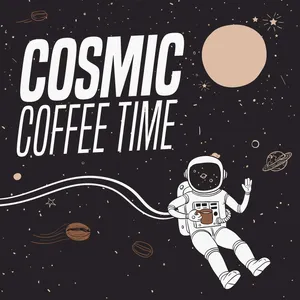
It's cosmology in a cup! - Cosmic Coffee Time is bite sized podcasts making sense of space, astronomy, life, and the universe, best enjoyed with a coffee. A down to earth look at what's up there, and it's just for you spacefans. Grab a coffee and see where in the universe we go this time.
Latest Episodes
The most recent episodes — sign up to get AI-powered summaries of each one.
- 5 days ago10 min
#93 What can we do to stop another dinosaur extinction asteroid smashing into Earth?
Send us Fan Mail 66 million years ago, an asteroid smashed into Earth and caused a mass extinction, including nearly all of the dinosaurs. What would we do if another extinction level asteroid was heading to Earth? The good news is we’re monitoring the skies to identify them early. And there are some incredible strategies for managing high risk objects, and we look at a dramatic test from 2022. Follow Cosmic Coffee Time on X for some special content X.com/CosmicCoffTime Email us! cosmiccoffee...
- 2 weeks ago28 min
#92 Particle physicist and author Dr. Sarah Alam Malik joins us to explore the history of astronomy and the universe. Her new book A Brief History of the Universe takes us from ancient astronomers to modern physics, and the future of the cosmos.
Send us Fan Mail Particle physicist and author Dr. Sarah Alam Malik stops by for an expansive conversation about astronomy, the history of scientific discovery, and our endless fascination with the night sky. In her new book, A Brief History of the Universe, And Our Place in It, Dr. Sarah explores how our understanding of the cosmos has evolved from ancient observers tracking the stars, through the revolutionary ideas of Copernicus and Newton, to modern discoveries about dark matter and the o...
- Apr 30, 20267 min
#91 What’s next for the Artemis program? Artemis 2 was incredible, but let’s take a look at what Artemis 3 & 4 will achieve in the next couple of years. (It’s amazing!)
Send us Fan Mail Artemis 2 was was a breathtaking moment for us all. We were mesmerised by the four astronauts and the images they sent back to Earth. But so much lies ahead, and that’s the really exciting part. Artemis 3 will orbit the Earth and try out some of the equipment and manoeuvres that we just can’t test on Earth. Artemis 4 will be truly amazing. That’s the mission that’s going to take people back to the surface of the Moon for the first time since 1972. Follow Cosmic Coffee T...
- Apr 21, 202624 min
#90 An Australian backyard astronomer helped NASA find 100 planets! Astronomy award winner Chris Stockdale used his home observatory in Churchill, Victoria to track distant stars and find the planets in their orbit. What a chat.
Send us Fan Mail Chris Stockdale is an award winning astronomer in the Gippsland area of Australia. His contribution to NASA's exoplanet research earned him the Berenice and Arthur Page Medal from the Astronomical Society of Australia. And he's an amateur. Chris uses an observatory in his own backyard to monitor candidate stars from NASA's Transiting Exoplanet Survey Satellite (TESS) and studies their brightness over time. If the light dims by as little as half a percent, he's found ano...
- Mar 31, 202611 min
#89 Rogue planets! It's possible that most planets in our galaxy don't orbit a star, like we do with our sun. Rogue planets float through interstellar space in the cold darkness. How do they form? And how do we find a planet at interstellar distances?
Send us Fan Mail We instinctively think of planets as rocky or gaseous bodies orbiting a star like our sun, with sunrise, sunset, heating and maybe even seasons. But what if a planet didn't orbit a light source? What if it just floated through space vaguely orbiting the centre of the galaxy, but tugged this way and that way by nearby stars and stellar systems. These are rogue planets. No sunrise, no sunset, no heat from an outside source. Just starlight and blackness as it wandered aimlessly ...
- Feb 28, 202612 min
#88 Is the Universe Infinite? It’s almost an instinctive question, but maybe it’s unknowable.
Send us Fan Mail Most people have looked to the skies and wondered if the universe has a boundary, or maybe it goes on for ever. The universe might be finite, with and end somewhere. Or, it might be infinite, with an infinite amount of space and matter. Both of thos throw up some mind bending questions, and maybe even real life duplicates of ourselves. Problem is, we would never be able to observe them, or even test for their presence, or even know if they exist. So does it matter? Follow Co...
- Jan 31, 20267 min
#87 The next crewed Moon mission is ready for launch. Let’s preview the historic Artemis II flight, sending humans to the Moon for the first time in over 50 years.
Send us Fan Mail The launch window for Artemis II opens on 6 February 2026. Humans will fly a test mission, swinging around the far side of the moon for the first time since Apollo 17 in 1972. There won’t be a landing, but just like Apollo 8 tested systems in the lunar vicinity before Apollo 11, Artemis II will test the modern systems under the same conditions the landing missions. There will be a crew of 4 including the first person of colour, the first woman and the first non American to fl...
- Dec 31, 20259 min
#86 We all love the Moon, but it hasn’t always been there. Where did it come from, and when did that happen?
Send us Fan Mail The Moon has a history longer than any of the features on Earth, but it isn’t as old as Earth. The Giant Impact hypothesis says that a Mars sized protoplanet collided with earth Billions of years ago and threw out enough of earth’s mantle to make the Moon. It’s an incredible story, and it might just have been the luckiest thing that ever happened for us. Without the Moon, life as we know it might never have existed. Follow Cosmic Coffee Time on X for some special content X.c...
About Cosmic Coffee Time with Andrew Prestage
It's cosmology in a cup! - Cosmic Coffee Time is bite sized podcasts making sense of space, astronomy, life, and the universe, best enjoyed with a coffee. A down to earth look at what's up there, and it's just for you spacefans. Grab a coffee and see where in the universe we go this time.
Customized Recaps
AI-powered recaps with compact key takeaways, quotes, and insights.
Straight to Your Inbox
Get key takeaways from Cosmic Coffee Time with Andrew Prestage in a 5-minute read.
Save Hours Every Week
Stay current on your favorite podcasts without falling behind.
Frequently Asked Questions
What is Podzilla's Cosmic Coffee Time with Andrew Prestage daily summary?
It's a free AI-powered email that summarizes new episodes of Cosmic Coffee Time with Andrew Prestage as soon as they're published. You get the key takeaways, notable quotes, and links & mentions — all in a quick read.
How does the Cosmic Coffee Time with Andrew Prestage podcast summary work?
When a new episode drops, our AI transcribes and analyzes it, then generates a personalized summary tailored to your interests and profession. It's delivered to your inbox every morning.
Is this an official Cosmic Coffee Time with Andrew Prestage product?
No. Podzilla is an independent service that summarizes publicly available podcast content. We're not affiliated with or endorsed by Andrew Prestage.
Can I get summaries of other podcasts too?
Absolutely! The free plan covers up to 3 podcasts. Upgrade to Pro for 15, or Premium for 50. Browse our full catalog at /podcasts.
How often does Cosmic Coffee Time with Andrew Prestage release new episodes?
Cosmic Coffee Time with Andrew Prestage publishes monthly. Our AI generates a summary within hours of each new episode.
What topics does Cosmic Coffee Time with Andrew Prestage cover?
Cosmic Coffee Time with Andrew Prestage covers topics including Science, Astronomy, Natural Sciences. Our AI identifies the specific themes in each episode and highlights what matters most to you.
Start getting Cosmic Coffee Time with Andrew Prestage summaries tomorrow morning.
Free forever for up to 3 podcasts. No credit card required.
Free forever for up to 3 podcasts. No credit card required.