Free Daily Podcast Summary
Critique of the Podcast Form: Daily Summaries Delivered
by Critical Theory Working Group
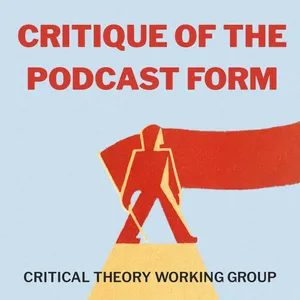
Critique of the Podcast Form is a bi-weekly podcast by the Critical Theory Working Group about Critical Theory, socialism, philosophy, Marxism, social theory, and everything in between. New episodes featuring the rotating cast of hosts and guests are posted every other Thursday. Visit https://ctwgwebsite.github.io/ for writing and updates.
Latest Episodes
The most recent episodes — sign up to get AI-powered summaries of each one.
- 5 days ago1h 31m
Bonus: Debrief Margin Notes 2, Excavations
Critics & theorists, this is a bonus episode containing a recording of the presentation and discussion of “Excavations,” the second volume of our E-Journal Margin Notes: A Journal of Critical Theory, which took place on zoom on the 19th of September, 2026.The link to the journal: https://ctwgwebsite.github.io/projects/3_project/If you want to support the show, donate to our Patreon, and visit our website for writing and updatesFollow our socials:Twitter | @crit_theory_grpBluesky | @crittheoryworkgrp.bsky.socialInstagram | @criticaltheoryworkinggroup
- 2 weeks ago1h 4m
Episode 28: On meta-meta science
The CTWG Marxist science subcommittee returns! In this episode, we discuss Pietro Daniel Omodeo’s Political Epistemology, which develops the Berlin school of historical epistemology (discussed in episode 19!). We examine Omodeo’s enlarged conception of ideology as the dialectic of identity and position as applied to science studies broadly construed, what political epistemology even is, and how action, understood as the unity of praxis and poiesis, mediates history, the middle term between the polis and episteme.Episode reading:Pietro Daniel Omodeo. Political Epistemology: The Problem of Ideology in Science Studies. Springer, 2019.Recommend readings:Lukas Meisner and Pietro Daniel Omodeo. “Beyond Facticity and Post-Truth: Towards a Marxist Political Epistemology.” Historical Materialism 33, no. 1 (2025): 88–118.Helen Eleonora. “On the Falsity of Prevailing Ideas: The Concept of Ideology in Early Critical Theory.” Margin Notes 1 (2024), 84–126.Wolfgang Lefèvre. Theory of Nature and Mode of Production: The Genesis of Modern Science in Materialist Perspective. Political Epistemology. Springer Nature Switzerland, 2025.Jürgen Renn. The Evolution of Knowledge: Rethinking Science for the Anthropocene. Princeton University Press, 2020.Peter Osborne. “The Planet as Political Subject?” New Left Review, no. 145 (March 2024): 103–16.For a good constructive critique of Boris Hessen, see: Ioannis Trisokkas. “Boris Hessen and Newton’s God.” Society and Politics 13, no. 1 (2019): 64–86.If you want to support the show, donate to our Patreon, and visit our website for writing and updatesFollow our socials:Twitter | @crit_theory_grpBluesky | @crittheoryworkgrp.bsky.socialInstagram | @criticaltheoryworkinggroup
- Sep 3, 20261h 7m
Episode 27: A History of Marx's Charaktermaske feat. Billie Cashmore
Nora and Imogen are joined by Billie to discuss her forthcoming essay 'Charaktermasken: Value, Relation and Performance in Marx's Critique of Political Economy' in which she traces the history of Marx's concept of the Charaktermasken.. With excursions into Goethe's Faust, the critique of Marx brought to bear by Black radical thinkers (namely Sylvia Wynter and Fred Moten), the antinomies of the structuralist reading of Capital and the comedy of the Rosean recovery of speculative thought, the three consider the Charaktermaske first as tragedy and again as farce.Donate to Billie's FFS fund! https://gofund.me/0a72791c1 Billie's Acid Horizon Course on the Commodity, starting September 8: https://www.acidhorizonpodcast.com/ahrc-courses/p/the-commodity-appearance-reification-and-practice-from-karl-marx-to-sylvia-wynterTexts mentioned:• Louis Althusser (1963) 'The ‘Piccolo Teatro’: Bertolazzi and Brecht - Notes on a Materialist Theatre' in: For Marx•Theodor S. Adorno (1966) 'Negative Dialectics'•Gillian Rose (1978) 'The Melancholy Science: An Introduction to the Thought of Theodor W. Adorno'• Fred Moten (2003) 'The Resistance of the Object' I&II in: 'In the Break: The Aesthetics of the Black Radical Tradition'•Sylvia Wynter (unpublished) 'Black Metamorphosis: New Natives in a New World'
- Aug 20, 20261h 21m
Episode 26: MUG Moment (ft. Ben L)
Resident CTWG Infantiles Morrain and Cam meet CTWGs resident Marxist Unity Group member Mac, with backup from NYCDSA MUG member Ben, to get to the bottom of what the heck this renegade Kautsky guy is all about and why today's hot TV stars such as Bill Maher can't get enough of him. In play is Lars Lih's book Lenin Rediscovered, as well asRevolutionary Social Democracy: Working-Class Politics Across the Russian Empire (1882-1917) by Eric BlancRevolutionary Strategy: Marxism and the challenge of left unity by Mike Macnairhttps://prometheus-mag.com/2026/07/29/a-short-course-on-the-history-of-the-marxist-unity-group-part-one-background-and-foundation/https://prometheus-mag.com/2026/07/30/a-short-course-on-the-history-of-the-marxist-unity-group-part-two-partyism-in-practice/https://www.marxists.org/archive/lenin/works/1908/nov/13.htm
- Aug 6, 20261h 1m
Episode 25: Cisification of the Bourgeoisie
Nora, Imogen, and Helen are joined by friend of the pod Ashley to discuss two articles from the new volume of Mediations: Emma Heaney's "On the Cisness of the Bourgeoisie" and Amy De'Ath's "Two Substantialisms: On Value and Sexual Difference." Together, they answer a burning question of our movement: are trans women bourgeois?
- Jul 23, 20261h 20m
Episode 24: Schelling’s Clara: Conversations on the Absolute.
For episode 24 and part 2 in our Schelling series, James is joined by Imogen and Nora to discuss one of Schelling's unfinished works: Clara, or On Nature's Connection to the Spirit World. After situating the text within Schelling's wider oeuvre and patiently clearing the author from accusations of dark magic, we ruminate on its themes of resurrection, transmigration, the singularity of the soul and the magnificence of beavers. Putting Schelling in discussion with Kant, Fichte, Hegel, Freud, Mao, Bordiga and Kazuo Ishiguro we ask the ultimate question: can Naturphilosophie mourn?
- Jul 9, 20261h 31m
Episode 23: Schelling's Early Philosophy of Nature
In this episode, Anatarah, Bile, and Crane discuss the introduction to Schelling’s 1797 Ideas for a Philosophy of Nature and the introduction to Schelling’s 1799 First Outline. Working up to Schelling’s ambitious declaration that philosophy is a “natural history of our mind,” the hosts discuss some of the fundamental concepts—like force, equilibrium, and organism—in Schelling’s philosophy of nature, the difference between Schelling’s earlier philosophy of nature and his “identity system,” and the relationship between Schelling’s project and those of his contemporaries in philosophy and natural science. In conclusion, we debate whether and, if so, how Schelling’s early philosophy of nature might provide us with a basis for a critical theory of nature and natural science.Recommend readings:Ideas for a Philosophy of Nature as Introduction to the Study of This Science, 1797. Cambridge University Press, 2001.First Outline of a System of the Philosophy of Nature. State University of New York Press, 2004.The Schelling Reader. 1st ed. Bloomsbury Academic, 2020.The Palgrave Schelling Handbook. Palgrave Handbooks in German Idealism. Palgrave Macmillan, 2026.
- Jun 26, 202655 min
Episode 22: Everybody Female
Imogen, Helen, and Nora kvetch about "The Logic of Gender" from Endnotes 3. Topics include whether capital is a totality (it is), whether Butler reduces gender to the value-form (they don't), and whether this article gets into enough detail regarding the history of the family (absolutely not.)Texts:The Logic of Gender in Endnotes Vol 3: https://www.endnotes.org.uk/issues/issue-3/endnotes-the-logic-of-gender
About Critique of the Podcast Form
Critique of the Podcast Form is a bi-weekly podcast by the Critical Theory Working Group about Critical Theory, socialism, philosophy, Marxism, social theory, and everything in between. New episodes featuring the rotating cast of hosts and guests are posted every other Thursday. Visit https://ctwgwebsite.github.io/ for writing and updates.
Customized Recaps
AI-powered recaps with compact key takeaways, quotes, and insights.
Straight to Your Inbox
Get key takeaways from Critique of the Podcast Form in a 5-minute read.
Save Hours Every Week
Stay current on your favorite podcasts without falling behind.
Frequently Asked Questions
What is Podzilla's Critique of the Podcast Form daily summary?
It's a free AI-powered email that summarizes new episodes of Critique of the Podcast Form as soon as they're published. You get the key takeaways, notable quotes, and links & mentions — all in a quick read.
How does the Critique of the Podcast Form podcast summary work?
When a new episode drops, our AI transcribes and analyzes it, then generates a personalized summary tailored to your interests and profession. It's delivered to your inbox every morning.
Is this an official Critique of the Podcast Form product?
No. Podzilla is an independent service that summarizes publicly available podcast content. We're not affiliated with or endorsed by Critical Theory Working Group.
Can I get summaries of other podcasts too?
Absolutely! The free plan covers up to 3 podcasts. Upgrade to Pro for 15, or Premium for 50. Browse our full catalog at /podcasts.
How often does Critique of the Podcast Form release new episodes?
Critique of the Podcast Form publishes biweekly. Our AI generates a summary within hours of each new episode.
What topics does Critique of the Podcast Form cover?
Critique of the Podcast Form covers topics including Science, Philosophy, Culture, Society & Culture, Social Sciences. Our AI identifies the specific themes in each episode and highlights what matters most to you.
Start getting Critique of the Podcast Form summaries tomorrow morning.
Free forever for up to 3 podcasts. No credit card required.
Free forever for up to 3 podcasts. No credit card required.