Free Daily Podcast Summary
Crypto Coin Show: Daily Summaries Delivered
by Crypto Coin Show
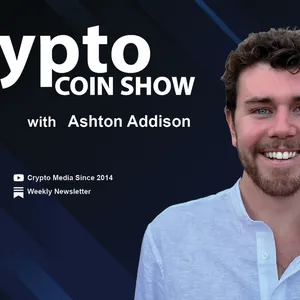
At the Crypto Coin Show, we interview investors, startups, and leading minds in the blockchain industries. Our team has been involved in blockchain since the early days of Ethereum in 2013, following the markets from the 2014 to 2021 Bull Runs and future ones! Our founder and CEO, Ashton Addison, is a thought leader in the industry, with over 1200 interviews including John McAfee, Roger Ver, Charles Hoskinson, and more. He is also a public speaker who has spoken in 10 countries on everything in Web3. We publish new videos multiple times per week. Follow us on Twitter, LBRY, Minds.com, and SUBSCRIBE TO OUR NEWSLETTER for the best of it all: https://bit.ly/100CCS We syndicate our content to financial publications, such as Reuters Insider financial network, Investment Pitch, and Fintech News Network. For inquires, contact ashton@cryptocoinshow.com. Join us on our journey to explore the world of blockchain and cryptocurrency and learn how to succeed in this rapidly evolving industry.
Latest Episodes
The most recent episodes — sign up to get AI-powered summaries of each one.
- 4 days ago24 min
Private credit is a 1.7 trillion market — and it's broken. Cap's founder on how to fix it onchain - Crypto Coin Show
Private credit has a trust problem. Borrowers, lenders, and underwriters operate in silos, incentives are misaligned, and most of the $1.7 trillion sitting in TradFi private credit markets is inaccessible to anyone outside institutional finance. ONCHAIN CREDIT changes that — and Cap is building the infrastructure to make it work.Benjamin Sarquis Peillard, Founder and CEO of Cap, joins Ashton Addison to break down how Cap brings private credit markets onchain with principal protection backed by Franklin Templeton. Benjamin previously scaled QiDAO from $0 to $400M in TVL and started his career in investment banking at Citi — a rare combination of TradFi credibility and DeFi execution. We cover how Cap's three-party model aligns borrowers, lenders, and underwriters in a way neither TradFi nor DeFi lending has managed, why this is structurally different from Celsius and the platforms that collapsed, and what happens at the protocol level when a borrower defaults.You'll learn:- How Cap's borrower-lender-underwriter model works and why principal protection changes the risk equation for lenders- Why Celsius, BlockFi, and Voyager collapsed — and the specific structural differences that make Cap's approach fundamentally different- What it took to bring Franklin Templeton in as the principal protection backer, and what that signals about institutional DeFi in 2026- How onchain credit can sit alongside traditional fixed income at institutional scale — and what has to be true for that to happen🔗 https://www.cap.app🐦 https://x.com/CapApp🔔JOIN OUR FREE NEWSLETTER FOR 100X GAINS🔔: https://cryptocoinshow.substack.com/subscribe
- 5 days ago22 min
Bitcoin DeFi is already here. Samuel Pat (OP_NET) explains at Consensus 2026 Miami - Crypto Coin Show
Bitcoin has $1 trillion in market cap sitting idle. The infrastructure to put it to work — natively, without bridges or wrapped tokens — has been the missing piece. OP_NET is building it. Samuel Pat, founder of OP_NET, breaks down how his team is bringing genuine DeFi utility to Bitcoin: a native DEX called Motoswap for peer-to-peer swaps and liquidity, a Bitcoin wallet built for the DeFi era, and an ecosystem being assembled on the world's most trusted chain. We dig into the velocity of money on Bitcoin — why BTC that can move through DeFi protocols creates compounding value versus BTC that just sits — and what it actually takes to build financial infrastructure on a chain that wasn't designed for it.🔔JOIN OUR FREE NEWSLETTER FOR 100X GAINS🔔: https://cryptocoinshow.substack.com/subscribe
- 6 days ago12 min
AI in YOUR crypto wallet. Adam Cai of Virgo Group on AI agents and Wallet V Consensus Miami 2026 - Crypto Coin Show
Most people manage their own crypto portfolio the same way they always have — manually, reactively, and without the tools that institutional investors take for granted. Wallet V changes that. Adam Cai from Virgo Group sits down with us live at Consensus Miami 2026 to break down Wallet V and the AI agents being built into it to act as autonomous financial portfolio managers for everyday users. We explore what it actually means for an AI agent to manage a portfolio — making decisions, allocating assets, executing strategies — without the user needing to intervene. Adam explains how this levels the playing field between retail and institutional crypto investors, and why the convergence of AI and Web3 wallets is the most practical application of agent technology happening in crypto right now.🔗 https://Virgo.co🔔JOIN OUR FREE NEWSLETTER FOR 100X GAINS🔔: https://cryptocoinshow.substack.com/subscribe
- 1 weeks ago13 min
Ethereum and Solana weren't built for AI. 0G Labs co-founder explains WHY - Crypto Coin Show
Centralized AI infrastructure gives a handful of companies control over the data, compute, and models that everyone else depends on — and most builders have no way to verify what's actually happening under the hood. DECENTRALIZED AI is the alternative, and 0G Labs is building the infrastructure layer to make it real. Michael Heinrich, Co-Founder of 0G Labs, joins us live at Consensus Miami 2026 to break down why AI needs its own blockchain, what the Apollo launchpad is unlocking for AI-native projects, and how 0G's open-source infrastructure gives developers, agents, and communities real ownership over data and compute. From why existing chains like Ethereum and Solana fall short for AI workloads to what verifiable, trustless AI execution actually looks like in practice, this is a clear-eyed look at where decentralized AI infrastructure is headed.You'll learn: Why AI workloads expose the limits of general-purpose blockchains and what 0G was built to fix How the Apollo launchpad works and what kinds of projects are being accelerated on the 0G network What open-source AI infrastructure means for developers who want to build without depending on centralized providers Why decentralized compute and data ownership are the two things that actually determine whether AI stays open🔗 https://0g.ai🐦 https://x.com/0G_labs🔔JOIN OUR FREE NEWSLETTER FOR 100X GAINS🔔: https://cryptocoinshow.substack.com/subscribe
- 1 weeks ago19 min
1.27 TRILLION queries and The Graph is just getting started. Nick Hansen at Consensus 2026 - Crypto Coin Show
The Graph has processed 1.27 trillion queries and most builders still treat it as a subgraph indexer. After the Horizon upgrade, that's not what it is anymore. Nick Hansen, Team Lead at The Graph Foundation, joins us live from Consensus Miami 2026 to break down what The Graph has become: a modular, multi-service data backbone targeting the $47 billion agentic AI economy. The December 2025 Horizon upgrade didn't just improve the protocol — it transformed it. Six new data services are now live or in deployment: Subgraphs, Substreams, Token API, Tycho for DeFi solvers, Amp for institutions, and JSON-RPC. We get into how AI agents will query The Graph and pay per-query with no API keys, why record usage hasn't translated to GRT price performance, and what the missing ingredient is to kick the economic flywheel into gear.🔗 https://thegraph.com🔔JOIN OUR FREE NEWSLETTER FOR 100X GAINS🔔: https://cryptocoinshow.substack.com/subscribe
- 1 weeks ago16 min
The AI That Audits Smart Contracts CertiK's Hudson Jameson on Securing 600B Consensus Miami 2026 - Crypto Coin Show
Hudson Jameson, blockchain security veteran, former Ethereum Foundation core dev liaison, SEAL Org member, and CertiK Security Advisor — sits down with us live at Consensus Miami 2026. CertiK controls over 65% of global blockchain auditing, has secured $600B+ in digital assets, uncovered 180,000+ vulnerabilities, and in April 2026 publicly launched its AI Auditor with an 88.6% hit rate across 35 real-world Web3 incidents. Hudson brings a rare perspective that spans Ethereum's earliest governance battles, Flashbots, Polygon, and now the front lines of AI-powered security. We dig into what AI can and can't catch, why cross-chain bridges remain the hardest attack surface to secure, how Skynet monitors threats in real time when both attacker and defender are AI systems, and what the industry still refuses to take seriously enough. This is the most honest conversation in Web3 security happening at Consensus this year.🔔JOIN OUR FREE NEWSLETTER FOR 100X GAINS🔔: https://cryptocoinshow.substack.com/subscribe
- 1 weeks ago20 min
Fixing Crypto Discovery David Track of SOSANA on Accountability Consensus 2026 - Crypto Coin Show
In this episode of Blockchain Interviews, Ashton Addison sits down with David Track, Founder of SOSANA — a Solana-based enforcement layer built to solve one of crypto's most persistent problems: discovery. With thousands of new tokens launching every week and retail investors drowning in noise, SOSANA is building a gated, verifiable community model that replaces trust-based systems with automated, transparent execution. David breaks down how the platform's community-driven voting reward system works, why enforced rules — not suggestions — are the only way to protect users, and how the bi-weekly "Safe from SOSANA" list is turning chaotic community sentiment into structured, accountable signal. A timely conversation for anyone trying to navigate the crowded crypto landscape.🔔JOIN OUR FREE NEWSLETTER FOR 100X GAINS🔔: https://cryptocoinshow.substack.com/subscribe
- 2 weeks ago29 min
Sportsbooks are taking your cut. PRED is building the exchange that cuts them out - Crypto Coin Show
Sports bettors lose to the bookmaker before the game even starts. The house sets the lines, pockets the margin, and decides who gets to play — and most people have no idea how much that spread is actually costing them. PRED is a peer-to-peer sports prediction exchange built on Base that removes the middleman entirely.We sit down with the team behind PRED to break down how a decentralized sports prediction exchange works, why betting peer-to-peer changes the economics for bettors, and what it takes to build a regulated, on-chain alternative to the sportsbook model. From how PRED's matching engine works to the role of liquidity providers and what PRED token holders actually get, this is a practical look at what sports betting looks like when the house no longer has an edge.You'll learn:- Why sportsbooks are structurally designed to take a margin on every bet — and how much it costs the average bettor over time- How PRED's peer-to-peer exchange model works and what it means to bet directly against other users- What building a sports prediction exchange on Base (Coinbase's Layer-2) changes about accessibility, cost, and settlement speed- How liquidity works on a decentralized prediction exchange and who the counterparty actually is- What the PRED token does and how value flows through the protocol🔗 https://pred.gg/🔔JOIN OUR FREE NEWSLETTER FOR 100X GAINS🔔: https://cryptocoinshow.substack.com/subscribe
About Crypto Coin Show
At the Crypto Coin Show, we interview investors, startups, and leading minds in the blockchain industries. Our team has been involved in blockchain since the early days of Ethereum in 2013, following the markets from the 2014 to 2021 Bull Runs and future ones! Our founder and CEO, Ashton Addison, is a thought leader in the industry, with over 1200 interviews including John McAfee, Roger Ver, Charles Hoskinson, and more. He is also a public speaker who has spoken in 10 countries on everything in Web3. We publish new videos multiple times per week. Follow us on Twitter, LBRY, Minds.com, and SUBSCRIBE TO OUR NEWSLETTER for the best of it all: https://bit.ly/100CCS We syndicate our content to financial publications, such as Reuters Insider financial network, Investment Pitch, and Fintech News Network. For inquires, contact ashton@cryptocoinshow.com. Join us on our journey to explore the world of blockchain and cryptocurrency and learn how to succeed in this rapidly evolving industry.
Customized Recaps
AI-powered recaps with compact key takeaways, quotes, and insights.
Straight to Your Inbox
Get key takeaways from Crypto Coin Show in a 5-minute read.
Save Hours Every Week
Stay current on your favorite podcasts without falling behind.
Frequently Asked Questions
What is Podzilla's Crypto Coin Show daily summary?
It's a free AI-powered email that summarizes new episodes of Crypto Coin Show as soon as they're published. You get the key takeaways, notable quotes, and links & mentions — all in a quick read.
How does the Crypto Coin Show podcast summary work?
When a new episode drops, our AI transcribes and analyzes it, then generates a personalized summary tailored to your interests and profession. It's delivered to your inbox every morning.
Is this an official Crypto Coin Show product?
No. Podzilla is an independent service that summarizes publicly available podcast content. We're not affiliated with or endorsed by Crypto Coin Show.
Can I get summaries of other podcasts too?
Absolutely! The free plan covers up to 3 podcasts. Upgrade to Pro for 15, or Premium for 50. Browse our full catalog at /podcasts.
How often does Crypto Coin Show release new episodes?
Crypto Coin Show publishes daily. Our AI generates a summary within hours of each new episode.
What topics does Crypto Coin Show cover?
Crypto Coin Show covers topics including Business, Investing. Our AI identifies the specific themes in each episode and highlights what matters most to you.
Start getting Crypto Coin Show summaries tomorrow morning.
Free forever for up to 3 podcasts. No credit card required.
Free forever for up to 3 podcasts. No credit card required.