Free Daily Podcast Summary
Directora: Daily Summaries Delivered
by Stephanie Weber
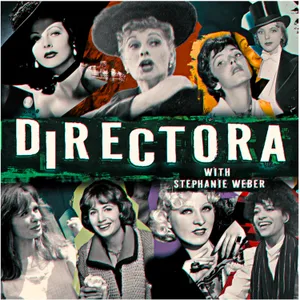
Directora is a podcast that celebrates the history and achievements of women in film. Directora is broken into seasons, with each season having a theme to explore. The podcast is researched, written, and hosted by writer and comedian Stephanie Weber.
Latest Episodes
The most recent episodes — sign up to get AI-powered summaries of each one.
- Yesterday44 min
The Actress Who Went to Jail for Sex: Mae West
“Come up and listen sometime.” Mae West was an icon of old Hollywood. She has been impersonated by The Looney Tunes and Drag Queens alike. She was a woman who was so ahead of her time that her comedy holds up to this day. She was an actress, writer, and producer who wrote her own material - and sometimes that material was SO controversial that she wound up having to go to court over it. We are talking about the one and only Mae West as we get into her enduring legacy, her impressive career, and her court case over sex. That was the title of her script, not like a court case over whether or not she could have. Because I’m pretty sure she did…a lot. Listen to her wild adventures in and out of show business. This episode originally aired on Grab Bag Collab earlier in 2026. Directora was created by Stephanie Weber, who researches, writes, records, edits, and hosts every episode. Artwork by Brock Alter. Check out film clips and stills from these movies on our Instagram and TikTok. Follow along! Email questions, concerns, press opps to directorapodcast@gmail.com. Rate and review as kindly as possible! Sources: American Masters: Mae West: Dirty Blonde. PBS. Season 34. June 16, 2020. Chandler, Charlotte. She Always Knew How: A Personal Biography of Mae West. Applause Publishers. March 1, 2010. Mae West and the Men Who Knew Her. Directed by Gene Feldman and Suzette Winter. PBS Documentary 1994. Wombat Productions. Longworth, Karina. "Fact Checking Hollywood Babylon: Mae West". You Must Remember This. December 3, 2018. West, Mae. Edited by Schlissel, Lillian. Three Plays By Mae West. Taylor and Francis, LTD. 1997. Hosted on Acast. See acast.com/privacy for more information.
- 1 weeks ago36 min
The Trailblazing Ida Lupino
Welcome to season two of Directora: Actresses Who Became Power Players! This is a great season. Yes, we have directors, but we also have writers, producers, studio executives, and even inventors. This season will feature some heavy hitters like Lucille Ball, Elaine May, Debbie Allen, Mae West, and Barbra Streisand, and some lesser-known actresses like Adrienne Shelly who made a big impact. And an inventor, Hedy Lamarr. But first? We have to start with one of the most important female directors of the 20th century. I can’t kick off my season on actresses who became power players without talking about Ida Lupino. The petite British actress with the femme fatale voice became one of the ONLY directors working in the 1940s and 50s. She made a lot of historic firsts, including being the first woman to direct film noir. She directed boundary-breaking independent films and then went on to direct some of the most legendary episodes of early television. This is why she often comes up in discussions of women directors or women in film history, and that’s exactly what our podcast is about. Her film The Hitch-Hiker is part of the National Film Registry, and her films Outrage and The Bigamist are considered important works of 20th-century art. Learn about her life, career, and triumphs in today's episode!This episode originally aired earlier in 2026 on Grab Bag Collab. Directora was created by Stephanie Weber, who researches, writes, records, edits, and hosts all episodes. Episode art by Brock Alter. Please visit Directora on Instagram or TikTok for clips of things discussed in the episode. Email directorapodcast@gmail.com for questions, concerns, and compliments. And, kindly rate and review! Sources:Donati, William J. Ida Lupino: A Biography. University Press of Kentucky. April, 1996. Kuperberg, Clara and Julia. Ida Lupino: Gentlemen and Miss Lupino. (2021)Longworth, Karina. “The Many Loves of Ida Lupino”. You Must Remember This. July 10, 2014.Lupino, Ida. “Outrage.” 1950. Lupino, Ida. “The Bigamist.” 1953.Lupino, Ida. “The Hitch-Hiker.” 1955. Ida Lupino- Documentary. Film Historian. Oct 12, 2016. https://www.youtube.com/watch?v=1XCu7O9sw-QThis is your life https://www.youtube.com/watch?v=2UgbgrLve7AWalsh, Raoul. “They Drive By Night.” 1940. Wellman, William. “The Light That Failed.” 1939. Hosted on Acast. See acast.com/privacy for more information.
- 2 weeks ago36 min
The Director Whose Film Was Banned Due to A Food Fight
If you're a quirky internet/Tumblr girl, the chances are super high that you've seen images of the 1966 Czech film Daisies. The images are vibrant, striking, and adorable; but the story behind the film and the reactions to it in director Věra Chytilová's home country go so much deeper than you can imagine and the film put her on a career blacklist for years. Find out why the Czech communist regime took issue with her films and attempted to ruin her career. This episode originally aired on Grab Bag Collab's Patreon. Thank you to Amanda Rossman for sound mixing and to Brock Alter for the artwork. Directora is hosted, created, researched, and written by Stephanie Weber. Follow Directora on Instagram and TikTok. Please email directorapodcast@gmail.com for any questions, suggestions, or compliments. I love those!Sources for this episode:Brockel, Cal. “Věra Chytilová: the Czech New Wave director banned by her government”. Hero Magazine. May 8, 2021. https://hero-magazine.com/article/189560/vera-chytilova“BFI At Home: Filmmakers in Focus: Věra Chytilová”. BFI YouTube Channel. April 8, 2021. https://www.youtube.com/watch?v=dwbA6aNiG7AČulík, Jan. “A Courageous Voice from Central Europe: The Films of Věra Chytilová”. Eastern European Film Bulletin. Volume 88. October 2018. https://eefb.org/retrospectives/The-Films-of-Vera-Chytilova“Daises: City Cinematheque.” CUNY TV YouTube Channel. Recorded January 1, 1997. Aired February 1, 1997. https://www.youtube.com/watch?v=G0tU4ioovoAGray, Carmen. “Vera Chytilová for beginners”. British Film Institute. February 27, 2015. https://www.bfi.org.uk/features/vera-chytilova-beginnersSarno, Elena Pachner. “Feminism, Destruction, and Joy in Daises”. East European Film Bulletin. Volume 88. October 2018. https://eefb.org/retrospectives/feminism-destruction-and-joy-in-daisies/ Hosted on Acast. See acast.com/privacy for more information.
- 3 weeks ago1h 8m
The Nazi Director: Leni Riefenstahl
Leni Riefenstahl was one of the most important directors of the 20th century. She pioneered several filmmaking techniques and forever influenced how sports and action are filmed on camera. But she was also a Nazi. Or was she? After the war, Riefenstahl spent the rest of her very long life defending her work and denying any involvement with the Nazi Party...sometimes in the face of very real evidence to refute her claims. So what's the truth? Listen to this episode to hear the full story.Warning: this episode talks about the Holocaust, bigotry, and stigmatization of mental illness. This episode was re-recorded for this release. The original version aired on Grab Bag Collab in May 2025. Stephanie Weber researched, wrote, recorded, and edited the episode. Brock Alter did all of the artwork. Follow us on social media to see clips and stills from the films discussed in this episode. SOURCES:Connolly, Kate. Gypsies’ Fate Haunts Film Muse of Hitler. August 18, 2002. https://www.theguardian.com/world/2002/aug/18/artsandhumanities.germanyConnolly, Kate. “Film suggests Nazis’ lead propagandist had role in 1939 massacre.” The Guardian. August 28, 2024. https://www.theguardian.com/film/article/2024/aug/28/film-suggests-nazis-propagandist-leni-riefenstahl-had-role-in-1939-massacre“Just What Did Leni Riefenstahl’s Lens See?” New York Times. March 13, 1994. Accessed via https://writing.upenn.edu/~afilreis/Holocaust/maslin.html on May 1, 2025.Indiana, Gary. “Leni Riefenstahl.” Art Forum. https://www.artforum.com/columns/leni-riefenstahl-168029/Muller, Ray. The Wonderful Horrible Life of Leni Riefenstahl. (1993)Prose, Francine. “Leni Riefenstahl: On a Nazi Filmmaker”. The Yale Review. October 1, 2018. https://yalereview.org/article/leni-riefenstahlRiefenstahl, Leni. “The Blue Light”. (1932). Riefenstahl, Leni. “Olympia Part One: The Festival of Nationals” (1938).Riefenstahl, Leni. “Olympia Part Two: Festival of Beauty” (1938). Veiel, Andres. Riefenstahl. (2024)Zajc, Melita. A cruel game by Hitler’s Favourite Filmmaker Exposed. Modern Times Review. February 20, 2022. https://www.moderntimes.review/a-cruel-game-by-hitlers-favourite-filmmaker-exposed/ Hosted on Acast. See acast.com/privacy for more information.
- 4 weeks ago37 min
Pauline Kael's Brutal Reviews Changed Hollywood
"She's so f***ing mean," Quentin Tarantino once said of film critic Pauline Kael. Kael was known for brutally harsh film reviews that could make or break a movie. People want to dismiss critics for "not knowing anything", but Kael knew a lot - and her knowledge was valuable to the industry. Her ability to spot up-and-coming talent in the 60s and 70s helped New American Cinema flourish. Find out about her life as we read her wildest reviews. Who could ever say something mean about The Sound of Music? Pauline Kael!This episode originally aired with Grab Bag Collab on their Patreon. Stephanie Weber is the host, creator, researcher, and writer of Directora. Amanda Rossman mixed this episode. Brock Alter made the artwork. Follow Directora on Instagram and TikTok. E-mail questions, suggestions, and anything else to directorapodcast@gmail.comSources for this episode:Barsanti, Chris. “When Film Mattered: Pauline Kael’s Age of Movies.” October 27, 2011. https://themillions.com/2011/10/when-film-mattered-pauline-kaels-the-age-of-movies.htmlBrody, Richard. “What Pauline Kael Failed to See About Young Film Lovers”. April 8, 2025. https://www.newyorker.com/culture/the-front-row/what-pauline-kael-failed-to-see-about-young-film-loversCwik, Greg. “The Critic as Artful Gadfly”. Pop Matters. November 14, 2012. https://www.popmatters.com/165416-the-critic-as-artful-gadfly-pauline-kael-2495797841.htmlGarver, Rob. What She Said: The Art of Pauline Kael. (2018).Hellerman, Jason. “The Controversy Behind ‘Citizen Kane’, ‘Mank’, and Pauline Kael”. December 2, 2020. https://nofilmschool.com/citizen-kane-pauline-kaelJones, Emma. “It Was Really Wrong: How Last Tango in Paris’ Infamous Explicit Scene Undid Its Female Star.” BBC News. April 3, 2025. https://www.bbc.com/culture/article/20250402-maria-schneider-how-last-tango-in-pariss-infamous-explicit-scene-undid-its-female-starKael, Pauline. “Circles and Squares.” JSTOR.org https://www.jstor.org/stable/1210726Kael, Pauline. “Bonnie and Clyde.” The New Yorker. October 13, 1967. https://www.newyorker.com/magazine/1967/10/21/bonnie-and-clydeLinfield, Susie. “The Perils of Pauline” LA Times. Sept. 29, 2002. https://www.latimes.com/archives/la-xpm-2002-sep-29-bk-linfield29-story.htmlPotton, Ed. “She’s So Mean - The Critic Everyone Loved to Hate”. The Times. March 17, 2023. https://www.thetimes.com/culture/film/article/tarantino-described-her-film-reviews-as-the-greatest-shit-ever-she-s-just-being-so-f-ing-mean-nnkt6056rRussell, Calum. “Pauline Kael Reviews Quentin Tarantino’s Pulp Fiction” Far Out Magazine. March 16 2013. https://faroutmagazine.co.uk/pauline-kael-reviews-quentin-tarantinos-pulp-fiction/ Hosted on Acast. See acast.com/privacy for more information.
- Jun 24, 202630 min
Alla Nazimova and Hollywood's Queer Pioneers
When I was planning episodes, a friend suggested that I talk about lavender marriages. Lavender marriages were essentially fake Hollywood marriages set up by studios, agents, or the actors themselves to hide a star’s sexuality or clean up their image. I know that lavender marriages and queerness in early Hollywood are really salacious and fun to talk about, but I couldn’t immediately figure out how to casually bring up the subject. And then I remembered Alla Nazimova and, folks, we've got ourselves a great episode on a queer producer, director, and actress who was said to be one of the best actresses of her day. Let’s talk about Alla Nazimova and her groundbreaking silent film with an allegedly all-gay cast, Salome. Happy Pride!“Alla Nazimova - AFI Catalogue Spotlight”. June 1, 2023. https://www.afi.com/news/alla-nazimova-afi-catalog-spotlight/“Alla Nazimova”. IMDB. Accessed on May 16, 2024. https://www.imdb.com/name/nm0623417/Anger, Kenneth. Hollywood Babylon. Dell Publishing, 1975.Longworth, Karina. “Rudolph Valentino (Fake News: Fact-Checking Hollywood Babylon). January 29, 2019. https://www.youmustrememberthispodcast.com/episodes/2019/1/29/hollywoodbabylonPacheco, Diego Pineda. “Critically Acclaimed Films that Roger Ebert Disliked”. Collider. April 25, 2024. https://collider.com/roger-ebert-worst-acclaimed-movies/Reise. “The 10 Most Sexually Prolific Lesbians and Bisexuals in Old Hollywood.” Astro Straddle. July 7, 2016. https://www.autostraddle.com/10-old-hollywood-stars-who-enjoyed-scissoring-343227/Shokin, Samantha. The Founding Mother of Sapphic Hollywood. Tablet Mag. June 1, 2022. https://www.tabletmag.com/sections/arts-letters/articles/alla-nazimova-sapphic-hollywoodTurnbull, Martin. “Salome”. JSTOR. https://www.loc.gov/static/programs/national-film-preservation-board/documents/salome.pdfhttps://www.theguardian.com/books/2024/mar/02/mercedes-de-acosta-the-poet-who-had-affairs-with-the-20th-centurys-most-famous-women Hosted on Acast. See acast.com/privacy for more information.
- Jun 17, 202628 min
Who Was the First Black Female Director?
Season one of Directora is all about foundations. We've talked about the first female director ever, and we talked about Hollywood's first successful female director. Today, we ask the question: who was the first Black female filmmaker? Well, this is actually a difficult question to answer. There is no one answer. There are a couple of early contenders, but the answer also depends on what you’re asking. In this episode, we'll talk about several Black female pioneers in film, from Madame Welcome to Tressie Souders to Eloyce King Patrick Gist to Zora Neale Hurston to Jessie Maple, and more! This episode originally aired with Grab Bag Collab. Thank you to Amanda Rossman, Daisy Eagan, and Amber Hunt. Thank you to Brock Alter for sound help and podcast artwork. Follow us on Instagram and TikTok to see clips and stills from the topics talked about in this episode. Sources used for this episode: Abbot, Robert. S. “Among the Movies,” Chicago Defender, 20 November 1915, p. 5. Baker, Christina N. Black Women Directors. Rutgers University Press, 2022. Bobo, Jaqueline. Black Women Film & Video Artists. AFI Film Readers. Routledge, 1998. The Billboard, NY Digital Library, 31 Dec. 1921, p. 43. www.fultonhistory.com/newspaperBlack Film Archive - 1920s. https://blackfilmarchive.com/1920-s“I Invest in Myself and I Make My Films: Jessie Maple on Breaking Boundaries in Filmmaking”. NU Block Museum. February 6, 2020. https://nublockmuseum.blog/2020/02/06/i-invest-in-myself-and-i-make-my-films-jessie-maple-on-breaking-boundaries-and-filmmaking-audio/Jackson, Ashwanta. “Black Camerawoman Jessie Maple’s Fight to Join a Union”. JSTOR Daily. May 13, 2021. https://daily.jstor.org/black-camerawoman-jessie-maples-fight-to-join-a-union/Knuppel, Jennie. “The First Black Woman to Write and Produce and Act in Her Own Film”. Saturday Evening Post. February 29, 2024. https://www.saturdayeveningpost.com/2024/02/the-first-black-woman-to-write-produce-and-act-in-her-own-film/Morgan, Kyna; Aimee Dixon. "African-American Women in the Silent Film Industry." In Jane Gaines, Radha Vatsal, and Monica Dall’Asta, eds. Women Film Pioneers Project. New York, NY: Columbia University Libraries, 2013. https://doi.org/10.7916/d8-vt0f-1758Stratton, L.E. “How White Women’s Patronage of Black Artists Exposed Racial Fault Lines.” Lit Hub. June 13, 2024. https://lithub.com/how-white-womens-patronage-of-black-artists-exposed-racial-fault-lines/ Hosted on Acast. See acast.com/privacy for more information.
- Jun 10, 202626 min
Sex Sells Feminism: Stephanie Rothman
They say sex sells, but can sex also sell feminist ideas? That's what director Stephanie Rothman did in the 60s and 70s. European movies and groovy new ideas inspired the bold director to make low-budget movies with big impacts. She began working for the great B-movie director Roger Corman, who trusted her to direct her first independent films. She directed The Student Nurses, launching a wave of "sexy nurse" movies in the 70s. However, it was so much more than a sexploitation film playing at drive-in movies to teen boys. The film followed its young female protagonists through a variety of dramas that touched on issues that were affecting real women in the outside world. From pregnancy to addiction to revolution, The Student Nurses was about a lot more than sex. Don't get me wrong - there IS sex in the movie, but there's more than that.Rothman cleverly "snuck" feminist ideas into raunchy movies. She also infused her sexy vampire film, The Velvet Vampire, with plenty of dreamy visuals that inspired later horror films such as The Love Witch. Her films touched on politics, sex, and love, and even included a sex-work film starring a young Cassandra Peterson (that's Elvira!). She did all of this while working within the exploitation genre, simply because it was the only avenue that she was offered. As a result, she fought against notions that her films were silly genre movies or filth. Rothman is still disregarded in feminist film studies for that reason. Let's change that! It's time to recognize Rothman's work as valuable for feminist filmmaking and female directors as a whole. Thank you for listening! This episode was originally published with Grab Bag Collab. Special thanks to them! Thanks to Brock Alter for the podcast art and tech help. Directora is researched, written, edited, and hosted by Stephanie Weber. Hosted on Acast. See acast.com/privacy for more information.
About Directora
Directora is a podcast that celebrates the history and achievements of women in film. Directora is broken into seasons, with each season having a theme to explore. The podcast is researched, written, and hosted by writer and comedian Stephanie Weber.
Customized Recaps
AI-powered recaps with compact key takeaways, quotes, and insights.
Straight to Your Inbox
Get key takeaways from Directora in a 5-minute read.
Save Hours Every Week
Stay current on your favorite podcasts without falling behind.
Frequently Asked Questions
What is Podzilla's Directora daily summary?
It's a free AI-powered email that summarizes new episodes of Directora as soon as they're published. You get the key takeaways, notable quotes, and links & mentions — all in a quick read.
How does the Directora podcast summary work?
When a new episode drops, our AI transcribes and analyzes it, then generates a personalized summary tailored to your interests and profession. It's delivered to your inbox every morning.
Is this an official Directora product?
No. Podzilla is an independent service that summarizes publicly available podcast content. We're not affiliated with or endorsed by Stephanie Weber.
Can I get summaries of other podcasts too?
Absolutely! The free plan covers up to 3 podcasts. Upgrade to Pro for 15, or Premium for 50. Browse our full catalog at /podcasts.
How often does Directora release new episodes?
Directora publishes weekly. Our AI generates a summary within hours of each new episode.
What topics does Directora cover?
Our AI identifies the specific themes in each episode and highlights what matters most to you.
Start getting Directora summaries tomorrow morning.
Free forever for up to 3 podcasts. No credit card required.
Free forever for up to 3 podcasts. No credit card required.