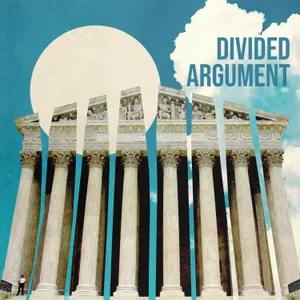
Free Daily Podcast Summary
Divided Argument: Daily Summaries Delivered
by Will Baude & Dan Epps
An unscheduled, unpredictable Supreme Court podcast. Hosted by Will Baude and Dan Epps.
Latest Episodes
The most recent episodes — sign up to get AI-powered summaries of each one.
- 3 weeks ago1h 19m
Shoe of Damocles
We're back after a break, and the August interim docket handed us two per curiam standing rulings. In Trump v. California, the Court stayed the injunction against the mail-ballot executive order because the states' injuries were too hypothetical, even as the Postal Service's final rule has already been enjoined and is already back at the Court. In National Park Service v. National Trust for Historic Preservation, the Court let the ballroom construction continue because a historic preservationist's aesthetic injury is "mere offense," which leaves us asking why a crocodile counts and the White House doesn't. We work through ripeness, the Purcell principle turned inside out, the standing realignment that may not have realigned after all, and why the Chief dissented. Along the way: the Justices' papers and who really owns them, a philosopher's note on conditionals, a mixed metaphor unmixed, and the difference between teaching from a script and teaching from a cocktail napkin.Highlights[00:00:21] Opening: a scheduled Friday recording is no longer unpredictable; Dan is teaching fed courts out of "Baude et al." (Hart & Wechsler), and Will insists he's only holding it in trust.[00:02:27] Jodi Kantor's NYT story on the justices' papers: Justice Scalia made no plan, Justice Ginsburg's Library of Congress conditions, and whether papers printed on government paper are personal property.[00:08:17] Will's tentative new institutionalist view: release everything after ten years so the justices have to talk to each other in person.[00:11:26] Feedback: Yale philosopher Daniel Greco on conditionals in formal logic vs. spoken English; a listener catches Will retelling the "thriving atrocities practice" story from Season 1.[00:15:27] Two per curiam standing rulings from the August interim docket, 6-3 and 5-4.[00:16:08] Trump v. California: Executive Order 14399's citizenship lists, prosecution priority, and Postal Service rule, plus a lowercase-r republican form of government and Luther v. Borden.[00:24:19] The stay: no standing, no ripeness, and whether ripeness is jurisdictional or equitable.[00:27:31] Walking Sections 2(a), 2(b), and 3: making a list is not an injury, "no well-founded fear" of prosecution, and Clapper.[00:32:26] The Post Office's final rule issued the weekend before the opinion, is already enjoined again, and is already back at the Court; cremated humans, replica explosives, and enough green ink.[00:36:29] Predictions: Will says at least five justices will keep the rule off the books before this election; Dan bets at least one majority justice says the president is fine; the major questions doctrine vs. Gregory v. Ashcroft.[00:39:09] Purcell inside out: when the body that isn't supposed to regulate elections meddles on the eve of one, courts stand back to let instability prevail.[00:45:11] The dissents: Justice Sotomayor's four don't-panic pages vs. Justice Jackson's 23, and her recurring Trump v. CASA-era argument that the Court should ask who is actually right.[00:49:45] "Another shoe drop in the Kafkaesque nightmare": Dan objects to the mixed metaphor, researches the origin of the other shoe, and proposes the shoe of Damocles.[00:53:42] Re and Paz-Priel's The Standing Realignment lands in the Supreme Court Review the same week an old-school 6-3 standing lineup comes back.[00:56:53] National Park Service v. National Trust: the demolished East Wing, 40 U.S.C. § 8106, Nixon's tennis nets, and a strong argument on the merits the Court never reaches.[01:00:12] Alison Hoagland's aesthetic injury: Lujan's crocodile, Mineral King, the White House as a national park, and the majority's "mere offense" line.[01:05:44] Alliance for Hippocratic Medicine and Judge Ho's aesthetic-babies theory; the ballroom is closer to a national park than to a baby; seeing X vs. not seeing Y.[01:08:21] Why the Chief dissented (the Smithsonian theory vs. the good-lawyer theory) and who wrote the per curiam ("Start with this" sounds like Justice Gorsuch).[01:13:52] Breaking mid-recording: National Republican Congressional Committee v. Brown, the FCC's lowest unit charge, Justice Jackson alone in dissent, deferred to next time.[01:15:33] Teaching notes: Will's one-page Word docs (now consolidated b
- Aug 19, 20261h 15m
A Thriving Atrocities Practice
After following up on Justice Alito's summer interview, the new birthright-citizenship executive orders, and the Court's record-low approval numbers, we devote the episode to Cisco Systems v. Doe, the Falun Gong surveillance case that closes the door Sosa v. Alvarez-Machain left open for new Alien Tort Statute claims. We try to build a theory of the ATS from first principles — Section 9 of the Judiciary Act of 1789, the law of nations, and the Marbois affair — before running through two decades of the Court narrowing the statute. Then we ask what to make of "door closing" as a phenomenon, from Edwards v. Vannoy to Rucho, and whether the Court would really be stuck if the perfect ATS unicorn finally showed up. Along the way: whether Justice Alito is an I-95 or an Amtrak guy, the seven-case October calendar led by Suncor, Rooker anti-Feldmanism, and a Phoenix bar band called the Blackstone Three.Highlights[00:00:21] Opening: 29 episodes makes a record-breaking season, and the secret to sub-4-hour recording sessions[00:02:28] Justice Alito's WSJ interview with James Taranto: "Obviously I'm here for another term," the vultures, and his high school English teacher's psychoanalysis[00:06:27] How Will became a libertarian: Mr. Flannery, Lexis news alerts for "Ayn Rand," and golfer David Duval[00:09:48] Still no action on the mail-in voting applications; a White House ballroom emergency application expected any day[00:11:15] No rehearing petition in Trump v. Barbara — instead, new executive orders probing the decision's edges[00:15:32] The October calendar: only 7 cases, starting with Suncor — "conservative intuitions in search of a constitutional clause"[00:17:04] Mailbag: Rooker anti-Feldmanism via Lance v. Dennis, and Michael Rosman on whether sex-segregated sports are really "equal opportunity"[00:20:32] Gallup has the Court at 33% approval, a record low — the maximally anti-legitimacy strategy[00:22:35] The main event: Cisco Systems v. Doe — an anonymous person versus a faceless corporation[00:23:16] ATS first principles: Section 9 of the Judiciary Act of 1789, the law of nations as brooding omnipresence, and the Marbois affair[00:37:27] The 1980 revival, Sosa v. Alvarez-Machain, and the door Justice Souter left ajar[00:42:45] Two decades of narrowing: Kiobel, Jesner, Nestlé — and Will's brush with a thriving atrocities practice[00:47:33] Cisco closes the door; the Edwards v. Vannoy parallel, and whether door closing is ever dicta[00:52:33] Door closing as a genre: Vieth v. Jubelirer, Rucho — a Green Bag piece for Richard Re[00:56:36] What about pirates? The Blackstone 3 — the doctrine, and the Phoenix bar band[01:00:18] Implied causes of action, the slow death of Bivens, and the Ex parte Young irony after Trump v. Cook[01:05:19] Scoring the opinion: a win for the Bradley–Goldsmith "Erie algorithm" — or selective originalism?[01:13:33] Sign-off: rate and review — and if we go quiet, Will has been taken by piratesRelevant linksCasesCisco Systems, Inc. v. Doe I — slip opinionTrump v. Barbara — the birthright-citizenship decision the new executive orders are testingSuncor Energy (U.S.A.) Inc. v. County Commissioners of Boulder County — the OT26 opener<a target="_blank" class="link" href="https://supreme.justia.com/cases/fe
- Aug 12, 20261h 9m
Very Civilized Orangutans
We squeeze in one more episode before Will's vacation, tying the single-season record in the process. The mailbag then demands a reckoning on whether Magneto's powers are really limited to ferrous metals, along with the origins of the S tier and the truth-value of conditional predictions. The main event is Hunter v. United States, which holds that a plea bargain's appeal waiver is unenforceable when enforcing it would work a "miscarriage of justice." We try to figure out where that rule could possibly come from — contract law? Rule 11? the supervisory power? procedural common law? — and why an opinion this law-free commanded this much agreement, while the separate writings range from a declaration of war on plea bargaining itself to a hunt for a sounder source of authority. Along the way: a field trip to the shuttered taproom of Ybarra v. Illinois fame, and thanks to the expanding Divided Argument production universe.Highlights[00:00:21] Opening: squeezing in one more before Will's vacation — and tying the single-season episode record.[00:01:42] The only Court news: Trump v. California, the mail-in-voting application, is fully briefed.[00:03:15] Mailbag: "lead is not magnetic." Are Magneto's powers limited to ferrous metals? The comic-book record says no.[00:05:40] Why is S the top tier? Japanese video-game rank screens and contested backronyms.[00:08:09] Parsec retcons in Star Wars, and the art of redeeming past misstatements.[00:09:09] Caleb Rogers on the logic of conditional predictions: "if A, then B" is true whenever not-A.[00:11:08] Thank-yous to the production universe — and the show is now on YouTube.[00:12:06] Jessie Henderson's field trip: the Aurora Tap of Ybarra v. Illinois fame, located and (sadly) shuttered.[00:15:30] The main event: Hunter v. United States — appeal waivers in federal plea bargains.[00:21:30] The wrinkle: a forced-medication condition, and a judge who says "you have a right to appeal" anyway (cf. Class v. United States).[00:24:45] Plea bargains as free-floating general contract law — territory of the forthcoming Epps & D'Onfro Harvard Law Review paper.[00:26:52] The circuit split: the Fifth Circuit's statutory-maximum rule vs. everyone else's miscarriage-of-justice exception.[00:29:16] The real puzzle: where does any of this authority come from — Rule 11? the judiciary's own self-image?[00:37:51] What definitely counts: race-based sentences, a no-pregnancy condition, sentencing by 12 orangutans.[00:40:40] Dan logs a scorecard prediction on what the Fifth Circuit does on remand.[00:43:04] How does an opinion this mushy get 8 votes in 2026? In for a dime, in for a dollar.[00:45:40] The Gorsuch concurrence comes out swinging against plea bargaining itself — Stuntz and Barkow make the U.S. Reports.[00:52:50] The Kavanaugh concurrence's high bar, and the 3–3–2 math of who wouldn't take sides.[00:55:00] The Thomas dissent: no source of law — and no sentencing appeals for most of American history anyway.[01:00:20] The Barrett concurrence: procedural common law, with citations to Professor Barrett.[01:08:16] Sign-off: thanks to the Constitutional Law Institute; Dan's predictions may yet be made falsifiable.Relevant linksCasesHunter v. United States — slip opinionTrump v. CaliforniaCommentary & articles
- Aug 3, 20261h 4m
Ice by Magneto
We're back — maybe getting a little too scheduled — with one opinion on the docket: West Virginia v. B.P.J. and Little v. Hecox, where the Court held that states may limit girls' and women's sports teams to biological sex without violation Equal Protection or Title IX. First, though, Will collects on a two-year-old prediction when the Court grants Jouppi v. Alaska, an Institute for Justice case about a five-figure airplane forfeited over a six-pack of beer. On the main event, we work through how the opinions are written (no pronouns, no "Lindsay"), what the litigants' Title IX concession did to the case, and whether there is any such thing as an as-applied equal protection challenge. Will makes a big-swing prediction about transgender status and heightened scrutiny, and we ask whether the Court's reasoning can be squared with VMI and the anti-stereotyping cases. Along the way: fencepost problems, Magneto's powers, Magic: The Gathering's crossover-IP wars, scrawny men, and Justice Kavanaugh's ode to the championship trophy.Highlights[00:00:21] Opening: continuing the roll, "starting to get a little scheduled," and record-setting season ambitions[00:02:05] Summer interim-docket check-in: a new SG filing on mail-in voting; still no rehearing petition in the birthright-citizenship case[00:03:23] Filing-day counting and the classic fencepost problem[00:04:50] Will doesn't condone violence, Dan; UFC, violent video games, and Dungeons & Dragons[00:07:46] The prediction workflow pays off: Will called the IJ excessive-fines cert push back in May 2024 (Culley)[00:08:05] Cert granted in Jouppi v. Alaska: a 5-figure aircraft forfeited over a 6-pack of beer[00:09:58] Scorecard methodology: easy predictions, Magneto clauses, and a slugging-percentage proposal[00:12:51] Dan's good news: Constitutional Rights in General Private Law, accepted at Harvard Law Review[00:13:32] The main event: West Virginia v. B.P.J. and Little v. Hecox — states can keep transgender athletes off girls' and women's teams[00:15:25] How the opinions are written: no pronouns, and the majority never says "Lindsay"[00:18:44] The Thomas concurrence: suspect class, "biological men and boys who identify as girls," and the Josef Pieper abuse-of-language quote[00:21:49] Title IX: the statutory text, the litigants' concession, and what the dissents are trying to preserve[00:29:39] The Equal Protection Clause: Skrmetti, two kinds of anti-trans laws, and Will's big-swing prediction on heightened scrutiny[00:35:29] VMI's inherent differences, bathrooms, and the anti-stereotyping mainstays (Craig v. Boren)[00:43:33] Is there such a thing as an as-applied equal protection challenge? Footnotes 7 and 9, scrawny men, and Nguyen[00:52:35] The Ninth Circuit's dropped thread: Idaho's invasive verification testing and the cis-woman plaintiff[00:54:41] Justice Kavanaugh, the sports justice: the championship-trophy passage and Flood v. Kuhn lore[00:56:52] The flip side: does Title IX sometimes require excluding transgender athletes? Dueling predictions[01:00:30] Why this isn't Bostock: Gorsuch, formalism, and a contested Indian-law analogy[01:02:49] Sign-off — and a preemptive accusation that Will will game the scorecard by refusing to recordRelevant linksCasesWest Virginia v. B.P.J. / Little v. Hecox
- Jul 27, 202654 min
The Based Direction
We're back from vacation and chipping away at the summer backlog. Before the substance: listeners weigh in on our AI-generated cover art, Claude's new prediction scorecard grades our respective forecasting records, and Justices Kagan and Barrett take the Court's budget request — and some docket-terminology talk — to Congress. Then we spend the rest of the show on T.M. v. University of Maryland Medical System Corporation, in which the Rooker-Feldman doctrine, pronounced dead in the Green Bag two decades ago, proves alive enough to reach state-court judgments still on appeal. We try to figure out what the doctrine actually is, whether § 1257 or § 1331 is doing the work, and why the Court's committed formalists split down the middle. Along the way: insider trading as a University of Chicago virtue, a concurrence that may be playing a long game on federal habeas, and a dissent that's "exactly correct and not the law."Highlights[00:00:21] Opening: back from vacation, episode 26 of the season, chasing the all-time record of 29[00:01:15] Listener verdict on the AI back-catalog covers — Proximity Mines in the Facility gets its due, and no, we're not commissioning an artist[00:03:33] Will's Kant remarks draw "especially strenuous criticism"; he declines to recant[00:04:38] Claude's prediction scorecard grades the back catalog: Dan 82.4%, Will 71.2% — hedged singles vs. high-variance swings[00:07:06] Are prediction markets just gambling? Kalshi, Manifold, and insider trading as a University of Chicago virtue[00:10:16] Justices Kagan and Barrett testify before the Appropriations Committees: the security budget, life with a detail, and a remembrance of Lindsey Graham[00:14:03] Kagan on the "terminology nightmare" — shadow vs. emergency vs. interim docket — and why the shadow docket "is not currently shadowy"[00:16:14] The main event: T.M. v. University of Maryland Medical System Corporation, a fed-courts-class case if there ever was one[00:17:44] Doctrine origins: Rooker v. Fidelity Trust, District of Columbia Court of Appeals v. Feldman, Exxon Mobil v. Saudi Basic's attempt to bury them, and Sam Bray's Green Bag obituary[00:20:35] What Rooker actually held: no bill in equity to void a state judgment — only the Supreme Court has appellate jurisdiction over state courts[00:25:17] The unusual lineup: Sotomayor writing for Thomas, Alito, Kavanaugh, and Jackson; Barrett in dissent with the Chief, Kagan, and Gorsuch[00:28:53] Where does the doctrine come from — § 1257 exclusivity, § 1331 "original" jurisdiction, or something constitutional about "inferior" courts?[00:38:42] Will's alternative: you're either in appellate mode or collateral estoppel mode — and the Full Faith and Credit Act already covers this[00:42:44] The Thomas concurrence: Rooker "correct as an original matter" — and footnote 4's possible long game on federal habeas[00:46:34] The puzzle of the missing Feldman: Thomas's concurrence is almost entirely about Rooker[00:48:06] The Barrett dissent — "exactly correct and not the law" — and Rooker-Feldman given an inch[00:51:49] What goes in the fed courts supplement, and whether Hart and Wechsler needs a bigger Rooker-Feldman chapter again[00:53:25] Sign-off: an efficient episode; browse the back-catalog art at dividedargument.comRelevant linksCasesT.M. v. University of Maryland Medical System Corp. — slip opinion<a target="_blank" class="link" href="https://suprem
- Jul 13, 20261h 29m
Norway-Sweden Worshippers
We picked two immigration decisions from the same day over the transgender-sports case because — Dan’s protests notwithstanding — that’s where the interesting law is. In Mullin v. Doe the Court lets the administration terminate temporary protected status for Haiti and Syria, holding the statute’s no-judicial-review bar swallows the procedural challenges and that the equal-protection claim fails on the merits — with a genuinely odd move: skipping the jurisdictional question the way Steel Co. says you can’t. In Mullin v. Al Otro Lado a fight about asylum-metering collapses onto a single preposition — whether a migrant stopped at the border “arrives in” the United States — and the majority says no. Along the way: brown M&Ms and Van Halen riders, whether Congress can strip review of constitutional claims without turning in a circle and sprinkling salt on the ground, Bolling v. Sharpe as a candidate for the worst decision ever, and why there’s no White Somalia to run a controlled experiment.Highlights[00:00:28] Opening: hype music, and listening to your own podcast to get in the mood[00:01:42] Building a live-show rider with Claude Code, and the Van Halen brown-M&Ms test as a safety checklist[00:03:18] Blogging origin stories — GeoCities, Movable Type, the death of Google Reader, a ransomed domain[00:06:26] Why we date-stamp episodes; the “too many episodes” complaint[00:07:27] Today’s slate: two June 25 immigration decisions, Mullin v. Doe and Mullin v. Al Otro Lado, chosen over the trans-sports case[00:10:37] A digression on the opinion’s broken line spacing on page 1[00:12:11] Mullin v. Doe setup: TPS, the consultation-and-review procedures, and the “no judicial review of any determination” bar[00:19:07] Does the bar reach the procedures or just the bottom line? The Court says the whole thing[00:24:32] Can Congress strip review of constitutional claims — or must it first “turn in a circle and sprinkle salt on the ground”?[00:25:01] Dan on his and Alan Trammell’s The False Promise of Jurisdiction Stripping[00:31:42] Steel Co. and jurisdiction-first — and the Court’s strange skip of it on the interim docket, which costs it Gorsuch and Barrett on that Part[00:38:54] Why leave a hard jurisdictional question unwritten — the stare-decisis dodge and the “do you write on the shadow docket” dilemma[00:42:17] The multiply-the-probabilities problem (70% × 70%), by way of the Section 3 disqualification argument[00:44:04] The merits: Trump v. Hawaii redux, and Alito’s very ginger, sanitized recounting of the President’s statements about Haitians[00:48:21] Arlington Heights, race as a motivating factor, and the burden-shift the Court blends into one step[00:52:32] The Thomas concurrence: equal protection doesn’t bind the federal government — Bolling v. Sharpe and Primus’s Bolling Alone[00:59:27] The Kagan dissent: the review bar reaches only the bottom line, so the failure-to-consult claim survives[01:03:34] Why there’s no perfect test case — no White Somalia — so the burden of proof is the ballgame[01:04:42] Mullin v. Al Otro Lado: metering, and whether a migrant stopped at the border “arrives in” the United States[01:08:31] IIRIRA swapped “arrives at” for “arrives in” — did changing the preposition change the meaning?[01:12:16] Dueling everyday-language examples: the running back, the mailbox, and Sotomayor’s Penn Station / DCA / Golden Gate / movie-theater hypos[01:15:44] The Chicago Skyway’s “Now arriving in Indiana” signs — “we say no thanks”[01:18:28] The dissent’s practical stakes: perverse incentives to cross illegally, the SS St. Louis, and the Footnote 5 vs. Footnote 4 spat[01:20:51] Mootness and the voluntary-cessation exception; Jackson’s advisory-opinion dissent and the Chatrie citation she just missed[01:24:13] The second Thomas concurrence: the § 1252 injunction bar (Garland v. Aleman Gonzalez) and an inherent Article II power to expel — “milling around”[01:26:18] The “an uniform rule” indefinite-article tangent; Conor Clarke on how we can’t pronounce anything[01:28:06] Sign-off: Dan’s two-week vacation, and than
- Jul 6, 20261h 25m
Smart Microwave
After a quick check on the Nina Totenberg embargo kerfuffle and one more revelation from Justice Thomas's memoir, we devote the episode to Chatrie v. United States, the Court's first major Fourth Amendment decision in years. We trace how the geofence-warrant ruling builds on — and goes beyond — Katz, United States v. Jones, and Carpenter v. United States, and what's left of the third-party doctrine and the mosaic theory. Will explains the positive law model of the Fourth Amendment; Dan tries to claim Justice Gorsuch's separate opinion for his general-law approach. We close with the dissents, the advisory-opinion objection, and whether the Court should be saying more about the Fourth Amendment or less about everything. Along the way: Venmo heroin deals, smart microwaves, whether Will has genuinely forgotten his passcode, and a field-trip assignment for Chicagoland listeners.Highlights[00:00:21] Cold open: three recording sessions in three days, and the theories swirling around the Nina Totenberg screw-up[00:02:04] Justice Alito's embargo story: the press-room idea he liked until he learned they have to let the journalists out of the room[00:03:04] My Grandfather's Son follow-up: Justice Thomas's over-cautious marijuana confession[00:04:35] Cleanup-order watch: GVRs still owed in light of Slaughter, Landor, and B.P.J.[00:04:57] The main event: Chatrie v. United States, the geofence-warrant case — and why a 5-Justice Fourth Amendment majority is a good get for Justice Kagan[00:06:51] What a geofence actually is (there is no fence) and the three-step Google Location History protocol[00:13:52] General warrants, particularity, the University of Chicago backpacks hypo, and Ybarra v. Illinois — with a field-trip assignment to the Aurora Tap House[00:21:09] Three questions — search, reasonableness, exclusion — and the clever cert grant that fenced out the exclusionary rule[00:25:52] The setup: Jones and the two tracks of Fourth Amendment doctrine, step 0 (the third-party doctrine), then Carpenter[00:33:13] Will's positive law model of the Fourth Amendment, and Justice Gorsuch's Carpenter dissent[00:36:29] Orin Kerr's mosaic theory: "building out the mosaic Byzantine style, it starts to become searchier"[00:39:15] Kagan shuts the mosaic door: where the Fourth Amendment applies, it applies regardless of quantity — a fortiori from Carpenter[00:47:36] What survives of the third-party doctrine: Strava, public Venmo feeds, and the "For heroin" hypo[00:50:53] Why it's a big deal: the anti-mosaic holding, and a majority of Justices revealed as Carpenter people[00:54:48] Tangent: Face ID, the Fifth Amendment, Will's forgotten passcodes, and his enemies[00:56:55] Does the Stored Communications Act make all this academic?[00:58:34] The Jackson concurrence's particularity nudge, en banc remand practice, and Levy & Newman on unwritten circuit rules[01:00:43] The Gorsuch concurrence: papers, effects, property — Will disowns it and gives it to Dan's general-law approach[01:08:36] The Alito dissent: the advisory-opinion objection, footnote 4, the Davis carve-out, and the NRA v. Vullo precedent for a do-over remand[01:18:59] Justice Barrett's à-la-carte joins and her one-paragraph dissent — "we should have more dissents like this"
- Jul 2, 20261h 14m
Weird Islands
It's the last opinion day of the term, and the big one landed: Trump v. Barbara, the birthright-citizenship case. We read the majority as the rare easy case and spend most of the episode on why the four dissents each end up somewhere different — and trying to figure out exactly where they actually land. Along the way: a bogus Nina Totenberg story, a Landor GVR that might quietly unsettle a chunk of Spending Clause criminal law, and whether the professors who defended the order deserve the "legal scholarship police." Highlights[00:00:27] The bogus Nina Totenberg wire story that Justice Alito was retiring — "Fake news, Dan."[00:02:03] The Justice Alito / Justice Sotomayor bench-dissent dust-up from the immigration hand-downs[00:03:11] Last opinion day — 3 opinions, 4 cases; NRSC v. FEC and West Virginia v. B.P.J. / Little v. Hecox flagged for later[00:05:27] A significant new grant teed up on possession of semi-automatic rifles (AR-15s)[00:06:43] A GVR in light of Landor in a federal arson case, and the narrow-vs-broad theory of what a GVR means[00:09:34] Whether Landor's narrowing of Sabri could upend a swath of Spending Clause federal criminal law[00:10:58] Why RLUIPA reaches prisoners — Chuck Colson's post-Watergate lobbying (courtesy of a listener, Emma Kaufman)[00:12:55] Trump v. Barbara — Trump loses, but closer than predicted: "Trump beats the spread"[00:15:25] Should professors who defended the order be punished? — "we don't need legal scholarship police"[00:19:58] The majority's walk: common law → Dred Scott → the 14th Amendment → Wong Kim Ark[00:26:21] Wong Kim Ark as linchpin, and whether its "domiciled here" language was doing any work[00:36:48] Justice Kavanaugh concurs in the judgment on the statute, then dispatches the constitutional question breezily[00:42:05] New states, Hawaii, and Living Originalism — when may you add new exceptions? "Weird islands you can't drive to"[00:48:33] The 91-page Justice Thomas dissent, the facial-challenge pivot, and the reserved domicile question[00:56:40] Justice Alito's Civil Rights Act / "not subject to any foreign power" reading, and the statelessness caveat[01:00:11] Justice Gorsuch's 3-page solo dissent: if not domiciled here, then where? — a jab Thomas may not share[01:05:33] Justice Jackson's anti-subordination concurrence, and whether it lands against Thomas[01:10:24] "I feel proud to be an American, Dan" — hail to the Chief, and to Justice Barrett; sign-offRelevant linksCasesTrump v. Barbara — slip opinionLandor v. Louisiana Dept. of Corrections — slip opinionSabri v. United States (2004)United States v. Wong Kim Ark (1898)NRSC v. FEC — slip opinionWest Virginia v. B.P.J. / Little v. Hecox — <a target="_blank" class="link" href="https://www.supremecourt
Get Divided Argument summaries in your inbox
Free AI-powered daily recaps. Key takeaways, quotes, and mentions — in a 5-minute read.
Get Free Summaries →Free forever for up to 3 podcasts. No credit card required.
You Might Also Like
Listeners also like.
Supreme Court Oral Arguments
Audio recordings of U.S. Supreme Court oral arguments, published immediately after each session.
5-4
A progressive critique of the U.S. Supreme Court and the political forces behind its landmark decisions.
Amicus With Dahlia Lithwick | Law, justice, and the courts
A weekly exploration of the U.S. Supreme Court, its justices, and the legal issues shaping American law and society.
Strict Scrutiny
Constitutional law professors analyze Supreme Court rulings, legal culture, and their impact on daily life.
Slow Burn
Examines pivotal political and cultural moments in American history through archival audio and firsthand accounts.
More Perfect
Explores the human stories behind landmark Supreme Court decisions and their impact on American life.
Main Justice
Veteran prosecutors analyze how the Department of Justice operates under Trump’s administration and its impact on U.S. law and democracy.
Law and Chaos
Legal journalists analyze pivotal courtroom cases and their impact on American democracy.

Brief Recess: A Legal Podcast with Michael Foote & Mélissa Malebranche
Lawyers analyze viral legal cases, answer listener questions, and explain how to navigate the justice system with humor and practical advice.

Civics 101
Explains how U.S. government institutions and constitutional rights function in everyday life.
Above the Law - Thinking Like a Lawyer
Three legal experts analyze everyday topics through a legal lens, exploring how law shapes common experiences and cultural phenomena.
Stanford Legal
Experts from Stanford Law explore constitutional law, voting rights, and landmark Supreme Court cases shaping democracy and civil rights.
About Divided Argument
An unscheduled, unpredictable Supreme Court podcast. Hosted by Will Baude and Dan Epps.
Customized Recaps
AI-powered recaps with compact key takeaways, quotes, and insights.
Straight to Your Inbox
Get key takeaways from Divided Argument in a 5-minute read.
Save Hours Every Week
Stay current on your favorite podcasts without falling behind.
Frequently Asked Questions
What is Podzilla's Divided Argument daily summary?
It's a free AI-powered email that summarizes new episodes of Divided Argument as soon as they're published. You get the key takeaways, notable quotes, and links & mentions — all in a quick read.
How does the Divided Argument podcast summary work?
When a new episode drops, our AI transcribes and analyzes it, then generates a personalized summary tailored to your interests and profession. It's delivered to your inbox every morning.
Is this an official Divided Argument product?
No. Podzilla is an independent service that summarizes publicly available podcast content. We're not affiliated with or endorsed by Will Baude & Dan Epps.
Can I get summaries of other podcasts too?
Absolutely! The free plan covers up to 3 podcasts. Upgrade to Pro for 15, or Premium for 50. Browse our full catalog at /podcasts.
How often does Divided Argument release new episodes?
Divided Argument publishes weekly. Our AI generates a summary within hours of each new episode.
What topics does Divided Argument cover?
Divided Argument covers topics including News, Government, Politics. Our AI identifies the specific themes in each episode and highlights what matters most to you.
Start getting Divided Argument summaries tomorrow morning.
Free forever for up to 3 podcasts. No credit card required.
Free forever for up to 3 podcasts. No credit card required.