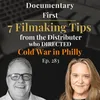
Ep. 283 I 7 Filmmaking Tips From the Distributor Who Directed "Cold War in Philly"
What does it really take to make a documentary that finds an audience and earns its money back?“You have to have the passion for the story and the passion to do the work, because it will not be easy.”— Joe AmodeiIf you want to make a documentary, the hardest questions are not the ones about cameras. They are about access, money, and whether anyone will ever watch it. In Documentary First Episode 283, a distributor who has spent more than forty-five years releasing films, and has now directed his first one, gives 7 filmmaking tips that cut straight to those questions, from getting access to a famous subject to setting a budget that can actually earn its money back.In Episode 283, Christian Taylor sits down with Joe Amodei, the founder of Virgil Films and a film distributor of more than forty-five years, who has released hundreds of documentaries including Super Size Me, the Oscar-nominated Restrepo, and Forks Over Knives. After decades of releasing other people's films and learning from the mistakes he watched filmmakers make, Joe finally made his own: Cold War in Philly, the story of the night in 1976 when the Philadelphia Flyers beat the Soviet Red Army. He came to find out whether his own advice would hold up.The throughline is simple and a little daring: a career distributor became a first-time director, determined not to repeat the mistakes he had watched other filmmakers make. Along the way he explains how he got access to a legendary NHL team through its alumni association, why he kept the budget under $250,000, why a built-in audience mattered so much, and a first documentary that sold out theaters across Philadelphia. Running underneath it is the Cold War itself: the KGB minders, the players who hated the government but not each other, and the heroes Joe got on camera before they were gone.IN THIS EPISODE, YOU'LL LEARN:How to get access to famous people and organizations, through the alumni associationWhat Joe did once he was in the room: prove yourself, be yourself, and be honestThe deals he had to clear before filming, the team, the owner, and the league, and that they took nearly a yearWhy a built-in audience is what decides whether an indie film succeedsWhat to budget for a documentary, and why Joe will not spend more than $250,000 on an indie docHow Joe made sure to get the players on camera, including two who passed away after their interviewsWhy his first film took two and a half years, and what he would do differently next timeThe qualities that make a film distributor worth trusting: answering calls, paying on time, being honestThe two things Joe says it takes to finish a filmWhy Joe believes the work is worth it, from the players' gratitude to a film that outlives everyoneCHAPTERS0:00 Becoming a First-Time Director2:42 How Do You Get Access?9:33 Capturing Heroes in Time13:04 Structuring the Documentary21:20 The Grind of Production28:11 Selling Out Theaters38:32 What Makes a Film Succeed?41:37 What Should a Doc Budget Be?44:48 How Do You Keep Going?47:38 Is Filmmaking Worth It?FREQUENTLY ASKED QUESTIONSHow do you get access to famous people or organizations for a documentary?Go through the alumni association. Joe Amodei got the Philadelphia Flyers by working with the team's alumni group, which controls appearances for former players. Nearly every major sports team and league has one, usually run by one or two people. Find that person, earn their trust, and they can open the door to the whole roster. Then be ready to handle the separate contracts with the team, the owner, and the league.How much does it cost to make a documentary?For an independent documentary
Podzilla Summary coming soon
Sign up to get notified when the full AI-powered summary is ready.
Free forever for up to 3 podcasts. No credit card required.
Listen to This Episode
More from Documentary First
Ep. 286 l RKO, Stax, and Music Rights: How Does a Catalog Become a Movie?
Ep. 285 l How to Make a Documentary With No Film School: 5 Lessons
Why Can't Your Documentary Find an Audience? l Deep Dive on Ep. 284
Ep. 284 I How to Fund a Documentary Without the Industry
Get summaries like this every morning.
Free AI-powered recaps of Documentary First and your other favorite podcasts, delivered to your inbox.
Free forever for up to 3 podcasts. No credit card required.