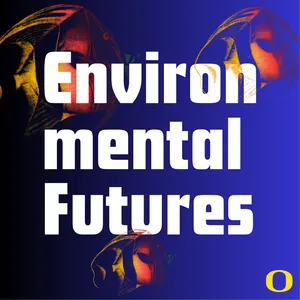
Free Daily Podcast Summary
Environmental Futures: Daily Summaries Delivered
by UOregon's Center for Environmental Futures
Mini-series about different parts of the earth. In season 1, Depths and Currents, we plunge the abyssal depths of ocean trenches, meet the Salmon People of the Salish Sea, travel in the ballast water of ocean tankers with Undaria pinnatifida (Wakame) seaweed, and learn how to foster resilience and collective care in times of crisis.
Latest Episodes
The most recent episodes — sign up to get AI-powered summaries of each one.
- 3 days ago45 min
In the spirit of right and respectful relations with Jay Julius
Got something to say to this podcast? Send a voicemail, and you might hear yourself on the next episode!What changes when we stop calling the living world a resource? Recorded on San Juan Island, this conversation with fisherman and former Lummi Nation chairman Jay Julius explores what it means to understand ourselves as part of, rather than separate from, the natural world. Through Lummi stories, fishing, salmon, killer whales, and the struggle to protect Xwe’chi’eXen (Cherry Point), Julius invites us to reconsider ideas of nature, resources, human supremacy, and the relationships that sustain life.https://se-si-le.orgReferencesRusso, Kurt W. 2025. In the Spirit of Right and Respectful Relations: Conversations about Indigenous Ways of Knowing and Being in Nature. First edition. With Jay Julius and Fiorella De La O. Braided River with Se’Si’Le.
- 1 weeks ago41 min
Passengers of Change with Joe Riley and Audrey Snyder
Got something to say to this podcast? Send a voicemail, and you might hear yourself on the next episode!What might environmental research look like if we learned to work at the speed of trust? In this episode, host Melody Allison talks with artists Joe Riley and Audrey Snyder about Passengers of Change, their collaborative exploration of Undaria pinnatifida, or wakame, in San Diego. Moving between studio, laboratory, archive, and ocean, their work brings art and science into conversation while questioning familiar stories about invasive species, belonging, and ecological change.At the heart of their practice is a deceptively simple mantra: “Include, involve, expand.” Riley and Snyder reflect on microscopic life, creating the Ballast Bench laboratory, and the patience, reciprocity, and trust necessary for meaningful collaboration. Their work invites us to move between panorama and detail, asking not only what we see when we look closely at environmental change, but how we might learn to see, research, and respond together.ReferencesProject website: https://www.passengersofchange.com/benchBrown, Adrienne M. 2017. Emergent Strategy: Shaping Change, Changing Worlds. AK Press.Hersey, Tricia. 2022. Rest Is Resistance : A Manifesto. First edition. Little, Brown Spark.
- 3 weeks ago54 min
The Abyss Stares Back with Stacy Alaimo
How do we learn to care for creatures we may never meet, in places we may never go? UO environmental humanities scholar Stacy Alaimo joins host Melody Allison to journey into the deep sea through her new book, The Abyss Stares Back, and to consider the creatures, images, and ethical questions we encounter there. Their conversation moves between wonder and violence, intimacy and estrangement, asking what happens when cameras, science, film, and art bring distant ocean lives close to us.From posthumanism to scientific capture, microplastics, and deep-sea mining, Alaimo asks what kinds of relationships are possible across enormous distances and differences. Can beauty and wonder move us toward care without turning other creatures into objects for human consumption? And what might happen if, rather than conquering the depths, we allowed ourselves to be unsettled by what looks back?Episode ReferencesBlue Peril. 2022. Film. Deep Sea Mining Campaign (DSMC), 2022. https://dsm-campaign.org/blue-peril/.Braidotti, Rosi. 2019. Posthuman Knowledge. Cambridge: Polity.Covarrubias, Miguel, Plate 1. With four jars of fanciful specimens in the background, a piscine-looking Beebe bends over to salt and fry a cheerful fish. Miguel Covarrubias, “Professor William Beebe,” in No. 2 of the Private Lives of the Great series, Vanity Fair, November 1933, 29. Library of Congress Control Number 2016680404. Image courtesy of Marina Elena Rico Covarrubias.Earle, Sylvia. 1996. Sea Change. New York: Ballantine.Haraway, Donna. 2003. The Companion Species Manifesto. Chicago: Prickly Paradigm.Majuli, Katrina. 2024. Managing Life's Future: Species Essentialism and Evolutionary Normativity in Conservation Policy, Practice, and Imaginaries. University of Oregon. https://scholarsbank.uoregon.edu/items/4d065eb3-efa5-4db6-a211-ec64ded2940dMeg 2: The Trench. 2023. Directed by Ben Wheatley. CMC Pictures.Oreskes, Naomi. 2014. “Scaling Up Our Vision.” Isis 105, no. 2.Sehgal, Melanie. 2018. “Aesthetic Concerns, Philosophical Fabulations: The Importance of a ‘New Aesthetic Paradigm.’” Substance 47, no. 1Widder, Edith. 2021. Below the Edge of Darkness: A Memoir of Exploring Light and Life in the Deep Sea. New York: Random House.Widder, Edith. 2016 “The Fine Art of Exploration.” Oceanography 29, no. 4.Wolfe, Cary. 2010. What Is Posthumanism? Minneapolis: University of Minnesota Press.
About Environmental Futures
Mini-series about different parts of the earth. In season 1, Depths and Currents, we plunge the abyssal depths of ocean trenches, meet the Salmon People of the Salish Sea, travel in the ballast water of ocean tankers with Undaria pinnatifida (Wakame) seaweed, and learn how to foster resilience and collective care in times of crisis.
Customized Recaps
AI-powered recaps with compact key takeaways, quotes, and insights.
Straight to Your Inbox
Get key takeaways from Environmental Futures in a 5-minute read.
Save Hours Every Week
Stay current on your favorite podcasts without falling behind.
Frequently Asked Questions
What is Podzilla's Environmental Futures daily summary?
It's a free AI-powered email that summarizes new episodes of Environmental Futures as soon as they're published. You get the key takeaways, notable quotes, and links & mentions — all in a quick read.
How does the Environmental Futures podcast summary work?
When a new episode drops, our AI transcribes and analyzes it, then generates a personalized summary tailored to your interests and profession. It's delivered to your inbox every morning.
Is this an official Environmental Futures product?
No. Podzilla is an independent service that summarizes publicly available podcast content. We're not affiliated with or endorsed by UOregon's Center for Environmental Futures.
Can I get summaries of other podcasts too?
Absolutely! The free plan covers up to 3 podcasts, any in the catalog. Basic raises that to 15, Pro to 40 and Max to 100. Browse our full catalog at /podcasts.
How often does Environmental Futures release new episodes?
Environmental Futures publishes biweekly. Our AI generates a summary within hours of each new episode.
What topics does Environmental Futures cover?
Environmental Futures covers topics including Science, Education, Nature. Our AI identifies the specific themes in each episode and highlights what matters most to you.
Start getting Environmental Futures summaries tomorrow morning.
Free forever for up to 3 podcasts. No credit card required.
Free forever for up to 3 podcasts. No credit card required.