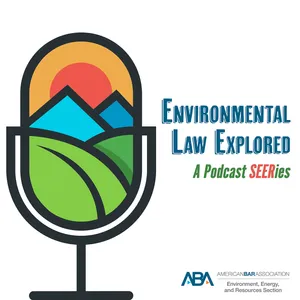
Free Daily Podcast Summary
Environmental Law Explored: A Podcast SEERies: Daily Summaries Delivered
by ABA Section of Environment, Energy, and Resources
Top environmental, energy, and resources lawyers discuss career development, legal issues, historical trends, and new developments in environmental law. The views, information, or opinions expressed in Environmental Law Explored: A Podcast SEERies are solely and exclusively those of the speakers and not those of the American Bar Association or the ABA Section of Environment, Energy, and Resources. Environmental Law Explored is intended for educational and informational purposes only.
Latest Episodes
The most recent episodes — sign up to get AI-powered summaries of each one.
- 3 weeks ago33 min
The Endangered Species Act at a Crossroads: Litigation, Regulation, and the Future of ESA Enforcement
*]:pointer-events-auto R6Vx5W_threadScrollVars scroll-mb-[calc(var(--scroll-root-safe-area-inset-bottom,0px)+var(--thread-response-height))] scroll-mt-[calc(var(--header-height)+min(200px,max(70px,20svh)))]" dir="auto" data-turn-id= "request-WEB:525dae71-3ec2-49c9-be14-5d140c2516ad-8" data-turn-id-container= "request-WEB:525dae71-3ec2-49c9-be14-5d140c2516ad-8" data-testid= "conversation-turn-12" data-scroll-anchor="false" data-turn= "assistant"> This podcast featuring Murray Feldman (Holland & Hart LLP) and Sam Kalen (Indiana University McKinney School of Law) examines the evolving legal and regulatory landscape surrounding the Endangered Species Act (ESA). Drawing from decades of experience in government, private practice, and academia, as well as their book, ESA Essentials: The Endangered Species Act, the speakers provide listeners with a practical overview of the ESA's core framework, including species listings, critical habitat designations, and the Section 7 consultation process. Tune in for an insightful conversation on where the ESA has been, the challenges it faces today, and what may lie ahead for one of the nation's most consequential environmental laws. For more from these speakers, see ESA Essentials: The Endangered Species Act, published by the American Bar Association.
- Dec 5, 202550 min
What We Talk About When We Talk About Forest Law
We are pleased to be joined by Professor John Leshy, author of Our Common Ground and the preeminent scholar on the history of America's public lands. Public land management is the cornerstone of forest law in the United States, and Professor Leshy's insights into its scope and evolution are invaluable in helping to piece together the fundamentals of forest law. Forest law presents a daunting barrier of entry to the uninitiated. Forest law is composed of and delimited by a broad swath of statutes, regulations, and norms, all shaped by a diverse array of stakeholders. The implications of forest management decisions are vast and varied, ranging from the hyperlocal—with decisions concerning timber harvest and wildfire mitigation bearing directly on the continued prosperity and existence of some rural communities—to the planetary, as climate change intensifies and the health of the world's forests grows ever further imperative to slow its most devastating effects. Complicating things further, today, forest law in the United States is undergoing rapid changes at the federal level. In beginning to explore the foundations of forest law, there is perhaps no better place to start than with a study of public lands. Host's note: This episode's title is an homage to the brilliant—and troubled—Raymond Carver and his 1981 short story collection "What We Talk About When We Talk About Love."
- Oct 28, 202539 min
Emerging Contaminants: Supply Chain
Emerging contaminants are by their nature neither fully regulated nor fully understood. In this final episode of the Emerging Contaminants series Juge Gregg (Crowell & Moring), Sal Giolando (Geosyntec Consultants, Inc.), and Adam Sowatzka (McGuire Woods) discuss how to assess emerging contaminants in your supply chains to identify potential substances that may be subject to further regulation or increase the risks associated with business operations. This episode explores how companies monitor and manage their supply chains through advanced technologies and strategic practices to prevent regulatory breaches and enhance transparency, ensuring they remain compliant and competitive in a global marketplace.
- Sep 25, 202546 min
Emerging Contaminants: Non-Tailpipe Vehicle Emissions
While we all notice the emissions exiting our vehicle's tailpipes, the emissions from brake dust and tire wear are often overlooked. Scientists are now turning their attention to these lesser-known pollutants, which are emerging as significant environmental concerns. As studies begin to grasp the extent of such impacts from automotive use on our environment, we discuss how regulation of these materials and emissions may impact our existing regulatory scheme and the auto industry as a whole. In this fourth episode of the Emerging Contaminants series, Jack Lyman speaks with Professor Greg Evans (University of Toronto) and Sean Dixon (Puget Soundkeeper) as they explore the role of contaminants like 6PPD and what future regulations might mean for the automotive sector.
- Sep 3, 202532 min
Emerging Contaminants: Pharmaceuticals and Personal Care Products (PPCPs)
Pharmaceuticals and personal care products can be found in every home in America, but now they are also showing up in our wastewater systems and even our lakes and rivers. In this third episode of the Emerging Contaminants series, hear from Professor Bill Arnold (University of Minnesota), Eva Weiler (K&L Gates), and Victor Xu (Marten Law) as they explore how these everyday products are making their way into the environment. The discussion also covers potential regulatory responses, including the possible U.S. ban of titanium dioxide—already prohibited in the EU—and the growing concern over pharmaceuticals and nanoparticles from personal care items polluting our waterways.
- Aug 15, 202530 min
Emerging Contaminants: Ethylene Oxide
In the second installment of our Emerging Contaminants series, we turn our attention to ethylene oxide, a chemical critical to the sterilization of medical and protective equipment yet increasingly scrutinized for its potential carcinogenic effects due to widespread use and long industrial history. In this episode, we're joined by Rebecca Pritchett (Maynard Nexsen), Heather Lynch (Integral Consulting), and David Fusco (K&L Gates) to examine the latest developments in ethylene oxide science, regulation, and litigation. Our guests discuss recent findings and interpretations suggesting that human health risks from ethylene oxide exposure may be lower than previously thought—a perspective that continues to generate scientific, legal, and policy debate.
- Jun 30, 202519 min
The ESG Era: Progress, Pushback, and the Path Ahead
In 2024, key legal and regulatory shifts transformed the ESG landscape across the U.S., Canada, U.K., and EU. In the U.S., the SEC adopted—and later stopped defending—climate disclosure rules, while the Department of Labor's ESG rule faced litigation and Congress advanced anti-ESG bills. At the same time, the EPA began deploying $27 billion under the Greenhouse Gas Reduction Fund, and youth-led climate lawsuits saw major wins. California's climate reporting laws (SB 253, SB 261, AB 1305) faced challenges but remained in effect, and greenwashing litigation expanded to cover broad corporate ESG claims. Internationally, the U.K. introduced mandatory Biodiversity Net Gain rules, the EU implemented the CSRD and CSDDD, and Canada passed a new Modern Slavery Act. Together, these changes mark a global move toward greater corporate transparency and environmental accountability. Join Josh Galperin, professor at the Elisabeth Haub School of Law, in conversation with Lauren Lynam and Morgan Martin as they unpack the year's most significant ESG legal developments across the U.S. and beyond.
- Jun 16, 202542 min
Emerging Contaminants: Microplastics
In the debut episode of our Emerging Contaminants series, we examine the widespread presence of microplastics in our environment, including in human and animal bodies and throughout our food systems. Because microplastics originate from larger plastic products, regulatory efforts have targeted the broader plastic lifecycle: from manufacture, import, and export to use, labeling, recycling, and disposal - with particular attention to single-use plastics. Join panelists Jennifer F. Novak (Law Office of Jennifer F. Novak), Talia Gordner (McMillan LLP), and Usha Vedagiri (WSP) as they discuss recent developments in plastic regulation, including the United Nations plastics treaty and efforts in the European Union and Canada, and share insights into what may lie ahead for the United States.
Get Environmental Law Explored: A Podcast SEERies summaries in your inbox
Free AI-powered daily recaps. Key takeaways, quotes, and mentions — in a 5-minute read.
Get Free Summaries →Free forever for up to 3 podcasts. No credit card required.
You Might Also Like
Listeners also like.
Stanford Legal
Experts analyze pressing legal issues, landmark cases, and constitutional questions shaping American democracy and society.
Lawless Planet
Each episode exposes environmental crimes and the high-stakes battles between those protecting the planet and those exploiting it.
Above the Law - Thinking Like a Lawyer
Three legal experts analyze everyday topics through a legal lens, exploring how law shapes common experiences and cultural phenomena.
Bloomberg Law
Legal analysis from prominent attorneys and scholars on current cases and news-shaping issues, hosted by June Grasso.
Law and Chaos
Legal journalists analyze pivotal courtroom cases and their impact on American democracy.

The Best SEO Podcast: Defining the Future of Search with LLM Visibility
Explores SEO and AI-driven marketing strategies in the evolving landscape of search engines and large language models.
Sustainable World Radio- Ecology and Permaculture Podcast
Experts discuss ecology, permaculture, organic gardening, and sustainable living through interviews and commentary.
Unf*cking the Future
A scientist explores environmental crises and practical solutions to secure a sustainable future.
The Lawfare Podcast
Discussions with experts on national security, law, and policy covering foreign policy, intelligence, cybersecurity, and governance.

Brief Recess: A Legal Podcast with Michael Foote & Mélissa Malebranche
Two lawyers dissect viral legal stories, answer listener questions, and explain how to use the law for social change.
The Just Security Podcast
Expert analysis of national security, foreign policy, and rights from practitioners, academics, and affected individuals.

The Law School Playbook
Provides coaching and resources to help students succeed in law school.
About Environmental Law Explored: A Podcast SEERies
Top environmental, energy, and resources lawyers discuss career development, legal issues, historical trends, and new developments in environmental law. The views, information, or opinions expressed in Environmental Law Explored: A Podcast SEERies are solely and exclusively those of the speakers and not those of the American Bar Association or the ABA Section of Environment, Energy, and Resources. Environmental Law Explored is intended for educational and informational purposes only.
Customized Recaps
AI-powered recaps with compact key takeaways, quotes, and insights.
Straight to Your Inbox
Get key takeaways from Environmental Law Explored: A Podcast SEERies in a 5-minute read.
Save Hours Every Week
Stay current on your favorite podcasts without falling behind.
Frequently Asked Questions
What is Podzilla's Environmental Law Explored: A Podcast SEERies daily summary?
It's a free AI-powered email that summarizes new episodes of Environmental Law Explored: A Podcast SEERies as soon as they're published. You get the key takeaways, notable quotes, and links & mentions — all in a quick read.
How does the Environmental Law Explored: A Podcast SEERies podcast summary work?
When a new episode drops, our AI transcribes and analyzes it, then generates a personalized summary tailored to your interests and profession. It's delivered to your inbox every morning.
Is this an official Environmental Law Explored: A Podcast SEERies product?
No. Podzilla is an independent service that summarizes publicly available podcast content. We're not affiliated with or endorsed by ABA Section of Environment, Energy, and Resources.
Can I get summaries of other podcasts too?
Absolutely! The free plan covers up to 3 podcasts. Upgrade to Pro for 15, or Premium for 50. Browse our full catalog at /podcasts.
How often does Environmental Law Explored: A Podcast SEERies release new episodes?
Environmental Law Explored: A Podcast SEERies publishes monthly. Our AI generates a summary within hours of each new episode.
What topics does Environmental Law Explored: A Podcast SEERies cover?
Environmental Law Explored: A Podcast SEERies covers topics including Education, Business, Non-Profit. Our AI identifies the specific themes in each episode and highlights what matters most to you.
Start getting Environmental Law Explored: A Podcast SEERies summaries tomorrow morning.
Free forever for up to 3 podcasts. No credit card required.
Free forever for up to 3 podcasts. No credit card required.