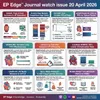
EP Edge Journal Watch Issue 20: AF Screening, Pulsed Field Ablation, ICD Shocks, CRT in AF, and Anticoagulation After Ablation
In this episode of EP Edge™ Journal Watch Issue 20, Dr. Sharma reviews some of the most clinically relevant new developments in cardiac electrophysiology, with a sharp focus on atrial fibrillation screening, pulsed field ablation expansion, device therapy trade-offs, and post-ablation anticoagulation strategy.This issue examines how Apple Watch–based atrial fibrillation detection performed in a randomized trial, and whether wearable screening becomes truly useful only when paired with a real adjudication workflow. It also reviews AI-enabled ECG risk models for AF screening, highlighting how precision screening may outperform broad age-based approaches by identifying the patients most likely to benefit from active surveillance.On the device side, this episode analyzes the randomized evidence comparing subcutaneous versus transvenous implantable cardioverter-defibrillators, with special attention to the mechanisms behind inappropriate shocks and how that should influence real-world patient counseling. It also covers the CAAN-AF trial, asking whether atrioventricular node ablation in patients with cardiac resynchronization therapy and permanent atrial fibrillation should remain routine when baseline rate control is already acceptable. In addition, the episode discusses new real-world data on leadless atrial pacing with AVEIR AR versus transvenous pacing for sinus node dysfunction, focusing on complications, reinterventions, and front-line device selection.A major section of the podcast is devoted to the rapid evolution of pulsed field ablation. Dr. Sharma reviews data on PFA versus radiofrequency ablation for typical atrial flutter, the LINEAR randomized trial of lattice-tip versus standard focal-tip catheter ablation for cavotricuspid isthmus lesions, and two important platform-specific studies—PULSAR and VARIPURE—that address lesion durability, workflow efficiency, and the growing question of whether next-generation PFA systems can deliver more reproducible pulmonary vein isolation in contemporary practice.The episode closes with a practical discussion of oral anticoagulant discontinuation after successful AF ablation, examining new data on the timing of anticoagulation withdrawal and the ongoing tension between bleeding reduction and thromboembolic protection.If you follow atrial fibrillation, catheter ablation, implantable cardioverter-defibrillators, cardiac resynchronization therapy, leadless pacing, wearable AF detection, and contemporary electrophysiology trials, this episode is built for you. Expect concise trial summaries, clear statistical interpretation, and the EP Edge™ critical appraisal of what these findings should actually mean for clinical practice.All references and graphics are available through the EP Edge Journal Watch newsletter on LinkedIn as well as on Substack at epedge.substack.com.
Podzilla Summary coming soon
Sign up to get notified when the full AI-powered summary is ready.
Free forever for up to 3 podcasts. No credit card required.
Listen to This Episode
More from EP Edge Journal Watch
Inaugural EP EdgeTM Journal Watch with Heart Rhythm Society: AVANT GUARD, LAA Closure, OCEAN, and the ALONE-AF Cognitive Substudy
EP Edge Journal Watch Issue 23 May 2026: PFA Durability, Posterior Wall Ablation, Outflow Tract PVCs, and Fitness as Substrate Modification
EP Edge Journal Watch Issue 22: PFA Safety, Lesion Durability, LAAO, Subcutaneous-ICD Testing & AF Ablation Success
EP Edge Journal Watch Issue 21 May 2026: AI-Guided AF Ablation, PFA/CIED Safety, VT Ablation, Cannabis and Arrhythmia Risk, HCM, HFpEF, RBBB, and Anticoagulation After AF Ablation
Get summaries like this every morning.
Free AI-powered recaps of EP Edge Journal Watch and your other favorite podcasts, delivered to your inbox.
Free forever for up to 3 podcasts. No credit card required.