Free Daily Podcast Summary
Failure to Franchise: Daily Summaries Delivered
by Trev & Chris
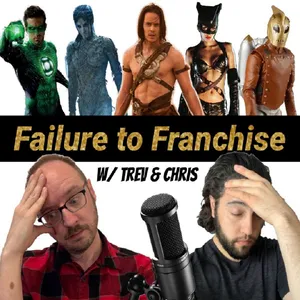
A bi-weekly podcast devoted to infamous examples of failed film-franchise starters. In a Hollywood landscape dominated by giant tentpole movies, not all attempted franchises can succeed. Many intended first entries of a series fail to generate the planned sequels due to low box office, poor judgement, or, simply put... utter incompetence. This show is a celebration of (or perhaps a memorial for) those failures, as hosts Trev and Chris dissect what went wrong with these cinematic misfires.@F2Fpod on all the socials!Like us there, Like us everywhere!
Latest Episodes
The most recent episodes — sign up to get AI-powered summaries of each one.
- Yesterday1h 38m
Episode 151 - Car 54, Where Are You? (1994) w/ Special Guest: Bede Jermyn
A successful music video director and the filmmaker behind a recently well-received cult hit is hired to helm the cinematic adaptation of a beloved '60s sitcom. Clearly aiming for something more hip and edgy than the original show, he largely eschews the tone of the source material, instead populating his film with esoteric cult celebs and performers, upping the raunch factor, and filming it as a musical. And then...nothing. The movie sits on the shelf for almost four years. Until - unbeknownst to the director himself - it is finally quietly released, in a drastically altered studio cut. Yes, the little-remembered Car 54, Where Are You? is truly one of strangest movies (and stories behind the movie) that we have done yet. So strange, we couldn't tackle it alone! And so, joining us for this New York movie edition of "Summer Surprise" is Trev's co-host from Bede & Trev vs The Big Apple, Bede Jermyn, aka "The Terrible Aussie." Our Twitter Our Facebook Our Instagram Our YouTube Trev's Letterboxd Chris' Letterboxd Bede's Letterboxd Bede's Linktree Bede & Trev Vs. The Big Apple
- 2 weeks ago1h 27m
Episode 150 - Action Jackson (1988)
A mega-successful Hollywood producer. A popular star ready for his first big lead role. A respected actor one year away from an iconic sitcom role. A singer turned actor enjoying the height of her sex symbol status. Another actress just a few years away from becoming one of the industry's all-time biggest sex symbols. And explosions. Lots and lots of explosions. Put them all together, and you got a stew going, baby! This year's "Summer Surprise," in which we let an online randomizer pick our movies for us, kicks off with Action Jackson, an 80s blaxploitation riff from mega action producer Joel Silver, and starring the late, great Carl Weathers. The film was meant to finally catapult Weathers into the same above-the-title megastar status as his famed co-stars Sylvester Stallone and Arnold Schwarzenegger, and Silver brought along a bunch of cast and crew from his other recent efforts to help make it happen. So, what happened? Why are there multiple Lethal Weapon's, Die Hard's, and Predator's, but only one Action Jackson? We try to figure it out, while jumping out of the way of the sports car barreling down our hallway. Our Twitter Our Facebook Our Instagram Our YouTube Trev's Letterboxd Chris' Letterboxd
- 4 weeks ago1h 42m
Episode 149 - Dolittle (2020)
Your iconic turn as a superhero made you one of Hollywood's most beloved (and well paid) stars, jump-started a genre's total dominance of the cinematic landscape, and gave you a decade-plus of mega-successful sequels and spin-offs. But that gig has finally ended. What do you do? Well, if you're Robert Downey Jr., and you've recently wrapped your long tenure as Tony Stark/Iron Man with Avengers: Endgame, you quickly find another franchise to jump into. Unfortunately for RDJ, his choice - a new spin on Dr. Dolittle, the classic kids book character who can talk to animals - wasn't as successful as his MCU days. But is the movie really the disaster many (including RDJ himself, after the fact) made it out to be? We're scrubbing up and getting ready to examine, as "June Is What the Doctor Ordered" comes to a close. Plus, after the Dolittle discussion, we allow an online randomizer to choose our next four featured movies for the upcoming "Summer Surprise" series! Our Twitter Our Facebook Our Instagram Our YouTube Trev's Letterboxd Chris' Letterboxd
- Jun 16, 20261h 19m
Episode 148 - Dr. Giggles (1992)
By the early '90s, the slasher subgenre that had dominated horror in the '80s was already seen as on life support. But that didn't stop an upstart comic book company, formed in 1986 and already quite successful in the publishing world, from seeing the genre as potentially their ticket to join the movie big leagues. And so, four years before Scream would re-invent and re-popularize the slasher, Dark Horse Comics first tried to revive the genre with a more "traditional," if somewhat dark-comedy skewed, entry. And let's face it, who better to "revive" and "resuscitate" a genre than a doctor? Though, it's safe bet the maniacal doctor played by Larry Drake in this film is not one you'd want making a house call. "June is What the Doctor Ordered" continues, as we take a look at 1992's Doctor Giggles, the film that dares to ask, "just how many medical puns can you fit into one movie??" Our Twitter Our Facebook Our Instagram Our YouTube Trev's Letterboxd Chris' Letterboxd
- Jun 2, 20261h 27m
Episode 147 - Doctor Detroit (1983)
They say there ain't no cure for the summertime blues, but we here at F2F disagree. So allow Trev & Chris to make a house-call, as we ring in a brand new series - "JUNE is What the Doctor Ordered," taking a look at three doctor-themed (sorta) movies. First up, the 1983 oddity Doctor Detroit, perhaps most remembered as SNL legend Dan Aykroyd's first (and last?) solo starring role in a movie. Aykroyd plays a nebbish college professor forced to pose as a tough-talking pimp in order to protect four beautiful sex workers from the wrath of an evil crime boss named "Mom." And if that premise already sounds pretty out-there to you, well, we haven't even said anything about the costuming, voice, and mannerism choices Aykroyd makes in regards to his "Doctor Detroit" persona. Why exactly did a movie starring a beloved comic icon, released so close to hits like Trading Places and Ghostbusters, not connect with audiences? We're here to diagnose what might have gone wrong. Our Twitter Our Facebook Our Instagram Our YouTube Trev's Letterboxd Chris' Letterboxd
- May 19, 20261h 47m
Episode 146 - Terminator Genisys (2015)
"No Fate But What We MAYke" concludes, with the TERMINATOR franchise under new ownership, and looking to forge a new path forward...by going all the way back to the beginning. That's right - perhaps appropriately for a series whose story has been built on a bootstrap paradox/causal loop time travel convention, TERMINATOR GENISYS looks to revisit and revisit and reinvent the events of the original TERMINATOR, creating a movie where even the makers seemed unsure whether to label it a "sequel," a "reboot," or an original "stand-alone entry." But despite the confusion, and despite obviously having to recast several of the key characters with new, younger actors, they did have at least one undeniable not-so-secret weapon: the return of Arnold Schwarzenegger to a starring role in the franchise. Was Arnie's return enough to make the film's story feel worth telling? Did the new actors live up to the original performances of the previous actors? How responsible might TERMINATOR GENISYS be for the glut of "legacy sequels" that followed in its wake? And just what is this franchise's beef with John Connor?? We discuss all this and more, so come with us if you want to live! Our Twitter Our Facebook Our Instagram Our YouTube Trev's Letterboxd Chris' Letterboxd
- May 5, 20261h 47m
Episode 145 - Terminator Salvation (2009)
Did the Terminator franchise really need to live on past James Cameron's excellent T2: Judgment Day? Probably not! But Hollywood can't let a good (or moneymaking) franchise die. And so after the strong performance of Terminator 3: Rise of the Machines, not even franchise star Arnold Schwarzenegger leaving movies for the world of politics could kill the series. But what is a franchise to do when it's under new ownership and it's lost it's usual leading man? The makers of the fourth entry decided to use the opportunity to finally deliver a movie the franchise's fans had been clamoring for since the beginning - a film set entirely during the post Judgment Day future war. And they recruited two new powerhouse leading men to front it - Christian Bale, a newly minted Hollywood blockbuster star after the mega-success of The Dark Knight, and Sam Worthington, a name on the rise about to also star in the same year's most anticipated blockbuster, Avatar (from, yep...James Cameron). So what could possibly go wrong? Well, the pre-release leak of audio of Bale freaking out and yelling at a crewmember, which overshadowed much else of the film's release, might be the start of the answer...but what about the movie itself? Join us as we start out new theme month - "No Fate But What We MAYke" - as we discuss 2009's Terminator Salvation! Our Twitter Our Facebook Our Instagram Our YouTube Trev's Letterboxd Chris' Letterboxd
- Apr 21, 20261h 27m
Episode 144 - American Samurai (1992)
"Misfired Cannons" comes to a conclusion as a post Golan & Globus era Cannon limps to its final days amidst new ownership but continued, and growing, financial woes. In a blatant attempt to try to recapture some of their past glory, Cannon looked to start a new franchise that might capture the same fans as those of one of its most popular previous successful series, American Ninja. So, recruiting one of the stars of that franchise, and the director of the first installments, Cannon unleashed American Samurai. But even with the lowered expectations of a straight-to-video release, this film didn't enjoy the same financial or cult success of the American Ninja series. So, what went wrong? We discuss leading man (and another important Cannon figure) David Bradley, the onscreen debut of martial arts star Mark Dacascos, the movie's strange "love story," its similarities to American Ninja, and why its attempt to also copy the recent success of another martial arts movie, Bloodsport, may have been its downfall. Our Twitter Our Facebook Our Instagram Our YouTube Trev's Letterboxd Chris' Letterboxd
About Failure to Franchise
A bi-weekly podcast devoted to infamous examples of failed film-franchise starters. In a Hollywood landscape dominated by giant tentpole movies, not all attempted franchises can succeed. Many intended first entries of a series fail to generate the planned sequels due to low box office, poor judgement, or, simply put... utter incompetence. This show is a celebration of (or perhaps a memorial for) those failures, as hosts Trev and Chris dissect what went wrong with these cinematic misfires.@F2Fpod on all the socials!Like us there, Like us everywhere!
Customized Recaps
AI-powered recaps with compact key takeaways, quotes, and insights.
Straight to Your Inbox
Get key takeaways from Failure to Franchise in a 5-minute read.
Save Hours Every Week
Stay current on your favorite podcasts without falling behind.
Frequently Asked Questions
What is Podzilla's Failure to Franchise daily summary?
It's a free AI-powered email that summarizes new episodes of Failure to Franchise as soon as they're published. You get the key takeaways, notable quotes, and links & mentions — all in a quick read.
How does the Failure to Franchise podcast summary work?
When a new episode drops, our AI transcribes and analyzes it, then generates a personalized summary tailored to your interests and profession. It's delivered to your inbox every morning.
Is this an official Failure to Franchise product?
No. Podzilla is an independent service that summarizes publicly available podcast content. We're not affiliated with or endorsed by Trev & Chris.
Can I get summaries of other podcasts too?
Absolutely! The free plan covers up to 3 podcasts. Upgrade to Pro for 15, or Premium for 50. Browse our full catalog at /podcasts.
How often does Failure to Franchise release new episodes?
Failure to Franchise publishes biweekly. Our AI generates a summary within hours of each new episode.
What topics does Failure to Franchise cover?
Failure to Franchise covers topics including History, Film, TV & Film, Film Reviews. Our AI identifies the specific themes in each episode and highlights what matters most to you.
Start getting Failure to Franchise summaries tomorrow morning.
Free forever for up to 3 podcasts. No credit card required.
Free forever for up to 3 podcasts. No credit card required.