Free Daily Podcast Summary
From First Principles: Daily Summaries Delivered
by Krishna Choudhary and Lester Nare
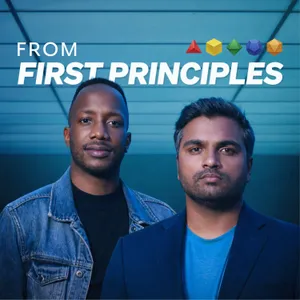
From First Principles is a fast, funny, and rigorous breakdown of the biggest science stories of the week, hosted by Lester Nare and physicist Krishna Choudhary, PhD. We go past headlines into the actual mechanics: what happened, why it matters, and what everyone’s missing. Expect physics, space, AI, energy, biotech, and the occasional “wait… is that real?” story. If you’re curious, skeptical, and you like learning in public — you’re in the right place.
Latest Episodes
The most recent episodes — sign up to get AI-powered summaries of each one.
- Today40 min
2026 Nobel Prize Predictions: Medicine, Physics & Chemistry (EP 60)
Who could win the 2026 Nobel Prizes? From the science behind Ozempic to quantum interference and droplets inside living cells, Lester Nare and Krishna Choudhary make their picks for Medicine, Physics and Chemistry, and explain the discoveries behind them.In Episode 60 of From First Principles, we explore seven research areas with a case for Nobel recognition: GLP-1, optogenetics, optical coherence tomography, the Aharonov–Bohm effect, atomic force microscopy, biomolecular condensates and Buchwald–Hartwig coupling. We also discuss Michael Berry’s geometric phase and the awkward question of how a prize limited to three people recognizes discoveries built by larger teams.These are our predictions, recorded before the 2026 announcements. Medicine, Physics and Chemistry will be announced October 5–7. Which discovery, and which researchers, would you pick? Tell us in the comments, then join us for our Nobel week breakdowns.CHAPTERS00:00 The science that could win a Nobel Prize00:57 Hello Internet: our 2026 predictions02:03 Medicine: GLP-1 and the science behind Ozempic07:41 Medicine: optogenetics and controlling neurons with light13:16 Medicine: optical coherence tomography16:28 Golden Goose Awards and FFP updates18:39 Physics: the Aharonov–Bohm effect and geometric phase27:37 Physics: atomic force microscopy32:04 Chemistry: biomolecular condensates36:36 Chemistry: Buchwald–Hartwig coupling38:42 Your predictions and our Nobel week plansRESEARCH & FURTHER READINGFoundational papers and background for the discoveries discussed:GLP-1: Mojsov, Weir & Habener (1987)https://doi.org/10.1172/JCI112855Optogenetics: Boyden et al. (2005)https://doi.org/10.1038/nn1525Optical coherence tomography: Huang et al. (1991)https://doi.org/10.1126/science.1957169Aharonov–Bohm effect (1959)https://doi.org/10.1103/PhysRev.115.485Berry’s geometric phase (1984)https://doi.org/10.1098/rspa.1984.0023Atomic force microscopy: Binnig, Quate & Gerber (1986)https://doi.org/10.1103/PhysRevLett.56.930Biomolecular condensates: Brangwynne et al. (2009); Li et al. (2012)https://doi.org/10.1126/science.1172046https://doi.org/10.1038/nature10879Buchwald–Hartwig coupling: Paul et al. (1994); Guram et al. (1995)https://doi.org/10.1021/ja00092a058https://doi.org/10.1002/anie.199513481Official Nobel announcement schedule:https://www.nobelprize.org/prizes/about/prize-announcement-dates/EDITORIAL NOTES19:30 David Bohm later held a professorship at Birkbeck, University of London (1961–1987); he did not spend the rest of his career in Brazil.33:23 The ribosome-producing compartment discussed is the nucleolus, not the nucleosome. These corrections also appear on screen.WATCH & EXPLOREYouTube: https://youtu.be/MgOpbh5VUGEEpisode page and research library: https://ffppod.com/episodes/ep60Support: https://ffppod.com/donateFollow @FFPPod on X / Instagram / TikTok / FacebookBreaking down science news so it makes sense to curious people everywhere.
- 4 days ago2h 7m
Golden Goose Awards 2026: The Science Behind the Winners (Part 1) (EP 59)
What connects a noise complaint, holiday lights seen from space, and the physics of a coffee stain? Three unexpected paths from basic research to discoveries with real-world impact.Krishna Choudhary and Lester Nare explore the science behind the 2026 Golden Goose Awards: Zhen Xu's work on histotripsy, NASA's Black Marble nighttime satellite data, and Sidney Nagel's discoveries in soft matter physics.We start with focused ultrasound and the tiny bubbles that can break apart targeted tissue, tracing the journey from early laboratory experiments to clinical research on liver tumors. Then we look at how Earth's nighttime lights reveal power outages, disaster recovery, and changing human activity. Finally, falling drops, coffee stains, and jammed grains open up a world of robotic grippers and materials that can be trained and retrained.The thread connecting all three stories is the unexpected value of federally funded basic research. Part 2 will feature conversations with the award-winning researchers and AAAS CEO Sudip Parikh.CHAPTERS00:00 Golden Goose Awards trailer01:19 Introducing our Golden Goose special02:42 Zhen Xu: From a noise complaint to histotripsy05:57 The early ultrasound experiments13:42 Controlling cavitation with microtripsy20:29 Tumor destruction and the immune response28:33 Histotripsy through the skull37:23 The HOPE4LIVER clinical trial43:55 Why basic research needs time47:17 FFP updates and supporting the show49:20 NASA Black Marble: Holiday lights from space55:29 Turning night lights into reliable data1:01:36 Hurricane Maria and unequal recovery1:08:12 COVID-19 and changing nighttime activity1:10:16 Mapping access to electricity1:15:20 Where Earth is brightening and dimming1:32:57 Sidney Nagel and the physics of everyday life1:37:07 The science of a falling drop1:46:02 Why coffee leaves a ring1:51:04 Jamming: When grains become rigid1:53:35 A robotic gripper filled with grains1:55:39 Why air pressure changes a splash1:58:55 Materials that can be trained and retrained2:03:26 The payoff from curiosity2:05:29 Coming in Part 22:07:06 OutroFEATURED RESEARCHHistotripsy: The #HOPE4LIVER single-arm pivotal trial (Radiology, 2024)https://doi.org/10.1148/radiol.233051NASA's Black Marble nighttime lights product suite (Remote Sensing of Environment, 2018)https://doi.org/10.1016/j.rse.2018.03.017Training and retraining liquid crystal elastomer metamaterials for pluripotent functionality (PNAS, 2025)https://doi.org/10.1073/pnas.2504304122WATCH ON YOUTUBEhttps://youtu.be/rDInUEtTojgEXPLORE FFPWebsite: https://ffppod.comScience Funding Tracker: https://ffppod.com/fundingScience Transfer Portal: https://ffppod.com/transfersAmerica 250: https://ffppod.com/America250SUPPORT THE SHOWhttps://ffppod.com/donateFOLLOW@FFPPod on X / Instagram / TikTok / Facebook
- 1 weeks ago4h 9m
What OpenAI Actually Did to Navier-Stokes (EP 58)
What does it mean to solve an equation that describes almost every fluid around us, from the air over a wing to the water swirling down a drain?In Episode 58 of From First Principles, Lester Nare and Krishna Choudhary build the Navier-Stokes equations from the ground up before digging into OpenAI’s claimed breakthrough and the debate surrounding it.SummaryHow Newton’s laws become equations for a moving fluidVelocity fields, incompressibility, pressure and the nonlinear convective termWhy viscosity smooths a fluid while nonlinear motion can create finer structureWhat finite-time blowup means, and why simulation is different from proofHow forced and unforced equations differ, and why those assumptions matterEarlier work on Euler, Boussinesq and related fluid equationsOpenAI’s claimed result, Lean verification and the scope of the theoremThe dispute over scientific credit and the human research behind AI-assisted workThe METR investigation of the Hugging Face incidentEmergence World and long-running multi-agent experimentsAI-assisted biological discovery, oversight and recursive self-improvementSeparating demonstrated capabilities from claims and future scenariosChapters00:00 Can AI solve Navier-Stokes?00:34 Episode introduction02:20 Navier-Stokes: Mathematics Meets AI10:20 Building the Equations of Fluid Motion21:34 Velocity fields, divergence and incompressibility34:33 Acceleration and the convective term52:18 Why Fluid Motion Is Nonlinear1:02:08 Pressure, Euler and the Missing Physics1:14:50 How Viscosity Changes Everything1:33:36 Solving Equations vs. Simulating Fluids1:44:59 Can a Smooth Fluid Blow Up?2:13:52 The Road to the Claimed Breakthrough2:31:13 Inside the Claimed Navier-Stokes Proof2:48:26 The Dispute Over Scientific Credit3:07:23 From Chatbots to Agents3:08:57 The METR report and Hugging Face incident3:23:23 AI Risk, Oversight and the Race Ahead3:38:51 AI Discovery Beyond Mathematics3:52:47 Why “just turn it off” gets complicated4:06:47 Closing thoughts and what comes next4:08:46 OutroFeatured ResearchOpenAI’s Navier-Stokes announcementTristan Buckmaster’s statementMETR investigationEmergence WorldAI-assisted enzyme discoveryExplore FFPffppod.comffppod.com/fundingffppod.com/transfersffppod.com/America250Watch on YouTubeyoutu.be/NGfGw1tGxUYSupport the showffppod.com/donateFollow@FFPPod on X / Instagram / TikTok / Facebook
- 2 weeks ago1h 5m
What’s Next in Science? Nobel Prizes, Space Missions & More (EP 57)
What science should you be watching this fall? From Nobel Prize season to NASA’s Roman Space Telescope, Mars’ moons and Mercury, Lester Nare and Krishna Choudhary take a relaxed tour of the discoveries and missions on their radar.In Episode 57 of From First Principles, we explore why curiosity-driven research matters, what the Golden Goose Awards celebrate, and how questions that once sounded impractical can lead to unexpected breakthroughs. Then we turn to space: Roman’s search for dark energy and exoplanets, JAXA’s Martian Moons eXploration (MMX) mission, and the mysteries ESA and JAXA’s BepiColombo mission will investigate at Mercury.Along the way, we tour the updated FFP website, revisit some favorite episodes, and ask which stories you want us to cover in depth next.A note before we begin: the main conversation was recorded before Labor Day weekend. The opening announcement addresses your requests for a separate episode on OpenAI, Navier–Stokes and the wider AI conversation. This episode is our fall science rundown; that deep dive is still to come.CHAPTERS00:00 Update on our upcoming Navier–Stokes and AI coverage03:43 Episode intro and football banter05:47 FFP intro06:01 Nobel Prize season and our coverage plans10:45 Golden Goose Awards: why basic research matters21:02 FFP website tour and favorite episodes42:24 Nancy Grace Roman Space Telescope46:20 Microlensing, exoplanets and dark matter51:25 MMX: where did Mars’ moons come from?54:40 BepiColombo and the mysteries of Mercury1:02:17 Your questions, future deep dives and sign-off1:05:40 OutroSHOW NOTESNASA’s Nancy Grace Roman Space Telescope:https://science.nasa.gov/mission/roman-space-telescope/JAXA’s Martian Moons eXploration (MMX):https://www.mmx.jaxa.jp/en/mission/ESA / JAXA BepiColombo:https://www.esa.int/Science_Exploration/Space_Science/BepiColomboExplore the research and episodes we cover:https://ffppod.comScience R&D Funding Tracker:https://ffppod.com/fundingScience Transfer Board:https://ffppod.com/transfersAmerica 250:https://ffppod.com/America250Support the show:https://ffppod.com/donateWATCH ON YOUTUBEhttps://youtu.be/snhQh0fjTX4Follow @FFPPod on X / Instagram / TikTok / FacebookBreaking down science news so it makes sense to curious people everywhere.Which mission or research story deserves a full FFP deep dive? Tell us in the comments.
- 3 weeks ago1h 35m
The Yak Mutation That Could Help Repair the Brain (EP 56)
What can a yak living thousands of meters above sea level teach us about repairing the human brain?In Episode 56 of From First Principles, Lester Nare and Krishna Choudhary break down a new Neuron paper that traces an evolutionary adaptation found in high-altitude animals to a previously hidden pathway involved in building and repairing myelin.SummaryWhat myelin actually does and why losing it disrupts neural communicationHow multiple sclerosis damages myelin and why the brain’s natural repair process eventually failsWhy oligodendrocyte precursor cells can remain present in damaged tissue without successfully rebuilding myelinWhy current therapies are better at slowing further damage than restoring what has already been lostThe challenge of getting drugs across the blood-brain barrier while maintaining target specificityHow evolutionary pharmacology has previously produced medicines from adaptations found in snakes and Gila monstersThe RETSAT Q247R variant identified in animals adapted to the hypoxic environment of the Tibetan PlateauHow researchers engineered the high-altitude variant into mice and tested its effect on myelinThe surprising discovery that neurons — rather than the myelin-producing cells themselves — generate the key repair signalHow RETSAT increases ATDR, which neurons convert into ATDRAHow ATDRA activates RXR-γ in oligodendrocyte precursor cells and promotes their differentiationHow administration of ATDR promoted remyelination across multiple preclinical modelsWhy the result is scientifically promising but still far from a proven human treatmentFeatured PaperA gain-of-function Retsat variant from high-altitude adaptation promotes myelination via a neuronal dihydroretinoic acid-RXR-γ pathwayNeuron, 2026DOI: 10.1016/j.neuron.2026.01.013Explore FFPffppod.comffppod.com/fundingffppod.com/transfersffppod.com/America250Support the showffppod.com/donateFollow@FFPPod on X / Instagram / TikTok / Facebook
- Aug 31, 20263h 46m
Why Spin Qubits Will Win the Quantum Race (Part 2) (EP 55)
Which quantum computer will actually scale?In Part 2 of our quantum computing deep dive, Lester Nare and Krishna Choudhary move from theory to hardware—comparing superconducting qubits, trapped ions, neutral atoms, and silicon spin qubits before going inside the new Nature cover paper Krishna co-authored with the HRL Quantum Team and collaborators.The episode begins with a simple question: what makes a good quantum computer? We evaluate each architecture using three criteria: qubit quality, qubit control, and scalability and economics.Superconducting qubits offer extremely fast operations, but scaling them introduces challenges involving microwave control, frequency crowding, cryogenic wiring, physical size, and cooling. Trapped ions preserve quantum information for extraordinary lengths of time, but their slower gates and increasingly complex optical systems introduce a different set of tradeoffs. Neutral atoms can be arranged in dense, reconfigurable arrays using optical tweezers and entangled through Rydberg interactions, while raising questions involving atom loss, correlated noise, readout, and execution time.Then we get to silicon.Beginning with the Loss–DiVincenzo proposal, Krishna explains how individual electron spins can be confined inside semiconductor quantum dots, manipulated through exchange interactions, and measured using single-electron transistors. We then explore exchange-only qubits, where three electron spins encode a single qubit and quantum gates can be performed using electrical control.That leads to the Nature cover paper, A digitally controlled silicon quantum processing unit. The HRL system integrates 18 encoded qubits built from 54 quantum dots with cryogenic control electronics, a superconducting interconnect, automated calibration, and an engineered silicon-germanium heterostructure.Krishna also explains his own work using machine learning to automate quantum-device tuning—an essential problem if spin-qubit systems are ever going to grow from dozens of components to millions.The larger thesis is about manufacturing. The semiconductor industry has spent decades learning how to fabricate silicon devices at enormous scale. If quantum processors can inherit that infrastructure, the architecture that ultimately wins may not be the one that reaches the finish line first—but the one humanity already knows how to manufacture.Nature paper:A digitally controlled silicon quantum processing unitDOI: 10.1038/s41586-026-10754-7https://www.nature.com/articles/s41586-026-10754-7Explore the FFP Science Transfer Portal:ffppod.com/transfersSupport the show:ffppod.com/donateFollow:@FFPPod on X / Instagram / TikTok / Facebook
- Aug 20, 20262h 11m
How Quantum Computing Actually Works (Part 1) (EP 54)
Quantum computers do not simply “try every answer at once.” So what do they actually do—and why have governments and technology companies spent billions trying to build them?In Part 1 of our two-part quantum computing deep dive, Lester Nare and Krishna Choudhary build the field from first principles.The series was prompted by a new Nature cover paper, A digitally controlled silicon quantum processing unit, co-authored by Krishna and members of the HRL Quantum Team and collaborators. Before getting into that hardware in Part 2, we first need to understand why anyone wanted to build a quantum computer in the first place.We begin with Bell’s theorem and the failure of local hidden-variable explanations of quantum mechanics. From there, we follow the realization that information is fundamentally physical through Rolf Landauer, reversible computation, Charles Bennett, Tommaso Toffoli, Paul Benioff, and the origins of quantum information science.Then Richard Feynman changes the question. Straightforward classical simulation of an interacting quantum system requires tracking a state space that grows exponentially with the number of particles. If nature itself is quantum mechanical, Feynman asks, why not build a computer that is quantum mechanical too?David Deutsch formalizes the universal quantum computer and introduces the first quantum algorithm. Using the Deutsch–Jozsa problem, the double-slit experiment, and Feynman’s path-integral intuition, we explain what a quantum algorithm is actually exploiting: carefully engineered constructive and destructive interference.Finally, we reach the discoveries that turned quantum computing from an academic curiosity into a strategic technology. Daniel Simon develops an early exponential quantum speedup. Peter Shor recognizes how the underlying mathematics can be used to attack problems central to public-key cryptography. Lov Grover follows with a quantum search algorithm—and suddenly governments have a very different reason to care about quantum machines.We also explore quantum money, quantum cryptography, the many-worlds interpretation, Google Willow and parallel-universe headlines, post-quantum security, and what useful quantum computers may ultimately be good for.Part 2: How do you actually build one?Nature paper:A digitally controlled silicon quantum processing unitDOI: 10.1038/s41586-026-10754-7Link: https://www.nature.com/articles/s41586-026-10754-7Explore the FFP science funding tracker:ffppod.com/fundingSupport the show:ffppod.com.com/donateFollow:@FFPPod on X / Instagram / TikTok / Facebook
- Aug 14, 20261h 47m
What Claude Actually Did to the Riemann Hypothesis (EP 53)
Claude did not solve the Riemann Hypothesis. But what it actually did may be one of the clearest examples yet of how rapidly AI systems are changing the way difficult mathematics can be attacked.In Episode 53, Lester Nare and Krishna Choudhary go from first principles on arguably the most famous unsolved problem in mathematics.We begin with Euler and the Basel problem, build the Riemann zeta function from the ground up, explain its deep connection to prime numbers, move into the complex plane and analytic continuation, unpack the famous 1 + 2 + 3 + 4 + … = -1/12 result, and finally arrive at the Riemann Hypothesis itself: the claim that every non-trivial zero of the zeta function lies on the critical line.Then we get into Claude.An unreleased Anthropic model was prompted to take a serious run at the problem. It orchestrated roughly 60 autonomous sub-agents, tested hundreds of mathematical approaches, executed code, searched academic literature, challenged its own strategies, created adversarial referees to attack its work, and ultimately produced a result pushing a related mathematical bound well beyond the previous state of the art.The human behind the prompt was not a mathematician. One of his instructions was essentially: believe in yourself.We explain what Claude actually accomplished, what it absolutely did not accomplish, why moving a bound toward two-thirds does not mean the Riemann Hypothesis is “two-thirds solved,” and what the process tells us about agentic AI, mathematical research, scientific discovery, and AI safety.Then it’s transfer season.For the first FFP Summer Transfer Window for Scientists, we look at prominent researchers leaving American institutions for universities and research centers abroad. Using the language of football transfers, we examine major moves in chemistry, battery research, gravitational-wave astrophysics, and neuroscience—and what they reveal about research funding, immigration, scientific infrastructure, and the global competition for talent.Explore the FFP science funding tracker:ffppod.com/fundingHelp shape Year Two and enter the anniversary merch giveaway:ffppod.com/surveySupport the show:ffppod.com/donateFollow:@FFPPod on X / Instagram / TikTok / Facebook
About From First Principles
From First Principles is a fast, funny, and rigorous breakdown of the biggest science stories of the week, hosted by Lester Nare and physicist Krishna Choudhary, PhD. We go past headlines into the actual mechanics: what happened, why it matters, and what everyone’s missing. Expect physics, space, AI, energy, biotech, and the occasional “wait… is that real?” story. If you’re curious, skeptical, and you like learning in public — you’re in the right place.
Customized Recaps
AI-powered recaps with compact key takeaways, quotes, and insights.
Straight to Your Inbox
Get key takeaways from From First Principles in a 5-minute read.
Save Hours Every Week
Stay current on your favorite podcasts without falling behind.
Frequently Asked Questions
What is Podzilla's From First Principles daily summary?
It's a free AI-powered email that summarizes new episodes of From First Principles as soon as they're published. You get the key takeaways, notable quotes, and links & mentions — all in a quick read.
How does the From First Principles podcast summary work?
When a new episode drops, our AI transcribes and analyzes it, then generates a personalized summary tailored to your interests and profession. It's delivered to your inbox every morning.
Is this an official From First Principles product?
No. Podzilla is an independent service that summarizes publicly available podcast content. We're not affiliated with or endorsed by Krishna Choudhary and Lester Nare.
Can I get summaries of other podcasts too?
Absolutely! The free plan covers up to 3 podcasts. Upgrade to Pro for 15, or Premium for 50. Browse our full catalog at /podcasts.
How often does From First Principles release new episodes?
From First Principles publishes weekly. Our AI generates a summary within hours of each new episode.
What topics does From First Principles cover?
From First Principles covers topics including Science. Our AI identifies the specific themes in each episode and highlights what matters most to you.
Start getting From First Principles summaries tomorrow morning.
Free forever for up to 3 podcasts. No credit card required.
Free forever for up to 3 podcasts. No credit card required.