Free Daily Podcast Summary
FunFactor: Daily Summaries Delivered
by Ty Schalter & Aidan Moher
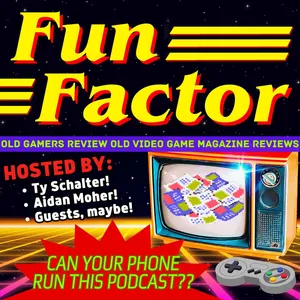
Ty Schalter (VICE, FiveThirtyEight) and Aidan Moher (WIRED, Vulture) review what rocked and what sucked about the classic video game magazines that inspired them to become professional journalists, authors, and critics—and what they can tell us about today's digital media and games.New episodes drop every other Tuesday!
Latest Episodes
The most recent episodes — sign up to get AI-powered summaries of each one.
- Yesterday1h 43m
Pocket Games 7 - Mario Kart Super Circuit [S2E8]
ISSUE LINK: https://archive.gamehistory.org/item/ebc34b2b-4088-4e7c-bc69-12e3a7a9f129Stop Skeletons From Fighting’s “My 2 Year Journey to Solve the 30-Year Myth of Faceball 2000” video: https://www.youtube.com/watch?v=y2AG-gAuS-U&t=6058s Aidan’s back in the saddle, and he’s got takes about what Ty talked about with last episode’s guest-host Jess Voidburger–but not Sonic the Hedgehog, handheld games!Aidan talks about how well portable systems fit into his life as a tween and teen, and this issue of Ziff-Davis’s Pocket Games magazine shows just how deep and rich Nintendo’s handheld scene was in the spring of 2002, even while the AAA console tides had gone way, way out between Christmas 2001 and the following summer.In an issue full of reviews and previews of absolute bangers, we looked at Pocket Games’ review of Mario Kart Super Circuit–what it does well, what it doesn’t, and whether we agree. ———Sources include the Video Game History Foundation, the Internet Archive, Retromags.com, our original research, and our personal magazine collections. The FunFactor theme, and all other original songs, are composed and performed by Millennium Falck. Check out his work at millenniumfalck.com!
- 2 weeks ago1h 5m
Nintendo Power 154 - Sonic Adventure 2 Battle [S2E7]
ISSUE LINK: https://archive.gamehistory.org/item/a8041ebf-095f-4bb9-b2bd-57702a22aff0SONIC ON THE COVER OF NINTENDO POWER??Special guest host Jess VoidBurger joins Ty to revisit Nintendo’s legendary in-house publication during its awkward tween years: still clinging to some of the looks and features of its 16-bit glory days, but starting to evolve to compete with the super-professional, grownuppy output of the Ziff-Davis and Future/IGN publications.With Sonic the Hedgehog on the cover and longtime “Publisher” (Nintendo of America president Minoru Arakawa) announcing his departure in the News section, Ty and Jess get whiplashed by the old-school/new-school dichotomy–and flummoxed by just how few games there are being released in spring of 2002.They discuss how it’s much like today, with AA and AAA publishers constantly scaling back release schedules and focusing on key franchises. But unlike today, reviewers back then didn’t have a robust indie scene to cover.And speaking of reviews, have Nintendo Power’s reviews gotten any more ‘independent’ or ‘unbiased’ since the last time we looked?———Sources include the Video Game History Foundation, the Internet Archive, Retromags.com, our original research, and our personal magazine collections. The FunFactor theme, and all other original songs, are composed and performed by Millennium Falck. Check out his work at millenniumfalck.com!
- 4 weeks ago1h 45m
GameNOW Vol. 2, Issue 4 - Super Smash Bros. Melee [S2E6]
ISSUE LINK: https://archive.gamehistory.org/item/ac4194d5-23d7-46fe-b6e2-0f364600532aSuper Smash Bros. Melee is Nintendo’s tightest, deepest, most technically rewarding fighting game of all time, with an active playerbase and tournament scene still uncovering its secrets.But what did reviewers make of it in 2002, when “lets put all the characters and properties we own in one game” wasn’t an obligatory and trite cash grab, but a novelty?Aidan and Ty checked it out in “GameNOW,” an unfamiliar title for what turns out to be a familiar editorial crew. We kick the whole thing off with a discussion on whether selling our old games was an obvious thing to do, or *~breaching a sacred bond between player and game~*.———Sources include the Video Game History Foundation, the Internet Archive, Retromags.com, our original research, and our personal magazine collections. The FunFactor theme, and all other original songs, are composed and performed by Millennium Falck. Check out his work at millenniumfalck.com!
- Jun 17, 20261h 25m
XBOX Nation 3 - Panzer Dragoon Orta + World Series Baseball [S2E5]
ISSUE LINK: https://archive.gamehistory.org/item/69555def-0cd8-4b5a-b4d2-3d324c7863f4Console exclusivity was the talk of this recent Summer Game Fest, and Aidan and Ty start off the episode with a discussion of their most badly missed-out-on exclusives from platforms they didn't have.And then, the issue: With Future Publishing/Imagine Media getting the "official" XBox magazine tag, Ziff-Davis launched an "independent" one--and they poached Simon Cox from Future/Imagine to lead it!The result was an ambitious, artistic, NEXT Generation/EDGE-looking publication that (perhaps a decade or two too early) pivoted towards a quarterly launch schedule, more original art and photography, and more rare and in-depth features and interviews--like the one anchoring their massive preview of Panzer Dragoon Orta, the capper of Aidan and Ty's discussion.And then...a review of World Series Baseball from actual-factual baseball writer of the time, Jeff Pearlman?? Of Sports Illustrated?? Who since written a ton of book and the Amazon series "Winning Time??" How would this non-games-writer do writing about games in 2002??———Sources include the Video Game History Foundation, the Internet Archive, Retromags.com, our original research, and our personal magazine collections. The FunFactor theme, and all other original songs, are composed and performed by Millennium Falck. Check out his work at millenniumfalck.com!
- Jun 3, 20261h 49m
Game Informer 101 - Final Fantasy X (FIXED) [S1E4]
ISSUE LINK: https://archive.org/details/game-informer-issue-105-january-2002(sped-up audio was Ty's fault; it's been fixed!)FINAL. FANTASY. X. After the final PS1 release was a mechanical, graphical, and literary callback to the deepest roots of the series, the first PS2 release set the tone for what this series would look–and, to an extent, play–like for the next quarter-century of HD video and streamed digital audio.We also check out how Game Informer has continued to grow and change since we last looked–years away from it being a glorified store catalog, but also years from it being the best magazine in the business. The seeds of the final form are present in here; are there seeds of the former?Aidan and Ty kick it all off with a surprisingly timely-for-Bluesky discussion on which super-popular games they’ve disliked, why, and what it means when that happens.———Sources include the Video Game History Foundation, the Internet Archive, Retromags.com, our original research, and our personal magazine collections. The FunFactor theme, and all other original songs, are composed and performed by Millennium Falck. Check out his work at millenniumfalck.com!
- May 27, 202623 min
ULTRA BONUS TEASER: What Killed the Sega Saturn? - Greg Sewart & PandaMonium [S2B1]
NICK’S PATREON: PandaMonium | creating a Sega Saturn documentary series. | Patreon GREG’S PATREON: Greg Sewart | creating Generation 16 | Let's Read Videos | Retro Game Streams | Patreon Please enjoy this snippet of our first Season Two ULTRA Review Crew bonus episode, where we're throwing it back to, um, the disastrous 1995 surprise launch of the Sega Saturn in North America??That’s right–thanks to a production whoopsie by someone very silly (Ty), we very nearly lost this amazing bonus episode. But thanks to a crucial save from our guests, a little bit of elbow grease, and a couple of months of Season Two launch stuff coming first, we managed to get this incredible conversation cleaned up and in your ears.We’re joined by two *incredible* guests: Greg “Stewy” Sewart, a former editor at EGM, and Nick “PandaMonium,” perhaps the Internet’s foremost Sega Saturn documentarian. We ask all the hard questions: What went wrong? Who’s fault was it? And–perhaps most importantly–could Sonic X-Treme have saved everything?———Sources include the Video Game History Foundation, the Internet Archive, Retromags.com, our original research, and our personal magazine collections. The FunFactor theme, and all other original songs, are composed and performed by Millennium Falck. Check out his work at millenniumfalck.com!
- May 19, 20261h 31m
XBox Official Magazine 2 - Halo + Munch's Oddysee [S2E3]
ISSUE LINK: https://www.retromags.com/magazines/usa/official-xbox-magazine/official-xbox-magazine-issue-2/XBOX OFFICIAL MAGAZINE: MAGAZINES EVOLVED.We had to stay in January 2002 for one more episode this season, because we just couldn’t overlook XBox Offical Magazine’s massive walkthrough for Halo: Combat Evolved. We also couldn’t overlook the fact that Imagine Media/Future U.S. Publishing launched this magazine at the same time they were sunsetting NextGen–and there was plenty of overlap between the two staffs.Goodbye to think-y features for (real and aspiring) grown-ups, hello to world-exclusive previews, reviews, and digital assets obtained via first-party licensing.For everything XBox Official Magazine did well, though, we were rubbed very much the wrong way by its unholy union of Ultra Game Players’s 100-point review scale and NextGen’s five-star rubric. Even still, we came away (mostly) very impressed with eventual editor-in-chief Francesca Reyes’s review of the idiosyncratic Munch’s Oddysee.———Sources include the Video Game History Foundation, the Internet Archive, Retromags.com, our original research, and our personal magazine collections. The FunFactor theme, and all other original songs, are composed and performed by Millennium Falck. Check out his work at millenniumfalck.com!
- May 5, 20261h 37m
EGM 150 - Metal Gear Solid 2 [S2E2]
ISSUE LINK: https://archive.org/details/electronic-gaming-monthly-issue-150-january-2002/mode/2upJanuary 2002 was all killer, no filler! EGM kicked off the new year by revisiting their Top 100 games of all time, and we take a look at the changes since their last attempt (which we covered last season)!But EGM also ranked their worst 20 games of all time, thanks to freelancer Seanbaby, and we start the episode with a discussion of the worst games we ever bought.We go back to the best-of-the-best with the review, though, as three EGM editors do a fantastic job with Metal Gear Solid 2–and as an extra-special surprise, the previews editor of the magazine at the time (and FunFactor ULTRA member) Greg Sewart jumped in mid-episode to share some incredible behind-the-scenes stories of how the MGS2 review came together!And, as always, we streamed this recording session live to FunFactor ULTRA members–so if you’d like to get in on the fun, just sign up at https://funfactorpod.com/! We'll see you on the Discord, and you’ll see us when we next go live!———Sources include the Video Game History Foundation, the Internet Archive, Retromags.com, our original research, and our personal magazine collections. The FunFactor theme, and all other original songs, are composed and performed by Millennium Falck. Check out his work at millenniumfalck.com!
About FunFactor
Ty Schalter (VICE, FiveThirtyEight) and Aidan Moher (WIRED, Vulture) review what rocked and what sucked about the classic video game magazines that inspired them to become professional journalists, authors, and critics—and what they can tell us about today's digital media and games.New episodes drop every other Tuesday!
Customized Recaps
AI-powered recaps with compact key takeaways, quotes, and insights.
Straight to Your Inbox
Get key takeaways from FunFactor in a 5-minute read.
Save Hours Every Week
Stay current on your favorite podcasts without falling behind.
Frequently Asked Questions
What is Podzilla's FunFactor daily summary?
It's a free AI-powered email that summarizes new episodes of FunFactor as soon as they're published. You get the key takeaways, notable quotes, and links & mentions — all in a quick read.
How does the FunFactor podcast summary work?
When a new episode drops, our AI transcribes and analyzes it, then generates a personalized summary tailored to your interests and profession. It's delivered to your inbox every morning.
Is this an official FunFactor product?
No. Podzilla is an independent service that summarizes publicly available podcast content. We're not affiliated with or endorsed by Ty Schalter & Aidan Moher.
Can I get summaries of other podcasts too?
Absolutely! The free plan covers up to 3 podcasts. Upgrade to Pro for 15, or Premium for 50. Browse our full catalog at /podcasts.
How often does FunFactor release new episodes?
FunFactor publishes biweekly. Our AI generates a summary within hours of each new episode.
What topics does FunFactor cover?
FunFactor covers topics including Leisure, News, Arts, Books, Games, Video Games. Our AI identifies the specific themes in each episode and highlights what matters most to you.
Start getting FunFactor summaries tomorrow morning.
Free forever for up to 3 podcasts. No credit card required.
Free forever for up to 3 podcasts. No credit card required.