Free Daily Podcast Summary
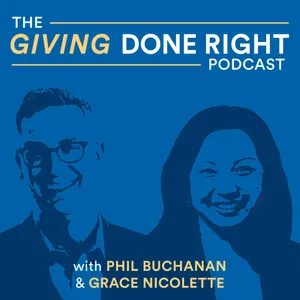
The Giving Done Right Podcast with Phil Buchanan: Daily Summaries Delivered
by The Center for Effective Philanthropy
From the Center for Effective Philanthropy (CEP), Giving Done Right offers hard-hitting conversations and vital resources to help you make an impact with your charitable giving. Whether you’re an individual donor or your job involves making grants, the challenges are universal: Where should I give? How do I know which nonprofits are effective, and how do I best support them? How can I increase the odds that I am making a difference? Join host Phil Buchanan as he welcomes nonprofit leaders, effective donors, and experts to answer philanthropy’s burning questions and bust some myths. In a time of great challenge for nonprofits and the communities they serve, giving is especially crucial: Giving Done Right cuts through the noise and focuses on what you need to know to be effective.
Latest Episodes
The most recent episodes — sign up to get AI-powered summaries of each one.
- 3 days ago50 min
Who Should Control The Money? With Glen Galaich and Jamie Allison
Phil Buchanan is joined by Elisha Smith Arrillaga, CEP's Vice President of Research, as co-host for a conversation focused on some of philanthropy's oldest tensions: who should decide how charitable dollars get spent and how to balance short-term needs with the long view? Their guests, Glen Galaich, CEO of the Stupski Foundation, and Jamie Allison, Executive Director of the Walter & Elise Haas Fund, are usually the ones asking the questions, as frequent co-hosts on Glen’s podcast, Break Fake Rules. Glen makes the case from his new book, CONTROL: Why Big Giving Falls Short, that too much charitable wealth sits parked in private equity and hedge fund accounts rather than moving out to the communities that need it, and that donors should treat public stewardship, not private control, as their guiding value. Jamie pushes back on the idea that this is a binary choice between spending down and staying perpetual, describing how the Walter & Elise Haas Fund has worked to increase payout and shift toward larger, unrestricted grants without abandoning a long time horizon. Together, they debate what foundations with large endowments owe to this moment of crisis for nonprofits, why "responsiveness" matters more than any single spending formula, and what foundations might learn from everyday donors. Disclosure Note: The Stupski Foundation is a CEP podcast sponsor and the Walter & Elise Haas Fund provides grant support to CEP. Resources: CONTROL: Why Big Giving Falls Short Break Fake Rules Giving Done Right book Center for Effective Philanthropy State of Nonprofits 2026: What Donors Need to Know Ruby’s Pantry closes The Democracy We Are Making: Philanthropy and America’s Next 250 Years A Sector in Crisis: How U.S. Nonprofits and Foundations Are Responding to Threats Rethinking Payout: The Hidden Costs of Undervaluing Social Return A Call for Higher Payout from a Believer in Perpetual Foundations The Debate That Belongs in Every Foundation Boardroom Right Now US Firms That Kept DEI Policies Thrived
- 1 weeks ago49 min
Lysa Ratliff Wants You to Trust Her
As nonprofits face sharply increased demand, deep federal funding cuts, and a fundraising climate unlike anything in recent memory, Lysa Ratliff, CEO of KABOOM!, joins Phil Buchanan for an unusually candid conversation about what it takes to lead right now, and why she refuses to soften the truth to make anyone comfortable. Ratliff discusses KABOOM!'s new report, State of Our Kids, which finds that 28 million children in the U.S. don't have access to a quality park within a 10-minute walk from their home. She explains why play is the foundation of childhood development, and walks through the report's unflinching look at the mental health crisis facing young people, including the adultification of Black children and the impact of a rise in ICE arrests on Latino families. She also talks candidly about the promise and limits of a landmark, unrestricted MacKenzie Scott gift, why so few other funders have followed that lead, and why she believes donors need to stop nitpicking nonprofits' budgets and start trusting their expertise to solve solvable problems. In a time defined by uncertainty, Ratliff makes the case for honesty over comfort: "It's not someone's right and someone's wrong. It's how do we, as adults, have really honest conversations that allow us to see very clearly what's going on around us and what we need to do to solve those challenges." Resources: KABOOM! State of Our Kids Report The 25 in 5 Initiative to End Playspace Inequity Center for Effective Philanthropy State of Nonprofits 2026: What Donors Need to Know Youth Truth
- 2 weeks ago43 min
Jeff Atwood and Dr. Betsy Burton Are Giving Big and Fast
Phil Buchanan sits down with spouses Jeff Atwood, co-founder of Stack Overflow and Discourse, and Dr. Betsy Burton, a scientist who has helped develop cancer therapies, to talk about their commitment to give away $50 million, half their family's wealth, over five years, with the bulk of it going toward guaranteed income programs in rural America. Jeff and Betsy describe a two-part strategy that began with $1 million, no-strings-attached gifts to eight organizations they trusted to "kick ass" with the money, before turning to what they call "fire abatement": tackling the systemic conditions that create so much need in the first place. That work led them to guaranteed income pilots in West Virginia, North Carolina, and Mississippi, run in partnership with GiveDirectly and built on research from Open Research's landmark basic income study. They share what that data actually shows about how people spend unconditional cash — including a drop in substance use and unexpectedly high rates of people sharing their payments with neighbors in need — and push back hard on the assumptions that so often shape how donors think about giving directly to people. The conversation also gets personal, as Jeff reflects on his father's own path out of generational poverty in West Virginia, and the two discuss raising philanthropically minded kids, their admiration for MacKenzie Scott's trust-based approach, and their frustration with slow-moving giving pledges that lack a real timeline for getting money out the door. Resources: Stay Gold, America "We Have Everything We Need": Jeff Atwood and Betsy Burton's Bold Mission to Guarantee Minimum Income in Rural America - Denver Frederick Giving Cash to Those in Need with Paul Niehaus of GiveDirectly Fighting Poverty with Direct Cash Transfers, Featuring Jesús Gerena UBI Data SEED Project Breaking the Mold: The Transformative Effects of MacKenzie Scott’s Big Gifts
- 3 weeks ago1 min
Introducing: Season 6 of Giving Done Right
Federal policy shifts continue to upend the landscape for domestic nonprofits, civil society, and international aid alike, leaving donors facing urgent questions about where and how to give. This season on the Giving Done Right podcast, host Phil Buchanan sits down with philanthropic and nonprofit leaders to explore what effective giving looks like in a moment of real strain and real opportunity. Together, these conversations dig into the questions donors are asking today: how to give when trust and partnership matter more than ever, the tension between short-term needs and a long-term view, and what good stewardship really demands of those with the resources to act. Follow along with season six of Giving Done Right for candid, urgent, and ultimately hopeful conversations about how to make your charitable giving as effective, and as meaningful, as it can be.
- Aug 27, 202633 min
A Special Goodbye from Grace
After 15 years at CEP and more than 50 episodes co-hosting Giving Done Right, Grace Nicolette is stepping away. In this special episode, Phil Buchanan turns the microphone to her. Together they look back on how philanthropy has shifted over the past decade and a half, from the rise of multi-year general operating support to the risks of inaction in a moment of crisis? Grace shares the guests and stories that have stayed with her, including April Tam Smith, Jeremy Lin, and a give and take with GiveDirectly's Paul Niehaus over effective altruism. She also opens up about the personal threads running through her career: her faith, her parents' own story of generosity, and the family reasons drawing her toward her next chapter. Through it all, one idea keeps surfacing for Grace: in philanthropy, relationships matter most. Resources: A Fond Farewell to a Catalyst of CEP’s Growth and Evolution Relationships Matter: Program Officers, Grantees, and the Keys to Success
- Feb 10, 20260 min
We Need Your Help
We want to hear from you about how the conversations on this podcast are making a difference in your approach to philanthropy. If our show has helped you, we want to hear about it! Can you take a few moments to send us a voice memo to gdrpodcast@cep.org? Please include your name, institutional affiliation if you have one, role, and the answer to these questions: What specific ways has Giving Done Right influenced your giving and the way you think about philanthropy? And if it hasn't, what topics would you like to hear that would help? Share your voice memo with us at gdrpodcast@cep.org. We can’t wait to hear from you! Thanks for listening!
- Dec 2, 20251h 12m
Ezra Klein on Philanthropy’s Role at a Precarious Time
As the current federal administration makes sweeping cuts to social safety net programs, political divisions deepen, and the guardrails of American democracy are tested, what is philanthropy’s role in this precarious time? In the final episode of this season, Phil Buchanan and Grace Nicolette interview New York Times columnist and podcast host Ezra Klein live at CEP’s 2025 conference. Klein contends that America needs to renew a politics of plenty, face up to the failures of liberal governance, and abandon what he calls the chosen scarcities that have deformed American life. But what does this analysis mean for philanthropy, particularly at a moment of so many competing and urgent crises? Additional Resources: “Mounting Pressure: U.S. Foundations and Nonprofits on the 2025 Political Climate” Elisha Smith Arrillaga, Ph.D. on the Giving Done Right podcast “Abundance,” by Ezra Klein and Derek Thompson
- Nov 20, 202541 min
Lessons on Disaster Giving With Patty McIlreavy
Effective disaster giving often begins before a disaster even occurs. So says Patty McIlreavy, president and CEO of the Center for Disaster Philanthropy, in this popular episode from the Giving Done Right archives. In conversation with hosts Phil Buchanan and Grace Nicolette, Patty offers insight into how donors can support disaster prevention by focusing on reducing vulnerabilities as well as support recovery efforts, and the most common pitfalls for donors to consider when responding to disasters. Patty shares her deep expertise on what can make disaster giving successful (or unsuccessful) and the three discuss examples that still hold lessons for donors looking to mitigate disasters — or prevent them — today. Additional Resources: Center for Disaster Philanthropy From Rapid Response to Sustainable Solutions: Disaster Response and Recovery in Post-Earthquake Haiti – Harvard Humanitarian Initiative Report “Complex Humanitarian Emergencies: Where Crisis, Conflict, Climate, and COVID Meet” – Center for Disaster Philanthropy Disasters, Dollars And Decisions: Lessons For Nonprofits To Prioritize Where And How To Help – Forbes Unprecedented Times Call For Unprecedented Actions – Forbes Asset-Based Framing: Trabian Shorters
Get The Giving Done Right Podcast with Phil Buchanan summaries in your inbox
Free AI-powered daily recaps. Key takeaways, quotes, and mentions — in a 5-minute read.
Get Free Summaries →Free forever for up to 3 podcasts. No credit card required.
You Might Also Like
Listeners also like.
Nonprofit Hub Radio
Interviews with nonprofit leaders and experts offering practical insights to help organizations improve and grow.
Nonprofit Everything
A bi-weekly Q&A podcast covering topics related to nonprofits.
FundraisingAI
Examines the ethical and practical use of AI in fundraising, including trends, data privacy, and social impact.
The Curiosity Shop with Brené Brown and Adam Grant
Two researchers examine leadership, connection, and change by combining qualitative and quantitative insights.
Impact Podcast, Mentorship with Eddie Wilson
A seasoned entrepreneur shares insights on purpose-driven living, entrepreneurship, leadership, and creating meaningful impact.
You Might Be Right
Two former Tennessee governors discuss national policy issues with experts, seeking common ground through civil dialogue.
Right About Now - Legendary Business Advice
Raw business insights from founders and industry leaders, revealing real wins, failures, and actionable strategies without the fluff.
Mick Unplugged
A leadership podcast exploring the deep personal motivations behind high achievers’ success by asking what drives them at their core.

Total Disruption Podcast
Entrepreneurs discuss mindset, business growth, and operational frameworks to move beyond hustle culture and build scalable companies.
Outloud with Gianno Caldwell
A conservative political commentator explores news and culture by challenging prevailing orthodoxies and advocating for free expression.

BigDeal
Conversations with driven entrepreneurs and investors reveal raw, practical lessons on building wealth and living intentionally.
Unstoppable Success Podcast
CEOs and entrepreneurs share strategies for growth, breaking plateaus, and building relationship capital that drives business success.
About The Giving Done Right Podcast with Phil Buchanan
From the Center for Effective Philanthropy (CEP), Giving Done Right offers hard-hitting conversations and vital resources to help you make an impact with your charitable giving. Whether you’re an individual donor or your job involves making grants, the challenges are universal: Where should I give? How do I know which nonprofits are effective, and how do I best support them? How can I increase the odds that I am making a difference? Join host Phil Buchanan as he welcomes nonprofit leaders, effective donors, and experts to answer philanthropy’s burning questions and bust some myths. In a time of great challenge for nonprofits and the communities they serve, giving is especially crucial: Giving Done Right cuts through the noise and focuses on what you need to know to be effective.
Customized Recaps
AI-powered recaps with compact key takeaways, quotes, and insights.
Straight to Your Inbox
Get key takeaways from The Giving Done Right Podcast with Phil Buchanan in a 5-minute read.
Save Hours Every Week
Stay current on your favorite podcasts without falling behind.
Frequently Asked Questions
What is Podzilla's The Giving Done Right Podcast with Phil Buchanan daily summary?
It's a free AI-powered email that summarizes new episodes of The Giving Done Right Podcast with Phil Buchanan as soon as they're published. You get the key takeaways, notable quotes, and links & mentions — all in a quick read.
How does the The Giving Done Right Podcast with Phil Buchanan podcast summary work?
When a new episode drops, our AI transcribes and analyzes it, then generates a personalized summary tailored to your interests and profession. It's delivered to your inbox every morning.
Is this an official The Giving Done Right Podcast with Phil Buchanan product?
No. Podzilla is an independent service that summarizes publicly available podcast content. We're not affiliated with or endorsed by The Center for Effective Philanthropy.
Can I get summaries of other podcasts too?
Absolutely! The free plan covers up to 3 podcasts. Upgrade to Pro for 15, or Premium for 50. Browse our full catalog at /podcasts.
How often does The Giving Done Right Podcast with Phil Buchanan release new episodes?
The Giving Done Right Podcast with Phil Buchanan publishes weekly. Our AI generates a summary within hours of each new episode.
What topics does The Giving Done Right Podcast with Phil Buchanan cover?
The Giving Done Right Podcast with Phil Buchanan covers topics including Business, Non-Profit. Our AI identifies the specific themes in each episode and highlights what matters most to you.
Start getting The Giving Done Right Podcast with Phil Buchanan summaries tomorrow morning.
Free forever for up to 3 podcasts. No credit card required.
Free forever for up to 3 podcasts. No credit card required.