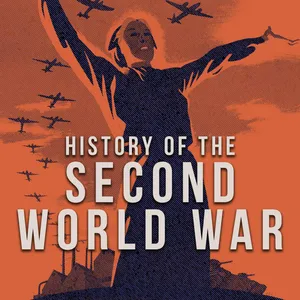
Free Daily Podcast Summary
History of the Second World War: Daily Summaries Delivered
by Wesley Livesay
History of the Second World War is a weekly podcast which will cover World War 2, beginning with the tumultuous years after the First World War, continuing into the descent into war during the 1930s, through the war years, and then into the post war aftermath.
Latest Episodes
The most recent episodes — sign up to get AI-powered summaries of each one.
- Today26 min
268: War at Sea '41 Pt. 6 - Aces Down
This episode follows the Battle of the Atlantic through the costly weeks of March 1941, when Germany lost three of its most celebrated U-boat commanders: Günther Prien, Joachim Schepke, and Otto Kretschmer. It examines the expanding British convoy-escort system, the battle surrounding convoy HX-112, and the decisions that pushed Dönitz to disperse his boats farther west and toward West Africa. Those losses marked the end of one phase of the U-boat war, even as rising German production and the approaching entry of the United States pointed toward an even larger struggle ahead. "One scam can cost you everything. Protect yourself now. The first 100 users get 20% off with code **history20** at **https://coveron.com/history20**." Credit Logo Image: https://www.flickr.com/photos/state_library_south_australia/3331881750/in/album-72157623232407924 Learn more about your ad choices. Visit megaphone.fm/adchoices
- 6 days ago27 min
267: War at Sea '41 Pt. 5 - The Undersea Hunters
This episode shifts the focus of the naval war from German surface raiders to the U-boats, tracing why they became the central German weapon in the Battle of the Atlantic and why there were still too few of them in late 1940 and early 1941. It covers the effect of French Atlantic bases, the construction of U-boat pens, cooperation with Fw-200 Condors, early combined attacks on convoys, and the contrasting struggles of British Coastal Command. The episode ends with the return of celebrated U-boat commanders like Günther Prien and Otto Kretschmer as the campaign enters a dangerous new phase. Credit Episode Image: https://www.flickr.com/photos/state_library_south_australia/3331881750/in/album-72157623232407924 Learn more about your ad choices. Visit megaphone.fm/adchoices
- 1 weeks ago24 min
266: War at Sea '41 Pt. 4 - The End of Operation Berlin
Operation Berlin reaches its conclusion as Scharnhorst and Gneisenau continue their Atlantic cruise, repeatedly finding merchant shipping but also repeatedly being checked by the presence of British battleships. This episode follows Lütjens through further searches, missed opportunities, encounters with Malaya and Rodney, and the final run into Brest, before turning to the RAF attacks that badly damaged Gneisenau and disrupted the Kriegsmarine's plans for an even larger surface-raiding operation. The result is a look at both the promise and the fragility of Germany's surface-raider strategy in the spring of 1941. Credit Episode Image: https://www.flickr.com/photos/state_library_south_australia/3331881750/in/album-72157623232407924 Learn more about your ad choices. Visit megaphone.fm/adchoices
- 2 weeks ago24 min
265: War at Sea '41 Pt. 3 - Operation Berlin
In early 1941, the German battleships Scharnhorst and Gneisenau set out on Operation Berlin, an attempt to break into the Atlantic and strike at Britain's convoy lifeline. This episode follows Admiral Günther Lütjens as he weighs weather, fuel, British patrols, and strict orders against the promise of a major commerce-raiding success, while also examining how the absence of German carrier aviation limited what the surface fleet could accomplish. When the two battleships finally found convoy HX-106, the presence of the aging battleship Ramillies revealed the central tension of the operation: Germany's most powerful raiders could threaten the Atlantic, but they could not afford the damage that might come from forcing the issue. Credit Episode Image: https://www.flickr.com/photos/state_library_south_australia/3331881750/in/album-72157623232407924 Learn more about your ad choices. Visit megaphone.fm/adchoices
- 3 weeks ago23 min
Listener Question Pt. 5
Start off this one with a few quick hitters, then a question that takes 15 minutes to answer. Allied invasion of France in 1942? That Churchill guy you may have heard of? How did occupied economies work? Learn more about your ad choices. Visit megaphone.fm/adchoices
- 4 weeks ago24 min
264: War at Sea '41 Pt. 2 - Cruisers Attack
This episode examines Germany's auxiliary cruisers and the heavy cruiser Admiral Hipper as they carried the commerce war into distant shipping lanes during 1940 and early 1941. It follows the disguised merchant raiders that forced the Royal Navy to disperse its strength around the globe, then traces the Hipper's design limitations, encounters with convoys WS-5A and SLS-64, and repeated mechanical setbacks. Together, their operations reveal both the reach and the limitations of Germany's surface-raiding strategy before the battleships Scharnhorst and Gneisenau entered the Atlantic. Credit Episode Image: https://www.flickr.com/photos/state_library_south_australia/3331881750/in/album-72157623232407924 Learn more about your ad choices. Visit megaphone.fm/adchoices
- Jun 25, 202625 min
263: War At Sea '41 Pt. 1 - The Surface Raiders
This episode begins a new look at the German surface raiding campaign of late 1940 and early 1941, when the Kriegsmarine tried to use cruisers and battleships to threaten Britain's Atlantic lifelines. We trace how the fall of France transformed Germany's naval options, why ports like Brest and St. Nazaire mattered, how intelligence shaped the hunt on both sides, and how the Admiral Scheer's attack on Convoy HX-84 forced the Royal Navy to rethink convoy protection just before the campaign reached its most dramatic phase. Learn more about your ad choices. Visit megaphone.fm/adchoices
- Jun 17, 202625 min
262: Crete Pt. 7 - Another Defeat; Another Victory
The evacuation from Crete reaches its final stage as British, Commonwealth, and Greek forces try to escape through Sphakia while others are left behind at Rethymno and across the island. This episode follows the difficult choices made by commanders and naval crews, the losses suffered by the Royal Navy, the surrender and occupation that followed, and the way the defeat shaped later judgments of Freyberg, Churchill, and the battle itself. Learn more about your ad choices. Visit megaphone.fm/adchoices
Get History of the Second World War summaries in your inbox
Free AI-powered daily recaps. Key takeaways, quotes, and mentions — in a 5-minute read.
Get Free Summaries →Free forever for up to 3 podcasts. No credit card required.
You Might Also Like
Listeners also like.
The WW2 Podcast
A military history podcast exploring various aspects of World War II as it moves beyond living memory.
The History of WWII Podcast
A detailed narrative exploration of World War II, covering its events, battles, and key figures.

WW2 Pod: We Have Ways of Making You Talk
A comedian and historian explore World War II through detailed analysis, personal stories, and dark humor.

School of War
In-depth interviews explore military history, strategy, and wartime decision-making with experts and policymakers.
The Unauthorized History of the Pacific War
Seth Paridon and Bill Toti explore the battles, strategies, and key figures of the Pacific War in detailed weekly episodes.

History Unplugged Podcast
Features interviews with history authors and answers to listener questions on a wide range of historical topics.

Tides of History
Explores how historical events and forces have shaped modern societies, cultures, and global systems.

HISTORY This Week
A weekly look at pivotal historical events and the people behind them, famous or forgotten, who shaped the world.
D-Day: The Tide Turns
Follows the personal stories of those who lived through the planning, execution, and aftermath of the 1944 Normandy landings.
Wartime Stories
Veterans recount unexplained, terrifying, and awe-inspiring events from the battlefield and beyond.

History That Doesn't Suck
A bi-weekly podcast delivering well-researched, engaging stories from American history.

The Rest Is History
Historians Tom Holland and Dominic Sandbrook analyze major historical events and figures with narrative depth and scholarly insight.
About History of the Second World War
History of the Second World War is a weekly podcast which will cover World War 2, beginning with the tumultuous years after the First World War, continuing into the descent into war during the 1930s, through the war years, and then into the post war aftermath.
Customized Recaps
AI-powered recaps with compact key takeaways, quotes, and insights.
Straight to Your Inbox
Get key takeaways from History of the Second World War in a 5-minute read.
Save Hours Every Week
Stay current on your favorite podcasts without falling behind.
Frequently Asked Questions
What is Podzilla's History of the Second World War daily summary?
It's a free AI-powered email that summarizes new episodes of History of the Second World War as soon as they're published. You get the key takeaways, notable quotes, and links & mentions — all in a quick read.
How does the History of the Second World War podcast summary work?
When a new episode drops, our AI transcribes and analyzes it, then generates a personalized summary tailored to your interests and profession. It's delivered to your inbox every morning.
Is this an official History of the Second World War product?
No. Podzilla is an independent service that summarizes publicly available podcast content. We're not affiliated with or endorsed by Wesley Livesay.
Can I get summaries of other podcasts too?
Absolutely! The free plan covers up to 3 podcasts. Upgrade to Pro for 15, or Premium for 50. Browse our full catalog at /podcasts.
How often does History of the Second World War release new episodes?
History of the Second World War publishes weekly. Our AI generates a summary within hours of each new episode.
What topics does History of the Second World War cover?
History of the Second World War covers topics including History, Documentary, Culture, Society & Culture. Our AI identifies the specific themes in each episode and highlights what matters most to you.
Start getting History of the Second World War summaries tomorrow morning.
Free forever for up to 3 podcasts. No credit card required.
Free forever for up to 3 podcasts. No credit card required.