Free Daily Podcast Summary
How I AI: Daily Summaries Delivered
by Claire Vo
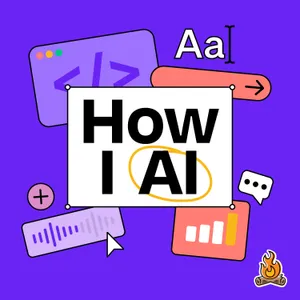
How I AI, hosted by Claire Vo, is for anyone wondering how to actually use these magical new tools to improve the quality and efficiency of their work. In each episode, guests will share a specific, practical, and impactful way they’ve learned to use AI in their work or life. Expect 30-minute episodes, live screen sharing, and tips/tricks/workflows you can copy immediately. If you want to demystify AI and learn the skills you need to thrive in this new world, this podcast is for you.
Latest Episodes
The most recent episodes — sign up to get AI-powered summaries of each one.
- 3 days agosolo46 min6-min read
Jev: 8 real use cases for the fastest, cheapest model I’ve ever used | John Lindquist
Jev, a fast, cheap, and type-safe decision model from TypeSafe AI, is unlocking new possibilities in real-time applications by transforming unstructured inputs into structured actions with high efficiency. Its speed and low cost enable developers to explore previously impractical use cases like live voice control, data deduplication, agent routing, and real-time coaching.
- 3 days agosolo24 min4-min read
OpenAI Dev Day 2026: The releases that actually matter
OpenAI's Dev Day unveiled a flood of new AI tools, including Dots (long-running agents), Spaces (collaborative AI workspaces), Sites with plugin integration, and powerful model updates like GPT-6-1 SOL, the vision-capable Decisions API, and ultra-fast Astra inference. While the sheer volume is overwhelming, the core advancements in agent autonomy, real-time collaboration, and low-latency high-intelligence APIs signal a major leap in how developers and enterprises will build and interact with AI.
- 5 days agonarrative26 min5-min read
Jev for beginners: how to use it and what to build
Jev, a new decision-focused AI model from TypeSafe AI, is transforming how developers and product teams handle classification, clustering, and real-time decision-making by offering a fast, cheap, and type-safe alternative to traditional LLMs. It’s not about generating text — it’s about making smart, structured decisions at scale.
- 1 weeks agosolo38 min6-min read
Opus 5.5 vs. GPT-6 Sol: which model won my blind taste test?
Despite initial skepticism and a strong preference for OpenAI's models, the host finds that Anthropic's Opus 5.5 has made significant improvements in usability and reliability, earning a spot in her daily workflow. While GPT-6 Soul and Astra win her emotional favor, Opus 5.5 emerges as the most consistently high-performing model across diverse tasks.
- 1 weeks agosolo24 min4-min read
I left Claude for months. Opus 5.5 is why I'm back
After months away due to frustration with verbosity and poor UX, the host has returned to using Claude, declaring Opus 5.5 a major improvement: it’s faster, cheaper, and crucially, no longer 'annoying.' While not perfect, it excels in frontend design, agentic tasks, and SVG generation, making it a strong contender in the AI model landscape.
- 1 weeks agosolo46 min6-min read
How Warp ships 2,000 PRs a month with AI factories | Zach Lloyd (CEO, Warp)
The software factory is a centralized, cloud-based system that automates the full software development lifecycle—from idea to deployment—with AI agents handling tasks like coding, testing, issue tracking, and QA, while enabling real-time observability, cost tracking, and self-improvement through agent-driven feedback loops. Humans remain a bottleneck, especially in code review, but the factory model shifts work into public channels to increase transparency, collaboration, and efficiency.
- 2 weeks ago37 min
Muse review: The personal AI agent that gets consumer UX right
I spent a few hours putting Meta’s Muse, its new personal AI agent, through a real first-pass test: onboarding, calendar management, goal setting, a one-shot family morning newsletter, browser-based shopping, and the animated avatar that honestly surprised me.What you’ll learn:Why Muse is the best-designed personal agent I’ve tested, and what specifically made it feel that wayThe one-shot family PDF Muse produced that Claude and Codex never quite nailedHow Muse’s permission model works, and why it’s different from every other agent I’ve usedWhy I set up a sleep training goal in Muse, and what it revealed about agent toneThe activity feed feature I immediately wished Codex and Claude Code hadWhere Muse failed, and what it says about the limits of this category right nowThe animated avatar decision that showed me what top-of-craft AI product design actually looks like—Brought to you by:Optimizely—Your AI agent orchestration platform for marketing and digital teamsOpenArt—An all-in-one AI creation platform for images, videos, music, audio, and more—In this episode, we cover: What Muse is and who it’s actually built for Signing in and the onboarding flow The activity feed and its task lineage First real task: managing the family calendar and deleting soccer practice Requesting a morning newsletter PDF The personalized news feed and how I set it up The “Ideas” feature as an out-of-the-box prompt library Setting up personal goals (water, shoes, and sleep training) Library: documents, websites, images, videos, and podcasts Quick recap and what I love Activity feed design deep dive: tool calls and step-by-step lineage How Muse handles permissions The animated avatar: Polly becomes Slime, the teal dragon Browser use test: shopping for New Balance 9060s (not great) Browser use test 2: buying IMAX tickets for The Odyssey (much better) TL;DR and what I’ll actually use Muse for going forward—Tools referenced:• Muse: https://muse.ai/• Stripe Link (payment method featured in Muse): https://link.com• 1Password (future Muse integration mentioned): https://1password.com• OpenClaw (Claire’s previous personal agent setup): https://openclaw.ai/• Grok Bot (Grok-based agent from prior stack): https://x.ai/news/introducing-grok-bot• Codex (OpenAI coding agent, comparison point): https://openai.com/codex• NotebookLM (Google, comparison to Muse’s podcast generation): https://notebooklm.google.com—Where to find Claire Vo:ChatPRD: https://www.chatprd.ai/Website: https://clairevo.com/LinkedIn: https://www.linkedin.com/in/clairevo/X: https://x.com/clairevo—Production and marketing by https://penname.co/. For inquiries about sponsoring the podcast, email jordan@penname.co.
- 2 weeks agoconversational41 min5-min read
How Grok Bot designers use AI agents to build personal sites and product prototypes | John Bai & Peng Zheng
In this episode of How I AI, host Claire Vo explores how AI agents like GrokBot are transforming both personal creativity and professional design workflows, featuring John Bai and Peng Zheng from the GrokBot design team. They demonstrate how AI can automate tedious tasks, enable rapid prototyping, and even generate personalized, evolving websites with minimal human effort.
Get How I AI summaries in your inbox
Free AI-powered daily recaps. Key takeaways, quotes, and mentions — in a 5-minute read.
Get Free Summaries →Free forever for up to 3 podcasts. No credit card required.
What How I AI Covers
Topics discussed across all episodes.
You Might Also Like
Listeners also like.
The AI Daily Brief: Artificial Intelligence News and Analysis
A daily analysis of artificial intelligence news, exploring its creative potential, industry impacts, and ethical challenges.

AI For Humans: Weekly AI News, Tools & Trends
A weekly breakdown of major AI news, tools, and breakthroughs for both newcomers and seasoned enthusiasts.

Everyday AI Podcast – An AI and ChatGPT Podcast
Practical AI and ChatGPT tips for professionals to improve productivity and grow their careers.

The AI XR Podcast.
Industry insiders interview top founders and executives on AI, spatial computing, VR/AR, and synthetic media.
OpenAI Podcast
Conversations with OpenAI researchers and builders exploring how frontier AI models are developed and used in practice.

AI Breakdown
Explores advancements, ethics, and real-world impacts of artificial intelligence across industries.

Latent Space: The AI Engineer Podcast
Explores AI engineering breakthroughs in foundation models, code generation, and AI agents through interviews with researchers and developers.
Me, Myself, and AI
AI leaders from top companies share real-world strategies for turning artificial intelligence into measurable business results.
"The Cognitive Revolution"
Interviews with AI developers and researchers exploring the transformative impact of artificial intelligence on society and technology.

Lenny's Podcast: Product | Career | Growth
Conversations with top product and growth leaders offering practical strategies for building, launching, and scaling successful products.
Practical AI
Discussions on practical applications of AI, machine learning, and related technologies for professionals, students, and enthusiasts.
ChatGPT Podcast
Explores how artificial intelligence is transforming technology and industry through expert insights and real-world applications.
Mentions
Most frequently mentioned across all episodes.
People
Companies
Products & Tools
About How I AI
How I AI, hosted by Claire Vo, is for anyone wondering how to actually use these magical new tools to improve the quality and efficiency of their work. In each episode, guests will share a specific, practical, and impactful way they’ve learned to use AI in their work or life. Expect 30-minute episodes, live screen sharing, and tips/tricks/workflows you can copy immediately. If you want to demystify AI and learn the skills you need to thrive in this new world, this podcast is for you.
Customized Recaps
AI-powered recaps with compact key takeaways, quotes, and insights.
Straight to Your Inbox
Get key takeaways from How I AI in a 5-minute read.
Save Hours Every Week
Stay current on your favorite podcasts without falling behind.
Frequently Asked Questions
What is Podzilla's How I AI daily summary?
It's a free AI-powered email that summarizes new episodes of How I AI as soon as they're published. You get the key takeaways, notable quotes, and links & mentions — all in a quick read.
How does the How I AI podcast summary work?
When a new episode drops, our AI transcribes and analyzes it, then generates a personalized summary tailored to your interests and profession. It's delivered to your inbox every morning.
Is this an official How I AI product?
No. Podzilla is an independent service that summarizes publicly available podcast content. We're not affiliated with or endorsed by Claire Vo.
Can I get summaries of other podcasts too?
Absolutely! The free plan covers up to 3 podcasts. Upgrade to Pro for 15, or Premium for 50. Browse our full catalog at /podcasts.
How often does How I AI release new episodes?
How I AI publishes every few days. Our AI generates a summary within hours of each new episode.
What topics does How I AI cover?
How I AI covers topics including AI agents, Productivity tools, AI automation, AI code querying, AI development agents. Our AI identifies the specific themes in each episode and highlights what matters most to you.
Start getting How I AI summaries tomorrow morning.
Free forever for up to 3 podcasts. No credit card required.
Free forever for up to 3 podcasts. No credit card required.