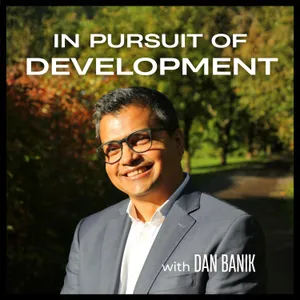
Free Daily Podcast Summary
In Pursuit of Development: Daily Summaries Delivered
by Dan Banik
Step into conversations that travel across continents and challenge the way you think about progress. From democracy and inequality to climate resilience and healthcare, Dan Banik explores how societies navigate the complex terrain of democracy, poverty, inequality, and sustainability. Through dialogues with scholars, leaders, and innovators, In Pursuit of Development uncovers how ideas travel, why policies succeed or fail, and what it takes to build a more just and resilient world. Expect sharp insights, candid reflections, and a global perspective that connects local struggles to universal aspirations.
Latest Episodes
The most recent episodes — sign up to get AI-powered summaries of each one.
- Jun 17, 202631 min
Why hope is what we need | Dan Banik
What does it mean to defend hope in an age of crisis, anxiety, and political exhaustion? In this Season 6 finale of In Pursuit of Development, Dan Banik reflects on why hope is not the same as optimism, and why evidence-based hope may be one of the most important political resources of our time. Drawing on debates about global poverty, democracy, climate anxiety, development practice, and collective action, this solo reflection challenges the seductive power of despair. The episode argues that doom is not only emotionally draining, but politically disabling, because it can convince people that action no longer matters. Against both naïve optimism and fatalistic pessimism, Dan makes the case for a disciplined form of hope grounded in evidence, historical progress, institutional realism, and the everyday work of building better futures. The episode also explores why hope must be treated critically. Hope can inspire movements, sustain democratic struggle, and help communities imagine alternatives. But it can also be misused by those in power to postpone justice, ration expectations, or ask vulnerable people to endure indefinitely. The task, then, is not to abandon hope, but to make it accountable to evidence, delivery, and real improvements in people’s lives. From falling extreme poverty and declining child mortality to the limits of today’s development models, from Paulo Freire and Václav Havel to Arjun Appadurai, Rebecca Solnit, Amartya Sen, Hans Rosling, Hannah Ritchie, and Charles Kenny, this episode asks what kind of hope can survive contact with reality. It closes Season 6 with a plea to younger listeners in particular: resist the politics of despair, look carefully at what is working, and remember that the future remains open. Host:Professor Dan Banik, Centre for Global Sustainability, University of OsloSubscribe:Apple Spotify YouTubehttps://globaldevpod.substack.com/
- Jun 3, 202648 min
How civil society adapts when aid shrinks | Tikhala Itaye
As traditional aid budgets shrink and donor priorities shift, civil society organizations across Malawi are being forced to rethink how they work, survive, and serve communities. In this conversation, Dan Banik speaks with Tikhala Itaye, a human rights lawyer and public health specialist, and the Founder and Executive Director of HeR Liberty, a young women-led organization in Malawi working to advance health, education, and economic empowerment for young people, especially adolescent girls and young women. The episode explores the changing relationship between international NGOs, local civil society organizations, and the Malawian state. Tikhala reflects on the long-standing inequalities in the aid system, where local organizations often do much of the frontline work while receiving only a small share of available funding. She and Dan also discuss how civil society groups are responding to cuts by exploring social entrepreneurship, domestic resource mobilization, coalition-building, and new partnerships with government. The conversation highlights Malawi’s broader development challenges, including rising prices, political uncertainty, gender inequality, youth unemployment, and the urgent need for more accountable leadership. At the same time, Tikhala points to sources of hope: community resilience, local innovation, the strength of women’s rights movements, progress in health, and the growing determination among Malawians to design solutions from within. Host:Professor Dan Banik, Centre for Global Sustainability, University of OsloSubscribe:Apple Spotify YouTubehttps://globaldevpod.substack.com/
- May 20, 202646 min
Is Rwanda a development success? | Pritish Behuria
Rwanda is often described as one of Africa’s most remarkable development success stories: a country that rebuilt itself after the 1994 genocide, delivered impressive improvements in health and education, reduced its dependence on coffee, attracted global attention, and turned Kigali into a symbol of order, ambition, and state effectiveness. But is Rwanda’s rise as durable as it appears? Dan Banik speaks with Pritish Behuria (Associate Professor in Politics, Governance and Development at the University of Manchester’s Global Development Institute) about his new book The Political Economy of Rwanda’s Rise. Drawing on more than a decade of research, Behuria offers a nuanced account of Rwanda’s services-led development model — from tourism, finance, conferences, and nation branding to agriculture, mining, foreign investment, and the politics of structural transformation. The conversation explores why Rwanda has become such a powerful reference point for policymakers across Africa, but also why its model raises difficult questions about underemployment, inequality, domestic firms, foreign dependence, political control, and the limits of branding as a development strategy. Rather than treating Rwanda as either a miracle or a mirage, this episode asks what the country’s experience reveals about the future of development in Africa. And whether a small, landlocked country can build lasting prosperity through a services-first path in an increasingly competitive global economy. Host:Professor Dan Banik, Centre for Global Sustainability, University of OsloSubscribe:Apple Spotify YouTubehttps://globaldevpod.substack.com/
- May 13, 202624 min
African agency at the crossroads | Dan Banik
In this solo episode, Dan Banik reflects on a series of recent conversations across Pretoria, Addis Ababa, Blantyre, and Mauritius, where African scholars, policymakers, civil society leaders, NGO directors, administrators, and practitioners debated the future of development in a rapidly changing world. Against a backdrop of dramatic aid cuts, geopolitical fragmentation, climate pressures, and growing interest in artificial intelligence, the episode asks what African agency really means in practice. Rather than treating the current moment simply as a crisis, many participants described it as a wake-up call: an opportunity to rethink aid dependency, strengthen domestic institutions, mobilize local resources, and move beyond donor-driven agendas. The discussion explores several recurring themes: who defines development, whose knowledge counts, what makes a just energy transition genuinely just, why “homegrown solutions” can be both powerful and problematic, and how African countries can shape the use of AI without accepting new forms of technological dependency. From Malawi’s debates on aid and production to Ethiopia’s reflections on a changing international order, from South Africa’s energy transition to Mauritius’s AI ambitions, the episode highlights the urgency of moving from rhetoric to bargaining power. At its core, this is an episode about voice, power, and direction. The crossroads may indeed be the best road. But only if Africans choose the path, set the terms, and ensure that development delivers what citizens actually want: decent jobs, reliable electricity, functioning schools and clinics, and governments that are accountable to the people they serve. Host:Professor Dan Banik, Centre for Global Sustainability, University of OsloSubscribe:Apple Spotify YouTubehttps://globaldevpod.substack.com/
- Apr 29, 202643 min
How public institutions become captured | Elizabeth Dávid-Barrett
Corruption is often imagined as a bribe paid to speed up a permit, avoid a fine, or gain access to a public service. But some of the most damaging forms of corruption operate at a much higher level, where powerful political and business actors reshape the rules of the game itself. This is the world of state capture: a process through which public institutions are bent away from the public interest and made to serve narrow networks of power, privilege, and private gain. Dan Banik speaks with Elizabeth Dávid-Barrett, Professor of Governance and Integrity and Director of the Centre for the Study of Corruption at the University of Sussex, about why state capture is one of the most serious threats to democracy, development, and public trust today. Drawing on cases from all around the world, they discuss how corruption can move from isolated transactions to systemic control over laws, public procurement, courts, banks, media, tax authorities, and accountability institutions. The conversation explores how state capture differs from petty corruption, why democracies are vulnerable to being hollowed out from within, and how powerful actors use strategically divisive narratives to consolidate support. Liz explains why captured systems reward loyalty over merit, connections over competence, and impunity over accountability — with severe consequences for economic growth, inequality, public services, and citizen confidence. Resources State Capture and Inequality State Capture and Development: A conceptual framework State capture: how democracy can be systematically corrupted Madagascar at a crossroads: breaking the cycle of state capture Does state capture facilitate strategic corruption? The political economy of open contracting reforms in low- and middle-income countries The GI ACE program (with policy-relevant evidence on what works in fighting corruption). Host:Professor Dan Banik, Centre for Global Sustainability, University of OsloSubscribe:Apple Spotify YouTubehttps://globaldevpod.substack.com/
- Apr 22, 202647 min
Why the UN looks different from the Global South | Alanna O’Malley
In this episode of In Pursuit of Development, Dan Banik speaks with Alanna O’Malley, Professor and Chair of Global Governance & Wealth and Head of Department of History at Erasmus University, about the hidden history of the United Nations and the decisive role of the Global South in shaping global governance. Drawing on her forthcoming book, Decolonising Global Order, The Invisible History of the United Nations and the Global South, she explains how actors from Africa, Asia, and Latin America helped transform debates on decolonisation, development, human rights, sovereignty, and economic justice — even as their contributions were often written out of mainstream histories. Dan and Alanna explore why the UN looks very different when viewed from the Global South, why the institution cannot be understood only through the lens of Security Council politics, and why international law and multilateralism still matter deeply to many countries despite growing frustration with double standards and inequality. This is a wide-ranging conversation on the United Nations, global development, the crisis of multilateralism, and the long struggle to build a more representative and just international order. Read a short article based on this episode at: https://globaldevpod.substack.com/ Host:Professor Dan Banik, Centre for Global Sustainability, University of OsloSubscribe:Apple Spotify YouTubehttps://globaldevpod.substack.com/
- Apr 15, 202651 min
The poverty trap that kills a million people a year | Madhukar Pai
Why does tuberculosis remain one of the world’s deadliest infectious diseases even though it is preventable and curable? In this episode of In Pursuit of Development, Dan Banik speaks with Madhukar Pai of the Department of Global and Public Health at the McGill School of Population and Global Health about why TB continues to thrive in conditions of poverty, undernutrition, overcrowding, and weak primary healthcare.The conversation explores why the global burden of TB remains so heavily concentrated in a small number of countries, what makes early diagnosis and treatment so difficult in fragmented health systems, and why social protection may be just as important as medicine in reducing illness and death. Dan and Madhu also discuss the limits of donor-driven global health, the meaning of decolonizing global health, and the power asymmetries that still shape who sets priorities, who controls resources, and who bears the consequences when systems fail.The episode also includes a reflection on the enduring legacy of Paul Farmer — physician, anthropologist, Harvard professor, and co-founder of Partners In Health — whose moral clarity and insistence on dignity in care continue to inspire global health practitioners around the world.Topics covered: tuberculosis, TB, global health, poverty, undernutrition, social protection, India, primary healthcare, health systems, decolonizing global health, donor dependence, Paul Farmer, Partners In Health, development, public policy. Host:Professor Dan Banik, Centre for Global Sustainability, University of OsloSubscribe:Apple Spotify YouTubehttps://globaldevpod.substack.com/
- Apr 8, 202639 min
Can aid still fight poverty? | Elina Scheja
What happens to development cooperation when aid budgets are cut, geopolitical tensions rise, and poverty reduction competes with a growing range of strategic priorities? In this episode of In Pursuit of Development, Dan Banik speaks with Elina Scheja, Chief Economist at the Swedish International Development Cooperation Agency (Sida), about the changing politics of foreign aid and the future of development in a far more fragmented world. The conversation explores why today’s turbulence cannot be explained by a single leader or decision alone, but must instead be understood in light of deeper structural shifts in global economic and political power. Dan and Elina discuss the implications of aid cuts in the United States and Europe, the growing emphasis on national interest and “enlightened self-interest,” and the difficult choices donor countries now face as support for Ukraine, climate priorities, regional security concerns, and poverty reduction compete for limited resources. They also examine a central question in global development today: Do we still need aid, and for whom? Elina argues that the answer is clearly yes, pointing to the hundreds of millions of people who remain trapped in extreme poverty and multidimensional deprivation. The discussion highlights why poverty cannot be understood through income measures alone, and why access to healthcare, education, decent work, voice, and security must remain central to any serious development agenda. Another major focus of the episode is evidence and learning in aid policy. Dan and Elina reflect on how development agencies such as Sida can make better use of research, impact evaluation, institutional memory, and artificial intelligence to improve decision-making. Rather than treating evaluation as something that happens only at the end of a project, they argue for a more iterative and adaptive approach — one that uses evidence throughout the entire chain of development cooperation, from country selection and sectoral priorities to implementation and course correction. The episode also turns to jobs, productive employment, and structural transformation. If citizens across the Global South are asking for opportunity rather than handouts, what should aid agencies do differently? Should they focus more on employment, infrastructure, and economic transformation? How can democracy, human rights, and job creation be understood not as competing priorities, but as deeply interconnected parts of inclusive development? Host:Professor Dan Banik, Centre for Global Sustainability, University of OsloSubscribe:Apple Spotify YouTubehttps://globaldevpod.substack.com/
Get In Pursuit of Development summaries in your inbox
Free AI-powered daily recaps. Key takeaways, quotes, and mentions — in a 5-minute read.
Get Free Summaries →Free forever for up to 3 podcasts. No credit card required.
You Might Also Like
Listeners also like.

Inquiring Minds
Explores the intersection of science and society through critical thinking and in-depth analysis.

The Inquiry
The Inquiry explores global trends, forces, and ideas shaping the world beyond the headlines.

The Jordan Harbinger Show
Conversations with top performers across fields, distilling actionable insights on success, relationships, and personal growth.

Into Africa
Examines cultural, political, and economic developments in Africa through interviews with experts and leaders across the continent.

How To Citizen with Baratunde
Explores civic engagement as an active practice, offering tools and stories to help people collectively shape a better society.

Exchanges: A Cambridge UP Podcast
Discusses new books by Cambridge University Press authors through author interviews.
A Podcast About Leadership
Examines modern leadership through interviews with experts in business, psychology, and human performance.

Analysis
Examines the ideas and forces shaping public policy in Britain and abroad with writers, journalists, and academics.

The Real Story
Experts and decision makers analyze and debate major news stories.
A Bit of Optimism
Conversations with thinkers and doers exploring what drives purpose, growth, and meaning in life.

The Documentary Podcast
A weekly exploration of global stories through personal voices and in-depth reporting from the BBC World Service.

Thriving Minds with Alberto Zandi
Conversations with experts and high achievers explore practical insights for thriving in business, career, and personal growth.
About In Pursuit of Development
Step into conversations that travel across continents and challenge the way you think about progress. From democracy and inequality to climate resilience and healthcare, Dan Banik explores how societies navigate the complex terrain of democracy, poverty, inequality, and sustainability. Through dialogues with scholars, leaders, and innovators, In Pursuit of Development uncovers how ideas travel, why policies succeed or fail, and what it takes to build a more just and resilient world. Expect sharp insights, candid reflections, and a global perspective that connects local struggles to universal aspirations.
Customized Recaps
AI-powered recaps with compact key takeaways, quotes, and insights.
Straight to Your Inbox
Get key takeaways from In Pursuit of Development in a 5-minute read.
Save Hours Every Week
Stay current on your favorite podcasts without falling behind.
Frequently Asked Questions
What is Podzilla's In Pursuit of Development daily summary?
It's a free AI-powered email that summarizes new episodes of In Pursuit of Development as soon as they're published. You get the key takeaways, notable quotes, and links & mentions — all in a quick read.
How does the In Pursuit of Development podcast summary work?
When a new episode drops, our AI transcribes and analyzes it, then generates a personalized summary tailored to your interests and profession. It's delivered to your inbox every morning.
Is this an official In Pursuit of Development product?
No. Podzilla is an independent service that summarizes publicly available podcast content. We're not affiliated with or endorsed by Dan Banik.
Can I get summaries of other podcasts too?
Absolutely! The free plan covers up to 3 podcasts. Upgrade to Pro for 15, or Premium for 50. Browse our full catalog at /podcasts.
How often does In Pursuit of Development release new episodes?
In Pursuit of Development publishes weekly. Our AI generates a summary within hours of each new episode.
What topics does In Pursuit of Development cover?
In Pursuit of Development covers topics including Science, News, Government, Politics, Social Sciences. Our AI identifies the specific themes in each episode and highlights what matters most to you.
Start getting In Pursuit of Development summaries tomorrow morning.
Free forever for up to 3 podcasts. No credit card required.
Free forever for up to 3 podcasts. No credit card required.