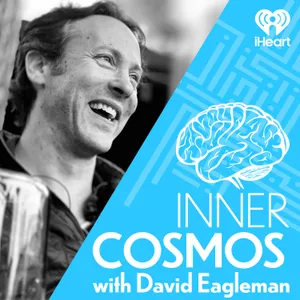
Free Daily Podcast Summary
Inner Cosmos with David Eagleman: Daily Summaries Delivered
by iHeartPodcasts
Neuroscientist and author David Eagleman discusses how our brain interprets the world and what that means for us. Through storytelling, research, interviews, and experiments, David Eagleman tackles wild questions that illuminate new facets of our lives and our realities.
Latest Episodes
The most recent episodes — sign up to get AI-powered summaries of each one.
- 5 days ago53 min
Ep173 "Why Do We Have Emotions?" with Robert Kurzban
What's a feeling for? What is jealousy measuring and motivating? Why do both awe and grief slow us down? What happens when ancient emotions meet dating apps and like buttons? Does the intensity of a feeling decide which part of you takes control? Can understanding an emotion loosen its grip? Today we sit down with evolutionary psychologist Robert Kurzban to understand the logic behind the our varied panoply of emotions.
- 1 weeks ago1h 3m
Ep172 "Can You Quantify Yourself to Improve Health?" with Michael Snyder
Can your smartwatch detect subtle changes before you feel them? Might a continuous glucose monitor pick up on things you didn’t know about yourself? Could a drop of blood map your future health? Why does your personal baseline matter more than a population average? Could AI decode the massive signaling networks of your body? Does seeing your own data change your behavior? Join Eagleman with Michael Snyder, Stanford professor of genetics and a pioneer in massive personal data, to understand what happens when healthcare moves from a snapshot of your body to a movie.
- 2 weeks ago46 min
Ep171 "Why Do Some Urges Feel Irresistible?" with Paige Gordon
Why do two people facing the same choice feel different urges? How much effort hides behind resisting a cookie? Why can the brain keep wanting something long after pleasure fades? Can a molecule crank down the volume of your internal radio? Does a biological understanding of behavior reduce responsibility, or does it deepen compassion? And how would your life change if your loudest urge went quiet? Today Eagleman examines free will through the lens of eating disorders, with guest Paige Gordon, an author and former model who spent decades suffering an invisible internal battle.
- 3 weeks ago48 min
Ep 170 "Will Mars Create a New Species of Human?" with Scott Solomon
What happens when we start birthing babies on Mars? Might a Martian human become unable to survive on Earth because of differences in microbes and gravity? How much of your body is shaped by the details of this planet? Will radiation accelerate human evolution on Mars? Could living on Mars eventually create a new species of human? Could Mars change the way humans dream? Would a Martian child find Earth's oceans as strange and awe-inspiring as we find another planet? Could two branches of humanity become too different to recognize each other? Today we’re joined by Scott Solomon, evolutionary biologist and author of the book “Becoming Martian: How Living in Space Will Change Our Bodies and Minds”.
- Aug 31, 20261h 21m
Ep169 "What Is Claude Thinking But Not Saying?" with Jack Lindsey
Is AI thinking things it never says aloud? How would we know if a large language model were having a subjective experience? Is there a way to read the 'thoughts' of an LLM? Human brains seem to have a 'global workspace' -- what would it mean if we discovered that AI has something similar? Can you reach inside an LLM to change one of its 'thoughts'? Join Eagleman with Anthropic interpretability researcher Jack Lindsey to talk about what might be going on inside the mind of Claude.
- Aug 24, 202646 min
Ep168 "Will it Someday Make Sense to Elect an AI President?"
Could there be a better form of government than the one we have now? As we enter an AI-powered world, when might we choose an AI leader? Will your grandchildren ever vote for a human president, who comes with a political party & the weaknesses of a human, or will they vote for a system that has a jaw-dropping capacity to extract patterns from vast rivers of data, simulate millions of possible futures, & govern with a deeper wisdom than a human could naturally possess? Will we all have personal AI agents that know our strongest political opinions, such that we finally achieve (for the first time at scale) a direct democracy rather than a representative one? Join Eagleman as he explores the future of an AI leader (pros & cons) and where he thinks we’re inevitably heading.
- Aug 17, 202638 min
Ep167 "What Happens With Stone Age Brains + Godlike Tools?" with Steven Kotler
What happens when old brain circuitry collides with modern tech? Are we heading into an age of abundance, and can abundance create its own psychological problems? Do we need friction in our lives to become better humans? Could curiosity become the most important survival skill of the twenty-first century? What happens to your biological neural networks when artificial neural networks do your thinking for you? Eagleman sits down with author and researcher Steven Kotler to discuss his new book, We Are As Gods.
- Aug 10, 202647 min
Ep166 "Could the Next Brain Interface Get Sprayed Up Your Nose?" with Tetiana Aleksandrova & Scott Meek
A brain computer interface (BCI) is any technology that allows you to connect your 3 pounds of wetware to a computer. But instead of implanting electrodes via neurosurgery, might the next revolution in BCIs come from something very small, like nanoparticles? Would this allow us to spy on millions (or billions) of neurons talking at once -- and could we do so without opening the skull? Will this allow BCI tech to become as common as smartphones? Join Eagleman as he talks with the company Subsense about why the next brain-computer interface might come from thinking small.
Get Inner Cosmos with David Eagleman summaries in your inbox
Free AI-powered daily recaps. Key takeaways, quotes, and mentions — in a 5-minute read.
Get Free Summaries →Free forever for up to 3 podcasts. No credit card required.
You Might Also Like
Listeners also like.

Sean Carroll's Mindscape: Science, Society, Philosophy, Culture, Arts, and Ideas
Conversations with leading thinkers exploring fundamental ideas in science, philosophy, culture, and the arts.
The Psychology Podcast
Explores human potential and possibility through conversations with scientists, thinkers, and self-actualized individuals.
Inquiring Minds
Explores the intersection of science and society through critical thinking and in-depth analysis.

Deepak Chopra’s Infinite Potential
Deepak Chopra explores consciousness, identity, and human potential through conversations with thought leaders and experts.
Daniel and Kelly’s Extraordinary Universe
Two scientists explore diverse topics across the universe, from particles to ecosystems, with accessible and engaging explanations.
Mayim Bialik's Breakdown
Explores the intersection of science and spirituality through conversations on consciousness, healing, and unexplained phenomena.
Stuff To Blow Your Mind
Explores the strange edges of science, consciousness, and reality through neuroscience, cosmology, evolution, and emerging technology.

Cosmos in a Pod
Explores space, science, philosophy, and technology to reveal the wonders of the universe and humanity's place within it.

Huberman Lab
Explores neuroscience and science-based tools for understanding and improving brain function, behavior, and health.
Deeply Human
Explores the psychology behind human behavior, emotions, and relationships to better understand what drives our thoughts and actions.
Consciousness and the Brain
Neuroscientist Bernard Baars and guests explore the science of consciousness and the brain, focusing on Global Workspace Theory.

Hidden Brain
Explores human behavior and the unconscious patterns that shape our decisions, relationships, and society through science and storytelling.
About Inner Cosmos with David Eagleman
Neuroscientist and author David Eagleman discusses how our brain interprets the world and what that means for us. Through storytelling, research, interviews, and experiments, David Eagleman tackles wild questions that illuminate new facets of our lives and our realities.
Customized Recaps
AI-powered recaps with compact key takeaways, quotes, and insights.
Straight to Your Inbox
Get key takeaways from Inner Cosmos with David Eagleman in a 5-minute read.
Save Hours Every Week
Stay current on your favorite podcasts without falling behind.
Frequently Asked Questions
What is Podzilla's Inner Cosmos with David Eagleman daily summary?
It's a free AI-powered email that summarizes new episodes of Inner Cosmos with David Eagleman as soon as they're published. You get the key takeaways, notable quotes, and links & mentions — all in a quick read.
How does the Inner Cosmos with David Eagleman podcast summary work?
When a new episode drops, our AI transcribes and analyzes it, then generates a personalized summary tailored to your interests and profession. It's delivered to your inbox every morning.
Is this an official Inner Cosmos with David Eagleman product?
No. Podzilla is an independent service that summarizes publicly available podcast content. We're not affiliated with or endorsed by iHeartPodcasts.
Can I get summaries of other podcasts too?
Absolutely! The free plan covers up to 3 podcasts. Upgrade to Pro for 15, or Premium for 50. Browse our full catalog at /podcasts.
How often does Inner Cosmos with David Eagleman release new episodes?
Inner Cosmos with David Eagleman publishes weekly. Our AI generates a summary within hours of each new episode.
What topics does Inner Cosmos with David Eagleman cover?
Inner Cosmos with David Eagleman covers topics including Science, Education, Fitness, Health & Fitness, Mental Health, Self-Improvement. Our AI identifies the specific themes in each episode and highlights what matters most to you.
Start getting Inner Cosmos with David Eagleman summaries tomorrow morning.
Free forever for up to 3 podcasts. No credit card required.
Free forever for up to 3 podcasts. No credit card required.