Free Daily Podcast Summary
Innovation to Impact: Drug Development, AI, and Regulatory Strategy: Daily Summaries Delivered
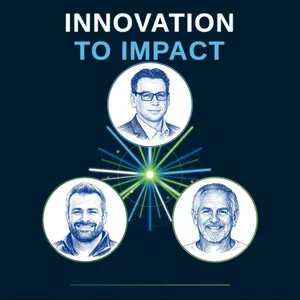
by Brian Berridge, Nick Kelly & Szczepan Baran
Innovation to Impact is a podcast on decision-grade drug development in regulated environments. We examine how high-stakes go/no-go calls are made inside pharma and biotech, and what evidence is required for new tools to change those decisions without creating hidden risk. Each episode focuses on predictivity, translational risk, decision rights, and accountability (what breaks, who owns it, and what triggers a stop). This is not a podcast about technology trends. It is about disciplined innovation that can survive audit, scale, and real-world biology.
Latest Episodes
The most recent episodes — sign up to get AI-powered summaries of each one.
- 2 weeks ago37 min
De-Risking What Matters
In this episode of Innovation to Impact: Ruminations & Ramblings, Szczepan Baran, Brian Berridge, and Nick Kelley tackle one of the biggest problems in modern drug development: we keep adding more technology, more data, and more complexity, yet clinical attrition remains painfully high. Across discussions on AI, NAMs, digital biomarkers, animal models, translational science, and organizational culture, they argue that innovation fails when tools become the strategy instead of serving clearly defined patient-centered decisions. The conversation explores why reverse translation matters, how AI should function as a decision-support system rather than a magic oracle, why “decision warranties” may become essential in AI-enabled science, and how the industry continues to confuse activity with progress. This is a candid, often uncomfortable discussion about predictivity, accountability, translational learning, and what it would actually take to build a drug development system optimized for patient outcomes instead of platform hype.
- Feb 15, 202633 min
Innovation That Earns Deletion (Subtractive Trust)
Click here to watch a video of this episode. Drug development workflows only get heavier, and subtractive change requires predictivity and decision-grade evidence that can survive regulatory science scrutiny. In this episode we talk about how AI and translational science can earn the right to delete steps, not decorate them. The tension is uncomfortable: are you willing to remove something you have always done, or will you just add another layer and call it progress? We introduce the idea of a Predictivity Ledger, a simple way to make miss rates visible and force clarity about what is being claimed, in what context, and with what failure modes. Deletion is not a vibe. It is a governance decision with receipts. Takeaway: pick one legacy step, define deletion criteria, and start logging misses like they cost time and money, because they do. - Episode purpose, resolutions, and AI adoption risks - Subtractive strategy and replacement opportunities in practice - Evidence authority, familiarity, and higher validation bars - Add-on endpoints and why adoption stalls - Decision bias and the need to challenge interpretation - Predictivity ledger components for accountable decisions - AI capabilities, limits, and accountability requirements - Administrative AI example and subtractive realization questions - Process efficiency versus biology, fast-fail critique - Breaking silos, expert finding, and organizational knowledge - Historical knowledge, foundational literature, and AI leverage - Closing remarks and next episode sign-off If you liked this episode, steal the monthly cheat sheet at Innovation2Impact Newsletter (we do the digging, you keep the credit).
- Feb 15, 202629 min
Biology, Loops, and Decision-Grade Trust
Click here to watch a video of this episode. In drug development, go/no-go decisions concentrate translational risk and expose real consequences. When AI or digital biomarkers influence that call, decision-grade evidence in a regulated environment is not optional. This episode sits in the moment every executive recognizes: the slide is on the screen and someone asks, “Do we advance?” Here’s the tension. We love the word validated, but what happens when the next dataset disagrees? We introduce a practical discipline we call the decision warranty: clear scope, clear evidence chain, clear boundaries, and explicit triggers for pause, rerun, or escalation. Someone has to own that call. Takeaway: if you cannot write the stop triggers and the decision owner on one page, do not let the tool move the decision. - Forward Looking Themes for 2025 - Reproducibility Crisis and Foundational Biology - Digital Measures and Preventive Health - Multimodal AI and Foundation Models - Closed Loop Data Generation and Innovation - Decision Making as a Core Capability - Human in the Loop and Accountability - Micro Physiological Endpoints and Decision Use Limits - Democratizing Data and Model Access - Biology as Foundation for Modeling Systems - Opportunity, Effort, and Due Diligence If you liked this episode, steal the monthly cheat sheet at Innovation2Impact Newsletter (we do the digging, you keep the credit).
- Feb 15, 202629 min
Rethinking Return in Drug Development
Click here to watch a video of this episode. In drug development, ROI debates can drown out decision-grade evidence and the hard work of translational science. This episode asks a blunt question: when AI, digital biomarkers, or new assays change the work, who actually gets the return and who carries the downside? The tension is that finance wants clean numbers, while biology delivers messy truth. We challenge the habit of treating ROI as a single scoreboard and propose a more honest framing: financial return, return on intention for patients, and return on learning for the next decision. When those diverge, teams optimize for optics. When they align, innovation becomes durable and defensible. Takeaway: define your returns explicitly and report them side by side at governance meetings, before you declare a “win.” If you liked this episode, steal the monthly cheat sheet at Innovation2Impact Newsletter (we do the digging, you keep the credit).
- Feb 15, 202623 min
Predictivity Is the New Currency of Drug Development
Click here to watch a video of this episode. Drug development punishes optimism, and predictivity is one of the few defenses we have against translational risk. In this episode we connect translational science and regulatory science to a simple operating idea: treat attrition as data, not embarrassment. The tension is real. Do you want a model that explains the past beautifully, or one that helps you be less wrong before the next big spend? We unpack why “validation” after the fact is not enough, and how forecast accuracy, calibration, and honest miss rates should travel across programs instead of dying in slide decks. When predictivity is measured, learning becomes infrastructure. When it isn’t, failure stays expensive and repetitive. Takeaway: start tracking misses across your portfolio and make calibration a standing agenda item, not a post-mortem ritual. - Attrition Framing and Episode Purpose - Shots on Goal and Fast Fail - Learning from Patients and Preclinical Gaps - Opening the Black Box of Attrition - Learning Fast and Digital Iteration - Intentional Learning and Structured Registries - Preventative Technology and Early Detection - Disease Continuum and Early Modulation - Chief Learning Officer and Incentive Shift - Redefining Disease and Closing Reflections If you liked this episode, steal the monthly cheat sheet at Innovation2Impact Newsletter (we do the digging, you keep the credit).
- Feb 15, 202635 min
Patients First. Platforms Second
Click here to watch a video of this episode. In drug development, translational science can generate endless options, but decision-grade evidence starts with the patient decision. This episode looks at why AI and digital biomarkers often get adopted before we agree what “better” means for patients and for the teams who carry the risk. Here’s the uncomfortable question: are we improving outcomes, or just improving the story we tell ourselves about progress? We talk about how platform-first thinking quietly rewires priorities, shifts incentives, and turns “innovation” into a procurement cycle instead of a decision discipline. The goal is not fewer tools. The goal is a tighter link between what we measure and what we are trying to decide, in a world where biology and regulators do not accept vibes as evidence. Takeaway: before you build or buy anything, write the decision, the patient impact, and the owner in one paragraph. - Videocast launch, origin, and purpose - Background and roles across multiple hats - Toxicologic pathology perspective on drug development - Machine learning career and pharma transition - Patients first, platforms second framing - Defining the problem before chasing solutions - Purpose-driven framing and leadership reward signals - AI not a miracle button framing - Data foundations, modalities, and emerging AI trends - Decision support versus dashboard accumulation - Breaking silos and improving probability of success - Closing takeaway on direction, feedback, and humility If you liked this episode, steal the monthly cheat sheet at Innovation2Impact Newsletter (we do the digging, you keep the credit).
About Innovation to Impact: Drug Development, AI, and Regulatory Strategy
Innovation to Impact is a podcast on decision-grade drug development in regulated environments. We examine how high-stakes go/no-go calls are made inside pharma and biotech, and what evidence is required for new tools to change those decisions without creating hidden risk. Each episode focuses on predictivity, translational risk, decision rights, and accountability (what breaks, who owns it, and what triggers a stop). This is not a podcast about technology trends. It is about disciplined innovation that can survive audit, scale, and real-world biology.
Customized Recaps
AI-powered recaps with compact key takeaways, quotes, and insights.
Straight to Your Inbox
Get key takeaways from Innovation to Impact: Drug Development, AI, and Regulatory Strategy in a 5-minute read.
Save Hours Every Week
Stay current on your favorite podcasts without falling behind.
Frequently Asked Questions
What is Podzilla's Innovation to Impact: Drug Development, AI, and Regulatory Strategy daily summary?
It's a free AI-powered email that summarizes new episodes of Innovation to Impact: Drug Development, AI, and Regulatory Strategy as soon as they're published. You get the key takeaways, notable quotes, and links & mentions — all in a quick read.
How does the Innovation to Impact: Drug Development, AI, and Regulatory Strategy podcast summary work?
When a new episode drops, our AI transcribes and analyzes it, then generates a personalized summary tailored to your interests and profession. It's delivered to your inbox every morning.
Is this an official Innovation to Impact: Drug Development, AI, and Regulatory Strategy product?
No. Podzilla is an independent service that summarizes publicly available podcast content. We're not affiliated with or endorsed by Brian Berridge, Nick Kelly & Szczepan Baran.
Can I get summaries of other podcasts too?
Absolutely! The free plan covers up to 3 podcasts. Upgrade to Pro for 15, or Premium for 50. Browse our full catalog at /podcasts.
What topics does Innovation to Impact: Drug Development, AI, and Regulatory Strategy cover?
Innovation to Impact: Drug Development, AI, and Regulatory Strategy covers topics including Science, Business, Management, Life Sciences. Our AI identifies the specific themes in each episode and highlights what matters most to you.
Start getting Innovation to Impact: Drug Development, AI, and Regulatory Strategy summaries tomorrow morning.
Free forever for up to 3 podcasts. No credit card required.
Free forever for up to 3 podcasts. No credit card required.