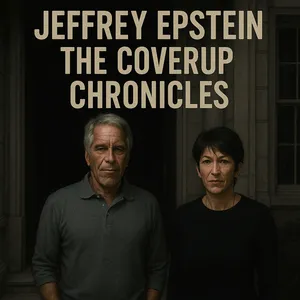
Free Daily Podcast Summary
Jeffrey Epstein: The Coverup Chronicles: Daily Summaries Delivered
by Bobby Capucci
Jeffrey Epstein: The Coverup Chronicles is a podcast dedicated to examining not just who Epstein was and what he did, but how so many people and institutions worked—then and now—to keep it all hidden. This series cuts past the headlines and digs into the documentation: court filings, deposition transcripts, plea deals, sealed exhibits, and the bureaucratic paper trail that still tells the real story. Our focus isn’t on speculation or recycled outrage. It’s on facts—and the deliberate efforts to keep those facts out of public view. Each episode will feature in-depth analysis of newly surfaced records and underreported legal developments, alongside expert commentary that connects them to the broader machinery of power that shielded Epstein for decades. We’ll revisit the timeline from his first arrests through his 2008 plea deal, and into the re-investigations that followed his 2019 death in federal custody. And we won’t stop there—we’ll look closely at the current state of affairs: the closed probes, the lingering co-conspirators, the civil suits, and the glaring gaps in accountability. What makes The Coverup Chronicles different is that we’re not here to sensationalize the story—we’re here to document the ongoing concealment of it. This isn’t just about reliving Epstein’s crimes. It’s about following the networks that enabled them, protected him, and continue to obscure the truth. If you want an honest look at what’s still being hidden—by whom, and why—this is the podcast that pulls those threads. I’ve spent over six years uncovering every dark corner of this case. My name is Bobby Capucci, and I’ve dedicated those same six years to exposing the truth about Epstein and the powerful figures who enabled him. From on-the-ground investigations at Epstein’s Zorro Ranch, where I spoke with insiders, to national appearances on Tucker Carlson, I’ve followed this story farther than most are willing to go. Who helped Epstein build his empire? Who protected him? And who is still pulling the strings? The answers lie in the shadows of Jeffrey Epstein's criminal empire. This is the truth they don’t want you to hear. And I’m here to make sure you do.
Latest Episodes
The most recent episodes — sign up to get AI-powered summaries of each one.
- Today47 min
Mega Edition: Jeffrey Epstein And The Art Of The Stash (10/8/26)
Jeffrey Epstein built a deliberately complicated financial structure that allowed him to move enormous sums of money through trusts, corporations, limited-liability companies and accounts tied to the U.S. Virgin Islands, where he claimed residency and received substantial tax advantages. Court filings from the Virgin Islands alleged that Epstein regularly created new entities, shifted properties and money among them and used the structure to preserve and shield his assets while obscuring how money was being used. Two of the most important entities were Southern Trust Company and Southern Financial, both based in the Virgin Islands and controlled by Epstein; JPMorgan records described Southern Financial as his primary personal investment vehicle and showed that most of his assets were held through these entities. Southern Trust alone held hundreds of millions of dollars at various points, while Epstein’s broader network included corporations and trusts connected to his islands, aircraft, real estate and investments. Shortly before his death in 2019, Epstein also transferred virtually all of his property into the newly restated 1953 Trust, further placing his wealth behind another legal structure rather than holding it straightforwardly in his own name. The Virgin Islands later alleged that this complex arrangement was designed not merely for tax planning but to conceal assets, payments and aspects of Epstein’s criminal enterprise.The money also moved rapidly across banks and international borders, making Epstein’s true financial picture extraordinarily difficult to follow from any single account. Records later showed relationships with JPMorgan, Deutsche Bank, Charles Schwab and other financial institutions, while suspicious-activity reporting disclosed accounts at additional banks including HSBC and Goldman Sachs. In 2019, as Deutsche Bank was pushing him out, tens of millions of dollars flowed through Southern Trust accounts, including approximately $27.7 million in attempted transfers connected to the purchase of a palace in Morocco, with money routed to an account in Switzerland. The larger pattern was one of constant movement: Epstein could hold investments through one Virgin Islands entity, maintain accounts at multiple financial institutions, shift money between corporate vehicles and trusts, and move funds internationally without his personal name necessarily appearing as the obvious holder of every asset. That did not make every offshore transaction illegal, but it created layers between Epstein and his wealth that complicated scrutiny by regulators, investigators and outsiders trying to determine where his money came from, where it went and what it financed. By the time he died, unraveling Epstein’s finances meant following hundreds of millions of dollars through a maze of entities, trusts, banks and jurisdictions rather than simply examining a conventional personal bank account.to contact me:bobbycapucci@protonmail.com
- Today42 min
Mega Edition: Epstein, Maxwell And Their Exploitation Of The Socioeconomic Divide (10/8/26)
Jeffrey Epstein and Ghislaine Maxwell exploited the class divide by operating in two completely different worlds at the same time. At the top were billionaires, royalty, academics, politicians, financiers and celebrities who gave Epstein social legitimacy and made his homes feel protected by wealth, influence and status. At the bottom were teenage girls and young women, many from working-class or unstable backgrounds, who were far easier to isolate, manipulate and discredit. Epstein’s recruitment system frequently relied on offering relatively small amounts of money for massages, then paying girls additional cash to bring in friends, creating a pipeline that disproportionately drew in young women for whom a few hundred dollars could represent a meaningful amount of money. Maxwell helped normalize the environment, presenting herself as sophisticated, connected and trustworthy while participating in the grooming process described by multiple victims and ultimately proven at her criminal trial. The imbalance was enormous: the girls entered mansions filled with wealth and important people, while Epstein and Maxwell controlled the money, the surroundings and the rules. That disparity made resistance harder and helped create the impression that the people running the operation were simply too powerful to challenge.The same class divide also shaped what happened after the abuse. Survivors often faced wealthy defendants surrounded by elite lawyers, private investigators, public-relations professionals and influential associates, while many victims lacked comparable resources and were forced to fight simply to be believed. Epstein could spend heavily on legal defense, negotiate extraordinary protections such as the 2007 non-prosecution agreement and continue moving through elite social circles even after his conduct had become known to law enforcement. Meanwhile, girls who came from troubled homes, struggled with addiction or worked in economically vulnerable circumstances could be portrayed as unreliable, disposable or responsible for their own exploitation. That was one of the central advantages Epstein and Maxwell possessed: they understood that society often grants credibility upward and suspicion downward. Their wealth did not merely provide luxury; it created insulation, access and leverage, while the economic vulnerability of many victims became something that could be exploited during recruitment and later used against them when they sought accountability. In that sense, the Epstein operation was not only built on sexual exploitation but on a social hierarchy in which enormous wealth and status helped protect the people at the top while making the young women at the bottom easier to abuse and easier to ignore.to contact me:bobbycapucci@protonmail.com
- Today20 min
Forensic Psychologist Caulklin's Gives Her Take On The Maxwell Deposition
A forensic psychologist who reviewed Ghislaine Maxwell’s 418-page 2016 deposition said Maxwell came across as unusually irritable, defensive and easily provoked, even though she had years to prepare with her lawyers. Cynthia Calkins of John Jay College said Maxwell often appeared “snappish,” particularly when questioned about recruiting girls for massages, her relationship with Jeffrey Epstein and allegations made by Virginia Giuffre. Maxwell repeatedly denied wrongdoing, called Giuffre a liar and pushed back aggressively against questions about whether she helped groom young girls for Epstein. Calkins cautioned that no one could determine Maxwell’s guilt from her demeanor in a deposition, especially during seven hours of adversarial questioning, but said the transcript gave the impression that Maxwell was guarded and possibly concealing something.Calkins also suggested Maxwell appeared unaccustomed to being challenged and may have felt entitled to resist the questioning, pointing to her privileged background and the amount of time she had to prepare for the deposition. She noted that Maxwell’s answers about Epstein were revealing in tone as well as content, including her statement that she “would have liked to think” of herself as his girlfriend, which Calkins interpreted as possibly reflecting bitterness or unresolved feelings about their relationship. The deposition was taken in connection with Giuffre’s civil lawsuit and remained sealed for four years before being released in 2020, by which time Maxwell was already facing federal criminal charges. The transcript became especially significant because prosecutors had also charged Maxwell with perjury over answers she gave during those sworn examinations.to contact me:bobbycapucci
- Today14 min
Denise George Tries And Fails To Depose Darren Indyke And Richard Kahn
Denise George’s effort to force Darren Indyke and Richard Kahn to sit for depositions in the U.S. Virgin Islands’ civil enforcement action ran into a major procedural roadblock when the court refused to compel the testimony on the timetable she wanted. George, then the Virgin Islands attorney general, had targeted Indyke and Kahn because of their central roles in Jeffrey Epstein’s financial and legal affairs, arguing that their testimony was necessary to understand how Epstein’s entities operated and whether his estate and associates had participated in conduct covered by the territory’s CICO claims. But the court found that the government had not established a sufficient basis to override the procedural protections and sequencing issues raised by the defendants, leaving George without the immediate depositions she had sought.The setback was significant because Indyke and Kahn were not peripheral figures in the litigation. As longtime Epstein advisers and later co-executors of his estate, they were positioned to possess information about the companies, money flows and decisions that George’s office was trying to trace. Her inability to depose them at that stage limited the government’s ability to question them directly under oath and underscored how aggressively the defendants were contesting discovery. It did not end the broader CICO case, but it deprived George of one of the most obvious avenues for testing the documentary record against the testimony of two men who sat near the center of Epstein’s financial structure.to contact me:bobbycapucci@protonmail.com
- Today12 min
Jane Doe And Her Allegations Against The Cornell 7 (Part 2) (10/7/26)
A Jane Doe plaintiff sued Cornell University, the Chi Phi fraternity and its national organizations, Tri Delta and its related entities, Moonies Bar & Nightclub, seven Cornell students and several other defendants over an alleged sexual assault at the Chi Phi house in October 2024. According to the complaint, Doe was a 20-year-old Cornell student and Tri Delta member who became heavily intoxicated during a sorority event, was served alcohol at Moonies despite being marked as under 21, and later went to the Chi Phi house. She alleges that fraternity members gave her additional alcohol, marijuana and what they described as ketamine before multiple men sexually assaulted her while she was too intoxicated and drugged to consent. The complaint alleges that one fraternity member posted a message to a Chi Phi Snapchat group inviting others upstairs while the assault was underway, after which additional members entered the room. Doe says the assaults continued for hours, ending shortly before 6 a.m., and that she later reported what happened to Cornell police. Cornell subsequently suspended the fraternity and several students, opened a Title IX investigation, and publicly described the allegations as involving drug abuse and sexual violence; the complaint says the matter also remained under investigation by Ithaca police.The lawsuit goes beyond the individual students and argues that Cornell, Chi Phi, Tri Delta and other institutional defendants failed to protect Doe despite years of warnings about sexual assault, drugging and alcohol-related misconduct within Greek life. The complaint points to prior reports of sexual assaults and druggings connected to Cornell fraternities, campus reform efforts dating back years and policies that allegedly demonstrated the university and Greek organizations understood the risks. Doe accuses the institutional defendants of negligence, negligent supervision and retention, breach of contract and other failures, while asserting sexual assault, sexual battery and emotional-distress claims against the individual students. She also brings claims under New York’s Human Rights Law, education law and Dram Shop Act, alleging that Moonies unlawfully served her alcohol despite clear indications that she was underage and visibly intoxicated. The suit seeks compensatory and punitive damages, attorneys’ fees, interest and a jury trial, while making clear that the allegations remain civil claims that the defendants are entitled to contest in court.to contact me:bobbycapucci@protonmail.comsource:doe-cornell-new-york-supreme.pdf
- Today17 min
Jane Doe And Her Allegations Against The Cornell 7 (Part 1) (10/7/26)
A Jane Doe plaintiff sued Cornell University, the Chi Phi fraternity and its national organizations, Tri Delta and its related entities, Moonies Bar & Nightclub, seven Cornell students and several other defendants over an alleged sexual assault at the Chi Phi house in October 2024. According to the complaint, Doe was a 20-year-old Cornell student and Tri Delta member who became heavily intoxicated during a sorority event, was served alcohol at Moonies despite being marked as under 21, and later went to the Chi Phi house. She alleges that fraternity members gave her additional alcohol, marijuana and what they described as ketamine before multiple men sexually assaulted her while she was too intoxicated and drugged to consent. The complaint alleges that one fraternity member posted a message to a Chi Phi Snapchat group inviting others upstairs while the assault was underway, after which additional members entered the room. Doe says the assaults continued for hours, ending shortly before 6 a.m., and that she later reported what happened to Cornell police. Cornell subsequently suspended the fraternity and several students, opened a Title IX investigation, and publicly described the allegations as involving drug abuse and sexual violence; the complaint says the matter also remained under investigation by Ithaca police.The lawsuit goes beyond the individual students and argues that Cornell, Chi Phi, Tri Delta and other institutional defendants failed to protect Doe despite years of warnings about sexual assault, drugging and alcohol-related misconduct within Greek life. The complaint points to prior reports of sexual assaults and druggings connected to Cornell fraternities, campus reform efforts dating back years and policies that allegedly demonstrated the university and Greek organizations understood the risks. Doe accuses the institutional defendants of negligence, negligent supervision and retention, breach of contract and other failures, while asserting sexual assault, sexual battery and emotional-distress claims against the individual students. She also brings claims under New York’s Human Rights Law, education law and Dram Shop Act, alleging that Moonies unlawfully served her alcohol despite clear indications that she was underage and visibly intoxicated. The suit seeks compensatory and punitive damages, attorneys’ fees, interest and a jury trial, while making clear that the allegations remain civil claims that the defendants are entitled to contest in court.to contact me:bobbycapucci@protonmail.comsource:doe-cornell-new-york-supreme.pdf
- Today11 min
Jes Staley And His Unredacted Motion To Exclude JP Morgan's Expert Witness Opinions (Part 2) (10/7/26)
Jes Staley asked Judge Jed Rakoff to exclude expert testimony JPMorgan planned to use against him in the litigation stemming from the bank’s relationship with Jeffrey Epstein. JPMorgan had brought third-party claims against its former executive, arguing that Staley should bear responsibility for some or all of the bank’s potential liability because of his close relationship with Epstein and his role inside JPMorgan. Staley attacked the bank’s experts under Federal Rule of Evidence 702 and the Daubert standard, arguing that their opinions were speculative, lacked a sufficient factual foundation, and did not reliably connect their methodologies to the actual issues the jury would have to decide. His motion was designed to prevent JPMorgan from using expert witnesses to strengthen its effort to shift blame and damages onto him.Staley also argued that allowing the challenged opinions would create unfair prejudice and risk confusing the jury by presenting conclusions that, in his view, went beyond proper expert analysis and into speculation about causation, responsibility and damages. The motion fit into his broader defense that JPMorgan was attempting to make him the principal fall guy for a relationship with Epstein that the bank itself maintained for years despite repeated warning signs. By seeking to exclude the experts entirely, Staley was trying to narrow the evidence JPMorgan could present in support of its indemnification and contribution claims and make it harder for the bank to prove that his conduct, rather than JPMorgan’s own institutional decisions, was responsible for the losses tied to the Epstein litigation.to contact me:bobbycapucci@protonmail.com
- Today15 min
Jes Staley And His Unredacted Motion To Exclude JP Morgan's Expert Witness Opinions (Part 1) (10/7/26)
Jes Staley asked Judge Jed Rakoff to exclude expert testimony JPMorgan planned to use against him in the litigation stemming from the bank’s relationship with Jeffrey Epstein. JPMorgan had brought third-party claims against its former executive, arguing that Staley should bear responsibility for some or all of the bank’s potential liability because of his close relationship with Epstein and his role inside JPMorgan. Staley attacked the bank’s experts under Federal Rule of Evidence 702 and the Daubert standard, arguing that their opinions were speculative, lacked a sufficient factual foundation, and did not reliably connect their methodologies to the actual issues the jury would have to decide. His motion was designed to prevent JPMorgan from using expert witnesses to strengthen its effort to shift blame and damages onto him.Staley also argued that allowing the challenged opinions would create unfair prejudice and risk confusing the jury by presenting conclusions that, in his view, went beyond proper expert analysis and into speculation about causation, responsibility and damages. The motion fit into his broader defense that JPMorgan was attempting to make him the principal fall guy for a relationship with Epstein that the bank itself maintained for years despite repeated warning signs. By seeking to exclude the experts entirely, Staley was trying to narrow the evidence JPMorgan could present in support of its indemnification and contribution claims and make it harder for the bank to prove that his conduct, rather than JPMorgan’s own institutional decisions, was responsible for the losses tied to the Epstein litigation.to contact me:bobbycapucci@protonmail.com
Get Jeffrey Epstein: The Coverup Chronicles summaries in your inbox
Free AI-powered daily recaps. Key takeaways, quotes, and mentions — in a 5-minute read.
Get Free Summaries →Free forever for up to 3 podcasts. No credit card required.
You Might Also Like
Listeners also like.

True Sunlight
Journalists investigate true crime and systemic corruption, focusing on victims and accountability with rigorous, empathetic reporting.

The Tara Palmeri Show
A political journalist reveals behind-the-scenes dynamics and unfiltered realities of power in Washington and beyond.

Deep Cover
People live double lives, from suburban fathers hiding criminal pasts to the secrets that unravel families.

MK True Crime
Covers high-profile trials, true crime cases, and legal analysis with expert hosts and insider perspectives.

Juicy Crimes with Heather McDonald
Explores sensational true crime cases with a focus on greed, deception, and celebrity, blending humor and insight with guest experts.

The Megyn Kelly Show
Provocative conversations with influential figures in politics, law, and culture, featuring candid and fearless dialogue.

Drop Dead Serious With Ashleigh Banfield
A veteran journalist explores true crime cases with a personal perspective and investigative depth.

Slow Burn
Examines pivotal political and cultural moments in American history through archival audio and firsthand accounts.

True Criminals
Investigative journalists revisit high-profile and overlooked crime cases with firsthand sources and deep reporting insight.

Serialously with Annie Elise
Annie Elise investigates true crime cases with deep detail and a conversational tone, uncovering overlooked facts and breaking developments.

Admissible: Shreds of Evidence
A reporter investigates a forensic analyst tied to 13 wrongful convictions and allegations of misconduct at a state crime lab.

The Prevailing Narrative with Matt Bilinsky
Analyzes news and current events through interviews with experts and innovators.
About Jeffrey Epstein: The Coverup Chronicles
Jeffrey Epstein: The Coverup Chronicles is a podcast dedicated to examining not just who Epstein was and what he did, but how so many people and institutions worked—then and now—to keep it all hidden. This series cuts past the headlines and digs into the documentation: court filings, deposition transcripts, plea deals, sealed exhibits, and the bureaucratic paper trail that still tells the real story. Our focus isn’t on speculation or recycled outrage. It’s on facts—and the deliberate efforts to keep those facts out of public view. Each episode will feature in-depth analysis of newly surfaced records and underreported legal developments, alongside expert commentary that connects them to the broader machinery of power that shielded Epstein for decades. We’ll revisit the timeline from his first arrests through his 2008 plea deal, and into the re-investigations that followed his 2019 death in federal custody. And we won’t stop there—we’ll look closely at the current state of affairs: the closed probes, the lingering co-conspirators, the civil suits, and the glaring gaps in accountability. What makes The Coverup Chronicles different is that we’re not here to sensationalize the story—we’re here to document the ongoing concealment of it. This isn’t just about reliving Epstein’s crimes. It’s about following the networks that enabled them, protected him, and continue to obscure the truth. If you want an honest look at what’s still being hidden—by whom, and why—this is the podcast that pulls those threads. I’ve spent over six years uncovering every dark corner of this case. My name is Bobby Capucci, and I’ve dedicated those same six years to exposing the truth about Epstein and the powerful figures who enabled him. From on-the-ground investigations at Epstein’s Zorro Ranch, where I spoke with insiders, to national appearances on Tucker Carlson, I’ve followed this story farther than most are willing to go. Who helped Epstein build his empire? Who protected him? And who is still pulling the strings? The answers lie in the shadows of Jeffrey Epstein's criminal empire. This is the truth they don’t want you to hear. And I’m here to make sure you do.
Customized Recaps
AI-powered recaps with compact key takeaways, quotes, and insights.
Straight to Your Inbox
Get key takeaways from Jeffrey Epstein: The Coverup Chronicles in a 5-minute read.
Save Hours Every Week
Stay current on your favorite podcasts without falling behind.
Frequently Asked Questions
What is Podzilla's Jeffrey Epstein: The Coverup Chronicles daily summary?
It's a free AI-powered email that summarizes new episodes of Jeffrey Epstein: The Coverup Chronicles as soon as they're published. You get the key takeaways, notable quotes, and links & mentions — all in a quick read.
How does the Jeffrey Epstein: The Coverup Chronicles podcast summary work?
When a new episode drops, our AI transcribes and analyzes it, then generates a personalized summary tailored to your interests and profession. It's delivered to your inbox every morning.
Is this an official Jeffrey Epstein: The Coverup Chronicles product?
No. Podzilla is an independent service that summarizes publicly available podcast content. We're not affiliated with or endorsed by Bobby Capucci.
Can I get summaries of other podcasts too?
Absolutely! The free plan covers up to 3 podcasts. Upgrade to Pro for 15, or Premium for 50. Browse our full catalog at /podcasts.
How often does Jeffrey Epstein: The Coverup Chronicles release new episodes?
Jeffrey Epstein: The Coverup Chronicles publishes daily. Our AI generates a summary within hours of each new episode.
What topics does Jeffrey Epstein: The Coverup Chronicles cover?
Jeffrey Epstein: The Coverup Chronicles covers topics including News, Commentary, Daily News. Our AI identifies the specific themes in each episode and highlights what matters most to you.
Start getting Jeffrey Epstein: The Coverup Chronicles summaries tomorrow morning.
Free forever for up to 3 podcasts. No credit card required.
Free forever for up to 3 podcasts. No credit card required.