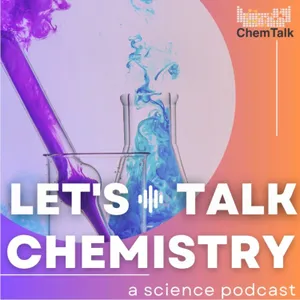
Free Daily Podcast Summary
Let's Talk Chemistry- a science podcast by ChemTalk: Daily Summaries Delivered
by The ChemTalk Team
ChemTalk (chemistrytalk.org) is a brand-new non-profit, whose mission is to make chemistry more fun, easier to learn, and more accessible to people around the world - in the safest manner possible and also to be perceived in a more positive way. On our podcast, we interview chemists, scientists, and educators from across the globe who show the many career paths that involve chemistry, and how a love for chemistry can manifest itself in many unique ways.
Latest Episodes
The most recent episodes — sign up to get AI-powered summaries of each one.
- Today49 min
Episode 70: Dr. Matthew Hartings on 3D Printing Materials & Food Science
For a chemist such as Dr. Matthew Hartings, 3D printing isn’t just about making inert products like plastic models or prototypes. Instead, he explores novel starting materials with specific chemical properties in order to 3D print products with the ability to store gases such as hydrogen. Dr. Hartings also bridges the world of chemistry to everyday life through food, exploring the science behind cooking and sharing some surprising yet simple ways to elevate a meal. On this exciting episode of Let’s Talk Chemistry edited by Presley Vu, hosts Poorvi Iyer, Michael Steitz, and Elizabeth Li talk with Dr. Hartings, Professor of Chemistry at American University, from everything from materials chemistry to the chemistry of cooking. We hope you enjoy!
- Jul 23, 202651 min
Episode 69: Dr. Martin Burke on Democratizing Molecular Innovation
With 8 billion imaginations in the world, Dr. Martin Burke calculates that the number of specialists who are able to create molecules can fit into a single building. On this exciting episode of Let’s Talk Chemistry edited by Presley Vu, hosts Nina Deng and Poorvi Iyer talk with Dr. Burke, Professor of Chemistry at the University of Illinois Champaign and Founding Director of the Molecule Maker Lab. Dr. Burke is known for pioneering BLOCC chemistry, a modular approach to synthesis that opens up molecule building to non-specialists, robotics, and AI. This has paved the way to creating new treatments and digital platforms where making molecules become easily programmable and accessible to anyone. We hope you enjoy!
- Jun 2, 202640 min
Episode 68: Dr. Michael Pollastri on Drug Discovery for Neglected Tropical Diseases
Drug discovery is already an incredibly difficult and tedious process, but what happens when there’s little financial incentive to develop the medicine at all? On this exciting episode of Let’s Talk Chemistry edited by Presley Vu, hosts Poorvi Iyer and Nina Deng talk with Dr. Michael Pollastri, senior vice provost and academic lead of the Roux Institute at Northeastern University. From his time as a bench chemist at Pfizer to his current role leading academic research on diseases affecting some of the world’s most vulnerable populations, Dr. Pollastri discusses the realities of neglected diseases and the role academic labs play in addressing gaps in global healthcare research. We hope you enjoy!
- Apr 29, 202643 min
Episode 67: Dr. John LaMattina on Drug Discovery, Pharma Innovation, and Industry Myths
Have you ever wondered why new medicines can take decades to be developed and why the process is so costly? On this exciting episode of Let’s Talk Chemistry edited by Presley Vu, hosts Amber Bakkum, Poorvi Iyer, and Nina Deng go behind-the-scenes of the pharmaceutical industry with Dr. John LaMattina, former president of Pfizer Global Research and Development and current biotech advisor. Dr. LaMattina shares his experience first as a bench scientist to becoming the head of global Research and Development at Pfizer Inc. He talks about the important skills needed for chemists to work their way to leadership positions and dispels common myths about the pharmaceutical industry. We hope you enjoy!
- Mar 9, 202620 min
Episode 66: Dr. Neil Garg on Reimagining Organic Chemistry
Organic chemistry has a reputation for being one of the most challenging college courses—but what if it could also be interactive, accessible, and even fun? On this exciting episode of Let’s Talk Chemistry edited by Jasmine Winter, hosts Jasmine Winter and Elizabeth Li share the story of Dr. Neil Garg, Professor of Chemistry and Biochemistry at the University of California, Los Angeles. Dr. Garg discusses his journey from discovering his passion for organic chemistry as an undergraduate to earning his PhD at Caltech and building a career that bridges both research and education. Dr. Garg’s career is built on challenging the status quo, from breaking a 100 year-old rule in chemistry known as Bredt’s rule, to developing innovative tools to help students better visualize and understand molecular structures. Dr. Garg emphasizes teamwork, intellectual curiosity, and making science approachable for learners of all ages. We hope you enjoy!
- Jan 9, 202647 min
Episode 65: Dr. Frank Leibfarth on Upcycling Plastic Waste and Tackling Forever Chemicals
Dr. Frank Leibfarth is the 2025 Blavatnik National Awards for Young Scientists Laureate in Chemical Sciences, recognized for his work in upcycling plastics and removing “forever chemicals” (PFAS) from water. In this episode of Let’s Talk Chemistry, edited by Presley Vu, hosts Nina Deng and Diya Garrepally dive into our interview with Dr. Frank Leibfarth, the Royce Murray Distinguished Term Professor of Chemistry at the University of North Carolina Chapel Hill. Dr. Leibfarth discusses how his research tackles the challenges of plastic recycling and PFAS contamination, and he shares all about his incredible journey to get here—from being a kicker on the University of South Dakota’s football team to testing PFAS-absorbing materials in municipal water treatment plants, hard hat and all! He also offers thoughtful advice and encouragement for other aspiring young scientists seeking to make an impact in their own paths. We hope you enjoy!
- Dec 17, 202520 min
Episode 64: Dr. David Julian McClements on Food Science
On the surface, food science may sound simple. But once you dive deeper, you’ll discover a world of innovation, challenges, and incredible scientists behind the food you find on grocery store shelves. On this exciting episode of Let’s Talk Chemistry edited by David Alvia, hosts Elizabeth Li and Poorvi Iyer discuss our interview with Dr. David Julian McClements, Distinguished Professor at the Department of Food Science at the University of Massachusetts and most cited author in food science. Dr. McClements talks about how next generation plant based foods are being developed to be more sustainable and healthy, while being able to successfully replicate meat products using reverse engineering. He then goes on to discuss his thoughts on highly processed foods, how to eat mindfully, as well as a few books of his that are all about the fascinating science behind food we eat everyday. We hope you enjoy!
- Nov 11, 202524 min
Episode 63: Dr. Aaron Burton on What Meteorites Can Teach Us About Life
How did life start on Earth and could life exist elsewhere? On this exciting episode of Let’s Talk Chemistry edited by David Alvia, hosts Erin Suh, Elizabeth Li, and Aanya Santosh discuss our interview with Dr. Aaron Burton, a Program Scientist in the Planetary Science Division at NASA Headquarters. Dr. Burton tackles these two questions head-on in his studies of meteorites and other astromaterial samples. By analyzing the organic molecules in these extraterrestrial samples, Dr. Burton is able to piece together what the origins of life on Earth could have looked like. In addition, Dr. Burton shares the special techniques used by astrobiologists to handle and examine extraterrestrial samples, as well as his thoughts on popular sci-fi films! We hope you enjoy!
Get Let's Talk Chemistry- a science podcast by ChemTalk summaries in your inbox
Free AI-powered daily recaps. Key takeaways, quotes, and mentions — in a 5-minute read.
Get Free Summaries →Free forever for up to 3 podcasts. No credit card required.
You Might Also Like
Listeners also like.
Bringing Chemistry to Life
Talks with leading chemists about their discoveries, careers, and the science shaping our world.
Modern Chemistry Podcast
Paul Orange Ph.D.
Stereo Chemistry
Voices and stories from the world of chemistry, reported by Chemical & Engineering News.
Dope Labs
Two scientist best friends break down trending topics through a scientific lens, making complex concepts accessible and entertaining.
Cannabis Cultivation and Science Podcast
Experts discuss science-based organic cannabis cultivation techniques and advancements in growing technology.
Seeking A Scientist
A chemist hosts conversations with scientists to explore futuristic scientific possibilities and their real-world implications.
Walk-In Talk Podcast
Raw conversations with food industry professionals about restaurant operations, culinary leadership, and the business of hospitality.
Elementary
A student-run podcast exploring a different chemical element each episode through fun facts, science games, and interviews with researchers.
Good Science
Fictional health officials parody conspiracy theories and anti-science rhetoric through absurdist comedy on public health topics.
Periodically
A University of Oxford podcast exploring how menstruation impacts undergraduate life in chemistry, from tutorials to labs.
Inquiring Minds
Explores the intersection of science and society through critical thinking and in-depth analysis.
The Science of Everything Podcast
Explores diverse topics in natural and social sciences through the lens of the scientific method.
About Let's Talk Chemistry- a science podcast by ChemTalk
ChemTalk (chemistrytalk.org) is a brand-new non-profit, whose mission is to make chemistry more fun, easier to learn, and more accessible to people around the world - in the safest manner possible and also to be perceived in a more positive way. On our podcast, we interview chemists, scientists, and educators from across the globe who show the many career paths that involve chemistry, and how a love for chemistry can manifest itself in many unique ways.
Customized Recaps
AI-powered recaps with compact key takeaways, quotes, and insights.
Straight to Your Inbox
Get key takeaways from Let's Talk Chemistry- a science podcast by ChemTalk in a 5-minute read.
Save Hours Every Week
Stay current on your favorite podcasts without falling behind.
Frequently Asked Questions
What is Podzilla's Let's Talk Chemistry- a science podcast by ChemTalk daily summary?
It's a free AI-powered email that summarizes new episodes of Let's Talk Chemistry- a science podcast by ChemTalk as soon as they're published. You get the key takeaways, notable quotes, and links & mentions — all in a quick read.
How does the Let's Talk Chemistry- a science podcast by ChemTalk podcast summary work?
When a new episode drops, our AI transcribes and analyzes it, then generates a personalized summary tailored to your interests and profession. It's delivered to your inbox every morning.
Is this an official Let's Talk Chemistry- a science podcast by ChemTalk product?
No. Podzilla is an independent service that summarizes publicly available podcast content. We're not affiliated with or endorsed by The ChemTalk Team.
Can I get summaries of other podcasts too?
Absolutely! The free plan covers up to 3 podcasts. Upgrade to Pro for 15, or Premium for 50. Browse our full catalog at /podcasts.
How often does Let's Talk Chemistry- a science podcast by ChemTalk release new episodes?
Let's Talk Chemistry- a science podcast by ChemTalk publishes monthly. Our AI generates a summary within hours of each new episode.
What topics does Let's Talk Chemistry- a science podcast by ChemTalk cover?
Let's Talk Chemistry- a science podcast by ChemTalk covers topics including Science, Chemistry. Our AI identifies the specific themes in each episode and highlights what matters most to you.
Start getting Let's Talk Chemistry- a science podcast by ChemTalk summaries tomorrow morning.
Free forever for up to 3 podcasts. No credit card required.
Free forever for up to 3 podcasts. No credit card required.