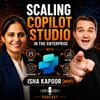
Scaling Copilot Studio in the Enterprise with Isha Kapoor [MVP]
In this episode of the M365 Podcast, host Mirko Peters sits down with Microsoft MVP and Copilot Engineer Isha Kapoor for an in-depth conversation about one of the most important topics facing organizations today: how to successfully scale Microsoft Copilot Studio in large enterprise environments.While many demonstrations of AI agents and Copilot Studio focus on building solutions in just a few minutes, the reality inside large organizations is dramatically different. Enterprises operating in highly regulated industries such as banking, government, healthcare, and financial services must navigate complex requirements around security, governance, compliance, deployment pipelines, data protection, auditing, and operational control before AI solutions can reach production.Drawing from her experience leading Copilot Studio implementations for large financial institutions and enterprise organizations, Isha shares practical insights into what it really takes to move from AI experimentation to enterprise-scale deployment. The discussion explores real-world governance models, deployment strategies, security controls, data residency requirements, responsible AI practices, and lessons learned from deploying AI agents at scale.ENTERPRISE AI IS MORE THAN BUILDING AGENTSOne of the biggest misconceptions surrounding AI is that building an agent is the difficult part. In reality, creating an AI agent in Microsoft Copilot Studio can often be accomplished within minutes. The true challenge begins when organizations attempt to deploy those agents safely into production environments that contain sensitive business data and mission-critical processes.Isha explains how enterprise organizations must establish strict governance frameworks that control where development occurs, who can access environments, how agents are reviewed, and how they move through deployment pipelines. Without these controls, organizations risk exposing sensitive information, creating compliance issues, or deploying agents that behave unpredictably.The conversation highlights why AI projects require the same rigor as enterprise application development, including change management, operational ownership, security reviews, approval processes, and ongoing monitoring.KEY TOPICS DISCUSSED IN THIS EPISODE• Microsoft Copilot Studio governance strategies• Enterprise AI deployment pipelines and ALM practices• Data Loss Prevention (DLP) policies for AI agents• Security and compliance requirements in regulated industries• Responsible AI implementation and monitoring• AI agent lifecycle management and operational controls• Power Platform integration with Copilot Studio• Future trends in Microsoft 365 Copilot and enterprise AIBUILDING A GOVERNANCE-FIRST COPILOT STUDIO STRATEGYA major focus of the episode is the importance of governance before innovation. Rather than allowing unrestricted AI experimentation in production environments, Isha outlines a structured Application Lifecycle Management (ALM) strategy that separates development, testing, and production workloads.Organizations must establish dedicated Power Platform environments for development, quality assurance, and production. Development environments should be isolated from production systems, ensuring makers cannot accidentally connect AI agents to live business data during experimentation. Through carefully designed DLP policies, endpoint filtering, connector restrictions, and environment-level controls, organizations can significantly reduce risk while still enabling innovation.The discussion also explores how environment owners and administrators play a critical role in maintaining visibility into AI projects, reviewing deployed agents, and conducting regular governance reviews to ensure compliance with organizational standards.AI SECURITY, PROMPT INJECTION, AND ENTERPRISE RISKAs AI adoption accelerates, security concerns continue to evolve. One of the most fascinating parts of the discussion centers on AI security risks and the practical realities of prompt injection attacks.Isha shares examples of enterprise testing scenarios where organizations attempted to manipulate AI behavior through prompt engineering techniques. The conversation examines the differences between Microsoft 365 Copilot and Copilot Studio, highlighting how enterprise agents require additional safeguards because they are often designed to perform specific business tasks and interact directly with enterprise systems.The episode explores how organizations can protect themselves through:• Responsible AI reviews before deployment• Security testing and red-team exercises• Alerting and monitoring for AI violations• Quarantine procedures for problematic agents• Strict permission and identity management controlsOne particularly interesting topic is th
Podzilla Summary coming soon
Sign up to get notified when the full AI-powered summary is ready.
Free forever for up to 3 podcasts. No credit card required.
Listen to This Episode
More from M365.FM - Modern work, security, and productivity with Microsoft 365

Steps to Microsoft 365 Copilot Extensibility with Gautam Sheth [MVP]

I building a Synthetic Market for M365 Strategy

My Microsoft Copilot is now JARVIS: This is how I built it
Leading AI, Delivering Transformation, and Building Community with Areti Iles [MVP]
Get summaries like this every morning.
Free AI-powered recaps of M365.FM - Modern work, security, and productivity with Microsoft 365 and your other favorite podcasts, delivered to your inbox.
Free forever for up to 3 podcasts. No credit card required.