Free Daily Podcast Summary
Mahabharat - The Complete Saga: Daily Summaries Delivered
by Anupam Tiwari
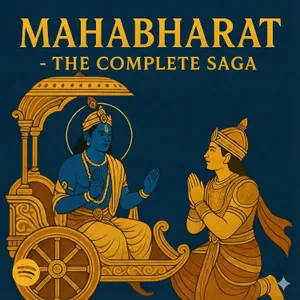
Mahabharat - The Complete Saga, an authentic retelling of the Hindu Epic of Mahabharat. This podcast decodes the psychology, management lessons, and spiritual science hidden in Ved Vyasa’s original text. Beyond the TV myths, it explores the untold stories of Karna, Krishna, Draupadi, and the Kurukshetra War. Discover the real history of Ancient India and Sanatan Dharma, analyzed for the modern Gen Z listener. Join the ultimate journey of Dharma and Karma.
Latest Episodes
The most recent episodes — sign up to get AI-powered summaries of each one.
- 4 days ago11 min
Karna vs Arjun - The Final Showdown | War Day 17 Part 4 | Mahabharat The Complete Saga | EP86
The climax of the 17th day of Kurukshetra War brings the defining rivalry of the Mahabharat to its ultimate, catastrophic conclusion. The battlefield clears as the supreme archers of their generation—Arjun and Karna—finally face off in a duel that has been brewing for decades. This is not just a clash of divine weapons; it is the absolute collision of two fundamentally opposed ideologies. For a brief, breathtaking period, the combat is remarkably even. Karna pushes Arjun to his absolute limits, proving beyond a shadow of a doubt that his martial prowess is equal to the greatest Pandava.However, in high-stakes warfare, raw talent cannot outrun the compounding debt of past systemic failures and moral compromises. At the exact moment Karna needs his supreme focus, his entire meticulously constructed identity begins to violently unravel. The curses of his past—the consequences of his deceit to Guru Parashuram and his collateral damage against an innocent Brahmin—activate simultaneously. His chariot wheel sinks immovably into the blood-soaked earth, and his mind completely blanks on the incantations for his ultimate divine weapons.Stripped of his tactical advantages, a desperate Karna tries to pause the battle, hypocritically invoking the ancient codes of Dharma Yuddha to demand a fair fight. What follows is Lord Krishna’s most devastating, cold-blooded psychological cross-examination in the entire epic. Krishna ruthlessly weaponizes Karna’s own history against him, demanding to know where his "Dharma" was when Empress Draupadi was dragged into the Dice Hall, or when six veteran commanders illegally slaughtered the teenage Abhimanyu. Stripped of all moral high ground and physically defenseless, Karna is trapped. On Krishna's uncompromising command, Arjun executes a flawless, fatal sniper strike using the Anjalika weapon, beheading the Supreme Commander. This episode profoundly deconstructs the tragedy of Karna: proving that incredible talent and loyalty mean nothing if they are pledged to a corrupt establishment, and that the universe eventually collects its karmic debts.
- 1 weeks ago12 min
85. War Day 17 Part 3 | Bheem kills Dushyasan | Arjun Kills Karna's son Vrishsen
As the 17th day of Kurukshetra War rages on, the Kurukshetra battlefield descends into absolute, unfiltered primal violence. Decades of unhealed trauma, systemic abuse, and suppressed rage from the infamous Game of Dice finally explode in one of the most terrifying and visceral sequences of the entire epic. The spotlight violently shifts to Bhima, who completely abandons conventional warfare to hunt down the architect of Empress Draupadi's public humiliation: Dushasan.What unfolds is not a standard martial duel, but a horrifying, calculated execution. Overpowering Dushasan, Bheem physically tears open his chest to fulfill his gruesome, decade-old vow: drinking the blood of his abuser. This act is deliberately designed to be a spectacle of sheer psychological terror. It sends a paralyzing shockwave of absolute dread through the Kaurava ranks, causing a mass exodus of soldiers and striking profound fear into the heart of Supreme Commander Karna himself. It is the ultimate, inescapable consequence of institutional arrogance, proving that the unpaid debts of systemic injustice are eventually collected in blood.Simultaneously, Arjun executes his own masterclass in psychological agony. Refusing to engage Karna immediately, Arjuna first targets Karna’s elite son, Vrishasen. In a ruthless display of tactical superiority, Arjun systematically dismantles and executes the young prince right before Karna's eyes, deliberately inflicting the exact same parental trauma Arjun suffered with Abhimanyu. Shattered by grief and fear, the Kaurava forces completely collapse. The episode culminates in the ultimate, long-awaited staredown: Lord Krishna steers the chariot through rivers of blood, finally positioning Arjun face-to-face with a psychologically devastated Karna for the climax of the war.
- 2 weeks ago12 min
84. War Day 17 Part 2 | Brothers Collide! | Arjun Vs Yudhishthir
The 17th day of Kurukshetra War continues with the Pandava empire to the absolute brink of self-destruction—not by the hands of the Kauravas, but through a catastrophic internal breakdown. While Supreme Commander Karna unleashes the apocalyptic Bhargavastra to decimate the Panchala army, a far more volatile crisis erupts inside the Pandava camp. When Lord Krishna and Arjun temporarily leave the frontlines to check on the severely wounded King Yudhishthir, a devastating miscommunication occurs. Yudhishthir mistakenly assumes Arjun has finally assassinated Karna. Upon discovering his nemesis is still alive and actively massacring their troops, the physically traumatized and deeply humiliated King completely loses his psychological composure.In a moment of blind, unchecked rage, Yudhishthir launches a vicious verbal assault on Arjun, culminating in the ultimate insult; he demands Arjun surrender his legendary Gandiv bow to someone more capable. This triggers a terrifying, deeply programmed response. Bound by a secret, absolute vow to behead anyone who insults the Gandiv, Arjun draws his sword to execute his own eldest brother. It is a moment of total systemic collapse; the Pandava leadership is mere seconds away from fratricide and the permanent loss of the war.Here, Lord Krishna delivers an unparalleled masterclass in extreme crisis management and ethical complexity. Intervening both physically and psychologically, Krishna thoroughly deconstructs Arjun’s rigid, black-and-white understanding of morality. Using the profound parables of the Balaka hunter and Kaushika Muni, Krishna proves that blind adherence to a vow or a literal "truth" becomes a grave sin if it results in the senseless destruction of life and a higher overarching purpose. Krishna brilliantly de-escalates the massive egos in the room, saves Arjun from the unforgivable sins of fratricide and suicide, and masterfully redirects that raw, volatile fury toward its rightful, ultimate target: the imminent assassination of Karna.
- 3 weeks ago10 min
83. War Day 17 Part 1 | Karna Vs Yudhishthir | The Ultimate Humiliation!
The 17th day of the Kurukshetra war escalates from physical combat into a devastating display of psychological warfare. Despite the toxic internal sabotage from his charioteer Shalya, Supreme Commander Karna enters the battlefield as an unstoppable, terrifying force. The day's most critical and shocking confrontation occurs when Karna directly engages the supreme leader of the Pandava army, King Yudhishthira.From a modern strategic perspective, this was not merely a military defeat; it was a total psychological dismantling of the Pandava leadership. Karna completely overpowers Yudhishthir, destroying his weapons and shattering his armor. However, strictly bound by his secret vow to Queen Kunti—to spare all Pandavas except Arjun—Karna stops short of executing the King. Instead, he weaponizes the moment to inflict maximum emotional damage. In a brutal public humiliation, Karna physically touches the defeated monarch with his bow, mocking his martial abilities and taunting that a coward should abandon the battlefield to perform sacrifices like a peaceful Brahmin.Deeply traumatized by this unprecedented public disgrace and suffering from severe physical wounds, a shattered Yudhishthira is forced to flee the frontlines and retreat to his camp. This retreat sends a catastrophic shockwave through the Pandava ranks, momentarily collapsing their morale. Meanwhile, the rest of the battlefield descends into absolute carnage: Bhima relentlessly slaughters more of Dhritarashtra's sons, and Arjun executes a flawless extermination of ten thousand Samsaptaka warriors. Yet, the day's defining legacy remains Karna's calculated psychological strike, proving that destroying a leader's dignity can often be far more devastating to an empire than taking their life.
- Sep 6, 202611 min
82. War Night 16 | Internal Sabotage by Shalya | Psychological War on Karna | Karna's 2 Curses
The night of the 16th day of Mahabharat War presents the Kaurava high command with a massive logistical and strategic crisis. To have any chance of defeating Arjun, Commander-in-Chief Karna requires a charioteer whose tactical genius matches that of Lord Krishna. Duryodhan identifies King Shalya of Madra as the only viable candidate. However, asking a royal, high-born monarch to drive the chariot of a man labeled a "Suta" (charioteer’s caste) is a monumental diplomatic insult. In a brilliant masterclass of political manipulation and ego management, Duryodhana frames the request not as a demotion, but as an ascension. He compares Shalya to Lord Brahma, who served as Lord Shiva's charioteer to destroy the impregnable Tripurasura. Flattered by the divine comparison, Shalya agrees, but lays down a highly destructive condition: he demands absolute, unfiltered freedom of speech on the chariot.What unfolds at the dawn of the seventeenth day is one of the most brutal displays of internal psychological sabotage in the entire epic. Rather than operating as a cohesive unit, the Kuru chariot becomes a profoundly toxic environment. Shalya immediately wages a relentless war on Karna’s mind, weaponizing extreme sarcasm and deep-rooted class prejudice. When Karna confidently offers massive wealth to anyone who spots Arjun, Shalya mocks his arrogance, comparing him to a delusional crow trying to outfly a majestic swan.Pushed to his absolute psychological breaking point, a deeply triggered Karna brutally retaliates. He launches a vicious, systematic verbal attack on the culture and morality of Shalya's Bahlika kingdom. Defensively fighting for his own legitimacy, Karna is forced to recount his deepest traumas, the fatal, inescapable curses he received from Guru Parashurama and a wandering Brahmin. This episode masterfully deconstructs how toxic alliances, unchecked egos, and internal psychological warfare can completely shatter a supreme commander's focus right before the most critical, life-or-death battle of his existence.
- Aug 30, 202611 min
81. War Day 16 | Karna Becomes Senapati | Karna defeats Nakul | Yudhishthir defeats Duryodhan
The dawn of the sixteenth day marks a monumental psychological and tactical shift in the Kurukshetra war. Following the catastrophic and controversial assassination of Dronacharya, the Kaurava empire is pushed to the absolute brink of systemic collapse. In a desperate bid to salvage their shattered morale and launch a final, aggressive counter-offensive, Duryodhan anoints his ultimate weapon—Surya-putra Karna—as the new Supreme Commander of the Kuru army. Driven by decades of systemic humiliation and a burning, obsessive desire to prove his supremacy over Arjun, Karna immediately reorganizes the Kaurava forces into the hyper-aggressive Makara Vyuh (Crocodile Formation), forcing the Pandavas into a defensive Ardhachandra Vyuh (Crescent Moon).With Karna at the helm, the sixteenth day strips away complex formations in favor of raw, chaotic, and deeply personal one-on-one combat. The battlefield transforms into a brutal arena of shifting power dynamics. Ashwatthama, blinded by apocalyptic grief over his father's murder, clashes so violently with Bheem that both legendary warriors physically collapse from sheer exhaustion. Meanwhile, Arjun executes a flawless, relentless blitzkrieg, systematically dismantling the remnants of the Samsaptaka suicide squad and neutralizing massive Kaurava divisions.However, the most psychologically fascinating moments of the day involve the royal leadership. King Yudhishthir—often underestimated in brute physical combat—achieves a massive tactical and emotional victory by fiercely overpowering Duryodhana himself, forcing the Kuru king to retreat. On the opposite front, Commander Karna unleashes his wrath upon the Pandava lines, engaging in a brutally one-sided duel with Nakul. Karna completely overpowers the younger Pandava, destroying his weapons and shattering his defenses. Yet, in a chilling display of ultimate control, Karna deliberately lets him live; a subtle, calculated adherence to his secret vow to Queen Kunti. The day ends with heavy casualties, setting the stage for a tense and highly strategic night in the camps.
- Aug 23, 202612 min
80. War Day 15 Part 2 | Ashwatthama's Rage | Wrath of Narayanastra |
The 15th day of Mahabharat War continues and the brutal, unconstitutional execution of Commander Dronacharya sends paralyzing shockwaves through the Kaurava camp, but the true catastrophe is only just beginning. Upon discovering that his father was assassinated through calculated psychological manipulation and deceit, Ashwatthama’s grief instantly transmutes into apocalyptic, uncontrollable rage. In a devastating act of retaliation, he unleashes the absolute ultimate weapon of mass destruction: the Narayanastra.Unlike conventional warfare that relies on physical impact and linear combat, the Narayanastra operates on a terrifying, reactive algorithm. It functions as a divine "smart weapon" the more aggression it senses, the more devastating it becomes. It multiplies its lethal force exponentially against anyone bearing arms, resisting, or even harboring hostile intent in their minds. As millions of fiery projectiles fill the sky, the Pandava empire faces imminent, absolute extinction. No counter-weapon in Arjuna's vast arsenal can neutralize it; any attempt to fight back only guarantees mutual destruction.In this moment of supreme systemic crisis, Lord Krishna demonstrates unparalleled strategic brilliance and supreme ego management. Recognizing that brute force will only fuel their own annihilation, Krishna mandates a radically counter-intuitive defense protocol: absolute, unconditional surrender. He commands the entire Pandava army to immediately drop their weapons, dismount their chariots, and physically bow down to the ground. This episode masterfully strips away the mythic hyperbole to explore the profound psychology of survival. It highlights the deadly danger of unchecked ego; personified by Bheem , who stubbornly refuses to surrender, equating submission with cowardice. Lord Krishna and Arjun must physically drag Bheem off his chariot to save him from vaporization. The Narayanastra Parva profoundly proves that in the face of an insurmountable, apocalyptic threat, survival often requires the total abandonment of pride and the ultimate courage to yield.
- Aug 16, 202613 min
79. War Day 15 Part 1 | Krishna's Masterstroke | Yudhishthir's Half Truth Causes Dronacharya's End
The dawn of the 15th day of Mahabharat War brings the Pandava army face-to-face with absolute annihilation. Fueled by divine weapons and unmatched tactical brilliance, Commander-in-Chief Dronacharya becomes an unstoppable, apocalyptic force, single-handedly burning through the Pandava ranks. Witnessing this massacre, Lord Krishna realizes a harsh, undeniable reality of ancient warfare: brute physical force will never defeat the Guru. To eliminate an invincible opponent, you must bypass their armor and completely shatter their psychological foundation. The strategy shifts from physical combat to a devastating psychological operation, targeting Dronacharya's single, fatal blind spot; his crippling emotional attachment to his son, Ashwatthama.In one of the most fiercely debated moral compromises of the entire epic, King Yudhishthir; the absolute embodiment of truth and righteousness, is convinced to execute this psychological strike. After Bheem tactically slaughters an elephant named Ashwatthama, Yudhishthir approaches his preceptor and confirms the death, deliberately muttering the words "the elephant" under the blaring noise of conch shells. The psychological impact on Drona is instantaneous and catastrophic. Believing his son is dead, the invincible Commander's will to live instantly evaporates. He drops his weapons, abandons his strategic post, and sits completely defenseless on his chariot in deep meditation.What follows is a brutal, cold-blooded execution that forever stains the concept of Dharma Yuddha. Dhrishtadyumna, who was born from the sacrificial fire with the singular, engineered purpose of assassinating Drona, seizes the vulnerability. Completely ignoring Arjun's desperate, agonizing screams to capture their Guru alive, Dhrishtadyumna ruthlessly beheads the unarmed, meditating preceptor. This episode strips away the mythic romance of war, presenting a profound masterclass in ruthless pragmatism. It explores the terrifying reality that when conventional strategy fails, ultimate victory often demands the agonizing sacrifice of one's own moral absolutes, setting the stage for a catastrophic wave of vengeance.
About Mahabharat - The Complete Saga
Mahabharat - The Complete Saga, an authentic retelling of the Hindu Epic of Mahabharat. This podcast decodes the psychology, management lessons, and spiritual science hidden in Ved Vyasa’s original text. Beyond the TV myths, it explores the untold stories of Karna, Krishna, Draupadi, and the Kurukshetra War. Discover the real history of Ancient India and Sanatan Dharma, analyzed for the modern Gen Z listener. Join the ultimate journey of Dharma and Karma.
Customized Recaps
AI-powered recaps with compact key takeaways, quotes, and insights.
Straight to Your Inbox
Get key takeaways from Mahabharat - The Complete Saga in a 5-minute read.
Save Hours Every Week
Stay current on your favorite podcasts without falling behind.
Frequently Asked Questions
What is Podzilla's Mahabharat - The Complete Saga daily summary?
It's a free AI-powered email that summarizes new episodes of Mahabharat - The Complete Saga as soon as they're published. You get the key takeaways, notable quotes, and links & mentions — all in a quick read.
How does the Mahabharat - The Complete Saga podcast summary work?
When a new episode drops, our AI transcribes and analyzes it, then generates a personalized summary tailored to your interests and profession. It's delivered to your inbox every morning.
Is this an official Mahabharat - The Complete Saga product?
No. Podzilla is an independent service that summarizes publicly available podcast content. We're not affiliated with or endorsed by Anupam Tiwari.
Can I get summaries of other podcasts too?
Absolutely! The free plan covers up to 3 podcasts. Upgrade to Pro for 15, or Premium for 50. Browse our full catalog at /podcasts.
How often does Mahabharat - The Complete Saga release new episodes?
Mahabharat - The Complete Saga publishes weekly. Our AI generates a summary within hours of each new episode.
What topics does Mahabharat - The Complete Saga cover?
Mahabharat - The Complete Saga covers topics including Religion & Spirituality, Spirituality, Hinduism. Our AI identifies the specific themes in each episode and highlights what matters most to you.
Start getting Mahabharat - The Complete Saga summaries tomorrow morning.
Free forever for up to 3 podcasts. No credit card required.
Free forever for up to 3 podcasts. No credit card required.