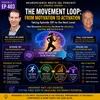
The Movement Loop: How Movement Activates the Brain for Learning, Adaptation & Performance
Welcome back to Season 16 of the Neuroscience Meets Social and Emotional Learning Podcast. I'm Andrea Samadi, and this is where we bridge neuroscience, social and emotional learning, and human performance so we can create measurable improvements in our well-being, achievement, leadership, productivity, and results. In this episode 403 The Movement Loop: How Movement Activates the Brain for Learning, Adaptation & Performance we will cover: ✔ Why movement is the biological input that prepares the brain for learning, adaptation, and performance. ✔ How Dr. Chuck Hillman's groundbreaking neuroscience research explains what happens inside the brain during and immediately after exercise. ✔ Why even one bout of physical activity can improve attention, executive function, and learning readiness. ✔ How Paul Zientarski translated neuroscience into practice through Naperville Central High School's internationally recognized Zero Hour PE Program. ✔ The science behind brain activation, neuroplasticity, positive stress, and cognitive reserve. ✔ Why movement isn't a break from learning—it's preparation for learning. ✔ How teachers, coaches, parents, and workplace leaders can use movement to improve focus, decision-making, creativity, and performance. ✔ How to apply the Movement Loop in everyday life using practical strategies you can begin today. ✔ Why movement is the input, adaptation is the process, and performance is the result. If you're just joining us, Season 16 explores Phase 3 of the Brain's Operating System for Human Performance—the Movement Loop. This season asks one central question: How does movement change the brain, adaptation change the body, and together create measurable improvements in performance? If you'd like the full overview of the five-phase framework, I encourage you to start with Episode 402. In Episode 402[i], we introduced Phase 3 of the Brain's Operating System for Human Performance—where we introduced The Movement Loop. We discovered one powerful idea. Movement is the input. When you move, your body sends a powerful biological signal to the brain that says: "Prepare. Activate. Adapt." Adaptation is the process. With movement, repetition, and recovery, the brain and body strengthen, rewire, and become more efficient. Performance is the output. The changes become visible in everyday life—clearer thinking, better decisions, stronger health, and improved performance. Then the loop begins again. Today we're asking the next question. Why does movement come first? Not simply because exercise is good for our bodies. But because movement is one of the most powerful biological signals we can send to the brain. Before we can focus... Before we can learn... Before we can adapt... The brain must first be activated. That's why movement isn't the outcome. It's the beginning. When we first interviewed Dr. Chuck Hillman on Episode 123[ii], (back in April 2021) I wanted to understand how his neuroscience research inspired Paul Zientarski's revolutionary Zero Hour PE Program at Naperville Central High School. It was Naperville's extraordinary performance on the Trends in International Mathematics and Science Study (TIMSS) that caught the eye of Dr. John Ratey. Naperville District 203 entered the international comparison as if it were its own "country" and ranked #1 in the world in science and #6 in the world in math. Those results made Dr. Ratey ask, "What are they doing differently?" That question ultimately led him to Naperville, (IL) where he discovered Zientarksi’s Zero Hour PE initiative and made it the opening case study in his book Spark. We will cover this story on our next episode Then years later, we revisited that conversation in Episode 397[iii] through the lens of motivation—exploring how movement increases engagement and helps us want to move more. But looking back through the lens of Phase 3, I realized I had been asking the wrong question. The bigger question isn't whether movement motivates us. The bigger question is: What happens inside the brain the moment we begin to move? That's the question we're answering today. And it's the reason movement sits at the beginning of the Brain's Operating System for Human Performance. Let's begin where every performance story begins... with movement. As we begin Phase 3, Dr. Chuck Hillman's research helps us understand why movement is the first step in the Movement Loop. In our interview, he mentioned that his lab has consistently demonstrated that even a single bout of physical activity can improve attention, cognition, and ac
Podzilla Summary coming soon
Sign up to get notified when the full AI-powered summary is ready.
Free forever for up to 3 podcasts. No credit card required.
Listen to This Episode
More from Neuroscience Meets Social and Emotional Learning
Five Years, 1,905 Recoveries: How Daily Movement Rewires Your Brain (Bonus Episode)
How Movement Builds the Brain, the Body & Human Performance (Phase 3 Introduction)
Trust as the Foundation with Greg Hill: How Great Leaders Create the Conditions for Learning, Growth and Performance
Episode 400: Sales Leadership Under Pressure with Majid Samadi: 7 Lessons Learned from 7 Years of Neuroscience
Get summaries like this every morning.
Free AI-powered recaps of Neuroscience Meets Social and Emotional Learning and your other favorite podcasts, delivered to your inbox.
Free forever for up to 3 podcasts. No credit card required.