Free Daily Podcast Summary
Outside The Dollar: Daily Summaries Delivered
by Outside The Dollar
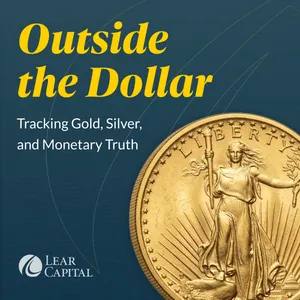
Outside The Dollar offers brief, 15-minute weekly updates on gold, silver, and the broader economic trends influencing the U.S. dollar and financial markets. Hosted by Kathrynn Ward of Lear Capital, the podcast provides straightforward insights designed to help listeners stay informed and protect their savings without all the noise. Information contained within Lear Capital's podcast is for general educational purposes and should not be construed as investment advice. Lear Capital does not provide legal or tax advice, or retirement-specific recommendations.
Latest Episodes
The most recent episodes — sign up to get AI-powered summaries of each one.
- 5 days ago8 min
Debt, Dimon, and Gold: Nearing $40 Trillion
Jamie Dimon told CNBC this month he wouldn't buy stocks or long-dated Treasurys at current prices, a warning that anchors this July 2026 episode of Outside The Dollar. Elena Reyes examines Goldman Sachs estimates suggesting China's real gold buying may run nearly five times official figures, alongside World Gold Council data showing a sharp May jump in central bank purchases. She connects this quiet accumulation to gold's recent pullback, its long-term performance against stocks, and the widening U.S. debt picture approaching forty trillion dollars. For anyone holding or considering precious metals, the episode raises pointed questions about who continues financing U.S. debt as interest costs climb. Figures cited include CBO fiscal year 2026 projections reported via Lear Capital.
- 1 weeks ago10 min
Financial Repression: Why Gold Jumped 2%
Gold rallied more than two percent in July 2026 after June's cooler-than-expected CPI report reduced expectations for an immediate Fed rate hike, even as U.S. debt surpassed thirty-nine trillion dollars. Elena Reyes examines why backward-looking inflation data tells only part of the story, unpacking financial repression's roots after World War Two and its relevance to today's debt debate. She breaks down the rate, dollar, and geopolitical forces behind gold's move, then turns to India and China's shrinking Treasury holdings as gold overtakes Treasuries as the top global reserve asset. For anyone holding or considering precious metals, the discussion clarifies whether this reflects sovereign diversification or a deeper shift in reserve confidence. The episode closes by weighing Citi's five-thousand-dollar gold forecast against the June producer price index report and renewed U.S.-Iran tensions.
- 2 weeks ago9 min
China Undermining the Dollar & AI Bubble Risk
Confidence in dollar-based markets faces pressure from multiple directions this July 2026, as China expands renminbi settlement, valuations stretch amid AI-concentrated gains, and inflation risks linger despite the Iran ceasefire. Elena Reyes examines why economic strength doesn't guarantee stock market strength, then unpacks Bundesbank President Joachim Nagel's warning on sticky inflation and UBS's raised $5,200 gold price target, weighing its three underlying assumptions against honest counterarguments. The discussion matters for anyone holding gold, silver, or precious metals as a hedge against currency uncertainty and market concentration risk, particularly with retirement portfolios increasingly tied to a handful of AI-linked stocks. The episode draws on UBS's gold forecast, Nagel's remarks at the Sintra forum, and Lear Capital's reporting on portfolio concentration to frame practical diversification questions for listeners to bring to a financial advisor.
- Jun 26, 202613 min
Gold at $6,000: What the Forecast Really Means
Bank of America reset its 12-month gold price target to $6,000 per ounce in June 2026, citing Fed leadership uncertainty, persistent fiscal deficits, and structurally low investor allocations. Elena Reyes stress-tests that forecast alongside Goldman Sachs data showing central banks purchased 59 tonnes of gold in April, with China accounting for roughly 24 tonnes, framing institutional buying behavior as a signal about purchasing power exposure rather than price speculation. She examines the macro relationship between dollar erosion and precious metals, walks through Peter Schiff's case for buying the recent $68 pullback, and analyzes a Lear Capital consumer survey finding that 69 percent of respondents ranked company reputation above price when evaluating a precious metals dealer. The episode draws on Bank of America research, Goldman Sachs central bank data, and an Advisor Perspectives framing of gold as a tool for measuring dollar debasement.
- Jun 19, 202612 min
Inflation Stays High: What Gold and Silver Signals Say Now
Central banks are accelerating gold accumulation at a pace not seen in recent years, and the June 2026 economic data makes that institutional behavior harder to dismiss. Elena Reyes examines three converging signals — inflation reaching 4.2%, the Federal Reserve holding rates steady, and rising gold demand among sovereign institutions — explaining what each means for investors holding or considering precious metals. She breaks down why a Fed hold at elevated inflation is not a neutral outcome for households, why small-business hiring data is a more honest recession signal than headline unemployment, and why Barclays and Societe Generale are both repositioning around commodities. The episode draws directly from the World Gold Council's 2026 central bank survey, which found that 93% of respondents hold gold and 45% plan to increase their precious metals holdings.
- Jun 15, 202616 min
U.S. Debt: 100% of GDP and the Case for Gold & Silver
High U.S. debt levels near 100% of GDP are reshaping inflation, interest costs, and how investors think about gold and silver as portfolio hedges. Elena talks with John Ohanesian about why the current debt and deficit path in June 2026 looks different from the post–World War II period, and how structural spending, rising rates, and de-dollarization pressures can affect everyday Americans. They explore what mounting federal obligations may mean for taxes, government spending choices, dollar confidence, and long-term purchasing power, and why more investors and family offices are allocating to precious metals as diversification tools. The conversation also covers the dual monetary and industrial role of silver, supply deficits, and how critical mineral designations and geopolitical tension are influencing demand. The episode references a UBS survey of wealthy families on dollar exposure, World Gold Council commentary, and price projections from Deutsche Bank and Bank of America.
- Jun 5, 20268 min
Gold Tops Treasuries: What Debt and Inflation Mean for Your Savings
For the first time in thirty years, gold has surpassed U.S. Treasuries as the world's largest reserve asset — a shift that carries real implications for individual investors in June 2026. Elena Reyes examines what is driving central bank gold accumulation, how eroding real incomes are squeezing household purchasing power, and why the structural trajectory of U.S. federal debt matters to anyone holding or considering precious metals. She explains the difference between short-term geopolitical noise and deeper systemic forces, and addresses what physical gold and silver actually offer a portfolio — including the honest caveat that gold dropped in 2022 even as inflation peaked. The episode draws on data from Goldman Sachs, J.P. Morgan, and Federal Reserve PCE reporting to ground each argument in specific evidence rather than speculation. To learn more, visit learcapital.com or call 800-576-9355 to speak with a specialist.
- May 28, 202613 min
Gold at $8,000? What Deutsche Bank and Goldman Sachs See Coming
Central banks are buying gold at a pace of roughly 60 tons per month through 2026, a structural shift that carries implications for individual investors thinking about long-term purchasing power. Elena examines why institutional players, from BRICS central banks to Goldman Sachs analysts, are focused on gold and silver simultaneously in May 2026, tracing the dollar's declining share of global reserves from 72 percent in 2001 to 58 percent in 2024. The episode breaks down Deutsche Bank's $8,000 per ounce scenario for 2031, explains what reserve diversification means in plain terms, and addresses silver's recent pullback alongside the mechanics and tax pitfalls of a Gold IRA rollover. The core question running through every segment is whether the same structural logic driving central bank precious metals demand applies to individual savers protecting long-term purchasing power. Data and context draw from Lear Capital research, Goldman Sachs demand forecasts, and a NY Post guide to Gold IRA rollovers. For Lear Capital's latest research on gold and silver, visit learcapital.com or call 800-576-9355 to speak with a specialist.
About Outside The Dollar
Outside The Dollar offers brief, 15-minute weekly updates on gold, silver, and the broader economic trends influencing the U.S. dollar and financial markets. Hosted by Kathrynn Ward of Lear Capital, the podcast provides straightforward insights designed to help listeners stay informed and protect their savings without all the noise. Information contained within Lear Capital's podcast is for general educational purposes and should not be construed as investment advice. Lear Capital does not provide legal or tax advice, or retirement-specific recommendations.
Customized Recaps
AI-powered recaps with compact key takeaways, quotes, and insights.
Straight to Your Inbox
Get key takeaways from Outside The Dollar in a 5-minute read.
Save Hours Every Week
Stay current on your favorite podcasts without falling behind.
Frequently Asked Questions
What is Podzilla's Outside The Dollar daily summary?
It's a free AI-powered email that summarizes new episodes of Outside The Dollar as soon as they're published. You get the key takeaways, notable quotes, and links & mentions — all in a quick read.
How does the Outside The Dollar podcast summary work?
When a new episode drops, our AI transcribes and analyzes it, then generates a personalized summary tailored to your interests and profession. It's delivered to your inbox every morning.
Is this an official Outside The Dollar product?
No. Podzilla is an independent service that summarizes publicly available podcast content. We're not affiliated with or endorsed by Outside The Dollar.
Can I get summaries of other podcasts too?
Absolutely! The free plan covers up to 3 podcasts. Upgrade to Pro for 15, or Premium for 50. Browse our full catalog at /podcasts.
How often does Outside The Dollar release new episodes?
Outside The Dollar publishes weekly. Our AI generates a summary within hours of each new episode.
What topics does Outside The Dollar cover?
Our AI identifies the specific themes in each episode and highlights what matters most to you.
Start getting Outside The Dollar summaries tomorrow morning.
Free forever for up to 3 podcasts. No credit card required.
Free forever for up to 3 podcasts. No credit card required.