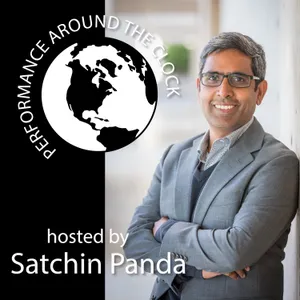
Free Daily Podcast Summary
Performance Around The Clock: Daily Summaries Delivered
by Dr. Satchin Panda
This is a podcast that explores how to keep our bodies and minds operating at peak levels around the clock, hosted by Dr. Satchin Panda from the Salk Institute in La Jolla, CA. Here, we talk with experts from different fields to learn about science and how to leverage that knowledge to improve performance. Dr. Panda is a leading expert on circadian rhythms and time-restricted feeding. His research has implications on metabolism, health, and aging and offers potential approaches to disease prevention and longevity.
Latest Episodes
The most recent episodes — sign up to get AI-powered summaries of each one.
- Jun 1, 20261h 11m
Ueli Schibler - cellular clocks. Performance Around the Clock episode 42.
Episode 42 of the Performance Around The Clock podcast comes from the European Biological Rhythms Society Congress in Lubeck, Germany. We are joined by Professor Ueli Schibler, an icon in the circadian field whose foundational discoveries helped establish fundamental principles in the field of circadian rhythms. This episode explores Professor Schibler’s scientific journey, marked by serendipity and a philosophy of keeping an open mind to unexpected observations. The conversation highlights how an initial failure to replicate a transcription factor experiment led to the groundbreaking realization that DBP (D-box binding protein) was the first mammalian transcription factor found to exhibit a circadian oscillation. We dive into his lab's revolutionary findings, including the surprise discovery that individual cells, such as fibroblasts, possess their own self-sustained circadian clocks that can be entrained by a simple serum shock. Dr. Schibler and Panda also explore his seminal experiments demonstrating that food acts as a primary time-giver, or zeitgeber, capable of entraining circadian clocks in peripheral tissues like the liver. The discussion moves toward the profound clinical implications of his foundational work, touching upon the massive potential of chronotherapy to optimize cancer treatments, such as timing the delivery of PD-1 immune checkpoint inhibitors. Finally, Professor Schibler shares invaluable advice for young scientists about avoiding "bandwagon" research, and discusses his fascinating future hypotheses regarding cancer homeostasis and why germline DNA is virtually immortal.Please join us for this wide-ranging and inspiring conversation. If you enjoy this episode, please like, comment, or subscribe. Thank you for listening.Guest: Professor Ueli Schibler, University of Geneva 1984-20152013 Aschoff’s Rule Prize Winner2012 Aschoff and Honma Prize Winner2000 Louis-Jeantet Prize Winner1996 Otto Naegeli prize for medicineHost: Dr. Satchin Panda X (Twitter): @SatchinPanda https://x.com/SatchinPanda Instagram: @satchin.panda https://www.instagram.com/satchin.panda/Links: Donations: https://panda.salk.edu/giving/ Research: https://www.salk.edu/scientist/satchidananda-panda/More science: https://mycircadianclock.org/
- Mar 6, 20261h 2m
Rae Silver - the master circadian clock. Performance Around the Clock episode 41.
In this episode of the Performance Around The Clock podcast, recorded at the European Biological Rhythms Society Congress in Lubeck, Germany, we are joined by Professor Rae Silver from Columbia University. Professor Silver is an iconic figure in circadian biology whose foundational research helped characterize the suprachiasmatic nucleus (SCN)—the brain's master circadian clock.We explore Professor Silver’s scientific journey, beginning with her early fascination with the perfectly timed, shared parental behaviors of doves and pigeons. The conversation highlights how this curiosity eventually led to her groundbreaking SCN transplant experiments in hamsters. By transplanting the clock of a "fast-running" donor into a "slow-running" host, her work definitively proved that the SCN controls circadian behavior. We dive into her revolutionary discovery that the SCN communicates its timing not just through neural synapses or "roads," but through "rivers and oceans"—secreting diffusible signals into the cerebrospinal fluid via a specialized portal blood vessel system.The discussion moves toward the profound clinical implications of this fluid communication network, including its connection to the brain's glymphatic system, waste clearance during sleep, and neurovascular diseases like Alzheimer's. We also touch upon the exciting future of the field, from the power of chronotherapy in optimizing cancer treatments to the massive economic and health benefits of lifestyle interventions like time-restricted eating and light management to combat diabetes. Finally, Professor Silver shares invaluable career advice for young scientists about balancing high-risk experiments with reliable projects, and the importance of cultivating a lifelong passion outside of the lab.Please join us for this wide-ranging and inspiring conversation. If you enjoy this episode, please like, comment, or subscribe. Thanks for listening.Guest: Professor Rae Silver, Columbia UniversityHelene L. and Mark N. Kaplan Professor of Natural & Physical SciencesChair of the Neuroscience Programhttps://psychology.columbia.edu/content/rae-silverHost: Dr. Satchin Panda X (Twitter): @SatchinPanda https://x.com/SatchinPanda Instagram: @satchin.panda https://www.instagram.com/satchin.panda/Links: Donations: https://panda.salk.edu/giving/ Research: https://www.salk.edu/scientist/satchidananda-panda/ More science: https://mycircadianclock.org/
- Jan 29, 20261h 4m
Emily Manoogian - optimizing shift work health. Performance Around the Clock episode 40.
In episode 40 of the Performance Around The Clock podcast, we are joined by Dr. Emily Manoogian, a leading clinical researcher focused on optimizing human health through the timing of food intake (time-restricted eating) and circadian rhythm regulation. Dr. Manoogian was recently honored with the Young Investigator Award for her seminal studies on circadian disruption among shift workers and interventions to mitigate its effects. We begin the episode by defining the complex reality of shift work—whether fixed, rotating, or split shifts—and how working outside typical hours challenges the human body.Dr. Manoogian and Panda explore the cascading health effects of "circadian disruption," distinguishing between acute annoyances and chronic risks that build up over months and years. Dr. Manoogian explains how being active and eating when the body expects rest can lead to insulin resistance, cardiovascular disease, mood disorders, and even increased cancer risk. We also discuss the broader societal impacts, from the "social jetlag" affecting students and new parents to the unique stressors faced by frontline workers like firefighters and nurses.The conversation highlights actionable science, focusing on the "Healthy Heroes" study conducted with San Diego firefighters. Dr. Manoogian shares how Time-Restricted Eating (TRE)—limiting food intake to a 10-hour window—significantly reduced VLDL (bad cholesterol). reduced blood sugar levels, improved blood pressure and improved emotional stability in this high-stress population. Dr. Manoogian is currently studying a different shift work group with the ongoing "Shift Study" for nurses, which is using continuous glucose monitoring to test if optimizing meal timing and low-glycemic snacks can protect the cardiometabolic health of night-shift workers.Please join us for this vital discussion on optimizing health for those who keep our society running around the clock. If you enjoy this episode, please like, comment, or follow. Thanks for listening.Guest:Dr. Emily ManoogianHillblom Fellow, Staff Scientist at the Salk Institute for Biological StudiesYoung Investigator Award Winner, Working Time SocietymyCircadianClock website:www.mycircadianclock.orgHealthy HEROES study:https://pmc.ncbi.nlm.nih.gov/articles/PMC9536325/SHIFT study:Participate by emailing:research@mycircadianclock.orgHost:Dr. Satchin PandaX (Twitter): @SatchinPandahttps://x.com/SatchinPandaInstagram: @satchin.pandahttps://www.instagram.com/satchin.panda/Links:Donations: https://panda.salk.edu/giving/Research: https://www.salk.edu/scientist/satchidananda-panda/More science: https://mycircadianclock.org/
- Jan 15, 202654 min
Alex Webb - sweaty plants and clocks. Performance Around the Clock episode 39.
In episode 39 of the Performance Around The Clock podcast, we are joined by Professor Alex Webb from the University of Cambridge, a leading expert in plant cell signaling and circadian clocks. The episode was recorded at the XVIII Congress of the European Biological Rhythms Society in Lubeck, Germany. Professor Webb shares his journey from psychology to plant physiology, discussing how a shared inspiration from researcher Andrew Miller led both him and also host Dr. Satchin Panda into the field of circadian rhythms.We explore the foundational history of biological clocks, starting with the 18th-century "wine cellar" experiment by De Mairan that first proved plants possess an internal oscillator. Professor Webb explains the complex behaviors of plants, such as the "yin and yang" of diurnal and nocturnal flowering to match pollinators, and the phenomenon of "sweaty plants"—how the circadian clock regulates stomata to balance carbon intake with water loss. We also discuss the metabolic math plants perform to survive the night, a process that explains why pumpkins actually grow in the dark. The conversation turns to "chronoculture," a concept focused on using circadian knowledge to optimize agriculture and meet the urgent goal of doubling food production by 2050. We examine how humans have inadvertently selected for clock mutations in crops like tomatoes and wheat—specifically the L3 gene—to adapt them to new environments. Finally, we discuss the "Plants for Space" program and how innovations in vertical farming for the International Space Station can teach us how to build sustainable, closed-loop food systems for our own "spaceship," Earth.Please join us for this fascinating discussion on the rhythms of the plant world. If you enjoy this episode, please like, comment or follow. Thanks for listening.Guest:Dr. Alex WebbHead of Circadian Signal Transduction GroupUniversity of CambridgeProfile:https://www.plantsci.cam.ac.uk/directory/alex-webbBlueSky:https://bsky.app/profile/alexwebblab.bsky.socialHost:Dr. Satchin PandaX (Twitter): @SatchinPandahttps://x.com/SatchinPandaInstagram: @satchin.pandahttps://www.instagram.com/satchin.panda/Links:Donations: https://panda.salk.edu/giving/Research: https://www.salk.edu/scientist/satchidananda-panda/More science: https://mycircadianclock.org/
- Dec 19, 20251h 10m
Andrew Miller - clocks, crops and climate. Performance Around the Clock episode 38.
Episode 38 of the Performance Around the Clock features another guest from the XVIII Congress of the European Biological Rhythms Society in Lubeck, Germany. We are joined by Professor Andrew Miller, a Professor at the University of Edinburgh and the Chair of the Systems Biology Center for Engineering Biology. Professor Miller is a seminal figure in plant biology whose early work served as the inspiration for host Dr. Satchin Panda to enter the field of plant circadian rhythms.In this episode, we explore Professor Miller’s scientific journey, beginning with his fascination with interacting genetic systems and his move to New York to study plant-microbe symbiosis. The conversation highlights his groundbreaking development of rhythmic bioluminescence using the luciferase protein to visualize the plant clock in real-time. This innovation allowed researchers to identify the genes building the plant clock without killing the specimens, a technique that revolutionized the field.We dive into the critical role the circadian clock plays in agriculture, from measuring day length to trigger flowering to helping crops like barley adapt to the unique growing seasons of Scotland. Professor Miller also explains the fascinating connection between the clock and metabolic timing, detailing how plants use their internal timer to manage starch degradation overnight to avoid starvation before dawn.The discussion moves toward the future of the field, including the creation of "digital twins" through mathematical modeling to predict how specific genomes will perform in various climates. We also touch upon Professor Miller's work with the UK government's ACRE committee, advising on the policy and safety of genetically edited crops to meet the challenges of climate change and food security. Please join us for this wide-ranging and inspiring conversation. If you enjoy this episode, please like, comment, or subscribe. Thanks for watching.Guest:Dr. Andrew MillerUniversity of EdinburghProfessor of Systems BiologyChair of the Systems Biology Center for Engineering BiologyPaper highlight:Circadian clock mutants in Arabidopsis identified by luciferase imaginghttps://pubmed.ncbi.nlm.nih.gov/7855595/Host:Dr. Satchin PandaX (Twitter): @SatchinPandahttps://x.com/SatchinPandaInstagram: @satchin.pandahttps://www.instagram.com/satchin.panda/Links:Donations: https://panda.salk.edu/giving/Research: https://www.salk.edu/scientist/satchidananda-panda/More science: https://mycircadianclock.org/
- Oct 27, 20251h 4m
Anna Krook - exercise timing. Performance Around the Clock episode 37
Episode 37 of the Performance Around the Clock comes from the XVIII Congress of the European Biological Rhythms Society in Lubeck, Germany. We welcome Professor Anna Krook, a Professor of Integrative Physiology at the Department of Physiology and Pharmacology and chair of the Strategic Research Programme in Diabetes at Karolinska Institutet. Professor Krook is an internationally recognized leader in metabolism, skeletal muscle and insulin biology. In this episode, we discuss Professor Krook’s research journey, which began with her Ph.D. work on insulin and the insulin receptor gene, identifying rare mutations that cause severe inherited insulin resistance. She then focused on the dysregulation of insulin action seen in Type 2 diabetes, noting that muscle is the main site where insulin action goes wrong. The conversation dives into the fascinating role of the circadian clock in regulating insulin, glucose, and muscle. Dr. Krook explains that while healthy muscle mitochondria show a functional rhythm that peaks in the afternoon, this crucial rhythm is absent in muscle cells from people with Type 2 diabetes. We cover her landmark study showing that for type 2 diabetic men doing high-intensity interval training, exercise in the afternoon led to lower blood glucose control and a beneficial "legacy effect" the next day. In contrast, morning exercise resulted in higher blood glucose levels for that entire day and the next. This negative effect may be linked to higher inflammatory markers and stress markers circulating in the plasma after morning exercise. Please join us for an insightful conversation between Dr. Satchin Panda and Dr. Krook on optimizing exercise timing for metabolic health. If you enjoy this episode, please like, comment or follow. Thanks for listening.Guest:Dr. Anna KrookKarolinska InstitutetProfessor of Integrative PhysiologyChair of the Strategic Research Programme in DiabetesProfile:https://ki.se/en/people/anna-krookIntegrative Physiology group:https://ki.se/en/fyfa/integrative-physiologyPaper highlight:Afternoon exercise is more efficacious than morning exercise at improving blood glucose levels in individuals with type 2 diabetes: a randomised crossover trialhttps://pubmed.ncbi.nlm.nih.gov/30426166/Host:Dr. Satchin PandaX (Twitter): @SatchinPandahttps://x.com/SatchinPandaInstagram: @satchin.pandahttps://www.instagram.com/satchin.panda/Links:Donations: https://panda.salk.edu/giving/Research: https://www.salk.edu/scientist/satchidananda-panda/More science: https://mycircadianclock.org/
- Oct 23, 20251h 4m
Anna Krook - exercise timing. Performance Around the Clock episode 37.
Episode 37 of the Performance Around the Clock comes from the XVIII Congress of the European Biological Rhythms Society in Lubeck, Germany. We welcome Professor Anna Krook, a Professor of Integrative Physiology at the Department of Physiology and Pharmacology and chair of the Strategic Research Programme in Diabetes at Karolinska Institutet. Professor Krook is an internationally recognized leader in metabolism, skeletal muscle and insulin biology. In this episode, we discuss Professor Krook’s research journey, which began with her Ph.D. work on insulin and the insulin receptor gene, identifying rare mutations that cause severe inherited insulin resistance. She then focused on the dysregulation of insulin action seen in Type 2 diabetes, noting that muscle is the main site where insulin action goes wrong. The conversation dives into the fascinating role of the circadian clock in regulating insulin, glucose, and muscle. Dr. Krook explains that while healthy muscle mitochondria show a functional rhythm that peaks in the afternoon, this crucial rhythm is absent in muscle cells from people with Type 2 diabetes. We cover her landmark study showing that for type 2 diabetic men doing high-intensity interval training, exercise in the afternoon led to lower blood glucose control and a beneficial "legacy effect" the next day. In contrast, morning exercise resulted in higher blood glucose levels for that entire day and the next. This negative effect may be linked to higher inflammatory markers and stress markers circulating in the plasma after morning exercise. Please join us for an insightful conversation between Dr. Satchin Panda and Dr. Krook on optimizing exercise timing for metabolic health. If you enjoy this episode, please like, comment or follow. Thanks for listening.Guest:Dr. Anna KrookKarolinska InstitutetProfessor of Integrative PhysiologyChair of the Strategic Research Programme in DiabetesProfile:https://ki.se/en/people/anna-krookIntegrative Physiology group:https://ki.se/en/fyfa/integrative-physiologyPaper highlight:Afternoon exercise is more efficacious than morning exercise at improving blood glucose levels in individuals with type 2 diabetes: a randomised crossover trialhttps://pubmed.ncbi.nlm.nih.gov/30426166/Host:Dr. Satchin PandaX (Twitter): @SatchinPandahttps://x.com/SatchinPandaInstagram: @satchin.pandahttps://www.instagram.com/satchin.panda/Links:Donations: https://panda.salk.edu/giving/Research: https://www.salk.edu/scientist/satchidananda-panda/More science: https://mycircadianclock.org/
- Sep 24, 20251h 20m
Geoff Wahl - foundational research and cancer. Performance Around the Clock episode 36.
Welcome to episode 36 of the Performance Around the Clock podcast. In this episode, Dr. Panda hosts Professor Geoff Wahl who is a renowned cancer scientist who conducted foundational research at the Salk Institute for 46 years. His long history in cancer research has focused on understanding the fundamental cellular and genetic mechanisms driving cancer, with an emphasis on the role of stem cells and the p53 tumor suppressor gene in breast and pancreatic cancers. Dr. Wahl also served as the president of the American Association of Cancer Research (AACR), utilizing the position to raise public awareness of the terrible toll of cancer and increase grassroots funding for research. Here, Professor Wahl highlights the crucial role of "foundational research" in combating cancer - explaining that cancer is a group of diseases, not a single one, where cells lose the ability to regulate division, with the most lethal factor being metastatic spread to distant organs. While research in breast cancer has led to effective targeted therapies for primary tumors, like Herceptin for HER2-positive cancers, there is a critical need for more research funding and a greater focus on understanding and treating metastatic cancers and intratumoral heterogeneity, which are major causes of mortality. Highlighting the value of funding foundational research, Dr. Tony Hunter’s work at the Salk Institute on tyrosine kinases has ultimately led to life-saving drugs like Gleevec, contributing to the 33% drop in the U.S. cancer death rate since 1991. We hope you enjoy this episode. If you want to support this channel, please like, comment, follow or donate. Thank you for listening.Guest:Dr. Geoff WahlProfessor Emeritus Salk InstituteProfile:https://www.salk.edu/scientist/geoffrey-wahl/Cancer statistics, 2023https://pubmed.ncbi.nlm.nih.gov/36633525/Host:Dr. Satchin PandaX (Twitter): @SatchinPandahttps://x.com/SatchinPandaInstagram: @satchin.pandahttps://www.instagram.com/satchin.panda/Links:Donations: https://panda.salk.edu/giving/Research: https://www.salk.edu/scientist/satchidananda-panda/More science: https://mycircadianclock.org/
Get Performance Around The Clock summaries in your inbox
Free AI-powered daily recaps. Key takeaways, quotes, and mentions — in a 5-minute read.
Get Free Summaries →Free forever for up to 3 podcasts. No credit card required.
You Might Also Like
Listeners also like.

Perform with Dr. Andy Galpin
Explores science-based strategies for optimizing physical and mental performance for all fitness levels.

The Peter Attia Drive
Conversations with experts on health, longevity, performance, and critical thinking led by physician Peter Attia.

Extend Podcast with Darshan Shah, MD
Explores science-backed strategies and expert insights to extend healthspan and optimize longevity through actionable health protocols.
The Biohacking Standards
A deep dive into biohacking fundamentals—nutrition, movement, sleep, and mindfulness—grounded in science and holistic wellness principles.

Everyday Wellness: Midlife Hormones, Menopause, and Science for Women 35+
A nurse practitioner shares science-based strategies for managing midlife hormones, menopause, and women's health.

The Dan Buettner Podcast
Shares practical habits and insights from the world’s longest-lived populations to improve longevity and well-being.

The Human Upgrade: Biohacking for Longevity & Performance
Dave Asprey explores biohacking, longevity, and performance through science and expert interviews to improve energy, focus, and resilience.

Health Optimization Medicine Podcast
Experts discuss science-based strategies for health optimization, performance, and human potential through targeted interventions.
The Dr. Hyman Show
Explores root causes of chronic disease and promotes functional medicine, nutrition, and preventive health through expert discussions.

The Genius Life
A health and science journalist explores cutting-edge research and practical strategies for optimizing brain function and overall wellness.
Get Better Faster
Doctors and researchers discuss functional medicine and root-cause approaches to chronic illness and health optimization.

Huberman Lab
Explores neuroscience and science-based tools for understanding and improving brain function, behavior, and health.
About Performance Around The Clock
This is a podcast that explores how to keep our bodies and minds operating at peak levels around the clock, hosted by Dr. Satchin Panda from the Salk Institute in La Jolla, CA. Here, we talk with experts from different fields to learn about science and how to leverage that knowledge to improve performance. Dr. Panda is a leading expert on circadian rhythms and time-restricted feeding. His research has implications on metabolism, health, and aging and offers potential approaches to disease prevention and longevity.
Customized Recaps
AI-powered recaps with compact key takeaways, quotes, and insights.
Straight to Your Inbox
Get key takeaways from Performance Around The Clock in a 5-minute read.
Save Hours Every Week
Stay current on your favorite podcasts without falling behind.
Frequently Asked Questions
What is Podzilla's Performance Around The Clock daily summary?
It's a free AI-powered email that summarizes new episodes of Performance Around The Clock as soon as they're published. You get the key takeaways, notable quotes, and links & mentions — all in a quick read.
How does the Performance Around The Clock podcast summary work?
When a new episode drops, our AI transcribes and analyzes it, then generates a personalized summary tailored to your interests and profession. It's delivered to your inbox every morning.
Is this an official Performance Around The Clock product?
No. Podzilla is an independent service that summarizes publicly available podcast content. We're not affiliated with or endorsed by Dr. Satchin Panda.
Can I get summaries of other podcasts too?
Absolutely! The free plan covers up to 3 podcasts. Upgrade to Pro for 15, or Premium for 50. Browse our full catalog at /podcasts.
How often does Performance Around The Clock release new episodes?
Performance Around The Clock publishes monthly. Our AI generates a summary within hours of each new episode.
What topics does Performance Around The Clock cover?
Performance Around The Clock covers topics including Science, Life Sciences. Our AI identifies the specific themes in each episode and highlights what matters most to you.
Start getting Performance Around The Clock summaries tomorrow morning.
Free forever for up to 3 podcasts. No credit card required.
Free forever for up to 3 podcasts. No credit card required.