Free Daily Podcast Summary
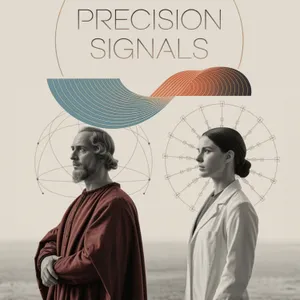
Precision Signals: Daily Summaries Delivered
by Sean Khozin, MD, MPH
Precision Signals is a podcast from the CEO Roundtable on Cancer about decoding biomedical progress: what’s real, what matters, and what’s next. We talk with scientists, regulators, investors, and builders operating across the messy interface of research, healthcare, and policy. Some are moving the system from within; others are reshaping it from the outside. All of them bring signal in a world crowded with noise.
Latest Episodes
The most recent episodes — sign up to get AI-powered summaries of each one.
- Aug 27, 20261h 40m
Peter Kolchinsky, PhD: Ideas That Refuse to Die
In the latest episode of Precision Signals, Sean Khozin speaks with Peter Kolchinsky, founder and managing partner of RA Capital Management.Peter’s perspective is shaped in part by his experience as the child of Soviet Jewish immigrants. His parents brought him a deep appreciation for education, hard work, entrepreneurship, and the opportunity to improve the systems around us.That mindset has guided his journey from scientist and virologist to biotech investor and institution builder.In this wide-ranging conversation, Sean and Peter discuss:• How Peter moved from studying biology to helping scientists translate discoveries into medicines• Why the biotech industry needs stronger institutional memory, including a willingness to learn from failed experiments• The limitations of AI in drug development, where generating a promising molecule is only the beginning of a years-long clinical learning process• Why China’s expanding clinical trial infrastructure may have a greater near-term impact on the pace of R&D than AI• How the FDA can be understood as a community of people working within a complex institution, rather than as an opaque gatekeeper• Why CEOs must define their role by what it takes to advance the mission, including advocacy for patients, innovation, and better policyA substantive discussion about immigration, science, entrepreneurship, AI, clinical trials, regulation, and what it means to build organizations that keep learning.
- Jul 21, 202656 min
Thomas Clozel, MD on Building Intelligence that Reads Life
There is a sentence most physicians are trained never to say. Three words: I don't know. Thomas Clozel learned early — from Valentin Fuster at Mount Sinai — that those three words are not a confession of failure, but the beginning of discovery.Thomas is an oncologist, co-founder, and CEO of Owkin. He trained in Strasbourg, then crossed the Atlantic to work under Fuster in cardiology and alongside Olivier Elemento and Ari Melnick at Weill Cornell in computational biology. Ten years ago, he left clinical medicine to build a new kind of superhuman intelligence for biology — on a contrarian bet that chemistry was the confined, solvable problem, and that biology, the messy, causal, unsolved one, was where the real discovery lived.In this conversation, we trace that arc: from federated learning across the world's hospitals, to a mesothelioma study that surfaced categories of disease no human had ever named, to Owkin Pro — an AI scientist that, in Thomas's words, is beginning to have ideas of its own. We discuss why big pharma keeps missing the AI wave, why he thinks Anthropic could be the biggest pharma in five years, why the treatment for Alzheimer's might one day come from a fifteen-year-old in a garage, and what it will actually take for him to say, someday, that he has succeeded.
- Jul 6, 20261h 24m
Everything is a Signal: Sahir Ali on Connecting AI, Biology, and Venture Capital
Sahir Ali’s career defies conventional paths. Trained as an engineer, he worked in quantitative finance, contributed to cancer research, built software companies, and ultimately founded Modi Ventures, where he developed the BioStack investment framework for technology-driven life sciences.In this conversation with Sean Khozin, Sahir explains how systems thinking, mathematics, and first-principles reasoning shaped his approach to investing. They discuss the evolution of artificial intelligence in medicine, the realities of drug discovery, founder psychology, venture capital, and why enduring innovation often comes from connecting ideas across disciplines rather than following trends.
- Jun 13, 20261h 6m
Navigating Change: Coach K's Perspective on Leadership in Modern Times
In this episode of Precision Signals, we speak with Mike Krzyzewski, known to most of the world as Coach K, about leadership, trust, teams, cancer advocacy, and the human side of progress.Coach K is one of the defining figures in American sports. Over more than four decades at Duke, he built championship teams, led the United States to Olympic gold, and shaped generations of players and coaches whose lives extended far beyond basketball. But this conversation is not only about winning. It is about what allows people to come together, stay connected under pressure, and do difficult things in service of something larger than themselves.That question matters well beyond the court. In medicine and healthcare, progress depends on more than discovery, technology, or individual excellence. It depends on trust between people, coordination across institutions, and the ability to keep patients at the center when the system becomes complex. As we discuss leadership, teamwork, artificial intelligence, and the future of care, Coach K offers a perspective that is practical, human, and deeply relevant to the work of improving health.At its core, this conversation asks a simple question: how do we build the kind of trust and shared purpose that allows people to do hard things together?
- May 22, 20261h 16m
Dr. Brian Druker on Gleevec, Precision Oncology, and the Future of Cancer Research
Dr. Brian Druker helped change the course of modern oncology through his central role in the development of imatinib (Gleevec), a therapy that transformed chronic myeloid leukemia (CML) and helped establish the modern era of precision oncology.In this episode of Precision Signals, Dr. Sean Khozin speaks with Dr. Brian Druker about the scientific, clinical, and human story behind Gleevec, from the early search for a drug that could inhibit the abnormal signal driving CML, to skepticism around targeted therapy, to the first clinical trials and the broader impact on cancer medicine.The conversation also explores Dr. Druker’s path into oncology, the development of targeted therapies beyond CML, the limits of molecularly targeted drugs, the arrival of immunotherapy, the challenge of persistent leukemia cells, current work in AML, and how AI may help generate hypotheses while still requiring rigorous biological validation.This is a conversation about scientific persistence, translational medicine, precision oncology, and what meaningful progress in cancer research really requires.
- May 20, 20261h 32m
Leading the Charge in Oncology: A Conversation with ASCO's Dr. Clifford Hudis
In this episode of Precision Signals, Sean Khozin, MD, MPH sits down with Clifford A. Hudis, MD, FACP, FASCO, CEO of the American Society of Clinical Oncology (ASCO), to trace a career that began with a childhood memory of Brian Piccolo and Memorial Sloan Kettering, and now sits at the helm of the world's largest professional society in cancer care.Dr. Hudis reflects on his path from Northeast Philadelphia to an accelerated BA/MD program, to a transformative fellowship at MSK under Larry Norton, and through three decades building the modern breast cancer clinic. He shares what it has meant to lead ASCO through a period of profound change: the rise of AI and real-world evidence, the persistence of access and equity gaps, the evolving science of clinical trials, and the tension between precision and pragmatism at the bedside.Takeaways:Dr. Clifford A. Hudis reflects on his transformative journey from a modest upbringing to becoming the CEO of ASCO, illustrating the profound impact of early life experiences on career trajectory.The evolution of oncology, particularly in breast cancer treatment, is marked by significant advancements such as dose-dense chemotherapy and HER2-targeted therapies, reshaping patient outcomes.ASCO's guidelines are undergoing a revolutionary change towards dynamic, living guidelines, ensuring that oncologists have access to the most current and relevant treatment protocols.AI is positioned to become an integral component of clinical practice, enhancing decision-making and patient care, thereby allowing oncologists to focus more on patient relationships.The tension between science and societal perceptions of healthcare necessitates an ongoing dialogue to build trust and understanding, particularly in the face of misinformation and skepticism.Leadership in oncology requires not only clinical excellence but also an embrace of business acumen and a visionary outlook, fostering progress in a rapidly changing medical landscape.Companies mentioned in this episode:ASCOAmerican Society of Clinical OncologyMemorial Sloan KetteringGenentechMD AndersonDana FarberNCCNNIHNCIAACRACS
- Mar 25, 20261h 0m
Sunil Verma on ADCs, AstraZeneca, and Eliminating Cancer as a Cause of Death
Sunil Verma, SVP and Global Head of Oncology at AstraZeneca, has lived a life defined by reinvention. Born in Zambia, raised across Africa, India, and Canada, he was accepted to medical school at 19, became one of the most respected breast cancer oncologists in Canada, built a cancer center in Calgary from the ground up, and then left academia entirely to help write the next chapters of oncology at AstraZeneca alongside the late Jose Baselga.In this conversation, Sean Khozin and Sunil explore the formative experiences that shaped his worldview and leadership philosophy, what it means to build healthcare infrastructure around the concept of healing, and how AstraZeneca's oncology portfolio expanded from a single asset into one of the most consequential in the world.They go deep on the science and strategy behind antibody-drug conjugates (ADCs), the frontier of ADC and immunotherapy combinations, and a distinction Sunil considers the true next frontier of the field: the difference between precision medicine and genuinely personalized medicine, where patient values are matched to therapeutic value.
- Mar 12, 20261h 6m
Beyond Survival: The Architecture of Cancer Immunotherapies
As cancer treatments become more powerful and precise, the field of oncology is entering a new era. We are moving beyond the question of "Can we extend life?" to "How do we live with the biology these therapies unleash?"In this episode of Precision Signals, host Sean Khozin is joined by Dr. Afreen Shariff (Director of the Endocrine Neoplasia Program at Duke University) and Jon McDunn (President of Project DataSphere) to discuss the complexities of immune-related adverse events (irAEs). While immune checkpoint inhibitors have revolutionized outcomes for various cancers, they can also trigger inflammatory conditions affecting the thyroid, heart, and nervous system. Our guests explore the "double-edged sword" of immunotherapy and how data science, AI, and clinician-led innovation are bridging the gap between clinical trials and real-world patient care. In this episode, we discuss: The "Next HIV": Why Dr. Shariff believes cancer care is reaching a similar turning point in long-term management. The Gap in Data: Why traditional clinical trial reporting often fails to capture the nuances physicians see at the bedside. AI & Triage: How unique e-consult models and AI tools are helping oncologists manage complex side effects more efficiently. The Future of Oncology: Predictions on patient-driven care and the push for greater data accessibility to drive innovation.
About Precision Signals
Precision Signals is a podcast from the CEO Roundtable on Cancer about decoding biomedical progress: what’s real, what matters, and what’s next. We talk with scientists, regulators, investors, and builders operating across the messy interface of research, healthcare, and policy. Some are moving the system from within; others are reshaping it from the outside. All of them bring signal in a world crowded with noise.
Customized Recaps
AI-powered recaps with compact key takeaways, quotes, and insights.
Straight to Your Inbox
Get key takeaways from Precision Signals in a 5-minute read.
Save Hours Every Week
Stay current on your favorite podcasts without falling behind.
Frequently Asked Questions
What is Podzilla's Precision Signals daily summary?
It's a free AI-powered email that summarizes new episodes of Precision Signals as soon as they're published. You get the key takeaways, notable quotes, and links & mentions — all in a quick read.
How does the Precision Signals podcast summary work?
When a new episode drops, our AI transcribes and analyzes it, then generates a personalized summary tailored to your interests and profession. It's delivered to your inbox every morning.
Is this an official Precision Signals product?
No. Podzilla is an independent service that summarizes publicly available podcast content. We're not affiliated with or endorsed by Sean Khozin, MD, MPH.
Can I get summaries of other podcasts too?
Absolutely! The free plan covers up to 3 podcasts. Upgrade to Pro for 15, or Premium for 50. Browse our full catalog at /podcasts.
How often does Precision Signals release new episodes?
Precision Signals publishes monthly. Our AI generates a summary within hours of each new episode.
What topics does Precision Signals cover?
Precision Signals covers topics including Science, Business, Medicine, Fitness, Health & Fitness, Life Sciences. Our AI identifies the specific themes in each episode and highlights what matters most to you.
Start getting Precision Signals summaries tomorrow morning.
Free forever for up to 3 podcasts. No credit card required.
Free forever for up to 3 podcasts. No credit card required.