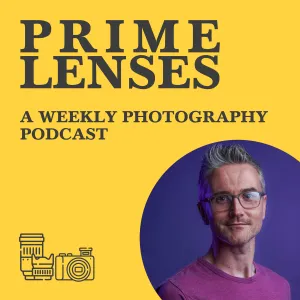
Free Daily Podcast Summary
Prime Lenses: Daily Summaries Delivered
by Iain Farrell
A camera is just a tool, but spend enough time with photographers, and you'll see them go misty-eyed when they talk about their first camera or a small, fast prime that they had in their youth. Prime Lenses is a series of interviews with photographers talking about their photography by way of three lenses that mean a lot to them. These can be interchangeable, attached to a camera, integrated into a gadget. I'm interested in the sometimes complex relationship we have with the tools we choose, why they can mean so much, and how they make us feel.
Latest Episodes
The most recent episodes — sign up to get AI-powered summaries of each one.
- Yesterday
Step Into Our Memory
Midweek Special. Step Into Our MemoryA tour of the Leica Archive, from Barnack’s signature to the one-off camera Jony Ive designed.Guest: Tim Pullmann — looks after the Leica Archive at Leitz Park in Wetzlar.In this episodeOn a recent trip to Wetzlar, Tim Pullmann took me through a side door at the Leica museum and into the archive, the place where the company keeps what it has made, drawn, printed and nearly thrown away.This one is a walk rather than an interview, and you hear the rooms as we go. The paper archive first: a 1923 technical drawing of the 0-Series signed off in pencil by Oskar Barnack, a hand-glazed ceramic Leica that exists exactly once, and a hundred-year-old bound magazine that may hold one of the first Leica adverts. Then the camera archive: original Barnack negatives that still print beautifully, a golden M4, a Paul Smith edition, and the prototype of the Leica M for (RED) that Jony Ive and Marc Newson designed.Tim also explains how a building’s keyholder became head of the archive, and why Leica came close to ending the M system in the 1970s.
- 4 days ago
Episode 140 - Platon
Platon has photographed more world leaders than almost anyone alive, but we start somewhere smaller: Paros, the island of his childhood, and the book he has been laying out on studio floors and hotel rooms for years. From there the conversation moves through why his white backgrounds began as the whitewashed walls of village houses, how a café called Parliament and a single post office phone line shaped a photographer who ended up working in parliaments, and why he thinks curiosity beats judgment every time. He tells the stories behind the portraits: Netanyahu twice, Obama before the smile, and Bill Clinton with seven and a half minutes of good behaviour and a wide-angle lens. We also get to the box, and what it means to the people who sit on it. A listener question about being constrained by a signature style gets a better answer than I expected. It ends with a message for anyone working alone.HighlightsNo timestamps were available, so positions are approximate (share of the conversation elapsed).• ~0% Forty years to deliver a promise to an old lady in the village who never got to see the book. She is in it.• ~8% Where the white background really came from: the white houses of a Greek village, not Penn, Avedon or Bailey.• ~22% The village as the original social media: one phone line in the post office, and a café called Parliament.• ~34% Replace judgment with curiosity, and what a picture of P. Diddy or Harvey Weinstein means now compared with when he took it.• ~43% The box. Pussy Riot and Putin sat on the same one, and so did a pregnant woman who told him nobody had ever asked how she felt.• ~53% Netanyahu twice, a year apart: "When he's vulnerable, he's volatile."• ~64% Obama's first Time cover, and why he refused to ask him to smile.• ~76% Clinton, the wide-angle lens, "show me the love", and a cover that went out to cable news outrage.• ~96% The Little Rock Nine portrait in the Smithsonian, and why the school canteen means more to him.ChaptersPositions are approximate, from where each topic starts in the transcript. Please replace with real timestamps from the edit.• ~0% Cold open and the Paros book: layouts on the floor, the title, the old lady• ~5% Defenders, Republic and permission to make something personal• ~8% Learning to take pictures on the island, the white background, film and the Leica• ~15% From magazines to filmmaking, and the first recorded interview• ~22% Village life, the phone line, Café Parliament• ~28% Influences: architecture, album covers, Churchill, democracy as a Greek word• ~32% Trust, legacy media and "all you need is attention"• ~34% Curiosity over judgment; Diddy and Weinstein• ~41% A listener asks about being constrained by a style• ~43% Dyslexia, reduction, and the box• ~53% Netanyahu twice• ~59% The responsibility of other people's stories, and The People's Portfolio• ~64% Obama, the first Time cover<p data-rte-preserve-em
- 1 weeks ago
Leica - A Century of Vision with Reiner Holzemer
Today, my guest is Reiner Holzemer, the director of Leica A Century of Vision, a documentary made last year to celebrate the 100th anniversary of the production of the first serialised Leica 35 mm camera. The film is not, as you might expect, just a film about Leica the brand, but rather a celebration of photography and recognition of the momentous impact that the invention of 35 mm cameras, the industry that it spawned, and the capability that it gave photographers.Reiner is fortunate enough to speak with some great photographers in this documentary, previous guests of the show that you may recognise, like Joel Meyerwitz, like Sarah M. Lee, and like Misan Harriman, but also people like Sir Johnny Ive, who worked with Marc Newson to design a one of one M camera, as well as legends in the field like Evelyn Jane Atwood, Ralph Gibson, Steve McCurry, and of course the late great Sebastião Salgado.I was lucky enough to see the film last year at a screening as part of the 100th anniversary event held in Wetzlar in Germany, and it's fair to say that a room full of people who’d just had dinner and were looking forward to Jamie Cullum coming on stage did not particularly want to watch a movie for 90 minutes. However, within minutes you could hear a pin drop in that room and the early appearance of Salgado on screen in a room filled with people who had known and worked with him was a very big moment that I won't forget. Leica: A Century of Vision, with Reiner HolzemerThe director on making a documentary about 100 years of 35mm photography, and why it isn’t a film about a brand.Guest: Reiner Holzemer, director of Leica – A Century of VisionIn this episodeA short, special episode. Reiner Holzemer made Leica – A Century of Vision to mark 100 years since the first series-produced Leica, but it is a celebration of photography far more than it is a brand film. I saw it last year at the centenary screening and the room went quiet within minutes. Reiner tells me how it started with a friend who ran Leica, why he insisted on making it as an independent documentary, and how the photographers came on board once they knew his earlier films. We talk about the Wetzlar archive footage, the books Ragnar Axelsson sent him, how Andy Summers ended up co-writing the score, and the film’s opening in German cinemas on 12 November.HighlightsEarly: Reiner explains how a friendship with Leica’s then CEO led to a meeting with the owning family, and permission to make the film.Early: He had no interest in a commercial piece. He wanted a homage to 35mm photography, made the way he makes all his documentaries.About a third in: Why the photographers said yes. Several told him they already knew his earlier films, so he never had to introduce himself.About a third in: Ragnar Axelsson sent ten of his books straight after their first call. Reiner admits he hadn’t known the work.Around the middle: The Berlin screening at Kino International, a near-sold-out Sunday morning, and Leica employees who didn’t know how important the company’s invention was.Around the middle: Asked in Berlin why the film omits Leica’s history during the Third Reich, Reiner says he has no knowledge of it, that it’s an important subject, and that his film focuses on photography.Two thirds in: Fear of failing as a motivator, with a nod to a Thom Yorke interview, and why Reiner prefers humble perfectionists.Late: How Andy Summers came to write six or seven pieces for the score, with compose
- 1 weeks ago
Episode 139 - Paul Sanders
- 2 weeks ago
Episode 138 - Simon King
138. Simon KingSimon King, a London based documentary photographer and teacher, and the director of Everything Happens All the Time · Instagram · Blog · 35mmc author pageIn this episodeSimon King spent about four months shooting Everything Happens All the Time, a free, feature-length film of 27 London street photographers talking to him and, in the edit, to each other. I'd watched it before we sat down and loved it, so this conversation started early and wandered: why the film lets photographers talk about whatever they like, what a photography community looks like when nobody is lurking in a doorway with a long lens, and why cheap kit isn't the barrier it's made out to be. Then it gets harder. What do you become once the thing is finished? Simon is candid about the slump that follows a project, about not caring whether anyone sees his work, and about why he thinks the making has to be the part you enjoy. There's also a very good story about a portrait that ended up on somebody's mum's fridge.HighlightsPositions are approximate (percentage of the way through the conversation) until real timestamps are added.• [~7%] Why the film shows photographers as people hanging out, not noir detectives with long lenses• [~11%] The production company that bought the cheapest CCTV tape going so marginalised communities could see themselves on TV• [~12%] Why the easiest film to make on a phone tends to be an aggro one, and the £3 karaoke-toy microphone going to India instead• [~25%] Around 35 interviews shot, 27 kept, and why street photography is a niche of a niche that most people only meet through controversy• [~42%] "So I'm making it for no one": the problem with a second film• [~47%] The slump after finishing, and why he doesn't buy the romantic version of it• [~64%] Why leaving your work behind sounds to him like litter, and the print that ended up on a fridge• [~72%] The electrician on a film set, and why the process has to be the enjoyable bitChaptersApproximate positions, not timestamps. Replace with real times from the edit before pasting into a host that reads chapter markers.~0% Warm-up: swearing, Scotland and first reactions to the film~3% The film lets photographers talk about what they want to talk about~6% Community, loneliness and "go outside"~9% Is cheap kit a barrier? Camcorders, phones and the CCTV-tape story~12% Why accessible filmmaking drifts to aggro, a £3 microphone and a trip to India~16% Krishnamurti, dissatisfaction and the problem with gear talk~19% The mock sign-off ("a great 17 minutes")~20% The proper start: why make a film about this group of people~24% 27 interviews kept, around 35 shot~25% Street photography's image problem and Tatsuo Suzuki~29% One voice, many versions of themselves~32% Joey, and London as an overlooked photographic city~35
- 3 weeks ago
Episode 137 - Ron Timehin
Prime Lenses Episode 136 – Colin PriorFour decades of Scottish landscapes, the camera he sold and never went back to, and thoughts on the future of photography and AI.Guest: Colin Prior — Scottish landscape photographer, best known for his panoramas · colinprior.co.ukIn this episodeColin Prior has spent four decades photographing Scotland’s mountains, much of it on a Fuji 6x17 panoramic film camera, and he opens this conversation with the one thing he says to everyone: it’s not what’s in the picture, it’s where it takes you. From there we talk about the eye path, which he’d like you to think about instead of leading lines, and why he’ll take a few stray white dots out of a frame. He explains why he sold the camera that got his early work noticed and never went back, and he’s blunt about the world it left behind: magazines that no longer pay, video eating stills, and inkjet ink that costs more than a good whisky. His case for books, and for handing yours to a publisher and a designer, runs through the middle of the episode. We finish on AI, an AI-made Odyssey, and the book he’s been working on for ten years and isn’t in a hurry to finish.Highlights~9:00 “Leading lines” is the wrong idea. Colin calls it the eye path, and he’s happy to remove a few stray white dots to protect it.~15:00 If you have to ask yourself whether you got the picture, you didn’t.~16:20 Why he sold the 6x17 camera behind his panoramas, and why stitching digital panoramas never tempted him.~22:20 The brain stores a still image as a single moment. Video, he says, goes in one ear and out the other.~24:50 Inkjet ink that costs more than a 21-year-old single malt, and the case for letting a lab do your printing.~29:10 Why he has never self-published: you sell to the choir and the congregation never sees it.~40:20 On his workshops: the camera stays in the bag while he walks the landscape looking for evidence.~56:30 The book he has been making for ten years, and why he doesn’t want an end date.Chapters0:00 Cold open: “It’s where it takes you”~0:20 Iain’s introduction~1:20 October light, and four winters without snow~5:30 Why landscape? Birds came first~9:00 The eye path, rogue highlights and what editing really is~14:00 Self-taught, and what failures teach~15:40 Selling the Fuji 6x17~21:00 Magazines, video and the brain that stores single moments~23:50 Megapixels, prints and the inkjet problem~27:40 Books: design, distribution and why not to self-publish~37:20 Running workshops: critiques, and the camera that stays in the bag~42:00 Thinking in layers~44:40 Undisturbed places, Skye as a theme park, and Munros~49:00 &
- 4 weeks ago
What I’ve Seen with Nicklas Pettersson
- Oct 18, 2026
Episode 136 - Colin Prior
Get Prime Lenses summaries in your inbox
Free AI-powered daily recaps. Key takeaways, quotes, and mentions — in a 5-minute read.
Get Free Summaries →Free forever for up to 3 podcasts. No credit card required.
You Might Also Like
Listeners also like.
The Lensrentals Podcast
A bi-weekly discussion on photography, videography, film, history, and technology aimed at educating and inspiring visual creators.

The PetaPixel Photography Podcast
A weekly discussion covering photography news, camera gear, technology, and industry culture.
Camerosity
A podcast dedicated to open source film photography.
The Art of Photography
Explores photography techniques, composition, and philosophy across digital and film formats, including darkroom practices.
Photography for Beginners | Learn the Basics of Photography
Learn photography fundamentals like exposure, composition, and visual storytelling from experienced instructors.
The Beginner Photography Podcast
Photographers share lessons and insights from their journeys to help beginners improve their creative skills and avoid common pitfalls.
Through the Telescope
Two hosts explore key astronomy topics in digestible episodes, making the cosmos accessible and engaging for all knowledge levels.
From First Principles
Breaks down major science stories weekly, explaining the mechanics behind physics, space, AI, and biotech developments.

Top Five Tech
A weekly roundup of five tech-related recommendations spanning media and ideas, curated and delivered each Friday.
From First Principles
Breaks down major science stories weekly, explaining the mechanics behind physics, space, AI, and biotech developments.

Primer
Explores non-English music genres through cultural context, artist stories, and listener impact, starting with Japanese City Pop.

Traveling Through with David Prior
Conversations with cultural figures explore how travel, objects, and meaningful experiences shape identity.
About Prime Lenses
A camera is just a tool, but spend enough time with photographers, and you'll see them go misty-eyed when they talk about their first camera or a small, fast prime that they had in their youth. Prime Lenses is a series of interviews with photographers talking about their photography by way of three lenses that mean a lot to them. These can be interchangeable, attached to a camera, integrated into a gadget. I'm interested in the sometimes complex relationship we have with the tools we choose, why they can mean so much, and how they make us feel.
Customized Recaps
AI-powered recaps with compact key takeaways, quotes, and insights.
Straight to Your Inbox
Get key takeaways from Prime Lenses in a 5-minute read.
Save Hours Every Week
Stay current on your favorite podcasts without falling behind.
Frequently Asked Questions
What is Podzilla's Prime Lenses daily summary?
It's a free AI-powered email that summarizes new episodes of Prime Lenses as soon as they're published. You get the key takeaways, notable quotes, and links & mentions — all in a quick read.
How does the Prime Lenses podcast summary work?
When a new episode drops, our AI transcribes and analyzes it, then generates a personalized summary tailored to your interests and profession. It's delivered to your inbox every morning.
Is this an official Prime Lenses product?
No. Podzilla is an independent service that summarizes publicly available podcast content. We're not affiliated with or endorsed by Iain Farrell.
Can I get summaries of other podcasts too?
Absolutely! The free plan covers up to 3 podcasts, any in the catalog. Basic raises that to 15, Pro to 40 and Max to 100. Browse our full catalog at /podcasts.
How often does Prime Lenses release new episodes?
Prime Lenses publishes weekly. Our AI generates a summary within hours of each new episode.
What topics does Prime Lenses cover?
Prime Lenses covers topics including Technology, Arts, Visual Arts. Our AI identifies the specific themes in each episode and highlights what matters most to you.
Start getting Prime Lenses summaries tomorrow morning.
Free forever for up to 3 podcasts. No credit card required.
Free forever for up to 3 podcasts. No credit card required.