Free Daily Podcast Summary
Quantum Foundations Podcast: Daily Summaries Delivered
by Maria Violaris
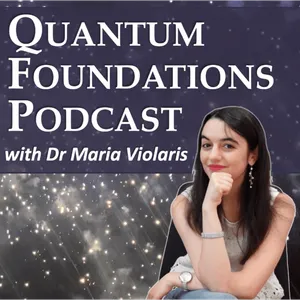
What does quantum physics tell us about reality? What progress have we made since the days of Einstein and Schrödinger, and what problems are today’s quantum research scientists trying to solve? This podcast aims to share a modern perspective on the most fundamental aspects of quantum theory, informed by up-to-date research insights. In each episode, I interview an active researcher about a topic related to their work, with the discussion aimed to be broadly accessible.
Latest Episodes
The most recent episodes — sign up to get AI-powered summaries of each one.
- May 11, 20262h 6m
Subquantum physics: nonlocality, pilot-waves & breaking the Born rule with Prof Antony Valentini
Quantum theory appears to allow some kind of connection between entangled particles, but not enough to send messages. Antony Valentini argues this is a conspiracy: there must be something deeper than quantum, where nonlocality can actually be used to send messages, but it is hidden from view in standard quantum experiments. In this episode of the Quantum Foundations Podcast, Valentini uses Pilot-wave theory to explain the physics of the nonlocal subquantum world. He discusses various ways that the theory could be experimentally tested, by looking for signatures of violations of the Born rule in extreme environments, such as the early universe. He also discusses the radical technological implications of subquantum physics, if we were able to harness it. Valentini recently released a book for a general audience explaining these ideas, "Beyond the Quantum: A Quest for the Origin and Hidden Meaning of Quantum Mechanics".
- Mar 17, 20261h 2m
A new theory of quantum & spacetime with Prof. Gerard Milburn
What if quantum particles have no gravity? In this episode of the Quantum Foundations Podcast, Professor Gerard Milburn explains how this radical idea could solve open problems in quantum theory and lead towards a theory of quantum gravity. It comes with extreme consequences for quantum measurements; the formation of black holes; and even the beginning of the universe. From a new understanding of Bell experiments to a cosmological arrow of time, find out if dropping gravity from the equation could be the start of transforming the field of quantum science and technology.
- Feb 19, 20261h 15m
Deriving probability in quantum many-worlds with Dr Tony Short
If there really is a quantum reality for every possible outcome of a measurement, then where do measurement probabilities come from? Dr Tony Short at the University of Bristol has used a set of intuitive assumptions to derive probability in a quantum multiverse. In this episode we discuss his motivations for exploring the many-worlds interpretation; what his assumptions are and how they lead to the Born rule for measurement probabilities; and how these ideas fit within the broader landscape of research in quantum foundations, probability and the many-worlds interpretation.
- Feb 5, 20261h 24m
Solving nonlocality with fractals, chaos & counterfactuals | Prof. Tim Palmer
The notion of true quantum nonlocality is absurd. Prof Tim Palmer from the University of Oxford suggests that there is a hidden assumption in standard quantum mechanics, and dropping it will save us from this absurdity. Namely, the reality of counterfactuals: the physics of what could have happened but did not. Inspired by chaos theory and the fractal structure widespread in atmospheric physics, Palmer has developed a new underlying structure for quantum theory, with radical implications for our fundamental principles of quantum physics; the limits of quantum computation; and perhaps even the search for quantum gravity.
- Jan 22, 20261h 18m
Testing quantum observers on quantum computers with Dr Will Zeng
What if you could put an observer in superposition on a quantum computer? Dr Will Zeng suggests that this experiment could stretch standard quantum theory so far that it might break — and radically update our understanding of physical reality. However, today's proof-of-principle experiments on quantum computers use single qubits to model observers. Zeng explains how a new programme of research aims to quantify "observer-ness" and conduct experiments with increasingly realistic observers, pushing quantum computers to the limits until they can run actual quantum Artificial General Intelligence experiments.
- Jan 8, 20261h 17m
Conservation laws with Dr Chiara Marletto
Our most far-reaching principles of physics are not about what changes, but what stays the same: conservation laws. In this episode of the Quantum Foundations Podcast, Dr Chiara Marletto from the University of Oxford explains how such principles enable discovery of new physical phenomena; their central role in thermodynamics; controversies about how they hold up in quantum mechanics; and how they can be used to formulate results about future theories of physics beyond quantum.
- Dec 10, 20251h 51m
Quantum, cryptography & metacomplexity with Oxford Computer Scientist Matthew Gray
You’ve heard of cryptography. Perhaps quantum cryptography too. Maybe even post-quantum cryptography. But what about *quantum post-quantum cryptography*?! When this came up in conversation with Oxford Computer Scientist Matthew Gray recently, I’d never heard of it. I wanted to know more, so I invited him for a podcast. Turns out, there’s a whole world of layers to unravel linking quantum and cryptography — or even multiple worlds… In this discussion, we dip into those, and how this all relates to “metacomplexity” problems: the hardness of figuring out the hardness of a problem. Listen to this episode if you want to experience your perception of how quantum computing meets cryptography shift from monochrome to technicolour, as we push cryptography to its limits through the lens of fundamental assumptions about computation, quantum physics and reality.
- Nov 19, 20251h 1m
A quantum theory of time with Dr Simone Rijavec
What if time isn’t fundamental — but emerges from quantum mechanics itself? In this episode, Dr Simone Rijavec explains how a timeless quantum universe can still give rise to the illusion of time flowing. We unpack the Wheeler–DeWitt equation, the Page–Wootters model of relational time, and how these ideas connect to the multiverse and quantum gravity. Dr Rijavec is a postdoctoral researcher at Tel Aviv University and former PhD researcher at the University of Oxford.
About Quantum Foundations Podcast
What does quantum physics tell us about reality? What progress have we made since the days of Einstein and Schrödinger, and what problems are today’s quantum research scientists trying to solve? This podcast aims to share a modern perspective on the most fundamental aspects of quantum theory, informed by up-to-date research insights. In each episode, I interview an active researcher about a topic related to their work, with the discussion aimed to be broadly accessible.
Customized Recaps
AI-powered recaps with compact key takeaways, quotes, and insights.
Straight to Your Inbox
Get key takeaways from Quantum Foundations Podcast in a 5-minute read.
Save Hours Every Week
Stay current on your favorite podcasts without falling behind.
Frequently Asked Questions
What is Podzilla's Quantum Foundations Podcast daily summary?
It's a free AI-powered email that summarizes new episodes of Quantum Foundations Podcast as soon as they're published. You get the key takeaways, notable quotes, and links & mentions — all in a quick read.
How does the Quantum Foundations Podcast podcast summary work?
When a new episode drops, our AI transcribes and analyzes it, then generates a personalized summary tailored to your interests and profession. It's delivered to your inbox every morning.
Is this an official Quantum Foundations Podcast product?
No. Podzilla is an independent service that summarizes publicly available podcast content. We're not affiliated with or endorsed by Maria Violaris.
Can I get summaries of other podcasts too?
Absolutely! The free plan covers up to 3 podcasts. Upgrade to Pro for 15, or Premium for 50. Browse our full catalog at /podcasts.
How often does Quantum Foundations Podcast release new episodes?
Quantum Foundations Podcast publishes biweekly. Our AI generates a summary within hours of each new episode.
What topics does Quantum Foundations Podcast cover?
Quantum Foundations Podcast covers topics including Science, Physics. Our AI identifies the specific themes in each episode and highlights what matters most to you.
Start getting Quantum Foundations Podcast summaries tomorrow morning.
Free forever for up to 3 podcasts. No credit card required.
Free forever for up to 3 podcasts. No credit card required.