Free Daily Podcast Summary
Quirks and Quarks: Daily Summaries Delivered
by CBC
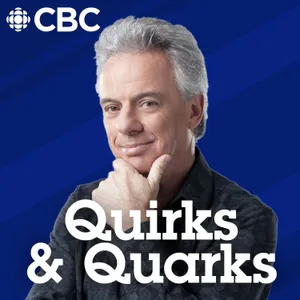
CBC Radio's Quirks and Quarks covers the quirks of the expanding universe to the quarks within a single atom... and everything in between.
Latest Episodes
The most recent episodes — sign up to get AI-powered summaries of each one.
- Yesterday54 min
How feasting black holes time their burps
Black holes are voracious eaters, but they’re also quite messy, and often after devouring a star, they’ll let out a big burp, launching jets of high energy particles through space. Now, in a recent study, a team of astrophysicists has figured out the formula behind the timing of these burps. Also today: Skiing, hiking and roads are taking a toll on wolverinesThe buzzy, chirpy sounds of the Jurassic forestA notorious invasive species has been here a lot longer than we thought. Does that matter?Anomalies suggest King Tut’s tomb may conceal hidden chambersQuirks & Quarks has been nominated for a Signal Award! You can vote for us here. For more information about today’s episode, visit cbc.ca/quirks.
- 1 weeks ago54 min
How corals tell us climate change is supersizing El Niño
The El Niño underway in the Pacific Ocean is a natural climate phenomenon but its warming effects are being boosted by climate change. Researchers recently used corals growing around the Galapagos Islands to create a local temperature record of the ocean going back 1,000 years.Also today: Massive study redraws bat family tree and uncovers genetic odditiesHow the Surinam toad uses star-shaped fingertip lobes to ‘see’ its preyT. rex tooth enamel reveals these dinosaurs were warm-bloodedWhy great white sharks are converging on the East Coast
- 1 weeks ago16 min
Coral archives reveal a shift in El Niño strength
The El Niño underway in the Pacific Ocean has been called extraordinary, supersized and likely record-breaking. And while El Niño is a natural climate phenomenon, its warming effects are being boosted by climate change. Julia Cole, a paleoclimatologist at the University of Michigan, recently used corals growing around the Galapagos Islands to create a local temperature record of the ocean going back 1,000 years to add to what they've learned from similar studies elsewhere in the Pacific. She said the temperature record in this area of the East Pacific indicates that the El Niños from the last 40 to 50 years are unlike anything the area experienced in the last millennium. Her study was published in the journal Science.
- 2 weeks ago54 min
A feather found in dino poop and more...
It’s long been a mystery why one particular avian dinosaur was the only kind to survive mass extinction, but the recent discovery of a perfectly preserved fossilized feather, found in a cherry-sized piece of dinosaur poop, offers new clues.Also today: Why citizen scientists buried thousands of undiesHow climate change tipped the scales on a catastrophic Himalayan avalancheWhy an AI leap has left mathematicians feeling uneasyWhy scientists put teeny-tiny micro-trackers on chimney swifts
- 3 weeks ago54 min
Summertime and the science isn’t always easy
Summer is fieldwork time for many scientists. We talk to researchers who have been busy hiking on fresh lava, capturing thousands of ticks, shooing away moose from their study sites, and even spelunking for Neanderthals — all in the ever-important quest for data.
- 4 weeks ago54 min
Sweat, comets and dino milk. It’s our summer question show!
Quirks & Quarks has been taking your burning questions for 50 years. And while we thought we might have answered every question there is, our listeners proved there are always more science questions for us to tackle. Including:What does the black hole orbit?What do you sweat out in a sauna?Why are robins' eggs blue?What if we no longer had a moon?Did dinosaurs produce milk?Were there ever giant humans?
- Aug 28, 202654 min
How to battle climate apathy, and more stories about humans
From doubting our doubts to sleuthing out scientific fraud, this week we revisit some of our favourite stories about humans.
- Aug 21, 202654 min
Celebrating 50 years of Quirks & Quarks!
For our 50th anniversary celebration last October, we spoke with some of Canada's top scientists about their predictions for the future. We revisit our conversations with:Evan Fraser, director of Arrell Food Institute and professor of geography at the University of GuelphKatie Mack, Hawking Chair in Cosmology and Science Communication at the Perimeter Institute for Theoretical PhysicsLuke Stark, assistant professor in the faculty of information and media studies at Western UniversityLaura Tozer, assistant professor of environmental studies at the University of TorontoAna Luisa Trejos, professor in the department electrical and computer engineering and the school of biomedical engineering and Canada Research Chair in wearable mechatronics at Western University in London, Ont.Yvonne Bombard, professor at the University of Toronto and scientist and Canada Research Chair in Genomics Health Services and Policy
Get Quirks and Quarks summaries in your inbox
Free AI-powered daily recaps. Key takeaways, quotes, and mentions — in a 5-minute read.
Get Free Summaries →Free forever for up to 3 podcasts. No credit card required.
You Might Also Like
Listeners also like.
Curious Cases
Hannah Fry and Dara Ó Briain use science to solve listeners' questions and mysteries.

The Quanta Podcast
A deep dive into fundamental questions in science and math through conversations with researchers and Quanta Magazine editors.
The Zooquarium Podcast
A biologist and an artist answer listener questions about animals and ecosystems, blending science and creativity for all ages.
Daniel and Kelly’s Extraordinary Universe
Two scientists explore diverse topics across the universe, from particles to ecosystems, with accessible and engaging explanations.
Unexpected Elements
Explores hidden scientific connections behind global news and everyday phenomena.
The World, the Universe and Us
Explores big scientific questions about life, consciousness, climate, and the cosmos with expert scientists and New Scientist journalists.

Science Friday
Explores diverse science and technology topics, from space to microscopic life, with engaging educational stories.

CrowdScience
Explores listener-submitted questions about life, Earth, and the universe with scientists at the forefront of research.
BrainStuff
Explores and explains the science behind everyday phenomena, from popcorn to particle physics.

Radiolab
Explores complex questions through investigative journalism, blending science, history, and human stories with innovative sound design.
Terrestrials
A nature podcast exploring surprising animal and plant behaviors through immersive storytelling and original songs.
Seeking A Scientist
A chemist hosts conversations with scientists to explore futuristic scientific possibilities and their real-world implications.
About Quirks and Quarks
CBC Radio's Quirks and Quarks covers the quirks of the expanding universe to the quarks within a single atom... and everything in between.
Customized Recaps
AI-powered recaps with compact key takeaways, quotes, and insights.
Straight to Your Inbox
Get key takeaways from Quirks and Quarks in a 5-minute read.
Save Hours Every Week
Stay current on your favorite podcasts without falling behind.
Frequently Asked Questions
What is Podzilla's Quirks and Quarks daily summary?
It's a free AI-powered email that summarizes new episodes of Quirks and Quarks as soon as they're published. You get the key takeaways, notable quotes, and links & mentions — all in a quick read.
How does the Quirks and Quarks podcast summary work?
When a new episode drops, our AI transcribes and analyzes it, then generates a personalized summary tailored to your interests and profession. It's delivered to your inbox every morning.
Is this an official Quirks and Quarks product?
No. Podzilla is an independent service that summarizes publicly available podcast content. We're not affiliated with or endorsed by CBC.
Can I get summaries of other podcasts too?
Absolutely! The free plan covers up to 3 podcasts. Upgrade to Pro for 15, or Premium for 50. Browse our full catalog at /podcasts.
How often does Quirks and Quarks release new episodes?
Quirks and Quarks publishes weekly. Our AI generates a summary within hours of each new episode.
What topics does Quirks and Quarks cover?
Quirks and Quarks covers topics including Science, Earth Sciences. Our AI identifies the specific themes in each episode and highlights what matters most to you.
Start getting Quirks and Quarks summaries tomorrow morning.
Free forever for up to 3 podcasts. No credit card required.
Free forever for up to 3 podcasts. No credit card required.