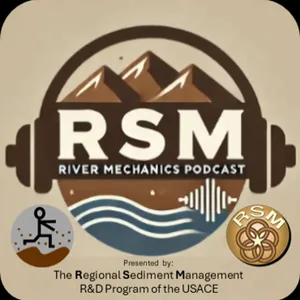
Free Daily Podcast Summary
RSM River Mechanics Podcast: Daily Summaries Delivered
by Stanford Gibson
Conversations about River Mechanics, Sediment Transport, and Fluvial Geomorphology
Latest Episodes
The most recent episodes — sign up to get AI-powered summaries of each one.
- Jul 17, 20261h 1m
Gary Parker on Gravel Bed Rivers
Dr. Gary Parker is one of the defining figures in modern river mechanics and sediment transport. He's a professor emeritus at the University of Illinois or Urbana Champlain where he's been since 2005. Before that he was a distinguished professor at the University of Minnesota. He's a member of the National Academy of Sciences and a fellow of the American Geophysical Union and has won more scientific awards than I can count - in multiple disciplines - that could each be thought of ...
- Jun 8, 20261h 3m
Floodplain Sedimentation Pannel with Desiree Tullos, Janine Castro, and Jon Czuba
About a year ago an interdisciplinary tam at Oregon State invited a collection of subject matter experts for workshop on floodplain sedimentation processes. The workshop took up a very specific question but gathering this much expertise on floodplain landforms and processes generated a wide-ranging discussion of how floodplains work, how to restore them, and even what they are. So when Desiree Tullos reached out and invited me I brought my podcast gear in just in case…...
- Apr 10, 20261h 27m
Bill Dietrich on Meander Mechanics, Hillslopes, and Where Rivers Begin
Over his career Dr. Bill Dietrich has had an outsized influence on both the discipline of geomorphology and the community that surrounds the discipline. He is Professor Emeritus in the Department of Earth and Planetary Science at the University of California, Berkeley. Dr. Dietrich is one of the most influential geomorphologists of the last several decades, known for developing process-based theories of landscape evolution and geomorphic transport laws for soil production, hillslope tra...
- Mar 13, 20261h 13m
Cohesive Sediment Properties and Processes with David Perkey, Jarrell Smith and Danielle Tarpley
So far on this podcast we've generally used the noun "sediment" to describe sand, gravel, and maybe cobbles and boulders. But the same word also gets used for silts, clays, and muds - materials that behave so differently that lumping them together as "sediment" can blur important distinctions. This podcast was overdue for a conversation about fine sediment, and I knew exactly who I wanted to talk to. In the notebook where I track episode ideas, I labeled this one the “ERDC Cohesive Brain Trust.” I wanted to sit down with the team for the Corps of Engineers that I call when I have questions about "very small sediment", and the team I point engineers toward when they need cohesive measurements or insight for a project or model. That team is Dr. Dave Perkey, Dr. Jarrell Smith, and Dr. Danielle Tarpley, all based at the USACE Coastal and Hydraulics Laboratory (CHL) at the Engineering Research and Development Center (ERDC) in Vicksburg. A lot of the Corps’ sediment expertise lives there. We’ve had several guests from ERDC over the years, and I’ve spent a lot of my own career collaborating with sediment specialists there. But Dave, Jarrell, and Danielle work on a part of the sediment world that is very different from the sand-and-gravel problems that dominate a lot of my work. Their focus is sediment that is finer - often much finer - than about 60 to 70 microns, roughly the diameter of a human hair. In the first half of this conversation, they lay out the basic properties and processes of cohesive sediment. Then we move into the research they’ve done to push that science forward. So whether mud is new territory for you or already part of your world, I think there’s a lot here that you will find useful. Dave Perkey has spent nearly two decades at ERDC studying cohesive sediment properties and processes, especially erosion, transport, and geochemical composition. He also manages the Regional Sediment Management program - the RSM behind the title of this podcast - and it is not much of a stretch to say this season would not exist without him. Jarrell Smith has been a research engineer at ERDC since 1994, working on sediment transport, hydrodynamics, cohesive and mixed beds, and sediment-vegetation-turbulence interactions. We also talk about one of the tools he’s especially known for, the Particle Imaging Camera System, or PICS, which I recently recommended on one of our own reservoir projects. Danielle Tarpley is a research oceanographer whose work spans sediment transport and hydrodynamics in inland and coastal settings. She works across field data collection, analysis, and modeling, and brings a great project-grounded perspective to the conversation. Dave, Jarrell, and Danielle took different paths through the Carolinas for their master’s work, but all earned PhDs through VIMS at William & Mary. And watch the HEC sediment YouTube channel for some videos illustrating the fine-sediment measurement techniques they describe. This series was funded by the Regional Sediment Management (RSM) program. Mike Loretto edited the first three seasons and created the theme music. Tessa Hall is editing most of Season 4. Stanford Gibson (HEC Sediment Specialist) hosts. Video shorts and other bonus content are available at the podcast website: https://www.hec.usace.army.mil/confluence/rasdocs/rastraining/latest/the-rsm-river-mechanics-podcast ...but most of the supplementary videos are available on the HEC Sediment YouTube channel: https://www.youtube.com/user/stanfordgibson If you have guest recommendations or feedback you can reach out to me on LinkedIn or ResearchGate or fill out this recommendation and feedback form: https://forms.gle/wWJLVSEYe7S8Cd248
- Jan 23, 20261h 19m
Mike Spoor on the Ohio River, Bank Failure, Glacial and Coal Mining Sediment Legacies...and 60 Years Working with Rivers
I only know one person who can claim >60 years of federal service. This episode's guest, Mike Spoor. Mike spent those years with the US Army Corps of Engineers Huntington District (in West Virginia on the banks of the Ohio River) and even more years before that as a contractor to the Kansas City District. But Mike did not just log federal service. He focused curiosity and insight with a relentless field program to convert those years into insight. Mike's decades of stories on the Ohio River and it's tributaries, and the impact of disturbances old (glaciers) and new (coal mining) is exactly the sort of conversations I had in mind when I launched this project. I don't think we got to 10% of Mike's stories, but somehow managed to cover an impressive range of river processes and projects, and some real insight on how he approaches rivers. I talked to Mike about the history of the Ohio River, the flood of record, and untangling the role of glacial-legacy soils on bank failure processes...and how a careful, causal understanding of these processes helped him identify the most cost-effective approach to mittigate them. We also talked about the impact of coal mining on rivers and reservoirs and the island erosion and restoration work that led to his Golden Eagle award. It was a fun and informative conversation and I'm thrilled to share it. (The interlude music in this episode is Dusty Horizons by Score Wizzard and HEC did the editing on this one). This series was funded by the Regional Sediment Management (RSM) program. Mike Loretto edited the first three seasons and created the theme music. Tessa Hall is editing most of Season 4. Stanford Gibson (HEC Sediment Specialist) hosts. Video shorts and other bonus content are available at the podcast website: https://www.hec.usace.army.mil/confluence/rasdocs/rastraining/latest/the-rsm-river-mechanics-podcast ...but most of the supplementary videos are available on the HEC Sediment YouTube channel: https://www.youtube.com/user/stanfordgibson If you have guest recommendations or feedback you can reach out to me on LinkedIn or ResearchGate or fill out this recommendation and feedback form: https://forms.gle/wWJLVSEYe7S8Cd248
- Jul 27, 20251h 2m
David Topping on the Grand Canyon Prototype Experiments, Disequilibrium Transport, and Hysteresis
Dr. David Topping is a Research Hydrologist with the US Geological Survey. He did his undergrad at MIT, a masters and Phd at the University of Washington and has published >100 well cited peer review publications. Dr Topping has worked with the USGS for >30 years but for the last 18 or so have been with the Grand Canyon Monitoring and Research Center in Flagstaff AZ where he has been one of the reasons that the Glen Canyon releases have become in one of the most ambitious and carefully measured protype sediment experiments in history. And it is his teams extensive and precise measurements of these experiments and thoughtful analyses of those data that echoed through multiple aspects of my work in the years that followed. I went back to the papers we talk about in this episode several times… …when I was working on bed mixing algorithms in HEC-RAS …and when I was working with the Corps’ Omaha district to restore sand bars on the Missouri river …and when I was interpreting sediment time series, from the main Amazon tributaries… I kept finding myself back in his literature. His team’s work on processes that build and erode sand bars, his distinction between flow regulated and bed regulated transport, and his careful identification of the time scales and grain sizes at play when we think about ‘supply limitation’ and disequilibrium transport have all made their way into my work and my mental model of rivers. You can find more of his work at these links: https://www.usgs.gov/staff-profiles/david-j-topping https://www.usgs.gov/centers/southwest-biological-science-center/science/river-sediment-dynamics https://www.gcmrc.gov/discharge_qw_sediment/ This series was funded by the Regional Sediment Management (RSM) program. Mike Loretto edited the first three seasons and created the theme music. Tessa Hall is editing most of Season 4. Stanford Gibson (HEC Sediment Specialist) hosts. Video shorts and other bonus content are available at the podcast website: https://www.hec.usace.army.mil/confluence/rasdocs/rastraining/latest/the-rsm-river-mechanics-podcast ...but most of the supplementary videos are available on the HEC Sediment YouTube channel: https://www.youtube.com/user/stanfordgibson If you have guest recommendations or feedback you can reach out to me on LinkedIn or ResearchGate or fill out this recommendation and feedback form: https://forms.gle/wWJLVSEYe7S8Cd248
- Apr 17, 202556 min
Rob Ettema on River Ice, Ice-Sediment Interactions, and Sediment Scientist Biographies
I grew up in one of North America’s great snow belts…and started my career in Buffalo NY So, that background and my fascination with sediment transport primes curiosity in ice transport. I’m sure my ice friends would cringe at this, but I sometimes call ice transport as upside down sediment transport. But despite the symmetry of ice and sediment transport, they are separate, complicated, disciplines with little overlapping expertise. Which is why its remarkable, that this episode’s guest is not only is not only world class in both disciplines, but unquestionably the go-to global expert in how they interact. It is fair to say that just about everything I know about how ice effects sediment transport and river morphology, I learned from Dr. Rob Ettema So I wanted to have Rob on the podcast to talk about the interactions between ice and the other river processes we tend to talk about in this feed. But recognizing that maybe not everyone who listens to this podcast, is initiated into the wild world of fluvial ice dynamics, we start out with some basics of river ice-formation and transport. But then we not only dove into the differences between ice-affected and ice-free rivers, but also how ice affects rivers of different latitudes, depths, and even flow directions. Dr. Rob Ettema retired Colorado State University last year, where he has been a professor since 2015 and continues to work as a research scientist. Before that he taught (and served as Engineering Dean) at the Universities of Iowa and Wyoming. He has edited ASCE’s cold regions journal, and won that society’s Rouse and Einstein (2015) Awards, which is particularly apt as he has written biographical works on the scientists both of those awards are named after. He is well know for his work on ice and scour; the former we talked about at length and the latter we barely touched. But Dr. Ettema, is also one of those researchers, that has multiple self-contained, bodies of work, which have each influenced me enough, that I would have invited him on the podcast for either topic. So in the second half of the conversation, we explore Dr Ettema’s interest in the history of the hydraulic and sediment disciplines, and a genre of literature in which he is second to none: sediment science biography. We talk about lessons from the characters he has written about, including names like Rouse, Einstein, and Radkivi. This will wrap up our Colorado State trilogy. Kind of…we are also releasing some remarkable bonus content with this episode. Jennifer Bountry (Bureau of Reclamation) invited Dr. Ettema and Dr Julien down to the Bureau’s technical service center to teach a short course together. She provided the zoom footage. So I edited a little bit and we are releasing the whole short course on the HEC sediment Youtube channel. If you found the last two episodes interesting, we have about 8 hours, of formal technical content for you to dig into. We’ll link This series was funded by the Regional Sediment Management (RSM) program. Mike Loretto edited the first three seasons and created the theme music. Tessa Hall is editing most of Season 4. Stanford Gibson (HEC Sediment Specialist) hosts. Video shorts and other bonus content are available at the podcast website: https://www.hec.usace.army.mil/confluence/rasdocs/rastraining/latest/the-rsm-river-mechanics-podcast ...but most of the supplementary videos are available on the HEC Sediment YouTube channel: https://www.youtube.com/user/stanfordgibson If you have guest recommendations or feedback you can reach out to me on LinkedIn or ResearchGate or fill out this recommendation and feedback form: https://forms.gle/wWJLVSEYe7S8Cd248
- Mar 14, 20251h 3m
Pierre Julien on Bed Forms, High Concentration Flow, and Engineering Rules of Thumb
Dr. Pierre Julien joined the Colorado State faculty almost 40 years ago, where he worked at CSU’s Engineering Research Center and Hydraulics laboratory. His book, Erosion and Sedimentation, is one of my most common references, and several of the algorithms we have in HEC-RAS (particularly for mud and debris flows) come directly from this text. But while Dr. Julien’s textbook includes as many partial differential equations and tensors as any other hydraulics text – maybe more – it also includes “rules of thumb” scattered throughout. I have integrated several of these nuggets of actionable, river mechanics wisdom into my field toolbox. They are heuristics I use regularly to quickly triage river processes and engineering proposals while standing next to a river or sitting in a meeting. So I was curious if these rules of thumb would make an appearance in our conversation…and I was not disappointed. We do talk some theory. He shared a couple great metaphors that helped me visualize some of the complex theoretical principles of fluid mechanics better than I had going into the conversation. But Dr. Julien does, also, intentionally develop these decision heuristics and rules of thumb, to help practitioners quickly rule in or rule out alternatives and they popped up throughout our conversation. Dr Julien won the Einstein award in 2004 and the Hunter Rouse award in 2015 the American Society of Civil Engineers lifetime achievement awards for sediment and hydraulics respectively (which is apt as we ended up talking about both the men those awards were named after). He was also named a Distinguished Member of the American Society of Civil Engineers - their highest honor - in 2022. Dr. Julien has completed projects world-wide with 50 different agencies including world bank and UNESCO and has guided at least 120 masters students and 44 PhDs from 16 different countries. This series was funded by the Regional Sediment Management (RSM) program. Mike Loretto edited the first three seasons and created the theme music. Tessa Hall is editing most of Season 4. Stanford Gibson (HEC Sediment Specialist) hosts. Video shorts and other bonus content are available at the podcast website: https://www.hec.usace.army.mil/confluence/rasdocs/rastraining/latest/the-rsm-river-mechanics-podcast ...but most of the supplementary videos are available on the HEC Sediment YouTube channel: https://www.youtube.com/user/stanfordgibson If you have guest recommendations or feedback you can reach out to me on LinkedIn or ResearchGate or fill out this recommendation and feedback form: https://forms.gle/wWJLVSEYe7S8Cd248
Get RSM River Mechanics Podcast summaries in your inbox
Free AI-powered daily recaps. Key takeaways, quotes, and mentions — in a 5-minute read.
Get Free Summaries →Free forever for up to 3 podcasts. No credit card required.
You Might Also Like
Listeners also like.
The Integral Principles of the Structural Dynamics of Flow
Steven Conrad

The Orvis Fly-Fishing Podcast
Weekly fly-fishing tips from expert Tom Rosenbauer to improve your time on the water.

GEO Podcast
Explores geology fundamentals and Earth's natural wonders, from rocks and minerals to volcanoes and glaciers, for learners of all levels.

Kosmographia
Randall Carlson

CSPI Podcast
Conversations with CSPI scholars and experts on topics in science, technology, and politics.

American Shoreline Podcast Network
Experts discuss coastal business, policy, science, engineering, and advocacy to inform and prepare listeners on American shoreline issues.

Math & Physics Podcast
Two University of Toronto students discuss topics in math and physics.

Sean Carroll's Mindscape: Science, Society, Philosophy, Culture, Arts, and Ideas
Conversations with leading thinkers exploring fundamental ideas in science, philosophy, culture, and the arts.

Woodshop Life Podcast
A bi-weekly podcast about the craft of woodworking.
Sustainable World Radio- Ecology and Permaculture Podcast
Experts discuss ecology, permaculture, organic gardening, and sustainable living through interviews and commentary.

Wildlife Photography
Photographers discuss wildlife and nature photography techniques, experiences, and creative inspiration in casual conversation.

The Science of Everything Podcast
Explores diverse topics in natural and social sciences through the lens of the scientific method.
About RSM River Mechanics Podcast
Conversations about River Mechanics, Sediment Transport, and Fluvial Geomorphology
Customized Recaps
AI-powered recaps with compact key takeaways, quotes, and insights.
Straight to Your Inbox
Get key takeaways from RSM River Mechanics Podcast in a 5-minute read.
Save Hours Every Week
Stay current on your favorite podcasts without falling behind.
Frequently Asked Questions
What is Podzilla's RSM River Mechanics Podcast daily summary?
It's a free AI-powered email that summarizes new episodes of RSM River Mechanics Podcast as soon as they're published. You get the key takeaways, notable quotes, and links & mentions — all in a quick read.
How does the RSM River Mechanics Podcast podcast summary work?
When a new episode drops, our AI transcribes and analyzes it, then generates a personalized summary tailored to your interests and profession. It's delivered to your inbox every morning.
Is this an official RSM River Mechanics Podcast product?
No. Podzilla is an independent service that summarizes publicly available podcast content. We're not affiliated with or endorsed by Stanford Gibson.
Can I get summaries of other podcasts too?
Absolutely! The free plan covers up to 3 podcasts. Upgrade to Pro for 15, or Premium for 50. Browse our full catalog at /podcasts.
How often does RSM River Mechanics Podcast release new episodes?
RSM River Mechanics Podcast publishes monthly. Our AI generates a summary within hours of each new episode.
What topics does RSM River Mechanics Podcast cover?
RSM River Mechanics Podcast covers topics including Science, Natural Sciences, Earth Sciences. Our AI identifies the specific themes in each episode and highlights what matters most to you.
Start getting RSM River Mechanics Podcast summaries tomorrow morning.
Free forever for up to 3 podcasts. No credit card required.
Free forever for up to 3 podcasts. No credit card required.