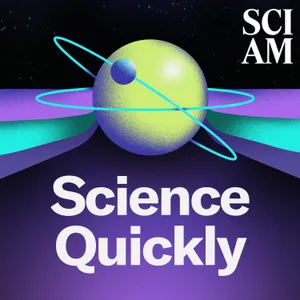
Free Daily Podcast Summary
Science Quickly: Daily Summaries Delivered
by Scientific American
Host Rachel Feltman, alongside leading science and tech journalists, dives into the rich world of scientific discovery in this bite-size science variety show.
Latest Episodes
The most recent episodes — sign up to get AI-powered summaries of each one.
- Yesterday19 min
You’re probably walking past edible plants every day
In this episode of Science Quickly, Rachel Feltman speaks with Alexis Nikole Nelson, better known as Black Forager, about her new book Happy Snacking, Don’t Die! Nelson shares how a childhood fascination with edible plants grew into a passion for foraging, conservation and science communication. From city sidewalk snacks and serviceberries to ocean-water pickles, she explains how foraging can deepen our connection to nature while encouraging responsible stewardship of the ecosystems that sustain us. Recommended Reading: Happy Snacking, Don’t Die! Alexis Nikole Nelson. S&S/Simon Element, 2026 E-mail us at sciencequickly@sciam.com if you have any questions, comments or ideas for stories we should cover! Discover something new everyday: subscribe to Scientific American and sign up for Today in Science, our daily newsletter. Science Quickly is produced by Rachel Feltman, Fonda Mwangi, Allison Rodgers and Jeff DelViscio. This episode was edited by Alex Sugiura, with fact-checking by Marielle Issa and Aaron Shattuck. Our theme music was composed by Dominic Smith. Learn more about your ad choices. Visit megaphone.fm/adchoices
- 3 days ago18 min
Can you spot a romance scam?
In this episode of Science Quickly, Rachel Feltman speaks with criminologist Fangzhou Wang about how romance scams have evolved from simple online deception into sophisticated, artificial-intelligence-powered fraud operations. They discuss how scammers use dating apps, fake identities, deepfakes and cryptocurrency schemes to build trust and steal money and what researchers are learning about helping people recognize and resist manipulation before they become victims. Recommended Reading: “Daejon Love Case Highlights Online Romance Scams: Research Reveals Scammers’ Tactics—And How to Defend against Them,” by Fangzhou Wang, in the Conversation. Published online September 2, 2026 Fangzhou Wang’s profile at the University of Texas at Arlington “A Crime Script Analysis of Pao Fen Operations and the Construction of Prevention Strategies,” by Fangzhou Wang, in Crime & Delinquency. Published online August 14, 2025 “The Prevention of Online Romance Scams Using a Crime Script Analysis from the Victim’s Perspective,” by Fangzhou Wang and James D. Kelsay, in International Review of Victimology, Vol. 32, No. 2; May 2026 E-mail us at sciencequickly@sciam.com if you have any questions, comments or ideas for stories we should cover! Discover something new everyday: subscribe to Scientific American and sign up for Today in Science, our daily newsletter. Science Quickly is produced by Rachel Feltman, Fonda Mwangi, Allison Rodgers and Jeff DelViscio. This episode was edited by Alex Sugiura, with fact-checking by Marielle Issa and Aaron Shattuck. Our theme music was composed by Dominic Smith. Learn more about your ad choices. Visit megaphone.fm/adchoices
- 4 days ago20 min
Navigating Science and Health Misinformation [Sponsored]
As health misinformation surges online, Morgan McSweeney—known online as Dr. Noc, a science communicator and immunology expert whose videos reach millions each month across TikTok, Instagram, and X—explores why facts alone might not be enough to earn public trust, and what science communicators can do differently. This podcast was produced for Bayer by Scientific American Custom Media, a division separate from the magazine's board of editors. Learn more about your ad choices. Visit megaphone.fm/adchoices
- 5 days ago10 min
Fire amoebas, fossilized vomit and AI energy demands
In this episode of Science Quickly, we cover discoveries both big and small, from the supersized particle collider needed to find the next subatomic specimen to tropical sea turtles that found new nesting grounds to a recently discovered eukaryote surprising scientists by surviving hellish temperatures and the ever growing energy needed to power artificial intelligence data centers. Recommended Reading: What’s the Smallest Particle in the Universe? Physicists trace particles back to the quantum vacuum AI’s Power Needs Will Destroy the Renewable Energy Revolution AI Will Drive Doubling of Data Center Energy Demand by 2030 E-mail us at sciencequickly@sciam.com if you have any questions, comments or ideas for stories we should cover! Discover something new everyday: subscribe to Scientific American and sign up for Today in Science, our daily newsletter. Science Quickly is produced by Rachel Feltman, Fonda Mwangi, Allison Rodgers and Jeff DelViscio. This episode was edited by Alex Sugiura, with fact-checking by Marielle Issa and Aaron Shattuck. Our theme music was composed by Dominic Smith. Learn more about your ad choices. Visit megaphone.fm/adchoices
- 1 weeks ago34 min
Unexplainable: Dark matter and the end of answers
In this episode of Science Quickly, we share part two of our crossover with Vox’s Unexplainable in which we explore one of the universe’s biggest mysteries: dark matter. Host Noam Hassenfeld talks with Scientific American senior reporter Joseph Howlett, a former physicist who spent years searching for dark matter deep beneath an Italian mountain. Their conversation traces the decades-long hunt for the invisible substance thought to make up most of the universe’s matter and explores an even deeper question: What if some mysteries are beyond science’s reach? Recommended Reading: What if we never find dark matter? Listen to Unexplainable Unexplainable on Spotify E-mail us at sciencequickly@sciam.com if you have any questions, comments or ideas for stories we should cover! Discover something new every day: subscribe to Scientific American and sign up for Today in Science, our daily newsletter. Science Quickly is produced by Rachel Feltman, Fonda Mwangi, Allison Rodgers and Jeff DelViscio. This episode was edited by Alex Sugiura, with fact-checking by Marielle Issa and Aaron Shattuck. Our theme music was composed by Dominic Smith. Learn more about your ad choices. Visit megaphone.fm/adchoices
- 1 weeks ago20 min
Rethinking Age-Related Vision Loss [Sponsored]
Treatment for wet age-related macular degeneration has advanced significantly with anti-VEGF therapies, but the need for frequent injections remains a challenge. A new, longer-lasting treatment now in development aims to reduce treatment burden while helping preserve vision. This podcast was produced for Ocular Therapeutix by Scientific American Custom Media, a division separate from the magazine’s board of editors. Learn more about your ad choices. Visit megaphone.fm/adchoices Learn more about your ad choices. Visit megaphone.fm/adchoices
- 1 weeks ago16 min
Should you be ‘poop maxxing’?
As colon cancer rates rise in younger adults, more and more people are paying attention to their poop and talking about it on social media, where such “poop maxxing” has become a hashtag. But what’s considered normal, and how can we measure our number twos? Board-certified gastroenterologist Wendi LeBrett joins Rachel Feltman to talk about what’s going on with the poop maxxing trend on social media, what a healthy stool should look and feel like, what common misconceptions around gut health people have, when to see a doctor, and more. Recommended Reading: Colon cancer is killing more young people in the U.S. than any other cancer Scientists gave the same sample to seven at-home microbiome tests. The results were dramatically different A pair of gut bacteria may cause constipation E-mail us at sciencequickly@sciam.com if you have any questions, comments or ideas for stories we should cover! Discover something new everyday: subscribe to Scientific American and sign up for Today in Science, our daily newsletter. Science Quickly is produced by Rachel Feltman, Fonda Mwangi, Allison Rodgers and Jeff DelViscio. This episode was edited by Alex Sugiura. Marielle Issa and Aaron Shattuck fact-check our show. Our theme music was composed by Dominic Smith. Learn more about your ad choices. Visit megaphone.fm/adchoices
- 1 weeks ago15 min
Space weapons are here, and AI experts are sounding alarms
In this episode of Science Quickly, we discuss newly revealed U.S. space weapons, growing artificial intelligence safety concerns and the Environmental Protection Agency’s rollback of power plant emissions limits before we end with a look at the tiny sand hoppers reshaping California’s beaches. Recommended Reading: It’s official: The U.S. has weapons in space Trump repeals emissions regulations of fossil-fuel power plants The real danger in OpenAI’s Hugging Face hack E-mail us at sciencequickly@sciam.com if you have any questions, comments or ideas for stories we should cover! Discover something new everyday: subscribe to Scientific American and sign up for Today in Science, our daily newsletter. Science Quickly is produced by Rachel Feltman, Fonda Mwangi, Allison Rodgers and Jeff DelViscio. This episode was edited by Alex Sugiura, with fact-checking by Marielle Issa and Aaron Shattuck. Our theme music was composed by Dominic Smith. Learn more about your ad choices. Visit megaphone.fm/adchoices
Get Science Quickly summaries in your inbox
Free AI-powered daily recaps. Key takeaways, quotes, and mentions — in a 5-minute read.
Get Free Summaries →Free forever for up to 3 podcasts. No credit card required.
You Might Also Like
Listeners also like.
Science Vs
A show that investigates popular topics and myths by analyzing scientific evidence to determine what’s fact, fiction, or uncertain.

Science Friday
Explores diverse science and technology topics, from space to microscopic life, with engaging educational stories.
Science In Action
The BBC covers the latest weekly developments and news in science.

Science Magazine Podcast
Weekly episodes covering original scientific research, global science news, and expert commentary.
Short Wave
A daily science podcast exploring discoveries, everyday mysteries, and the stories behind scientific headlines.
The Science Show
Explores diverse scientific topics and research, from physics to politics, with a focus on Australian perspectives.

Inquiring Minds
Explores the intersection of science and society through critical thinking and in-depth analysis.

Sidenote by AsapSCIENCE
Greg and Mitch explore the science behind controversial topics using research and anecdotes to inform and entertain.
Unexpected Elements
Explores hidden scientific connections behind global news and everyday phenomena.
Seeking A Scientist
A chemist hosts conversations with scientists to explore futuristic scientific possibilities and their real-world implications.
The World, the Universe and Us
Explores big scientific questions about life, consciousness, climate, and the cosmos with expert scientists and New Scientist journalists.
Science Weekly
The Guardian provides weekly updates on the latest science and environment news.
About Science Quickly
Host Rachel Feltman, alongside leading science and tech journalists, dives into the rich world of scientific discovery in this bite-size science variety show.
Customized Recaps
AI-powered recaps with compact key takeaways, quotes, and insights.
Straight to Your Inbox
Get key takeaways from Science Quickly in a 5-minute read.
Save Hours Every Week
Stay current on your favorite podcasts without falling behind.
Frequently Asked Questions
What is Podzilla's Science Quickly daily summary?
It's a free AI-powered email that summarizes new episodes of Science Quickly as soon as they're published. You get the key takeaways, notable quotes, and links & mentions — all in a quick read.
How does the Science Quickly podcast summary work?
When a new episode drops, our AI transcribes and analyzes it, then generates a personalized summary tailored to your interests and profession. It's delivered to your inbox every morning.
Is this an official Science Quickly product?
No. Podzilla is an independent service that summarizes publicly available podcast content. We're not affiliated with or endorsed by Scientific American.
Can I get summaries of other podcasts too?
Absolutely! The free plan covers up to 3 podcasts. Upgrade to Pro for 15, or Premium for 50. Browse our full catalog at /podcasts.
How often does Science Quickly release new episodes?
Science Quickly publishes every few days. Our AI generates a summary within hours of each new episode.
What topics does Science Quickly cover?
Science Quickly covers topics including Science. Our AI identifies the specific themes in each episode and highlights what matters most to you.
Start getting Science Quickly summaries tomorrow morning.
Free forever for up to 3 podcasts. No credit card required.
Free forever for up to 3 podcasts. No credit card required.