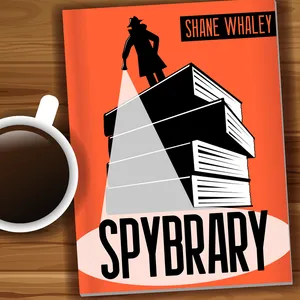
Free Daily Podcast Summary
Spybrary Spy Podcast: Daily Summaries Delivered
by Shane Whaley
Spybrary is a podcast for fans of spy books, spy tv and spy movies since 2017. We bring you author interviews and reader discussions on our favorite spy books and novels.
Latest Episodes
The most recent episodes — sign up to get AI-powered summaries of each one.
- 2 days ago1h 1m
Robert Pattinson Is James Bond! Can He Reinvent 007?
The name's Pattinson. Robert Pattinson. After years of speculation, the wait is finally over. Robert Pattinson has been unveiled as the next James Bond. But is the former Twilight heartthrob and Gotham's Dark Knight the right man to carry 007 into a new era? In this special edition of Spybrary, three passionate Bond enthusiasts assemble for an emergency debrief on one of the biggest announcements in the history of the franchise. Joining Spybrary founder Shane Whaley are Ajay Chowdhury, James Bond author and spokesman for the International James Bond Fan Club, and Paul Burke, Spybrary's Head of Fiction and author of Spies on Screen. There's plenty to discuss. Pattinson arrives with an impressive acting CV, but unlike many of his predecessors, he's already a household name. Will his Hollywood stardom help introduce Bond to a new generation, or will audiences struggle to see past Batman and Twilight? Then there's the question of what kind of Bond we're going to get. Daniel Craig brought grit, vulnerability and emotional complexity to the role. Should Pattinson continue down that darker path, or is it time to rediscover some of the charm, wit and escapism that made 007 a cinematic icon? The creative team offers more clues. With Dune director Denis Villeneuve behind the camera and Peaky Blinders creator Steven Knight writing the screenplay, could we be heading towards a more sophisticated, atmospheric and espionage-driven Bond adventure? And after the extraordinary conclusion of No Time to Die, how does the franchise begin again? The panel also tackles the bigger questions surrounding Bond's future. With Amazon MGM now holding creative control, will the franchise retain its distinctive identity? Could spin-offs and television series be on the horizon? And in a world of cyberwarfare, shifting alliances and increasingly complex geopolitical threats, what should a modern James Bond actually be fighting? From Ian Fleming's literary creation to the changing world of cinematic espionage, this is a discussion about much more than casting a new leading man. It's about what James Bond needs to become to remain relevant. In This Episode Robert Pattinson as 007: Inspired casting or a gamble? From Batman to Bond: What Pattinson's performances tell us about his potential as Britain's most famous secret agent. The Daniel Craig legacy: Should Bond remain dark and emotionally complex, or rediscover his charm, humour and escapism? Denis Villeneuve and Steven Knight: What their creative partnership could mean for the next Bond film. Life after No Time to Die: Can the franchise simply start again, or does Craig's dramatic finale need addressing? The Amazon era: Will new creative ownership breathe fresh life into 007, or risk turning Bond into another sprawling entertainment franchise? Bond's changing enemies: What do modern geopolitics, intelligence operations and global threats mean for the next generation of Bond villains? The competition: How has the espionage and action entertainment landscape changed since the last Bond adventure? Getting Bond right: What's the single most important ingredient for a successful new era of 007? Meet the Panel Ajay Chowdhury is a James Bond author, researcher and spokesman for the International James Bond Fan Club. He has written extensively about the world of 007 and brings his deep knowledge of Bond's literary and cinematic history to the discussion. Paul Burke is Spybrary's Head of Fiction and the author of Spies on Screen, an exploration of espionage films and television. He is also known for his work with Crime Time FM and The Spymaster podcast. Shane Whaley is the founder and host of Spybrary, the podcast and community dedicated to spy books, espionage fiction, intelligence history and spies on screen. Join the Spybrary Conversation What do YOU think of Robert Pattinson as James Bond? Are you excited about the casting? Who would you have chosen instead? And what kind of Bond adventure would you like Denis Villeneuve and Steven Knight to deliver? We'd love to hear your verdict. Join thousands of fellow spy fiction and James Bond enthusiasts in the Spybrary community to discuss the casting, sha
- 2 weeks ago1h 4m
George Smiley Goes to America: Nick Harkaway on The Taper Man
Smiley goes to America. Roy Bland goes to Leningrad. And Nick Harkaway goes back inside his father's Circus. In Paul Burke's first interview as Spybrary's Head of Fiction, he sits down with Nick Harkaway to talk about The Taper Man. It's Nick's second novel set in John le Carré's Circus and the follow-up to Karla's Choice. The year is 1965. Polyakov has arrived in London and the pieces are moving into place for Tinker Tailor. George Smiley is in Los Angeles, about as far from home as he could be, chasing a Moscow mole hunt. In Leningrad, Roy Bland is running a dangerous operation.. Nick talks about absorbing Smiley before he could read: his father read pages aloud across the table to his mother every day. He also explains the family meeting where he agreed to take on the series, and why Smiley's world comes with strict rules about what can and can't happen in it. What you'll hear How growing up with Smiley read aloud every day shaped Nick's ear for the books The family meeting, and his brother Simon's nudge, that turned "I won't do it" into "all right" Why a true CIA story about an inflatable decoy spy could never appear in a Smiley novel The "Indiana Jones warehouse" rule for writing Karla: every answer should open up more questions Inventing the Taper Man as new Circus lore, plus le Carré's gift of the term "honey trap" Smiley as an "archaeologist of espionage" and the "original sin" at the heart of every Circus story Roy Bland's backstory and why The Taper Man goes in for proactive spying Hungary, Finland and the idea that history doesn't come packaged in neat periods A not-quite-CIA, illegals in America, and the question of who counts as a "proper American" What comes next: a third Circus book is under contract, a Harkaway book is also on the way, and his thoughts on a WWII Smiley or a modern le Carré
- 4 weeks ago41 min
Crime Fiction Legend Sara Paretsky Takes on the Spy Thriller with Bad Company
Sara Paretsky, legendary creator of V.I. Warshawski, joins me on the Spybrary Spy Podcast to talk about Bad Company — her new spy thriller featuring retired CIA officer Lily, a woman who discovers that you never really leave the Company. We talk about Sara's leap from detective fiction into espionage, creating the fictional Central Asian country of Hayalistan, women inside the CIA, and why an older female intelligence officer offers such a different take on the traditional spy hero. Sara also reveals why she needed eight drafts to find Bad Company, the dog-sled exfiltration scene that survived every rewrite, and how questions of power, anger and voicelessness drive her fiction. And, naturally, we talk spy books: John le Carré, Tinker Tailor Soldier Spy, Mrs Pollifax, Manning Coles and the wonderful Walter Matthau and Glenda Jackson espionage caper Hopscotch. A fascinating conversation with one of crime fiction's most influential writers about what happens when she enters the world of spies. Join the Spybrary Community Support Spybrary - a monthly dination helps us keep the lights on at the safehouse. Full Shownotes with links to buy Sara Paretsky's Bad Company herehttps://www.spybrary.com/311
- Oct 7, 20261h 0m
The Ultimate Spy Movie & TV Guide — Inside Spies on Screen with Paul Burke
Paul Burke joins Spybrary hosts Shane Whaley and Michael Huie to discuss his new book, Spies on Screen, an ambitious guide to more than 900 spy films and television series. From James Bond and John le Carré to Slow Horses, The Bureau, The Americans and forgotten spy thrillers, Paul explores how espionage on screen has evolved from glamorous secret agents to damaged, morally complex intelligence officers. Along the way, the trio debate which Bond actor is closest to Ian Fleming's original creation, why The Spy Who Came in from the Cold remains one of the great adaptations, what makes The Day of the Jackal such an enduring classic, and which overlooked spy films and TV series deserve to be rediscovered. Paul also explains why many of the best spy stories are really anti-spy stories, how streaming has transformed the genre, and why international espionage dramas are becoming more important than ever. Plus, stay to the end for the Spybrary quick-fire round, where Paul reveals his picks for best Bond, best spy film, best spy TV series, most underrated espionage movie and more. If you love spy films, spy TV shows and discovering hidden gems, this episode is for you. In this episode: The evolution of spy films and TV James Bond, Timothy Dalton and Ian Fleming The Spy Who Came in from the Cold The Day of the Jackal Slow Horses The Bureau The Americans Forgotten Cold War spy films Underrated espionage TV The future of spy stories on screen Spies on Screen by Paul Burke is out now. Visit Spybrary for more spy books, films, TV, interviews and intelligence history.
- Sep 29, 202641 min
William Boyd on the Appeal of Spy Fiction and Creating Gabriel Dax
What makes a great spy novel? For William Boyd, it is complexity, uncertainty and that irresistible feeling that, as a reader, you are constantly trying to work out who can be trusted. In this SPOILER FREE special Spybrary conversation, Boyd joins Ollie Webb Carter (History Book Club Podcast) to discuss his Gabriel Dax novels and the latest instalment, Cold Sunset. They explore Boyd's lifelong fascination with espionage fiction, the influence of John le Carré, the real history that feeds into his novels, and why the analogue world of Cold War spying remains such fertile ground for a novelist. Along the way, William reveals the remarkable real-life MI6 figure who helped inspire Faith Green, shares his thoughts on the JFK assassination, reflects on the old-boy network that once dominated British intelligence, and explains how a television project that never came to fruition ultimately helped give birth to Gabriel Dax. They also discuss: • Why the best spy novels force the reader to think • Betrayal, false identities and the double and triple bluff • John le Carré and the literary tradition of spy fiction • How Gabriel Dax is gradually becoming a more accomplished spy • The real intelligence officer behind Faith Green • MI6, the CIA and Cold War regime change • Why modern surveillance makes contemporary espionage harder to write • The unexpected origins of the Gabriel Dax series • What could come next for Gabriel A fascinating conversation with one of Britain's most celebrated novelists about spies, history, writing — and the enduring appeal of espionage fiction. Featuring William Boyd in conversation with Ollie Webb Carter for Spybrary.
- Sep 23, 202644 min
CIA vs MI6: David McCloskey Goes Inside London Station
What if the CIA and MI6 stopped behaving like allies—and started spying on each other? David McCloskey joins Tim Shipman to discuss London Station, his fifth spy novel, and the real intelligence relationship behind its central premise. McCloskey explains why the CIA–SIS "Special Relationship" can sometimes resemble a dysfunctional marriage, what the CIA Chief of Station in London actually does, and how conversations with former American and British intelligence officers shaped the book. He also introduces the wonderfully British intelligence concept of "deep chat"—those unofficial conversations where trusted allies may share rather more than appears in the official cables. There's plenty for Artemis Procter fans too. David discusses her move to London, why she is spectacularly ill-suited to the diplomatic side of the job, and the changes the character is going through. And then comes one of the episode's best stories: McCloskey reveals what happened when he unexpectedly came face-to-face at CIA headquarters with the former colleague he had in mind when he first created Artemis. Plus: Bobby Jerome, CIA vs MI6 tensions, how McCloskey researched Vauxhall Cross, his direct sequel to Damascus Station, the Artemis TV series, Moscow X on film, and what's coming next. A must-listen for David McCloskey readers, Artemis Procter devotees, and anyone fascinated by the real world behind modern spy fiction.
- Sep 10, 202640 min
Lies, Spies and Suspense: Inside Traitors with Robert B. McCaw
A propulsive, high-stakes thriller—Robert McCaw delivers a gripping tale of espionage, betrayal, and deception amid the race to expose Russian moles at the highest levels of the US government. Tense, timely, and full of international intrigue, Traitors will keep you on the edge of your seat. Highly recommended. David McCloskey, former CIA analyst and author of The Persian Author Robert B McCaw joins us to discuss Traitors, a geopolitical thriller shaped by his background in law, Washington and international affairs. He reveals how real-world stories involving Russia, Ukraine, Finland, nuclear weapons and ballistic submarines helped inspire the novel—and how his legal experience taught him to think about lies, interrogation and the search for truth. Support Spybrary every month with a small donation and help us keep the lights on at the Spybrary Safehouse McCaw also explains why he believes a thriller writer has to "play fair" with the reader: the clues should be there, the twists should feel earned, and even the most dramatic developments need to feel possible. Along the way, we explore his unusual path to publication—from spending nearly 20 years on his first novel and self-publishing it, to a chance encounter on a Mediterranean cruise that led to a literary agent and, eventually, Traitors being published by W. W. Norton.
- Sep 1, 202637 min
From Bourne to le Carré: Jinwoo Park on The Oxford Soju Club
In this episode of Spybrary, host Matthew Hurst talks with author Jinwoo Park about his debut novel, The Oxford Soju Club. The book centres on North Korean spies and their Korean American adversaries, who are regulars at an Oxford restaurant run by an oblivious South Korean. It's as much about the psychology of their ethnic identities as shoot outs and chases. Jinwoo discusses how the book developed from a simple action thriller to drawing out parallels of how deep cover spies and immigrants share a need to to mould themselves to their surroundings. The conversation explores Jinwoo's influences, from the Bourne films and Robert Ludlum to John le Carré and The Sympathizer, to conversations with his uncle — a former deputy director in South Korea's National Intelligence Service. It also explains why spies should never be rude to taxi drivers. Support Spybrary on Patreon, every little helps us produce content for you.
Get Spybrary Spy Podcast summaries in your inbox
Free AI-powered daily recaps. Key takeaways, quotes, and mentions — in a 5-minute read.
Get Free Summaries →Free forever for up to 3 podcasts. No credit card required.
You Might Also Like
Listeners also like.

The Rest Is Classified
Former CIA analyst David McCloskey and journalist Gordon Corera examine real espionage cases and intelligence operations from the Cold War to present.
The Spy Who
Real spy stories from intelligence operatives who risked everything in high-stakes missions for national or personal interests.
SPYCRAFT 101
Justin Black

Spyology Squad
Three young agents use science to stop a villain and his Purple Ninjas in weekly spy-themed adventures.

John Kiriakou's Dead Drop
A former CIA officer explores the psychology and realities of espionage through personal experience and analysis.
Deep Cover
People live double lives, from suburban fathers hiding criminal pasts to the secrets that unravel families.

True Criminals
Investigative journalists revisit high-profile and overlooked crime cases with firsthand sources and deep reporting insight.
Good Assassins
Virginia Hall, a disabled American spy, sabotages Nazi operations in occupied France while evading capture by the Gestapo.

Smashing Security
Weekly episodes explore cybercrime, hacking, privacy failures, and tech disasters with insight and humor.

Bridgewater
A folklore professor investigates a supernatural mystery that forces him to confront his beliefs and the possibility of changing history.
The Langley Files: CIA's Podcast
Firsthand accounts from CIA officers about their real-life missions and experiences at the agency’s headquarters.

The Lawfare Podcast
Discussions with experts on national security, law, and policy covering foreign policy, intelligence, cybersecurity, and governance.
Customized Recaps
AI-powered recaps with compact key takeaways, quotes, and insights.
Straight to Your Inbox
Get key takeaways from Spybrary Spy Podcast in a 5-minute read.
Save Hours Every Week
Stay current on your favorite podcasts without falling behind.
Frequently Asked Questions
What is Podzilla's Spybrary Spy Podcast daily summary?
It's a free AI-powered email that summarizes new episodes of Spybrary Spy Podcast as soon as they're published. You get the key takeaways, notable quotes, and links & mentions — all in a quick read.
How does the Spybrary Spy Podcast podcast summary work?
When a new episode drops, our AI transcribes and analyzes it, then generates a personalized summary tailored to your interests and profession. It's delivered to your inbox every morning.
Is this an official Spybrary Spy Podcast product?
No. Podzilla is an independent service that summarizes publicly available podcast content. We're not affiliated with or endorsed by Shane Whaley.
Can I get summaries of other podcasts too?
Absolutely! The free plan covers up to 3 podcasts, any in the catalog. Basic raises that to 15, Pro to 40 and Max to 100. Browse our full catalog at /podcasts.
How often does Spybrary Spy Podcast release new episodes?
Spybrary Spy Podcast publishes biweekly. Our AI generates a summary within hours of each new episode.
What topics does Spybrary Spy Podcast cover?
Spybrary Spy Podcast covers topics including Fiction, Arts, Books. Our AI identifies the specific themes in each episode and highlights what matters most to you.
Start getting Spybrary Spy Podcast summaries tomorrow morning.
Free forever for up to 3 podcasts. No credit card required.
Free forever for up to 3 podcasts. No credit card required.