Free Daily Podcast Summary
Star Trails: From Backyard Astronomy to Cosmic Wonder: Daily Summaries Delivered
by Single Malt Sky
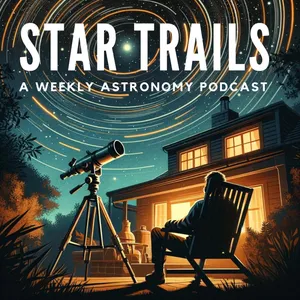
Star Trails is a weekly astronomy podcast that begins in your backyard and expands outward to the edge of the universe. Each episode features a guide to the night sky visible across North America — constellations, planets, moon phases, and celestial events — along with deeper explorations of the science, history, and perspective that make astronomy one of humanity’s greatest adventures.From ancient skywatchers to modern spacecraft, from quiet stargazing to the violent deaths of stars, Star Trails reveals the beauty, mystery, and sometimes haunting reality of the cosmos.
Latest Episodes
The most recent episodes — sign up to get AI-powered summaries of each one.
- Today25 min
The Star That Wouldn't Die
How many times can a star explode before astronomers begin to suspect something strange is happening?In a galaxy some 30 million light-years away, a massive star known as AT 2016blu has been putting on an extraordinary performance. Since 2012, astronomers have recorded at least 27 dramatic outbursts, roughly one every 113 days. Each resembles a stellar explosion, yet somehow the star survives to do it all over again.Now, new observations from NASA's Chandra X-ray Observatory suggest that the secret behind these recurring eruptions may be an unseen companion—a neutron star or black hole left behind by the death of another massive star. We'll explore how astronomers pieced together this cosmic mystery and how more than 30 amateur variable-star observers helped make the discovery possible.Then, in our night sky report for November 22–28, 2026, we'll look for the full Beaver Moon, a close encounter between the Moon and the Pleiades, Uranus at opposition, and a busy morning sky featuring Jupiter, Mars, Venus, and Mercury. We'll also revisit Algol, the famous Demon Star, an eclipsing binary whose brightness changes are visible to the naked eye. An eclipse predicted for Thanksgiving evening offers backyard observers a chance to witness a star's changing light for themselves.Connect with us on Bluesky @startrails.bsky.socialIf you’re enjoying the show, consider sharing it with a friend! Want to help? Buy us a coffee! Also, check out music made for Star Trails on our Bandcamp page!Podcasting is better with RSS.com! If you’re planning to start your own podcast, use our RSS.com affiliate link for a discount, and to help support Star Trails.
- 1 weeks ago30 min
One Light-Day From Home
After nearly 50 years in space, Voyager 1 is about to cross a remarkable milestone. On November 18, humanity's most distant spacecraft will reach a distance of one light-day from Earth, more than 16 billion miles away, so distant that even a radio signal traveling at the speed of light needs a full day to reach it.In this episode, we celebrate the astonishing longevity of Voyager 1, including the recent engineering efforts to squeeze a few more precious watts from its fading power supply. Then we use Voyager's journey to confront one of astronomy's most humbling subjects: the sheer scale of space. How long would Voyager take to reach Alpha Centauri? How fast is the record-setting Parker Solar Probe compared with light? And why has BepiColombo needed eight years to reach Mercury when New Horizons crossed billions of miles to Pluto in only a little more time?We'll also look at a provocative AI-assisted proposal for an interstellar mission using technology that largely exists today, provided you're willing to wait roughly 80,000 years for arrival.Then, in this week's night sky for November 15–21, Mars and Jupiter meet in a striking predawn conjunction, Mercury returns to the morning sky, the Moon passes Saturn, the Leonid meteor shower peaks, and the winter stars begin taking over the evening. We finish with Sirius — one of our nearest stellar neighbors at just 8.6 light-years away — and one final reminder of just how enormous even our own little corner of the galaxy really is.Connect with us on Bluesky @startrails.bsky.socialIf you’re enjoying the show, consider sharing it with a friend! Want to help? Buy us a coffee! Also, check out music made for Star Trails on our Bandcamp page!Podcasting is better with RSS.com! If you’re planning to start your own podcast, use our RSS.com affiliate link for a discount, and to help support Star Trails.
- 2 weeks ago32 min
The Case of the Martian Meteorite
Somewhere in the Sahara Desert, someone picked up an unusual, rose-colored stone. It wasn't particularly impressive to look at, but scientists would eventually discover that this little rock had traveled across millions of miles of space, survived a violent escape from another planet, and preserved evidence of events more than four billion years old.It came from Mars.In this episode, we're investigating the remarkable science of Martian meteorites. How can researchers identify a rock from another planet with such confidence? What do the Viking landers have to do with meteorites discovered on Earth? And what kind of cosmic catastrophe could send a piece of the Martian crust hurtling across the solar system?Along the way, we'll revisit one of the biggest astronomy stories of the 1990s: the sensational announcement that a Martian meteorite might contain evidence of ancient microbial life. We'll also examine the newly studied Teghaza 001 meteorite, whose minerals preserve clues to the earliest chapters of Martian history, including the role of water on the young Red Planet.Then, we'll turn our attention to one of the world's most famous paintings. New astronomical research suggests that Vincent van Gogh's The Starry Night may have been inspired by a particular arrangement of the Moon, Venus, and the stars of Taurus in July 1889. Could modern astronomy help solve a 137-year-old artistic mystery?Finally, in our night sky report for November 8–14, 2026, we'll explore excellent dark-sky observing conditions around the new Moon, the Northern Taurid meteor shower, Saturn in the evening sky, Jupiter and Mars drawing closer before dawn, and some of autumn's finest celestial sights, including the Pleiades, Hyades, Andromeda Galaxy, and Orion Nebula.Connect with us on Bluesky @startrails.bsky.socialIf you’re enjoying the show, consider sharing it with a friend! Want to help? Buy us a coffee! Also, check out music made for Star Trails on our Bandcamp page!Podcasting is better with RSS.com! If you’re planning to start your own podcast, use our RSS.com affiliate link for a discount, and to help support Star Trails.
- 3 weeks ago29 min
The Darkroom at the Edge of the Universe
There was a time when photographing a distant galaxy required enormous telescopes, glass photographic plates, exotic chemistry, and almost unimaginable patience. But capturing the light was only half the battle. Sometimes the greatest discoveries were hiding inside the photographs themselves, waiting for someone clever enough to bring them into view.This week we explore the extraordinary work of David Malin, the photographic scientist whose ingenious darkroom techniques helped transform our view of the universe. Working with massive telescopes at the Anglo-Australian Observatory, Malin developed ways to reveal faint cosmic structures and assemble breathtaking color photographs from black-and-white negatives. His work helped uncover previously unseen features of distant galaxies, including an enormous, ghostly spiral that now bears his name.We'll also revisit the sometimes miserable world of film astrophotography, from manually guiding telescopes through hours-long exposures to treating photographic film to make it more sensitive to faint light. And we'll consider how Malin's legacy lives on in today's digital cameras, image-stacking software, and remarkable little smart telescopes that can photograph galaxies from our own backyards.Plus, in our night sky report for November 1–7, 2026: The waning Moon brings darker evenings, Mars and Jupiter brighten the morning sky, Venus returns to the dawn, and Saturn remains a rewarding evening target. We'll also visit some of autumn's finest binocular sights, including the Andromeda Galaxy, the Double Cluster, and the Pleiades.Connect with us on Bluesky @startrails.bsky.socialIf you’re enjoying the show, consider sharing it with a friend! Want to help? Buy us a coffee! Also, check out music made for Star Trails on our Bandcamp page!Podcasting is better with RSS.com! If you’re planning to start your own podcast, use our RSS.com affiliate link for a discount, and to help support Star Trails.
- 4 weeks ago35 min
The Telescope is Full of Water!
What began as an innocent evening of stargazing quickly descended into a strange expedition through the peculiar subcultures of amateur astronomy. Armed with little more than an inexpensive pair of binoculars, I ventured into the darkness among veteran telescope operators, technological evangelists, observatory aristocrats, and one particularly determined defender of old-school astronomy.There were passionate disagreements about computerized telescopes, unexpected debates over lawn furniture, and an aging Schmidt-Cassegrain telescope slowly transforming itself into a rainwater collection system. Somewhere along the way, a humble pineapple cake achieved legendary status, and the Andromeda Galaxy proved considerably easier to find with binoculars than with a telescope.But beneath the absurdity lies something worth remembering. Whether we're navigating by printed star charts, collecting photons with sophisticated digital instruments, or simply wandering the Milky Way with a pair of binoculars, we're all looking for the same thing: a little wonder beneath the stars. There's no single correct way to enjoy the universe, and sometimes the best observing equipment is whatever makes you happiest.Also in this episode: Remember when we said there were no green stars? Well, astronomers have discovered a remarkable white dwarf that may force us to qualify that statement. Drew revisits the science of stellar colors and explains how a dead star contaminated by the remains of its planetary system can appear ghostly green.And in our Halloween-themed Night Sky Report for October 25–31, 2026, we'll explore the Hunter's Moon, a visit to the Pleiades, the eerie eclipses of Algol, the Demon Star, and the possibility of a few spectacular Taurid fireballs.Connect with us on Bluesky @startrails.bsky.socialIf you’re enjoying the show, consider sharing it with a friend! Want to help? Buy us a coffee! Also, check out music made for Star Trails on our Bandcamp page!Podcasting is better with RSS.com! If you’re planning to start your own podcast, use our RSS.com affiliate link for a discount, and to help support Star Trails.
- Oct 18, 202620 min
The Death of Andromeda
The Andromeda Galaxy is not disappearing, exploding or running out of stars. But it may be entering something astronomers recognize as a kind of galactic old age: it is gradually losing the ability to make new ones.Using the Hubble Space Telescope, researchers reconstructed 500 million years of star formation across two-thirds of Andromeda's disk. They found a long decline, followed by an especially steep drop during the past 40 million years. The galaxy's great ring of stellar nurseries is going quiet.This week on Star Trails, we'll find out how astronomers read the fossil record of 200 million individual stars, why a small satellite galaxy named M32 may be involved and what Andromeda's slowdown could tell us about the future of the Milky Way.Then, in the Night Sky Report for October 18 through the 24th, we'll look for Andromeda itself, explore the first-quarter Moon, watch for fast Orionid meteors from Halley's Comet and finish the week with the Moon beside Saturn.Connect with us on Bluesky @startrails.bsky.socialIf you’re enjoying the show, consider sharing it with a friend! Want to help? Buy us a coffee! Also, check out music made for Star Trails on our Bandcamp page!Podcasting is better with RSS.com! If you’re planning to start your own podcast, use our RSS.com affiliate link for a discount, and to help support Star Trails.
- Oct 11, 202634 min
The Moon That Sends Us Its Ocean
Saturn has a moon with a hidden ocean, and that ocean is spraying samples of itself into space.Enceladus is only about 310 miles wide, but beneath its brilliant shell of ice lies a global saltwater ocean warmed by the pull of Saturn. Along its south pole, enormous fractures release water vapor and tiny frozen grains. NASA's Cassini spacecraft flew through that spray and found salts, organic compounds, molecular hydrogen, silica and phosphorus: an intriguing collection of water, chemistry and energy.Now two new studies make the story even more compelling. One suggests that Enceladus naturally separates and concentrates its ocean chemistry into individual ice grains, potentially making signs of life easier for a future spacecraft to detect. The other shows that a methane-producing microorganism from Earth can survive under a laboratory recreation of Enceladus-like conditions.This week on Star Trails, we'll visit the little moon that may be preparing its own samples for us. Then, after the break, we'll discover why the average color of the universe is called Cosmic Latte before heading outside for Mars in the Beehive Cluster, a young Moon beside Antares, Vesta at opposition and a perfectly timed fade of the Demon Star.Connect with us on Bluesky @startrails.bsky.socialIf you’re enjoying the show, consider sharing it with a friend! Want to help? Buy us a coffee! Also, check out music made for Star Trails on our Bandcamp page!Podcasting is better with RSS.com! If you’re planning to start your own podcast, use our RSS.com affiliate link for a discount, and to help support Star Trails.
- Oct 4, 202629 min
A Black Hole Is Pointing at Us
A black hole in our galaxy appears to be aiming a relativistic jet almost directly toward Earth. That sounds like a reasonably good opening line for October.The object, IRAS 18293−0941, is a binary system about 12,000 light-years away. A stellar-mass black hole is feeding on material from a massive companion star and launching jets at no less than roughly two-thirds the speed of light. Because one jet is directed close to our line of sight, astronomers believe they may have found the Milky Way's first convincing microblazar—a miniature version of the blazars powered by supermassive black holes in distant galaxies.This week on Star Trails, we'll look down the barrel of that cosmic engine, learn why the jet is far more interesting than frightening, and follow the other jet as it crashes into a molecular cloud and may accelerate particles to extraordinary energies.Then in the Night Sky Report for October 4 through the 10th, Saturn reaches opposition, the waning Moon visits Mars and the Beehive Cluster, and much of North America gets to watch the Moon make Jupiter disappear. We'll also look for a dragon's handful of meteors under nearly moonless skies before the new Moon arrives on Saturday.Connect with us on Bluesky @startrails.bsky.socialIf you’re enjoying the show, consider sharing it with a friend! Want to help? Buy us a coffee! Also, check out music made for Star Trails on our Bandcamp page!Podcasting is better with RSS.com! If you’re planning to start your own podcast, use our RSS.com affiliate link for a discount, and to help support Star Trails.
Get Star Trails: From Backyard Astronomy to Cosmic Wonder summaries in your inbox
Free AI-powered daily recaps. Key takeaways, quotes, and mentions — in a 5-minute read.
Get Free Summaries →Free forever for up to 3 podcasts. No credit card required.
You Might Also Like
Listeners also like.
Bedtime Astronomy
A calming exploration of cosmic wonders, sharing stories about stars, planets, and celestial phenomena to inspire curiosity before sleep.
Through the Telescope
Two hosts explore key astronomy topics in digestible episodes, making the cosmos accessible and engaging for all knowledge levels.

StarTalk with Neil deGrasse Tyson
Astrophysicist Neil deGrasse Tyson blends science, pop culture, and comedy with guests to explore space, physics, and life in the universe.
SpaceTime with Stuart Gary
Weekly explorations of astronomy, space, and science news with insights from a veteran science journalist and industry experts.
StarTripper!!
A cosmic road-trip through the galaxy in search of wild and extraordinary experiences.

Hostile Worlds: Exploring Space
A documentary-style podcast exploring extreme alien environments through immersive audio storytelling aboard a fictional exploration vessel.

Cosmos in a Pod
Explores space, science, philosophy, and technology to reveal the wonders of the universe and humanity's place within it.

Exoplanet Radio
Deep Astronomy, LLC
Planetary Radio: Space Exploration, Astronomy and Science
Explores space exploration, astronomy, and science through conversations with experts and advocates shaping humanity's journey beyond Earth.

The Cosmic Controversy Podcast
brucedorminey
SpaceKid
Ish

Somewhere in the Skies
A weekly exploration of UFO phenomena and unexplained aerial encounters hosted by an author and investigator.
About Star Trails: From Backyard Astronomy to Cosmic Wonder
Star Trails is a weekly astronomy podcast that begins in your backyard and expands outward to the edge of the universe. Each episode features a guide to the night sky visible across North America — constellations, planets, moon phases, and celestial events — along with deeper explorations of the science, history, and perspective that make astronomy one of humanity’s greatest adventures.From ancient skywatchers to modern spacecraft, from quiet stargazing to the violent deaths of stars, Star Trails reveals the beauty, mystery, and sometimes haunting reality of the cosmos.
Customized Recaps
AI-powered recaps with compact key takeaways, quotes, and insights.
Straight to Your Inbox
Get key takeaways from Star Trails: From Backyard Astronomy to Cosmic Wonder in a 5-minute read.
Save Hours Every Week
Stay current on your favorite podcasts without falling behind.
Frequently Asked Questions
What is Podzilla's Star Trails: From Backyard Astronomy to Cosmic Wonder daily summary?
It's a free AI-powered email that summarizes new episodes of Star Trails: From Backyard Astronomy to Cosmic Wonder as soon as they're published. You get the key takeaways, notable quotes, and links & mentions — all in a quick read.
How does the Star Trails: From Backyard Astronomy to Cosmic Wonder podcast summary work?
When a new episode drops, our AI transcribes and analyzes it, then generates a personalized summary tailored to your interests and profession. It's delivered to your inbox every morning.
Is this an official Star Trails: From Backyard Astronomy to Cosmic Wonder product?
No. Podzilla is an independent service that summarizes publicly available podcast content. We're not affiliated with or endorsed by Single Malt Sky.
Can I get summaries of other podcasts too?
Absolutely! The free plan covers up to 3 podcasts, any in the catalog. Basic raises that to 15, Pro to 40 and Max to 100. Browse our full catalog at /podcasts.
How often does Star Trails: From Backyard Astronomy to Cosmic Wonder release new episodes?
Star Trails: From Backyard Astronomy to Cosmic Wonder publishes weekly. Our AI generates a summary within hours of each new episode.
What topics does Star Trails: From Backyard Astronomy to Cosmic Wonder cover?
Star Trails: From Backyard Astronomy to Cosmic Wonder covers topics including Leisure, Science, Hobbies, Astronomy. Our AI identifies the specific themes in each episode and highlights what matters most to you.
Start getting Star Trails: From Backyard Astronomy to Cosmic Wonder summaries tomorrow morning.
Free forever for up to 3 podcasts. No credit card required.
Free forever for up to 3 podcasts. No credit card required.