Free Daily Podcast Summary
State of Play: Daily Summaries Delivered
by Center for Strategic and International Studies
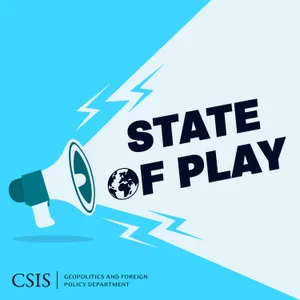
The world order has been disrupted, and a new international system is emerging. Hosted by Will Todman, State of Play unpacks the biggest geopolitical developments of the week. Every episode brings together CSIS’s leading regional experts to explore how global power is shifting, how allies and adversaries are responding, and what it all means for the future of international order. State of Play is produced by Cera Baker.
Latest Episodes
The most recent episodes — sign up to get AI-powered summaries of each one.
- Yesterday42 min
Could Fighting in Ethiopia Spark Regional War in the Horn of Africa?
Fighting has broken out between the Ethiopian government and an alliance of 7 opposition groups. Ethiopia has accused Eritrea, Egypt, and Sudan of backing the rebel alliance, though officials from all three governments have denied this. This week, Aaron Stanley and Dr. Yonas Ashine Demisse discuss how we got to this place, how shifting geopolitics are shaping conflict dynamics, and what the most likely trajectory of the war is. Yonas Ashine Demisse, "Rethinking Pax Africana in Multipolar Disorder: A Genealogical Return to Pan-African Futures," Security Context, August 10, 2026. Aaron Stanley, "After the Supermajority: Ethiopia’s Trajectory Following the 2026 Election," CSIS, June 18, 2026. Oge Onubogu, "In the Shadows of the Iran War: The Horn of Africa," CSIS Into Africa, March 26, 2026.
- 1 weeks ago50 min
What Did Trump and Xi Agree to at the White House?
The summit between Donald Trump and Xi Jinping could cover a range of issues to potentially include trade, investment, AI, the war with Iran, and Taiwan. The morning after the summit, CSIS’s leading China experts will provide a rapid assessment of its outcomes in a live episode of State of Play on Friday, September 25, at 9:00 AM EDT. Amb. Edgard Kagan, Dr. Thomas Christensen, Dr. Scott Kennedy, and Dr. Bonny Lin will join host Will Todman to discuss how successful the summit was and what it means for the future of U.S.-China relations. This event is made possible through general support to the Center for Strategic and International Studies.
- 3 weeks ago24 min
Is the U.S.-Philippines Alliance Really at a Historic High?
A recent opinion poll found that Filipinos have the most positive view of President Trump of any of the 36 countries surveyed. On the sidelines of the Manila Strategy Forum, Amb. John Negroponte and Greg Poling join Will to assess the strength of the U.S.-Philippines alliance, the drivers of Filipinos' positive attitudes towards the U.S., and what might threaten bilateral ties going forward. "Manila Strategy Forum" CSIS, September 9 to 10, 2026.
- Aug 27, 202635 min
Will Trump’s Pressure on Canada Break the USMCA?
When faced with President Trump’s economic pressure, most U.S. allies have fallen into line. Canada bucked the trend and stood firm. This week, Will talks with Chris Hernandez-Roy and Diego Marroquin Bitar to discuss if Canada can withstand U.S. pressure, what lies ahead, and what U.S.-Canada tensions mean for the future of free trade in North America. Christopher Gundermann, Hugh Grant-Chapman, and Diego Marroquín Bitar, "Understanding President Trump’s New Tariffs on Canadian Imports," CSIS, July 21, 2026. Diego Marroquín Bitar and Juan Carlos Baker Pineda, "Inside the Mechanics of the 2026 USMCA Review," CSIS, October 27, 2025. Diego Marroquin Bitar, Christopher Hernandez-Roy, and Earl Anthony Wayne, "USMCA Review 2026," CSIS, August 18, 2025.
- Aug 17, 202641 min
Did Iran Attack U.S. Water Systems?
Cyberattacks targeting water and wastewater utilities have been reported in at least a dozen states across the United States since late July. Although there has been no widespread contamination or immediate threat to public drinking water, it is a serious and apparently coordinated attack. Nikita Shah, Caitlin Welsh, and Lauryn Williams join Will Todman to discuss why U.S. critical infrastructure is vulnerable, what can be done to respond, and if there is enough evidence to blame Iran. State of Play audience survey Nikita Shah, "The Cyberattacks on the U.S Water Sector and the Iran Question: Escalation or Opportunism?" CSIS, August 14, 2026. Franck Gbaguidi and Caitlin Welsh, "Rethinking Water as a Frontline Security Risk," CSIS, August 5, 2026. Lauryn Williams, "Cyberattacks on U.S. Water Systems" CSIS, August 4, 2026.
- Aug 13, 202631 min
Is Cuba Nearing an Inflection Point?
President Trump is ramping up economic pressure on Cuba and has instructed U.S. intelligence agencies to find a new leader who could work with the United States – like Delcy Rodriguez in Venezuela. Christopher Hernandez Roy and William LeoGrande join Will to discuss how the Trump administration’s strategy on Cuba is evolving, how Cuban leaders are responding, and if we are nearing an inflection point. State of Play audience survey Christopher Hernandez-Roy, Mark Cancian, and Henry Ziemer, "The Next Caribbean Crisis? Assessing U.S. Military Options Toward Cuba," CSIS, June 3, 2026. William M. LeoGrande and Peter Kornbluh, "Is the United States on the Verge of Military Intervention in Cuba?" Foreign Policy, May 22, 2026. Christopher Hernandez-Roy et al, "Preparing for the Consequences of Collapse in Cuba," CSIS, April 9, 2026. William M. LeoGrande and Peter Kornbluh, Back Channel to Cuba: The Hidden History of Negotiations between Washington and Havana, University of North Carolina Press, 2014.
- Jul 30, 202635 min
How Should the U.S. Counter China in the Pacific?
A Chinese submarine recently launched an intercontinental ballistic missile into the Pacific, and China has been on the hunt for a security foothold in the region. Meanwhile, the United States has cut assistance and reduced its diplomatic presence in the Pacific. This week, Charles Edel and Kathryn Paik join Will to discuss China’s ambitions in the Pacific, how U.S. interests in the region are evolving, and how Pacific countries are navigating geopolitical competition. State of Play audience survey Kathryn Paik, "Bolstering Pacific Resilience: A New Paradigm for Engagement by U.S. Allies and Partners," CSIS, July 21, 2026. Joseph Rodgers, Bonny Lin, and Charles Edel, "Unpacking China’s Recent SLBM Test into the Pacific," CSIS, July 17, 2026. Charles Edel and Kathryn Paik, "The Peril of American Neglect in the Pacific," Foreign Affairs, October 10, 2024.
- Jul 17, 202657 min
Was This World Cup More Political?
The 2026 FIFA World Cup unfolded against a backdrop of geopolitical tension, trade disputes, and competing national ambitions. But did these politics shape the tournament more than in previous years? Max Bergmann, Victor Cha, and Enoh Ebong join Will to assess the geopolitical dimensions of this year's World Cup in a live episode of State of Play. They examine how host nation diplomacy, soft power competition, and economic interests played out on and off the pitch, and what the tournament revealed about the emerging world order. Gretchen Scott and Andrew Friedman, "Protecting Human Rights at the World Cup: Progress on Paper, Gaps on the Ground," CSIS, July 15, 2026. Victor Cha and Andy Lim, "The 2026 World Cup: Sports and Conflict," CSIS, June 10, 2026.
Get State of Play summaries in your inbox
Free AI-powered daily recaps. Key takeaways, quotes, and mentions — in a 5-minute read.
Get Free Summaries →Free forever for up to 3 podcasts. No credit card required.
You Might Also Like
Listeners also like.
The Truth of the Matter
Breaks down complex global policy issues through informed, balanced discussions without spin or sensationalism.

Into Africa
Examines cultural, political, and economic developments in Africa through interviews with experts and leaders across the continent.

The Global Story
A daily look at global politics, business, and foreign policy through the lens of US decisions and their worldwide impact.
Southeast Asia Radio
Discusses Southeast Asian geopolitics, post-pandemic recovery, democracy, and human rights through expert interviews and regional analysis.
The Impossible State
Experts analyze North Korea's politics, security threats, and global impact in in-depth discussions led by Victor Cha.
Global Security Briefing
Expert analysis on global security issues, focusing on UK foreign and defense policy in a changing international landscape.

American Power
A geopolitical podcast examining the hidden systems—military, energy, and politics—driving global conflicts and decisions.
Pekingology
A deep dive into Chinese politics, the Communist Party’s operations, and the global implications of China’s domestic and foreign policies.

The Real Story
Experts and decision makers analyze and debate major news stories.

One Decision
Former intelligence leaders and journalists examine high-stakes decisions that shaped global events.
35 West
Examines politics and U.S. policy in 35 Western Hemisphere countries, covering trade, diplomacy, and security issues.

Pod Save the World
A former White House official and a political commentator analyze key foreign policy and global events each week.
About State of Play
The world order has been disrupted, and a new international system is emerging. Hosted by Will Todman, State of Play unpacks the biggest geopolitical developments of the week. Every episode brings together CSIS’s leading regional experts to explore how global power is shifting, how allies and adversaries are responding, and what it all means for the future of international order. State of Play is produced by Cera Baker.
Customized Recaps
AI-powered recaps with compact key takeaways, quotes, and insights.
Straight to Your Inbox
Get key takeaways from State of Play in a 5-minute read.
Save Hours Every Week
Stay current on your favorite podcasts without falling behind.
Frequently Asked Questions
What is Podzilla's State of Play daily summary?
It's a free AI-powered email that summarizes new episodes of State of Play as soon as they're published. You get the key takeaways, notable quotes, and links & mentions — all in a quick read.
How does the State of Play podcast summary work?
When a new episode drops, our AI transcribes and analyzes it, then generates a personalized summary tailored to your interests and profession. It's delivered to your inbox every morning.
Is this an official State of Play product?
No. Podzilla is an independent service that summarizes publicly available podcast content. We're not affiliated with or endorsed by Center for Strategic and International Studies.
Can I get summaries of other podcasts too?
Absolutely! The free plan covers up to 3 podcasts. Upgrade to Pro for 15, or Premium for 50. Browse our full catalog at /podcasts.
How often does State of Play release new episodes?
State of Play publishes biweekly. Our AI generates a summary within hours of each new episode.
What topics does State of Play cover?
State of Play covers topics including Government. Our AI identifies the specific themes in each episode and highlights what matters most to you.
Start getting State of Play summaries tomorrow morning.
Free forever for up to 3 podcasts. No credit card required.
Free forever for up to 3 podcasts. No credit card required.