Free Daily Podcast Summary
Ta Shma: Daily Summaries Delivered
by Hadar Institute
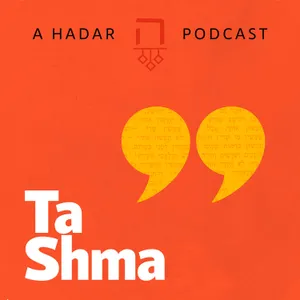
Bringing you recent lectures, classes, and programs from the Hadar Institute, Ta Shma is where you get to listen in on the beit midrash. Come and listen on the go, at home, or wherever you are. Hosted by Rabbi Avi Killip of the Hadar Institute.
Latest Episodes
The most recent episodes — sign up to get AI-powered summaries of each one.
- Today8 min
R. Avi Strausberg on Parashat Bereishit: A Song of Rising Up
In the beginning, God lifted the world out of chaos. The Torah paints a dramatic scene. A wasteland. A darkness covering the surface of the tehom, the great depths. God sweeping over the face of the water. Out of this expanse of nothingness, God creates something. God creates order.
- 2 days ago37 min
R. Avi Killip: The Long and Winding Road to Redemption
We long for a better world. Judaism teaches us to yearn and pray and work to bring the messiah, reach redemption, and earn our place in the world to come. But what does that mean? What are these different conceptions of redeemer and redemption, and what does each require of us? This class explores these terms and the tremendous, exhilarating, terrifying potential each holds. Recorded at Hadar's July Learning Seminar, 2026. Source sheet: https://mechonhadar.s3.us-east-1.amazonaws.com/mh_...
- 1 weeks ago8 min
A Festival About Nothing: Dr. Tsivia Frank Wygoda on Shemini Atzeret-Simhat Torah
In Israel, Shemini Atzeret-Simhat Torah feels like the busiest day of the year. So many prayers; so many different atmospheres. Year after year, juggling back and forth from the joy of celebrating the completion of the annual Torah cycle with singing, dancing, and endless Torah readings, to the more somber parts of the holiday—Yizkor; the prayer for rain—leaves me exhausted and a little dizzy, almost wishing for the peace and quiet of “aharei ha-hagim - after the holidays.”
- 1 weeks ago8 min
R. Avital Hochstein on VeZot HaBerakhah: Journey Summary
R. Simlai taught: Torah—its beginning is kindness and its end is kindness. Its beginning is kindness—as it is written, “God made leather garments for Adam and his wife and dressed them” (Genesis 3:21) And its end is kindness—as it is written, “[God] buried [Moshe] in the valley” (Deuteronomy 34:6), (from Tractate Sotah 14a). Dear Friends, with the end of the year, we also complete another cycle of reading through the Five Books of the Torah. This offers a pause to look back on the philosophic...
- 2 weeks ago37 min
R. Dena Weiss: Language As a Lens: Silence (Part 5)
Explore the role that language plays in our personal, religious, and spiritual lives, by challenging assumptions about core areas of speech like prayer (is it supposed to be effective?) gossip (is it really bad?), and telling the truth (is it necessary?). Recorded in Summer 2026. Source sheet: https://mechonhadar.s3.us-east-1.amazonaws.com/mh_torah_source_sheets/WeissLanguageLensPart52026.pdf
- 3 weeks ago7 min
R. Avital Hochstein on Parashat Ha'azinu: A Topography of Distance
“I will hide My face from them” (Deuteronomy 32:20)—so declares the Holy Blessed One in Parashat Ha’azinu. This is one of the most painful and jarring statements in the Bible. It describes a deep rift in the relationship between God and Israel: a dynamic of hiding, withdrawal, and a sealed face. This is called in Jewish theology and tradition hester panim, the hiding of God’s face.
- 3 weeks ago43 min
R. Dena Weiss: Language As a Lens: Prayer (Part 4)
Explore the role that language plays in our personal, religious, and spiritual lives, by challenging assumptions about core areas of speech like prayer (is it supposed to be effective?) gossip (is it really bad?), and telling the truth (is it necessary?). Recorded in Summer 2026. Source sheet: https://mechonhadar.s3.us-east-1.amazonaws.com/mh_torah_source_sheets/WeissLanguageLensPart42026.pdf
- Sep 2, 202610 min
R. Avital Hochstein on Parashat Nitzavim-VaYeilekh: On Mutual Responsibility
At this time of year, as the High Holidays approach, we are used to thinking about our own personal responsibility. In the Yom Kippur Vidui, we worry not only about our sins that we are aware of, but even those that “are not revealed to us,” rather known to God alone. But the verse that introduces the concept of revealed or hidden sins is about not personal, but national responsibility. Since the evil of others can be even more hidden to us than our own, this introduces diff...
Get Ta Shma summaries in your inbox
Free AI-powered daily recaps. Key takeaways, quotes, and mentions — in a 5-minute read.
Get Free Summaries →Free forever for up to 3 podcasts. No credit card required.
You Might Also Like
Listeners also like.

The Tanakh Podcast
A daily commentary on the Hebrew Bible, offering 10-15 minute insights chapter by chapter at a pace of five chapters per week.

The Frieda Vizel Podcast
Conversations exploring Hasidism, Judaism, New York City, and cultural topics through interviews and personal insights.

Likutei Moharan Amud Yomi | Rabbi Yaakov Klein
A daily study of Rebbe Nachman’s Likutei Moharan, exploring deep Torah insights and spiritual wisdom.

Nach Yomi
Discusses the daily Nach Yomi chapter with brief insights.

Tablet Studios
Explores Jewish identity, tradition, and culture through diverse podcasts offering insight for contemporary Jewish life.

The Jewish History Podcast - With Rabbi Yaakov Wolbe
A podcast featuring Rabbi Yaakov Wolbe's lectures on Jewish history.

Chosen People Problems
Two Jewish women—one secular, one Orthodox—explore faith, culture, and modern life through candid dialogue.
Ask Haviv Anything
A history podcast shaped by listener questions, covering identity, conflict, and culture with moments of humor.

Call Me Back - with Dan Senor
Discusses challenges and dilemmas facing Israelis and Jews worldwide.
Hebrew School
Kids play games to learn about Jewish culture, traditions, and history in this interactive podcast.

Moral Edge
Authentic Torah perspectives from Israel on geopolitics, faith, identity, and the human spirit amid global crises.

Being Jewish with Jonah Platt
Candid conversations exploring the diverse facets of Jewish identity and culture with prominent Jewish figures and allies.
About Ta Shma
Bringing you recent lectures, classes, and programs from the Hadar Institute, Ta Shma is where you get to listen in on the beit midrash. Come and listen on the go, at home, or wherever you are. Hosted by Rabbi Avi Killip of the Hadar Institute.
Customized Recaps
AI-powered recaps with compact key takeaways, quotes, and insights.
Straight to Your Inbox
Get key takeaways from Ta Shma in a 5-minute read.
Save Hours Every Week
Stay current on your favorite podcasts without falling behind.
Frequently Asked Questions
What is Podzilla's Ta Shma daily summary?
It's a free AI-powered email that summarizes new episodes of Ta Shma as soon as they're published. You get the key takeaways, notable quotes, and links & mentions — all in a quick read.
How does the Ta Shma podcast summary work?
When a new episode drops, our AI transcribes and analyzes it, then generates a personalized summary tailored to your interests and profession. It's delivered to your inbox every morning.
Is this an official Ta Shma product?
No. Podzilla is an independent service that summarizes publicly available podcast content. We're not affiliated with or endorsed by Hadar Institute.
Can I get summaries of other podcasts too?
Absolutely! The free plan covers up to 3 podcasts. Upgrade to Pro for 15, or Premium for 50. Browse our full catalog at /podcasts.
How often does Ta Shma release new episodes?
Ta Shma publishes 2x weekly. Our AI generates a summary within hours of each new episode.
What topics does Ta Shma cover?
Ta Shma covers topics including Religion & Spirituality, Spirituality, Judaism. Our AI identifies the specific themes in each episode and highlights what matters most to you.
Start getting Ta Shma summaries tomorrow morning.
Free forever for up to 3 podcasts. No credit card required.
Free forever for up to 3 podcasts. No credit card required.