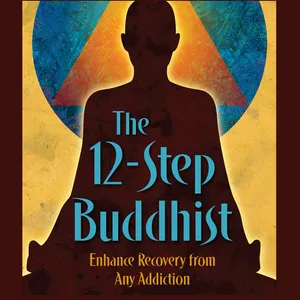
Free Daily Podcast Summary
The 12-Step Buddhist Podcast: Daily Summaries Delivered
by Darren Littlejohn
Readings and meditations from sacred Buddhist masters. Discussion of methods, techniques and essential principles of Buddhist recovery. Now we're integrating the next level. Are you ready to drop into the deep work? The correct answer is yes! Based on the groundbreaking new book, Compassionate Recovery: Mindful Healing for Trauma and Addictions (2022 Rainbow Light Media). AA deals with the cunning, baffling and powerful nature of addictions. Here, we go down to the roots, with ACEs, Western neuropsychology, and the application of scientifically tested training methods that are based on the wisdom of Tibetan Buddhist, Yoga other systems. Learn to practice easy to follow methods, with powerful effects. Enhance and strengthen your emotional stability in recovery. Discover self-compassion, the wisdom of generosity and more. For a foundation in Buddhist recovery and Dharma recovery, read The 12-Step Buddhist 10-Year Anniversary Edition (2018 Atria/Beyond Words) anywhere books are sold.
Latest Episodes
The most recent episodes — sign up to get AI-powered summaries of each one.
- Dec 31, 202327 min
The Joy of Living: Don't Miss the Bliss
The Joy of Living: Don't Miss the Bliss The 12-Step Buddhist Podcast Episode 112 How do we connect with the joy of living, even when it's not so easy? Discussion of Dharma in recovery from addictions on this week's show. OK, we do that every week! THE FIVE POWERS Devotion Joyful Effort Mindfulness Concentration Wisdom From Restricted Text: Two Venerable Khenpos Alternate title: Keith Dowman
- Dec 10, 202324 min
Humility as Medicine: How to Overcome Arrogance
Suffering as Compassion, Humility as Medicine: How to Overcome Arrogance The 12-Step Buddhist Podcast Episode 111 from Dodrupchen Jigme Tenpe Nyima, "Dropping the Attitude of Being Entirely Unwilling to Suffer Think about all the depression, anxiety and irritation we put ourselves through by always seeing suffering as unfavourable, something to be avoided at all costs. Now, think about two things: how useless this is, and how much trouble it causes. Go on reflecting on this repeatedly, until you are absolutely convinced. Then say to yourself: "From now on, whatever I have to suffer, I will never become anxious or irritated." Go over this again and again in your mind, and summon all your courage and determination. 2 Cultivating the Attitude of Being Joyful when Suffering Arises Seeing suffering as an ally to help us on the path, we must learn to develop a sense of joy when it arises. Yet whenever suffering strikes, unless we have some kind of spiritual practice to bring to it, one which matches the capacity of our mind, no matter how many times we might say to ourselves: 'Well, as long as I've got roughly the right method, I'll be able to use suffering and obtain such and such a benefit', it's highly unlikely that we'll succeed. We'll be as far from our goal, the saying goes, as the earth is from the sky. Therefore, use suffering as the basis for the following practices: c. Using Suffering to Overcome Arrogance As I explained before, [as long as we are in samsara] we are never independent or truly free or in control of our lives. On the contrary, we are always dependent on and at the mercy of suffering. So we must eliminate 'the enemy that destroys anything that is wholesome and good', which is arrogance and pride; and we must do away with the evil attitude of belittling others and considering them as inferior. Transforming Suffering https://podcast.compassionaterecovery.us/all-podcast-teachings/transformsuffering/ Sapiens https://amzn.to/3GEBkId
- Dec 2, 202317 min
Appreciating the Now: How to Train Our Minds to Feel Better
It's well understood in the recovery community that an attitude of gratitude isa potent antidote to much of what ails us addicts in recovery. We all know how to make our gratitude lists. But how do Buddhists in Recovery use the Dharma (teachings) to further explore the medicine of true appreciation? Tune in, we'll get into it with a meditation so simple, you'll be amazed before we are halfway through. Word. Appreciating the Now: How to Train Our Minds to Feel Better The 12-Step Buddhist Podcast Episode 110 Grab a copy of The 12-Step Buddhist for someone that you love. Compassionate Recovery: Mindful Healing for Trauma and Addictions Available in Kindle, Trade Paperback, Hardcover
- Nov 18, 202317 min
Genghis Khan or Thich Nhat Hanh - How Do We Respond in Recovery?
The 12-Step Buddhist Podcast Episode 109 We're often told that what happens may be out of our control, but how we respond is up to us. That's easy for regulated people to say. For those who suffer with CPTSD and other problems due to ACEs have more work to do to get to the level where we can "pause when agitated," and not send that text or make that post! The Dharma offers us trainings that help us be fit for maximum service. Let's talk about it.
- Nov 10, 202323 min
Psychedelic Sobriety: Is the Use of Psychedelics a Relapse in Recovery?
What is the nature of our relationship to psychedelics? As people in recovery, we've probably abused them at one time or another. Some people have taken mass overdoses and lost total control. So why would anyone in recovery consider the use, medicinal or otherwise, of something that seems pretty risky? It's OK. You can and it'll be alright. Let's talk about it on today's show, Episode 108. St. Theresa of Avila "The time has come to love more and think less. Sit in a deep quiet in which love is translating you into God." Meditation: what we're powerless to attain is attaining us in our inability to attain it inhale breathing in God, into the unresolved questions. Exhale give yourself in love. from James Finley, "Mystical Sobriety." The number 108 has a variety of significances across different fields: Mathematics: It's an abundant and a semiperfect number. A tetranacci number. The hyperfactorial of 3, as it is of the form 11⋅22⋅3311⋅22⋅33. Divisible by the value of its φ function, which is 36. Divisible by the total number of its divisors (12), making it a refactorable number. The angle in degrees of the interior angles of a regular pentagon in Euclidean space. Palindromic in several bases and a Harshad number in multiple bases. Religion and the Arts: Sacred in Dharmic Religions like Hinduism, Buddhism, and Jainism. In Hindu tradition, there are 108 attendants of Shiva, and in Gaudiya Vaishnavism, Krishna had 108 followers known as gopis. The Sri Vaishnavite Tradition has 108 Divya Desams (temples of Vishnu). The Sudarshana Chakra, a weapon in Hindu mythology, has 108 serrated edges. The total number of Upanishads is 108 as per the Muktikā canon. In Tibetan Buddhism, malas or rosaries are usually 108 beads. Zen priests wear juzu, a ring of prayer beads, consisting of 108 beads. The Lankavatara Sutra has sections where 108 questions are asked and 108 statements of negation are listed. Martial Arts: Many East Asian martial arts, due to their ties to Buddhism, consider 108 an important symbolic number. According to Marma Adi and Ayurveda, there are 108 pressure points in the body. The ultimate Gōjū-ryū kata, Suparinpei, translates to 108. The Yang Taijiquan long form and Wing Chun wooden dummy form taught by Ip Man have 108 moves. Literature: There are 108 outlaws in the Chinese classic "Water Margin/Outlaws of the Marsh." "Astrophil and Stella," the first English sonnet sequence, has 108 love sonnets. Edgar Allan Poe's poem "The Raven" has 108 lines. Science: Hassium, a chemical element, has the atomic number 108. The human body's vital organs begin to fail at an internal temperature of 108 degrees Fahrenheit. The distance of Earth from the Sun is about 108 times the diameter of the Sun. Technology: 108 Mbit/s is a non-standard extension of IEEE 802.11g wireless network using channel bonding. Sports: An official Major League Baseball baseball has 108 stitches. The Chicago Cubs won the World Series in 2016 for the first time in 108 years. Card Games: There are 108 cards in a deck of UNO cards. Other Fields: In India, 108 is the toll-free emergency telephone number.
- Nov 4, 202322 min
Surrender to the Now: Get Grounded in Recovery
Surrender to the Now: Get Grounded in Recovery The 12-Step Buddhist Podcast Episode 107 The famous now is where we want to be. But wanting gets us nowhere. The root of suffering, said Buddha, is attachment. To free ourselves, we must cut it out at the root. The root lies in our very desire to be somewhere, anywhere, other than right here, right now. As addicts we've tried to be somone else, somewhere else for our own survival. In recovery we need to learn heart opening, mindful skills to be our own best healers. In service to this vital necessity of practice, let's not gloss over the now, objectify the now, reify or even deify the now. Rather, let's follow the advice of the AA Big Book, which says that we had to let go absolutely, or the result was nil. Therein lies the conundrum, and the very core opportunity for practice. Let's talk about it. Books mentioned: Wisdom of the Desert Fathers and Mothers: Ancient Advice for the Modern World Desert Fathers and Mothers: Early Christian Wisdom Sayings, Merton Total Mind Power
- Oct 29, 202322 min
Life on Life's Terms: Acceptance in Recovery
Life on Life's Terms: Acceptance in Recovery The 12-Step Buddhist Podcast Episode 106 "And acceptance is the answer to all my problems today. When I am disturbed, it is because I find some person, place, thing, or situation – some face of my life – unacceptable to me, and I can find no serenity until I accept that person, place, thing or situation as being exactly the way it is supposed to be at this moment. Nothing, absolutely nothing, happens in God's world by mistake. Until I could accept my alcoholism, I could not stay sober; unless I accept life completely on life's terms, I cannot be happy. I need to concentrate not so much on what needs to be changed in the world as on what needs to be changed in me and my attitudes." Alcoholics Anonymous, Basic Text, pg 417
- Oct 20, 202320 min
How to Be a Flimsy Reed
"We sought escape with all the desperation of drowning men. What seemed at first a flimsy reed, has proved to be the loving and powerful hand of God. A new life has been given us or, if you prefer, a 'design for living' that really works." Working with "Life as it is, the only teacher." Rather than fight, our recovery program says that we cease fighting anything, or anyone. This is surrender. From a Dharma perspective, as a Buddhist in recovery, this means we stop resisting our own mental\emotional\physical state. This is the Buddhist corollary to the AA adage, "Let Go and Let God," except in our case, God, the authority, the truth and the reality is righte here, right now. How to Be a Flimsy Reed The 12-Step Buddhist Podcast Episode 105 Resistance=suffering, so we try to relax, no matter what the situation. We work with it, rather than fighting against it. In AA terms, we "get out of the way," but here again, it's internal. We get out of the way of our own total experience and let life be, as it is, without attempting to fix it. Moving with the wind, like a flimsy reed, we are less likely to break.
Get The 12-Step Buddhist Podcast summaries in your inbox
Free AI-powered daily recaps. Key takeaways, quotes, and mentions — in a 5-minute read.
Get Free Summaries →Free forever for up to 3 podcasts. No credit card required.
You Might Also Like
Listeners also like.

Recovery Dharma Audiobook
A guided audiobook exploring Buddhist practices and principles to support recovery from addiction.
Tao of Our understanding Alcohol Recovery Podcast
Examines Taoist teachings and their relevance to alcohol recovery, using ancient philosophy to inform modern sobriety practices.

Sober Cast: An (unofficial) Alcoholics Anonymous Podcast AA
AA speaker meetings and workshops delivered in podcast form for those in recovery.

10% Happier with Dan Harris
Practical mindfulness and meditation advice from experts, blending science and ancient wisdom for skeptics.
Being Well with Forrest Hanson and Dr. Rick Hanson
Explores the science of lasting well-being through psychology, neuroscience, and mindfulness with expert guests.

We're Out of Time
Discusses the fentanyl crisis, mental health, and resilience through interviews with recovery experts, survivors, and public figures.

Tara Brach
Teaches mindfulness and self-compassion through meditation, blending psychology and Eastern spirituality to ease emotional suffering.

Sisters In Sobriety
Two women share their personal journeys of sobriety, discussing recovery, wellness, and life without alcohol with honesty and humor.
The Way Out Is In
A podcast exploring mindfulness and compassion through Buddhist teachings, hosted by a Zen monk and a transformational coach.

Feel Better, Live More with Dr Rangan Chatterjee
A doctor-hosted podcast offering practical health advice on eating, sleeping, moving, and relaxing from medical experts and real-life stories.
The Dr. Lee Warren Podcast
A neurosurgeon explores how faith and neuroscience combine to rewire the brain for focus, resilience, and hope.

Let's Get Naked
Anne Karber discusses personal growth, relationships, and difficult life topics through candid conversations with guests.
About The 12-Step Buddhist Podcast
Readings and meditations from sacred Buddhist masters. Discussion of methods, techniques and essential principles of Buddhist recovery. Now we're integrating the next level. Are you ready to drop into the deep work? The correct answer is yes! Based on the groundbreaking new book, Compassionate Recovery: Mindful Healing for Trauma and Addictions (2022 Rainbow Light Media). AA deals with the cunning, baffling and powerful nature of addictions. Here, we go down to the roots, with ACEs, Western neuropsychology, and the application of scientifically tested training methods that are based on the wisdom of Tibetan Buddhist, Yoga other systems. Learn to practice easy to follow methods, with powerful effects. Enhance and strengthen your emotional stability in recovery. Discover self-compassion, the wisdom of generosity and more. For a foundation in Buddhist recovery and Dharma recovery, read The 12-Step Buddhist 10-Year Anniversary Edition (2018 Atria/Beyond Words) anywhere books are sold.
Customized Recaps
AI-powered recaps with compact key takeaways, quotes, and insights.
Straight to Your Inbox
Get key takeaways from The 12-Step Buddhist Podcast in a 5-minute read.
Save Hours Every Week
Stay current on your favorite podcasts without falling behind.
Frequently Asked Questions
What is Podzilla's The 12-Step Buddhist Podcast daily summary?
It's a free AI-powered email that summarizes new episodes of The 12-Step Buddhist Podcast as soon as they're published. You get the key takeaways, notable quotes, and links & mentions — all in a quick read.
How does the The 12-Step Buddhist Podcast podcast summary work?
When a new episode drops, our AI transcribes and analyzes it, then generates a personalized summary tailored to your interests and profession. It's delivered to your inbox every morning.
Is this an official The 12-Step Buddhist Podcast product?
No. Podzilla is an independent service that summarizes publicly available podcast content. We're not affiliated with or endorsed by Darren Littlejohn.
Can I get summaries of other podcasts too?
Absolutely! The free plan covers up to 3 podcasts. Upgrade to Pro for 15, or Premium for 50. Browse our full catalog at /podcasts.
How often does The 12-Step Buddhist Podcast release new episodes?
The 12-Step Buddhist Podcast publishes weekly. Our AI generates a summary within hours of each new episode.
What topics does The 12-Step Buddhist Podcast cover?
The 12-Step Buddhist Podcast covers topics including Fitness, Religion & Spirituality, Spirituality, Buddhism, Health & Fitness, Mental Health. Our AI identifies the specific themes in each episode and highlights what matters most to you.
Start getting The 12-Step Buddhist Podcast summaries tomorrow morning.
Free forever for up to 3 podcasts. No credit card required.
Free forever for up to 3 podcasts. No credit card required.