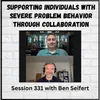
Supporting Individuals With Severe Problem Behavior Through Collaboration: Session 331 with Ben Seifert
In Session 331, I sat down with Dr. Ben Seifert to talk about some of the most challenging — and important — work happening in applied behavior analysis today: supporting individuals with severe problem behavior. Ben shared his journey into the field, beginning with his early experiences at Lindamood-Bell and later at BACA under the mentorship of Carl Sundberg and others who helped shape his clinical perspective. Along the way, we discussed what originally drew him toward working with clients who many providers often avoid, and why he remains deeply committed to ensuring that all individuals have access to meaningful, compassionate support. We spent a good amount of time talking about trends in the ABA marketplace, including the growing difficulty families face when trying to access services for older learners or individuals with significant behavioral challenges. Ben offered thoughtful commentary on how insurance systems, staffing pressures, and private equity may be influencing the types of services many organizations are willing to provide. Ben also shared several fascinating clinical stories that highlight the importance of long-term relationship building, careful observation, and interdisciplinary collaboration. One particularly memorable discussion centered around learning to identify subtle behavioral indicators of physical discomfort that would have been easy to miss in a traditional assessment framework. Toward the second half of the conversation, we shifted into supervision, staff training, and burnout prevention. Ben made a compelling point that supervisors should think of new staff members almost like new learners — people who require shaping, reinforcement, feedback, and support rather than immediate criticism when challenges arise. We also talked openly about clinician mental health, psychological safety within organizations, and the importance of creating environments where people can ask for help. Finally, Ben shared advice for newly certified BCBAs, including the importance of collaboration, humility, and learning from the frontline staff who often know clients best. This was a thoughtful and deeply practical conversation that I think clinicians, supervisors, and graduate students alike will get a lot out of. In this episode, we discuss: Ben's path into behavior analysis Early mentorship experiences at BACA His early career experiences at the Central Texas Autism Center What led him to found Collaborate ABA Why severe problem behavior services are becoming harder to access Insurance and marketplace pressures affecting clinical care The importance of interdisciplinary collaboration Clinical case examples involving subtle behavioral indicators Long-term relationship building with clients and families Supervision strategies for supporting RBTs and frontline staff Staff burnout and mental health Advice for newly certified BCBAs Reach out to Ben on LinkedIn, or follow Collaborate ABA in Instagram! Sponsor shoutouts! Behavior University. Their mission is to provide university quality professional development for the busy Behavior Analyst. Learn about their CEU offerings, including their 8-hour Supervision Course, as well as their RBT offerings over at behavioruniversity.com/observations. Don't forget to use the coupon code, PODCAST to save at checkout! The 2026 Behavior Supports in Schools
Podzilla Summary coming soon
Sign up to get notified when the full AI-powered summary is ready.
Free forever for up to 3 podcasts. No credit card required.
Listen to This Episode
More from The Behavioral Observations Podcast with Matt Cicoria
What is Facilitated Communication? BOP Rewind | Session 199/336 | Jason Travers

Conducta Verbal: Cultura, Contexto y Comunicación Funcional | BOP en ESP 18 con Janet Enriquez
Essential for Living in Action: Building Meaningful Skills Through Everyday Events | Session 334 with Kristina Montgomery and Emily Beal Wilkinson
Beyond 80% Correct: Rethinking Mastery Criteria in ABA: Session 333 with Sarah Richling & Dan Fienup
Get summaries like this every morning.
Free AI-powered recaps of The Behavioral Observations Podcast with Matt Cicoria and your other favorite podcasts, delivered to your inbox.
Free forever for up to 3 podcasts. No credit card required.