Free Daily Podcast Summary
The Cosmos: Daily Summaries Delivered
by Sol Good Media
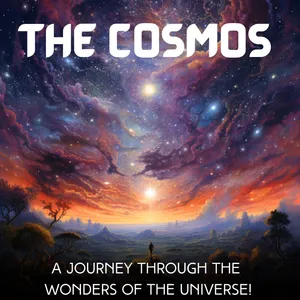
Venture into the vast expanse of the universe with "The Cosmos," where the wonders of space and the mysteries of existence unfold before your ears. This podcast serves as a gateway to a rotating collection of audiobooks that delve into the realms of astronomy, astrophysics, and cosmic phenomena. Each day, a new complete audiobook is featured, inviting you to explore the intricacies of galaxies, the enigma of black holes, and the potential for extraterrestrial life. This is not a single narrative but a series of unique explorations designed to ignite your curiosity and deepen your understanding of the universe's marvels. From the latest scientific discoveries to timeless insights about our place in the cosmos, listeners are encouraged to discover a new book every day, expanding their horizons and embracing the beauty of the night sky. Join us on this enlightening journey through the celestial wonders that shape our understanding of reality.
Latest Episodes
The most recent episodes — sign up to get AI-powered summaries of each one.
- Yesterday6h 55m
Story of Eclipses-George F. Chambers
Story of Eclipses by George F. Chambers.Solar eclipses have both frightened and fascinated humankind for thousands of years. At first believed to be caused by angry gods punishing the people on Earth, we now know that a solar eclipse occurs when the Moon passes between the Earth and the Sun and fully or partially covers the Sun. Ever since scientists were able to predict the next solar eclipse, people - at least the less superstitious ones - wanted to go there and see it for themselves. This book, published in 1899, was written for potential spectators of the total eclipse of the Sun on May 28, 1900. It deals with the science behind solar eclipses and their prediction, and lists a number of known historic eclipses from antiquity to the 19th century. Also included are eclipses mentioned in books, strange customs surrounding the eclipses, and how best to watch one.Featured on The Cosmos.Public-domain recording courtesy of LibriVox (librivox.org).This episode includes AI-generated content.
- 2 days ago4h 33m
History of Astronomy-George Forbes
History of Astronomy by George Forbes.An attempt has been made in these pages to trace the evolution of intellectual thought in the progress of astronomical discovery, and, by recognising the different points of view of the different ages, to give due credit even to the ancients. No one can expect, in a history of astronomy of limited size, to find a treatise on “practical” or on “theoretical astronomy,” nor a complete “descriptive astronomy,” and still less a book on “speculative astronomy.”Featured on The Cosmos.Public-domain recording courtesy of LibriVox (librivox.org).This episode includes AI-generated content.
- 3 days ago5h 1m
Little Masterpieces of Science - The Skies and The Earth-George Iles
Little Masterpieces of Science by The Skies and The Earth-George Iles.The Skies and the Earth is another in the series Little Masterpieces of Science edited by George Iles and published in 1902. It includes essays on the Sun, Astronomy, Geological Change on Earth, Rivers, the Sea and Earthquakes and Volcanoes by eminent scientists of the 19th Century.Featured on The Cosmos.Public-domain recording courtesy of LibriVox (librivox.org).This episode includes AI-generated content.
- 4 days ago4h 43m
Man on the Meteor-Ray Cummings
Man on the Meteor by Ray Cummings.Nemo's first memory is of waking up on a self-contained world on a meteor in the rings of Saturn. Soon he meets Nona, and together they explore their world. New discoveries, hidden wonders, and an entire civilization are tucked away on the little meteor. Originally published as a serial in Science and Invention magazine, from January to September 1924.Featured on The Cosmos.Public-domain recording courtesy of LibriVox (librivox.org).This episode includes AI-generated content.
- 5 days ago5h 9m
Beyond the Stars-Ray Cummings
Beyond the Stars by Ray Cummings.Is the entire universe just one of the atoms of some even greater cosmos? Such was the conception of one scientist — and his effort to prove this theory was to take a party of Americans on an expedition to a place that was literally BEYOND THE STARS.Featured on The Cosmos.Public-domain recording courtesy of LibriVox (librivox.org).This episode includes AI-generated content.
- 6 days ago7h 15m
Meteorology, On the Universe & On Breath-Aristotle
Meteorology, On the Universe & On Breath by Aristotle.Meteorology (Greek: Μετεωρολογικά; Latin: Meteorologica or Meteora) by Aristotle Translated by Erwin Wentworth Webster before he fell in action in 1917. Book I: The Celestial Sphere, Stars & Precipitation Book II: Seas, Winds & Earthquakes Book III: Halos, Rainbows & Mock Suns Book IV: The Elements & Secondary Qualities On the Universe (Greek: Περὶ Κόσμου; Latin: De mundo) is attributed to Aristotle but may have been written by Posidonius the Stoic or someone well acquainted with his work. Two candidates for the Alexander addressed in the text are Alexander the Great and Tiberius Claudius Alexander, nephew of Philo Judaeus and Procurator of Judaea, and in A.D. 67 Prefect of Egypt. The text describes a geocentric universe and theorizes that other continents must exist beyond the Atlantic. Translated by Edward Seymour Forster.Featured on The Cosmos.Public-domain recording courtesy of LibriVox (librivox.org).This episode includes AI-generated content.
- 1 weeks ago2h 40m
Cosmos A Sketch of a Physical Description of The Universe Introduction-Alexander von Humboldt
Cosmos A Sketch of a Physical Description of The Universe Introduction by Alexander von Humboldt.Featured on The Cosmos.This episode includes AI-generated content.
- Aug 30, 20262h 7m
New Discoveries at Jamestown - John L Cotter J Paul Hudson
Chances are, you are reading this because you are aware that Jamestown, Virginia, celebrated its 400th birthday in 2007. It was the first "successful" English settlement in America. Although the colonists eventually moved upriver to be quit of the hard luck and difficult conditions on the small island, they left behind a trove of possessions - used, worn out, or forgotten.Did you ever stop to consider just how many different items you have, need, or use, to live, work, and amuse yourself? Chances are that you would seriously underestimate! But once you put such a list together, another person could tell quite a story about the life you lead.The puzzle of archeology is how to tell that story, just from the discovery of the traces you leave behind. Literally hundreds of thousands of artifacts have been recovered from this pioneering community during three major efforts (1903, the 1950's, and 1994-present) to reconstruct how Europeans of the early 17th century managed to transplant themselves to a wild and hostile land.The authors, writing for the National Park Service in 1956, relate a fascinating tale of the colonists' resources, their possessions, and their manufactures. They relate documentary evidence from England, Virginia, and elsewhere, and then match it up with items found on the site.Think about packing for a trip to a new world, where you will spend the rest of your life. There are no shops, no regular supply deliveries. You will build your own home. Food is strictly grown or caught on your own. The local folks (Indians) may be (and were, at some times!) hostile to your presence. You will depend on only a few dozen other people to help you with the things you don't know how to do, and they will depend on you. How do you prepare? What do you take?This is that story.For an easy-to-understand history of Jamestown, have a look at this site: http://www.tobacco.org/History/Jamestown.htmlTo help you visualize Jamestown, and especially the area of the original three-sided fort, I highly recommend this site: http://www.apva.org/finding/index.html (Summary by Mark F. Smith)
About The Cosmos
Venture into the vast expanse of the universe with "The Cosmos," where the wonders of space and the mysteries of existence unfold before your ears. This podcast serves as a gateway to a rotating collection of audiobooks that delve into the realms of astronomy, astrophysics, and cosmic phenomena. Each day, a new complete audiobook is featured, inviting you to explore the intricacies of galaxies, the enigma of black holes, and the potential for extraterrestrial life. This is not a single narrative but a series of unique explorations designed to ignite your curiosity and deepen your understanding of the universe's marvels. From the latest scientific discoveries to timeless insights about our place in the cosmos, listeners are encouraged to discover a new book every day, expanding their horizons and embracing the beauty of the night sky. Join us on this enlightening journey through the celestial wonders that shape our understanding of reality.
Customized Recaps
AI-powered recaps with compact key takeaways, quotes, and insights.
Straight to Your Inbox
Get key takeaways from The Cosmos in a 5-minute read.
Save Hours Every Week
Stay current on your favorite podcasts without falling behind.
Frequently Asked Questions
What is Podzilla's The Cosmos daily summary?
It's a free AI-powered email that summarizes new episodes of The Cosmos as soon as they're published. You get the key takeaways, notable quotes, and links & mentions — all in a quick read.
How does the The Cosmos podcast summary work?
When a new episode drops, our AI transcribes and analyzes it, then generates a personalized summary tailored to your interests and profession. It's delivered to your inbox every morning.
Is this an official The Cosmos product?
No. Podzilla is an independent service that summarizes publicly available podcast content. We're not affiliated with or endorsed by Sol Good Media.
Can I get summaries of other podcasts too?
Absolutely! The free plan covers up to 3 podcasts, any in the catalog. Basic raises that to 15, Pro to 40 and Max to 100. Browse our full catalog at /podcasts.
How often does The Cosmos release new episodes?
The Cosmos publishes daily. Our AI generates a summary within hours of each new episode.
What topics does The Cosmos cover?
The Cosmos covers topics including Science, Astronomy, Culture, Society & Culture. Our AI identifies the specific themes in each episode and highlights what matters most to you.
Start getting The Cosmos summaries tomorrow morning.
Free forever for up to 3 podcasts. No credit card required.
Free forever for up to 3 podcasts. No credit card required.