Free Daily Podcast Summary
The Culture of Cloth: Daily Summaries Delivered
by Veronica Tucker
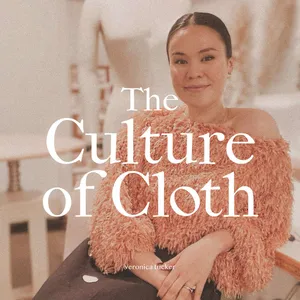
Clothing is never just clothing.Every fibre, every colour, every silhouette is telling you something. About power, politics and whose story got told and whose didn’t. The Culture of Cloth is a podcast about learning to read that story. Starting with the cloth itself and then following it wherever it leads.Most fashion history looks at the outside. This show looks at the inside. The construction, the decisions, the invisible hands that made it, and the world those hands were living in. The women who encoded military intelligence into knitting. The weavers whose binary logic built the first computer. The dyers, the spinners, the pattern cutters whose names were never written down.Cloth tells the truth even when the official record doesn’t.For makers and thinkers. For everyone who has ever looked at a garment and felt there was more to it than they were being told.Hosted by Veronica Tucker.
Latest Episodes
The most recent episodes — sign up to get AI-powered summaries of each one.
- 5 days ago54 min
“The Fun Police”: Garment Tech Confessions
Garment technicians rarely get interviewed. But buyers, designers, textile experts? Everyone talks about them. But the person who actually decides whether a garment fits, closes properly, and survives being worn? Almost invisible. In this episode, I sit down with my friend and fellow industry veteran Debbie, a garment technician who’s spent her career being the bridge between a designer’s sketch and the customer trying it on in a change room. We get into what a tech pack actually is...
- 1 weeks ago8 min
The First Makers: Pacific and Oceania
It’s the final episode of The First Makers series. In this episode we speak about the Polynesian goddess Hina and how she is seen across many different islands and known by many different names, but her message is the same. We also touch on the important of the possum cloak in the culture of Indigenous Australians and how that knowledge was almost lost but is fortunately alive and thriving today. Cover image is of Mildred Taniova colouring in the tapa designs with red...
- 2 weeks ago9 min
The First Makers: The Americas
Before there was a world, there was a thread. In this episode of First Makers, I’m looking at two very different models of the same idea. Divinity and thread as the origin of everything that matters. First, Mama Ocllo, sent by the Inca sun god Inti to teach the first women to spin and weave. She is a culture-hero, not a weaver herself, whose myth explains where an entire craft tradition came from. Then Spider Grandmother, who in Navajo and Hopi tradition isn’t a teacher at all, but the maker ...
- Jun 22, 202613 min
The First Makers: West Africa & the Diaspora
The First Makers: West Africa and the Diaspora This edition is different from every other one in this series. Every tradition we’ve covered so far came to us through a written documentary record (the Kojiki, the Rigveda, Hesiod). The traditions in this edition travelled through the worst thing human beings have ever done to each other. And they survived. In this episode I cover: Anansi (ah-NAHN-see) – the Akan spider trickster of Ghana, whose web became the origin of kente cloth. The Do...
- Jun 13, 202614 min
The First Makers: South & East Asia
Every culture created a goddess who presided over making. But not all of them did it the same way. This episode introduces two categories. The first: goddesses whose mythology is explicitly about weaving. Documented, primary sources, this is what the texts actually say. The second: goddesses that weavers chose. Figures whose domains of creativity, wisdom and skill made them the natural patrons of women at the loom, even though weaving isn’t the centre of their story. Both catego...
- Jun 5, 202653 min
A Compass, Not a Photocopier: Trend Forecasting, AI and Why Origin Matters with Tully Walter
Tully Walter is a Strategic Futures Director at Soon Futures and this is one of the most substantial conversations I've had on the show. We get into what trend forecasting actually is (observed, invented, or accelerated) and how the answer changes depending on who's paying. We talk about cultural appropriation and why origin gives a trend its meaning, what happens when that context gets stripped out, and why the Prada sandal situation was an after-the-fact correction that should have been bui...
- May 30, 202611 min
The First Makers: Celtic & European
Every single one of these goddesses survived, but none of them survived intact. In this episode I trace the weaving goddesses of Celtic and European mythology (Brigid, Arianrhod, Frigg, and Holda) and the pattern running through all of them. They were rewritten, renamed, absorbed into new religions, turned into fairy tales, reduced to saints. Brigid survived by becoming a saint. Holda survived by becoming a fairy tale. Arianrhod survived in a manuscript written by people who tried to conta...
- May 23, 20269 min
The First Makers: Ancient Mediterranean & Near East
While researching the Goddess Project, I came across something that stopped me completely. Every culture, independently and without contact with each other, created a goddess who presided over weaving. Not because ideas travelled along trade routes, but separately. Across thousands of years and thousands of kilometres. In this episode I walk through the oldest part of that record, from Uttu, the Sumerian spider goddess who dates to 3000 BCE, through Inanna, Neith, Hathor, Isis, and Athena. S...
About The Culture of Cloth
Clothing is never just clothing.Every fibre, every colour, every silhouette is telling you something. About power, politics and whose story got told and whose didn’t. The Culture of Cloth is a podcast about learning to read that story. Starting with the cloth itself and then following it wherever it leads.Most fashion history looks at the outside. This show looks at the inside. The construction, the decisions, the invisible hands that made it, and the world those hands were living in. The women who encoded military intelligence into knitting. The weavers whose binary logic built the first computer. The dyers, the spinners, the pattern cutters whose names were never written down.Cloth tells the truth even when the official record doesn’t.For makers and thinkers. For everyone who has ever looked at a garment and felt there was more to it than they were being told.Hosted by Veronica Tucker.
Customized Recaps
AI-powered recaps with compact key takeaways, quotes, and insights.
Straight to Your Inbox
Get key takeaways from The Culture of Cloth in a 5-minute read.
Save Hours Every Week
Stay current on your favorite podcasts without falling behind.
Frequently Asked Questions
What is Podzilla's The Culture of Cloth daily summary?
It's a free AI-powered email that summarizes new episodes of The Culture of Cloth as soon as they're published. You get the key takeaways, notable quotes, and links & mentions — all in a quick read.
How does the The Culture of Cloth podcast summary work?
When a new episode drops, our AI transcribes and analyzes it, then generates a personalized summary tailored to your interests and profession. It's delivered to your inbox every morning.
Is this an official The Culture of Cloth product?
No. Podzilla is an independent service that summarizes publicly available podcast content. We're not affiliated with or endorsed by Veronica Tucker.
Can I get summaries of other podcasts too?
Absolutely! The free plan covers up to 3 podcasts. Upgrade to Pro for 15, or Premium for 50. Browse our full catalog at /podcasts.
How often does The Culture of Cloth release new episodes?
The Culture of Cloth publishes weekly. Our AI generates a summary within hours of each new episode.
What topics does The Culture of Cloth cover?
Our AI identifies the specific themes in each episode and highlights what matters most to you.
Start getting The Culture of Cloth summaries tomorrow morning.
Free forever for up to 3 podcasts. No credit card required.
Free forever for up to 3 podcasts. No credit card required.